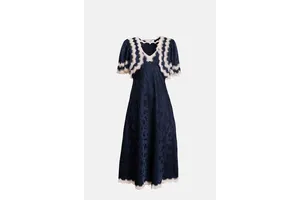
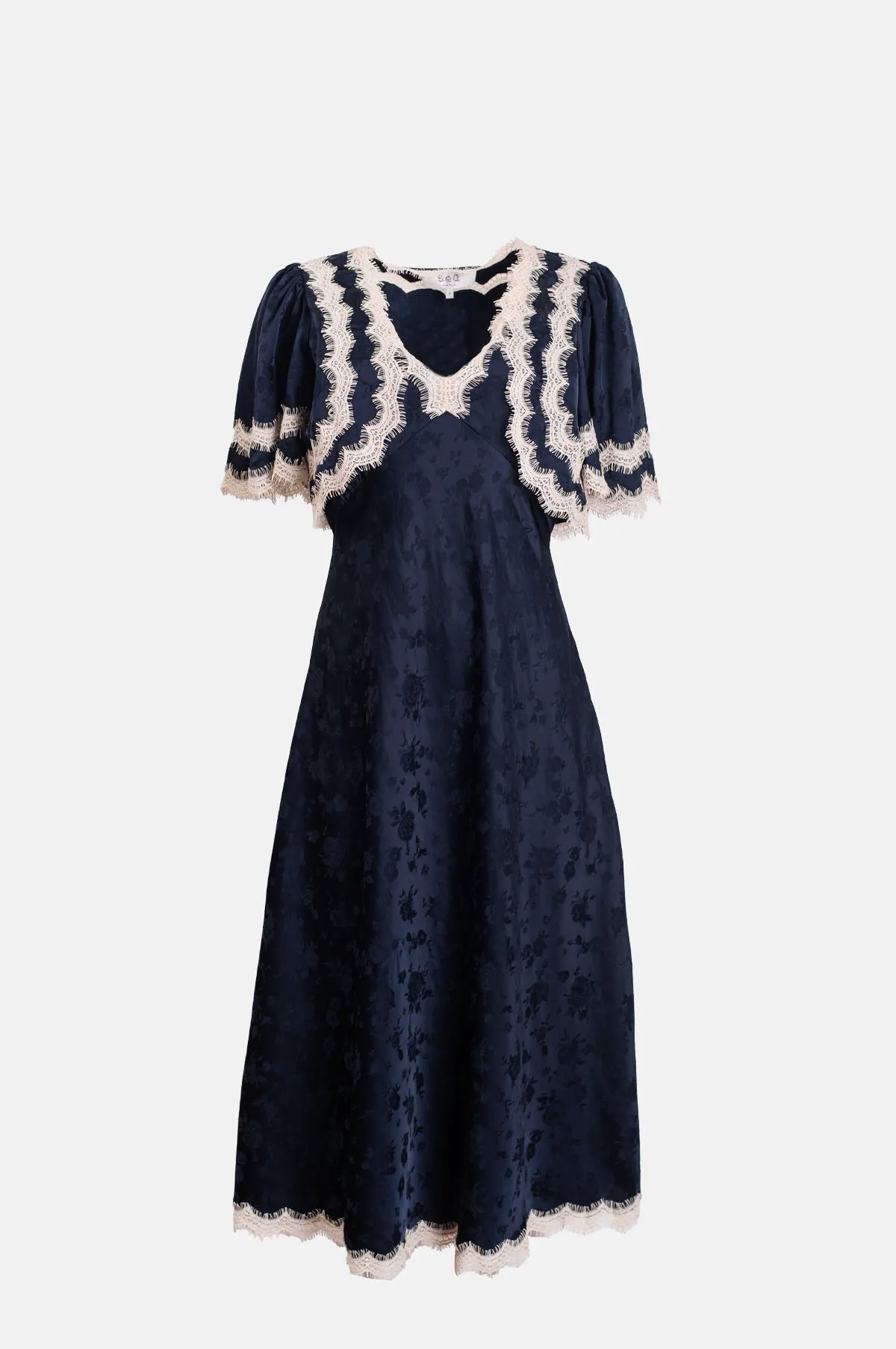

A navy midi dress from Sea New York in silky viscose with an all over floral motif, a deep v-neckline, ruffled cape sleeves and an invisible side zip, listed at 540 GBP, which makes it the most expensive garment this run has examined. Two things about it are worth a close look and they pull in opposite directions. The first is praise, because this page does something almost no page in this run does: it publishes the height of the model, five feet ten, and the size she wears. Combined with a published length, that is enough for a customer to work out where the hem will fall on her own body, and this run has been asking for exactly that for fifteen batches. The second is the reason she needs to: the length is 122 centimetres on all four sizes, so it does not move at all between the smallest and the largest, and on a dress that falls near the ankle a length that does not move means the garment looks like a different dress on every height. The reference is the Shay Lace Cape Midi Dress in Navy. Dongguan Bafinasa Garments Co., Ltd. develops comparable dresses on OEM and ODM terms, from cloth selection to retail or FBA ready packing. We publish this as a development reference and build your own version of it, and we do not supply the branded original or reproduce anyone else's label.
Key Features
- Model height and model size both published, five feet ten in a size 4, which makes the length usable. See the note below
- Total length of 122 cm on all four sizes, so the hem falls in a different place on every height. See the note below
- Cape-style sleeves as stated, with a sleeve length published for them that no cape can be measured for. See the note below
- Designed for a slimmer fit as stated, with about three and a half down to one and a half inches of ease, which supports the claim
- Invisible side zipper as stated, with the type and the position given and the length not. See the note below
- Trim published with its own fibre line, 100% nylon, which is the part most pages miss. See the note below
- Dry clean only as stated, on a viscose that will crease and shrink in water
Customisable Options
- Cloth: silky viscose to the reference, with the weight in grams per square metre specified, or a viscose crepe, a cupro or a silk, each quoted separately
- Motif: all over floral to the reference, printed or woven or embroidered, with the repeat specified, or a plain cloth
- Trim: nylon lace to the reference, stated as a separate component with its own fibre, or a cotton lace, or a broderie, or none
- Sleeves: cape to the reference, with the cape length and the drape specified, or a short sleeve, or a flutter sleeve, or sleeveless
- Closure: invisible side zip to the reference, with the length specified, or a concealed back zip, or a side seam zip, or a button placket
- Length: midi to the reference at 122 cm and held constant, or graded across the size range, or offered in two lengths
- Cloth weight, motif method and repeat, trim specification, cape length, zip length, neck depth, ease, body length, size set, colour development, private label and care labelling
Specifications
| Style | Slim fitting midi dress with cape sleeves, a deep v-neck and an invisible side zip |
| Reference | Sea New York, Shay Lace Cape Midi Dress, style AW26-138, navy, sizes 2 to 8 US |
| Composition | 100% viscose as stated, with no weight given |
| Trim | 100% nylon as stated, which is the only page in this run to give a trim its own fibre line. See the note below |
| Cloth | Silky viscose with an all over floral motif as stated, with no weight and no motif method given. See the note below |
| Fit | Designed for a slimmer fit as stated. See the note below |
| Neck | Deep v-neckline as stated, with no depth given. See the note below |
| Sleeves | Ruffled cape-style sleeves as stated, measured at 29 cm on all four sizes. See the note below |
| Closure | Invisible side zipper as stated, with no length given. See the note below |
| Silhouette | Fluid midi-length as stated |
| Care | Dry clean only as stated. See the note below |
| Sizes Offered | 2, 4, 6 and 8 US, four sizes, three in stock with the 6 sold out. See the note below |
| Size Conversion | Published: 2 US is XS, 4 US is S, 6 US is M and 8 US is L |
| Model | Published: 5'10'', wearing a size 4. See the note below |
| Measurements Published | Pit to pit, sleeve length and total length for all four sizes. See the note below |
| Published Chest | Pit to pit 44, 45, 47 and 49 cm flat, or 17.3 through 19.3 in. See the note below |
| Chest Around | 88, 90, 94 and 98 cm, or 34.6, 35.4, 37.0 and 38.6 in. See the note below |
| Ease Against Body Bust | About 3.6, 2.4, 2.0 and 1.6 in from smallest to largest, which supports the slimmer fit. See the note below |
| Published Sleeve | 29 cm on all four sizes, on a cape sleeve that has no armhole to measure from. See the note below |
| Published Length | 122 cm on all four sizes, with no grading. See the note below |
| Neck Depth | None, on a neckline described as deep. See the note below |
| Zip Length | None. See the note below |
| Published Hem | None |
| Cloth Weight | Not stated |
| Fibre Provenance | Not stated, on the most expensive garment in this run. See the note below |
| Photographs | Six |
| Production | Made in China as stated |
| Reference Retail | 540 GBP as listed, the most expensive garment this run has examined, quoted to show the price band this sits in, not as our price |
| Category | Filed by the reference under dresses |
| Occasion | Autumn and winter, evening, weddings, occasions, dressed up as the reference suggests |
| MOQ | 100 pcs per style per colourway, mixed sizes and colourways accepted |
| Sampling | 7-10 days after tech pack or reference sample confirmation |
| Bulk Lead Time | 20-30 days after sample approval and deposit |
| Service | OEM / ODM / private label, viscose sourcing with weight specified, lace trim sourcing, cape sleeve development, concealed zip specification, retail or FBA ready packing |
Size Chart as Published by the Reference
| Size | Pit to Pit (flat) | Sleeve Length | Total Length |
|---|---|---|---|
| 2 US / XS | 44 cm | 29 cm | 122 cm |
| 4 US / S | 45 cm | 29 cm | 122 cm |
| 6 US / M | 47 cm | 29 cm | 122 cm |
| 8 US / L | 49 cm | 29 cm | 122 cm |
The chest figures are flat half measures taken with the dress laid down, doubling to 88, 90, 94 and 98 cm around, or 34.6, 35.4, 37.0 and 38.6 in. Against a body bust of 31, 33, 35 and 37 in across XS to L, the ease is about three and three fifths inches at the smallest and about one and three fifths at the largest, which is genuinely slim and which supports the description. The chest grade is uneven, running one centimetre between the 2 and the 4 and two centimetres at each step after. Both the sleeve and the total length are published as one figure for all four sizes. Because the model height and the size she wears are both given, the length can be worked out against a body, which is not the case on most pages in this run.
Our Proposed Body Chart
| Size | Body Bust | Sleeve | Body Waist | Body Hips | Length | Source |
|---|---|---|---|---|---|---|
| 2 US / XS | 31 in / 79 cm | 29 cm | 24 in / 61 cm | 34 in / 86 cm | 122 cm / 48 in | Our proposal |
| 4 US / S | 33 in / 84 cm | 30 cm | 26 in / 66 cm | 36 in / 91 cm | 124 cm / 48.8 in | Our proposal |
| 6 US / M | 35 in / 89 cm | 31 cm | 28 in / 71 cm | 38 in / 97 cm | 126 cm / 49.6 in | Our proposal |
| 8 US / L | 37 in / 94 cm | 32 cm | 30 in / 76 cm | 40 in / 102 cm | 128 cm / 50.4 in | Our proposal |
Occasions and Styling
Suits autumn and winter, evenings, weddings and occasions. A midi dress with a cape sleeve is an event piece rather than a day one, because the cape is the sort of detail that reads as dressed up, and the deep neck and the fluid cloth are what let it be worn with a heel rather than a boot.
Production and Quality Control
The reference publishes three columns for all four sizes, states its fibre and its trim separately, describes the fit, the neck, the sleeves and the closure, gives a care instruction, names the country of make, publishes a size conversion and, unusually, publishes the height of the model and the size she wears. It gives no cloth weight, no neck depth, no zip length and no fibre provenance, its chest grade is uneven and two of its three columns do not move. Three things follow: what the model height makes possible and the length column takes away, a sleeve measured on a garment with no armhole, and the trim as the best thing on the page.
The model height, and the arithmetic it unlocks, and that is the first thing. This page says the model is five feet ten and wearing a size 4, which is the first of the two facts this run has been asking for on every garment for fifteen batches, and it is worth being precise about why it matters rather than just praising it. A length figure on its own is a number with no body attached to it: 122 cm means nothing until you know how tall the person is and where on her the tape started. Give the height and the customer can do the arithmetic herself. Five feet ten is 178 cm, and the shoulder of a woman of that height sits at roughly four fifths of it, so around 146 cm from the ground. The dress falls 122 cm from there, so the hem is about 24 cm off the floor, which is just above the ankle, and that is the look in the photograph. Now take a woman of five feet four, 162 cm, whose shoulder sits at around 133 cm, and the same 122 cm dress puts the hem about 11 cm off the floor, which is grazing it. So the same garment is an above-ankle midi on the model and a floor-sweeping one on a woman six inches shorter, and that is a difference large enough to change whether she buys it. This is the calculation this run has been unable to do on page after page for want of one line of text, and it is worth saying what it costs to provide: three words, model is five feet ten. There is a second thing the model height does that is less obvious and just as useful, which is that it lets a customer judge the ease rather than just the length, because she can see in the photograph how much room there is on a body she now knows the size of. And now the bad news, which is the length column itself. It reads 122, 122, 122 and 122. So the dress is the same length on a size 2 and a size 8, and the consequence is not just the height problem above but a proportion problem: the chest grows from 88 to 98 cm around while the length stays put, so the dress gets wider without getting longer and the silhouette changes with size. On a top that would be a small thing. On a dress whose length is most of its look, it is the whole thing. There are two honest fixes and they suit different products. The first is to grade the length, which is what most dress patterns do, at two centimetres a size or so. The second, which is better for a garment at this price, is to hold the length and offer it in two lengths, because a length that suits five feet ten will never suit five feet four, and no amount of grading within a four size range solves that. It is worth adding which sizes are missing from the shelf, because it is unusual: the sold out size here is the 6, the middle of the range, whereas on most garments in this run the top size has gone first. A brand that sells out of the middle size first is a brand whose size buy matches its customers, which is worth noting as the exception rather than the rule.
Twenty-nine centimetres of sleeve on a garment with no armhole, and that is the second thing. The sleeves are described as ruffled and cape-style, and the sleeve length is published as 29 cm on every size. A cape sleeve is not a sleeve in the ordinary sense. It is a piece of cloth that hangs from the shoulder line over the top of the arm, with no seam under the arm and no armhole for the arm to go through, which is precisely what makes it a cape and not a sleeve. So there is no underarm point and no armhole seam, and a sleeve length, which is conventionally taken from the shoulder seam or from the centre back neck down to the cuff, has neither a cuff nor a conventional start to be taken to. What is published is therefore a number attached to a measurement that has no definition on this garment. It is worth setting this beside the other three sleeve constructions this run has met, because the sequence is neat and the conclusion is the same every time. A set-in sleeve has a shoulder seam and an armhole, so a sleeve length is unambiguous and this run has never had to complain about one. A raglan sleeve, met on the American Vintage boat neck and on the geese sweater, has an armhole but no shoulder seam, so the start point is ambiguous. A dropped shoulder, met on the Vitow knitwear and on the cardigan, has both seams but puts the shoulder one down the upper arm, so the start point is not on the body. And a cape has no armhole at all. Three of the four make the published figure uninterpretable, and not one of the three says where the tape went. The remedy is the same in each case and it is one clause: state the point. On a cape the useful figure is not a sleeve length at all, it is the length of the cape from the shoulder seam to its lowest edge, which is what decides how much of the arm is covered and how much movement there is, and which is a number a factory can work to. It is worth adding what else the word cape implies and does not say, because it is the practical part. A cape sleeve moves because it is not attached under the arm, and the description says the sleeves and shoulders move, which is true by construction. But that also means the armhole opening underneath is exposed when the arm is raised, and how far the cape covers it depends on its length and its width, and neither is given. Then two smaller absences in the same family. The neck is described as a deep v-neckline and no depth is published, so a customer cannot know how deep, and a deep neck changes what can be worn underneath and how much the wearer has to think about. And the closure is described as an invisible side zipper, which is genuinely good and more specific than most, since it gives both the type and the position, and it is missing only the length, which is the figure that decides whether the dress can be got on over the bust and the hips on a garment described as slim.
The trim, the fibre, and the word lace, and that is the third thing. The specification panel reads 100% viscose and then, on its own line, trim: 100% nylon. That second line is the single best piece of specification on this page and it is worth saying why, because this run has spent many batches on the opposite problem. The vitow knitwear stated a fibre and was trimmed with something else and never said so. The wooden button pages described a button material in the prose and left it out of the data. The velvet trousers had a trim whose fibre was never given. Here the trim is named, given its own line and given its own fibre, which is exactly right, and it is the first time in this run. It matters because a trim is a component with its own behaviour: nylon and viscose take dye differently, shrink differently and need different temperatures, and a cleaner and a factory both need to know there are two materials here. So credit where it is due. But there is a question the two lines raise and do not answer, and it is about the name of the garment. The dress is called a lace dress. Its body is viscose and its trim is nylon. So how much of this dress is lace? The description says the viscose fabric has an all over floral motif, which could be printed, woven or embroidered, and the page does not say which, and it calls the dress lace without saying whether the lace is the whole cloth, the overlay, or the trim at the hem and the sleeve. A customer paying 540 pounds for a lace dress is entitled to know whether she is buying a lace dress or a printed viscose dress with lace on the edge. Those are two different garments with two different prices and two different care needs. There is a second absence that belongs with it. The cloth is described as silky viscose with no weight, and here the weight matters more than usual, because a fluid midi-length dress in a light viscose will cling and show every line, whereas the same shape in a heavier viscose will hang away from the body, and the difference is the grams per square metre. And a third: no provenance for the fibre. Viscose is a regenerated cellulose made from dissolved wood pulp, and the question with it is always where the pulp came from and how the mill handles its chemicals, which is why the credible viscose on the market carries a chain of custody. This run has examined three unverified fibre claims in fifteen batches, organic cotton on the Antonyms tee, recycled cotton on the Sunray tee, and now regenerative cotton on a jean published alongside this dress, and in each case the word was there and the programme behind it was not. This dress says only viscose, and it says it at the highest price in the run. Then the care instruction, which is short and defensible: dry clean only, on a viscose that will shrink and crease badly in water and that has a nylon trim and a cape attached, is the right call, and it is worth noting that this is the third garment in this run where a restrictive label is justified by what is attached to it rather than by the fibre alone. The one thing missing from it is a word about creasing, since a viscose dress will crease when sat in and the customer will want to know whether she can steam it, which she can. Every bulk shipment gets a measurement report against your approved chart.
Optional upgrades include grading the body length across the size range or offering the dress in two lengths, which is the better fix at this price, stating the cape length from the shoulder seam to its lowest edge in place of an undefined sleeve length, publishing the neck depth, specifying the invisible zip by length as well as type and position, stating the cloth weight so the drape can be judged, stating the motif method and its repeat, saying how much of the dress is lace, adding the fibre provenance for the viscose, adding a steaming note to the care label, publishing the hem width, more photographs including the back and the sleeve raised, a plain hem and a shorter length option, short flutter and sleeveless options, a concealed back zip and a button placket option, size set, colour development, private label, hangtag and care labelling.
Pre-production sample approval, in-line inspection during cutting and sewing, and a final AQL inspection before packing, with measurement reports and photos shared before shipment.
Send us your tech pack, a photo or a reference garment and we will quote within 24 hours. Contact bafinasa@bafinasa.com or WhatsApp +86 13827222469.