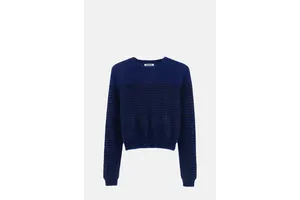
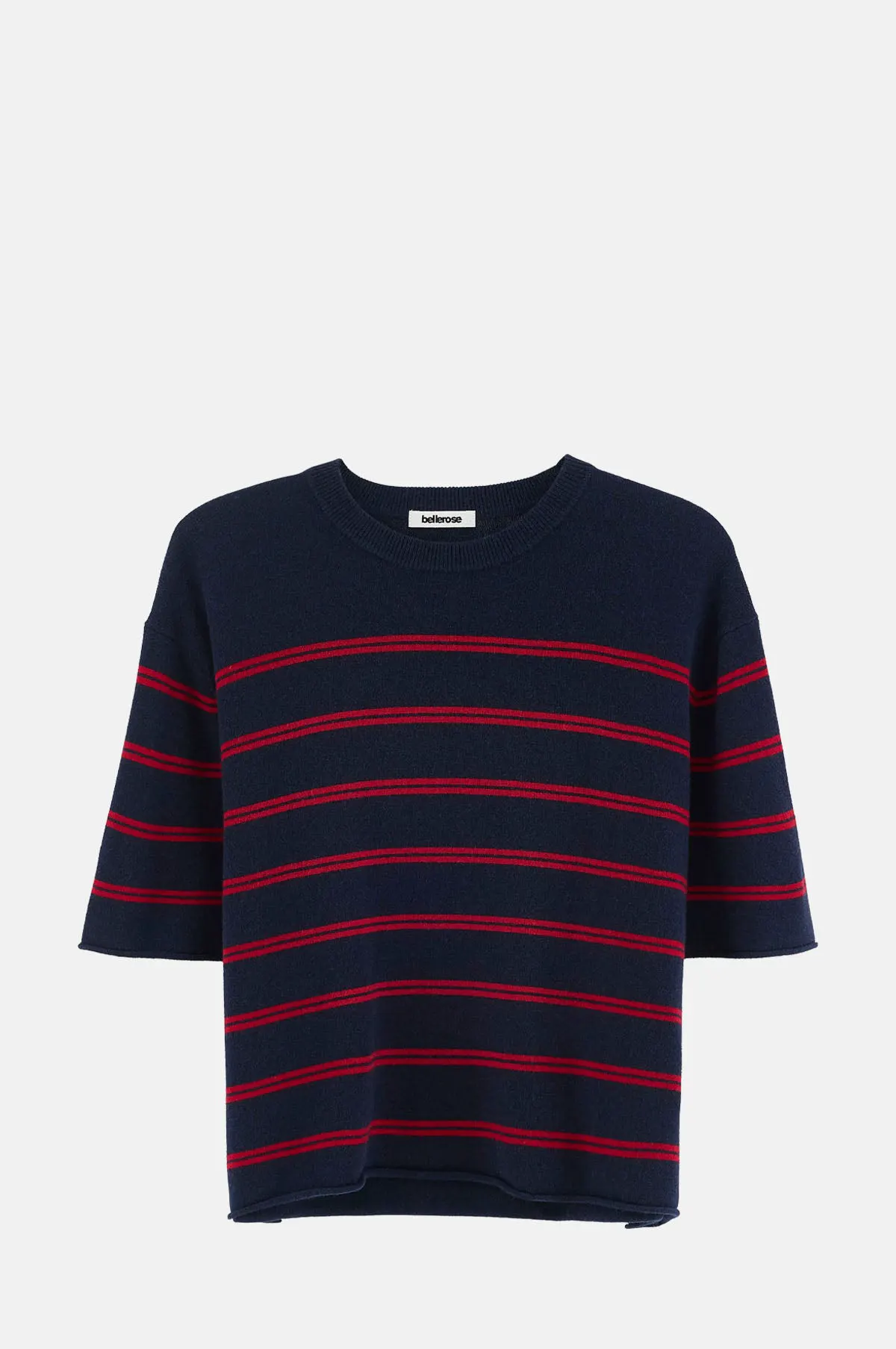

The Sonza Knit from Bellerose, in a fine wool and cashmere blend with a relaxed fit, a cropped silhouette, elbow length sleeves, a ribbed crew neck, slanted shoulders and rolled edges, in navy with a red stripe, listed at 175 GBP with all four sizes in stock. It is worth beginning with the sleeve, because it is the cleanest contradiction in this batch and it does not stand alone. The sleeve measures 20, 21, 22 and 23 centimetres, and the bullet says elbow length sleeves. Twenty centimetres is about eight inches. An elbow length sleeve is not eight inches long. And in the same batch there is a garment whose bullet says short puff sleeves and whose sleeve measures 39 to 42 centimetres. So a sleeve called short is nearly twice the length of a sleeve called elbow length, and both numbers are published by reputable brands on the same kind of chart. And in the batch immediately before this one there is a garment with short puffed sleeves at 28 to 31 centimetres, so the word short spans eleven centimetres on its own. This run has spent its whole length finding individual words that disagree with individual numbers, and this is that failure at its plainest: the sleeve vocabulary has no fixed meaning from one page to the next, and the pages never state where the tape starts. The second thing worth setting out is the fibre, which is better than most and still leaves out the one number that matters. The panel says 70% wool and 30% cashmere, and a percentage on a cashmere blend is more than most pages give, so the brand should be credited for it. But the description says lightweight gauge and the bullet says lightweight, and gauge is the single most important specification of a knitted garment. It is normally given as a number, and here it is given twice as an adjective. The reference is the Sonza Knit. Dongguan Bafinasa Garments Co., Ltd. develops comparable knitwear on OEM and ODM terms, from yarn sourcing by count and gauge to retail or FBA ready packing. We publish this as a development reference and build your own version of it, and we do not supply the branded original or reproduce anyone else's label.
Key Features
- A sleeve of 20 to 23 cm called elbow length, against 39 to 42 cm called short on another garment in this batch. See the note below
- Lightweight gauge as stated, and gauge given as an adjective twice rather than as a number. See the note below
- 70% wool and 30% cashmere as stated, a percentage on a cashmere blend, with no wool type, no micron and no ply. See the note below
- Cropped silhouette as stated, at 50 cm at XS and 59 cm at L, a 9 cm spread under one word. See the note below
- Sleeve graduating 1 cm and length graduating 3 cm, both perfectly, while the bust steps 2, 3 and 1. See the note below
- Hand wash or dry clean as stated, with no temperature, no drying instruction and no pilling guidance. See the note below
- Relaxed fit as stated, and the published bust supports it. See the note below
Customisable Options
- Yarn: a wool and cashmere blend to the reference at 70 and 30, with the wool type and micron stated, or a merino wool, or a lambswool, or extra fine merino, or a wool and cotton blend, or a cashmere blend at a different ratio, each quoted separately
- Gauge: a lightweight gauge to the reference, with the gauge number stated, or a fine 14 gauge, or a mid 12 gauge, or a chunky 7 gauge, each quoted separately
- Sleeve: elbow length sleeves to the reference, with the sleeve measurement origin and length agreed, or a short sleeve, or a long sleeve, or a three quarter sleeve, each quoted separately
- Length: cropped silhouette to the reference, with the target length agreed at every size, or a regular length, or a longline, each quoted separately
- Neck: ribbed crew neck to the reference, with the neck depth and rib width stated, or a V neck, or a roll neck, or a boat neck, each quoted separately
- Shoulder: slanted shoulders to the reference, with the shoulder width stated, or a set in shoulder, or a raglan, or a drop shoulder, each quoted separately
- Edge: rolled edges at the hem and sleeves to the reference, with the roll depth stated, or a ribbed hem, or a plain hem, each quoted separately
- Gauge number, yarn count and ply, wool type and micron, cashmere grade, grams per square metre, sleeve measurement origin, shoulder width, neck depth and rib width, roll depth, stripe width and repeat, shrinkage and pilling test results, size set, colour development, private label and care labelling
Specifications
| Style | Cropped jumper with elbow length sleeves, a ribbed crew neck and rolled edges |
| Reference | Bellerose, Sonza Knit, style BW262902 K1674S-STA, colour stripe A, sizes XS to L |
| Composition | 70% wool and 30% cashmere as stated in the panel. See the note below |
| Wool Type | Not stated, and no micron count given. See the note below |
| Cashmere Grade | Not stated, though the percentage is. See the note below |
| Gauge | Lightweight gauge as stated, given as an adjective rather than a number. See the note below |
| Yarn Count | Not stated |
| Ply | Not stated |
| Cloth Weight | Not stated, in either unit |
| Handle | Fine as stated, with no micron to support it |
| Fit Word | Relaxed fit as stated, and the published bust is consistent with it. See the note below |
| Fit Statement | A relaxed fit for ease and comfort as stated. See the note below |
| Length | Cropped silhouette as stated, and 50 to 59 cm across the sizes. See the note below |
| Neck | Ribbed crew neck as stated, with no neck depth and no rib width given |
| Shoulder | Slanted shoulders as stated, with no shoulder width measured |
| Sleeve | Elbow length sleeves as stated, measured at 20 to 23 cm, with no measurement origin given. See the note below |
| Edge | Rolled edges at the hem and sleeves as stated, with no roll depth given |
| Pattern | Timeless red stripe on navy as stated, with no stripe width and no repeat given |
| Care | Hand wash or dry clean only as stated. See the note below |
| Certification | None named |
| Sizes Offered | XS, S, M and L, four sizes, all four in stock at the time of writing |
| Size Conversion | None published |
| Fit Guidance | A relaxed fit for ease and comfort as stated, which is more than most pages give. See the note below |
| Model | None published. See the note below |
| Measurements Published | Pit to pit, sleeve length and total length for all four sizes. See the note below |
| Published Bust | 53, 55, 58 and 59 cm pit to pit, stepping 2, 3 and 1. See the note below |
| Bust Around | 106, 110, 116 and 118 cm, or 41.73, 43.31, 45.67 and 46.46 in. See the note below |
| True Bust Grade | None: no uniform grade rounds to this column. See the note below |
| Published Sleeve Length | 20, 21, 22 and 23 cm, stepping exactly 1 cm at every step. See the note below |
| Published Total Length | 50, 53, 56 and 59 cm, stepping exactly 3 cm at every step. See the note below |
| Length Grade | About 3 cm per size, clean and larger than the usual 1.3 to 2.5 cm. See the note below |
| Cloth Weight | Not stated. See the note below |
| Photographs | Five |
| Production | Made in China as stated, with no certification named |
| Reference Retail | 175 GBP as listed, quoted to show the price band this sits in, not as our price |
| Category | Filed by the reference under knitwear |
| Occasion | Autumn and winter, layering, everyday |
| MOQ | 100 pcs per style per colourway, mixed sizes and colourways accepted |
| Sampling | 7-10 days after tech pack or reference sample confirmation |
| Bulk Lead Time | 20-30 days after sample approval and deposit |
| Service | OEM / ODM / private label, wool and cashmere yarn sourcing by count and micron, gauge development, stripe development with the repeat set, rolled edge and slanted shoulder pattern development, retail or FBA ready packing |
Size Chart as Published by the Reference
| Size | Pit to pit (flat) | Sleeve Length | Total Length |
|---|---|---|---|
| XS | 53 cm | 20 cm | 50 cm |
| S | 55 cm | 21 cm | 53 cm |
| M | 58 cm | 22 cm | 56 cm |
| L | 59 cm | 23 cm | 59 cm |
The pit to pit figures are flat half measures taken with the knit laid down, doubling to 106, 110, 116 and 118 cm around, or 41.73, 43.31, 45.67 and 46.46 in. The bust steps 2, 3 and 1 cm, which no uniform grade produces. The sleeve length runs 20 to 23 cm, stepping exactly 1 cm at every step, and the total length runs 50 to 59 cm, stepping exactly 3 cm at every step. No size conversion is published for XS to L.
Our Proposed Body Chart
| Size | Body Bust | Sleeve | Body Waist | Body Hips | Length | Source |
|---|---|---|---|---|---|---|
| XS | 31 in / 79 cm | 20 cm | 24 in / 61 cm | 34 in / 86 cm | 50 cm / 19.7 in | Our proposal |
| S | 33 in / 84 cm | 21 cm | 26 in / 66 cm | 36 in / 91 cm | 52 cm / 20.5 in | Our proposal |
| M | 35 in / 89 cm | 22 cm | 28 in / 71 cm | 38 in / 97 cm | 54 cm / 21.3 in | Our proposal |
| L | 37 in / 94 cm | 23 cm | 30 in / 76 cm | 40 in / 102 cm | 56 cm / 22 in | Our proposal |
Occasions and Styling
Suits autumn, winter and layering. A lightweight cropped knit in navy with a red stripe works over a shirt or under a jacket, and the relaxed fit layers without bulk.
Production and Quality Control
The reference publishes three columns for all four sizes with two of the three grading cleanly, gives a fibre composition with both percentages stated, states the fit, describes the neck, the shoulder, the sleeve, the edges and the pattern, gives a care instruction that offers a choice rather than a prohibition, names the country of production and has all four sizes in stock. It gives no gauge number, no yarn count, no ply, no wool type, no micron, no cashmere grade, no cloth weight, no shoulder width, no neck depth, no roll depth, no stripe width or repeat, no sleeve measurement origin, no shrinkage figure, no pilling guidance, no size conversion and no model, and one of its three columns does not grade. Three things follow: the sleeve that contradicts the word on it, the gauge that is twice described and never numbered, and the fibre that is properly declared and then left without the one number a knit needs.
Twenty, and that is the first thing, and it is worth setting out slowly because it is not one garment's error. The sleeve on this knit measures 20, 21, 22 and 23 centimetres across XS to L. The bullet says elbow length sleeves. Twenty centimetres is about eight inches. There is no reading of the word elbow on which an eight inch sleeve reaches an elbow. Now this run has to be careful here, and it has been careful about this before, because a sleeve measurement has an origin and the page does not state one. A sleeve measured from the centre back neck is longer than the same sleeve measured from the shoulder seam, and on a garment with slanted shoulders the difference could be several centimetres. So it is possible that 20 centimetres is measured from somewhere that makes it larger than it sounds. But that is the finding rather than the defence: the page does not say, and therefore the number cannot be checked against the word, and cannot be compared with any other sleeve number on any other page. And this batch makes that concrete in a way this run has not been able to before. Three garments, three sleeve numbers, three sleeve words. A short puff sleeve at 39 to 42 centimetres. An elbow length sleeve at 29 centimetres. An elbow length sleeve at 20 to 23 centimetres. So the word short is attached to a longer measurement than the word elbow by a factor of nearly two, and the word elbow is attached to two numbers nine centimetres apart. And in the batch immediately before this one, short puffed sleeves measured 28 to 31 centimetres, so the word short alone spans eleven centimetres across two garments. This run has spent its entire length finding single words that fail against single numbers: a rise called mid that measures high, an inseam called ankle that measures cropped, a fit claim of true to size on a garment three inches over its label. Those were failures of accuracy. This is a failure of meaning. The sleeve vocabulary on these pages does not denote anything a customer can rely on, and the remedy is not a better word, it is a stated origin. It is worth adding the one column that does grade, because it makes the contrast. The sleeve steps one, one and one. It is perfectly regular. A column can be perfectly graded and still not mean anything, if nobody says where it starts.
Lightweight gauge, and that is the second thing, and it is worth dwelling on because knitwear has one specification that matters more than all the others and this page uses it twice as an adjective. The description opens with its lightweight gauge. The bullet says lightweight. And there is no number. Gauge is the count of needles per inch on the machine that knitted the cloth, and it is the figure that determines how a knit looks, how it drapes, how warm it is and how much it costs to make. A 14 gauge knit and a 7 gauge knit made from identical yarn are different garments. There is no other number on a knitwear page that carries as much information, and it costs nothing to publish, because the factory knows it. It is worth setting that beside what the page does publish, because the comparison is unflattering. The panel gives 70% wool and 30% cashmere, which is two numbers, and this run will credit them: a cashmere blend with the percentage stated is better than a cashmere blend without one, and 30% is a substantial share of an expensive fibre. But what is missing is the rest of the yarn specification, and there is a lot of it. There is no wool type, so nobody knows whether this is merino or lambswool or something coarser. There is no micron count, which is how wool fineness is actually specified, and the description calls the wool fine, which is precisely the word that a micron count exists to replace. There is no cashmere grade and no fibre length, and cashmere is graded precisely because the difference between grades is large and invisible. There is no yarn count, no ply, and no weight in grams per square metre. So a knit described as lightweight has no weight anywhere on it. It is worth adding what that costs a buyer, because it is not abstract. Everything a customer wants to know about this garment before buying it, which is how warm it is, how it will hang, and whether it will pill, is decided by the gauge, the yarn count and the fibre grade. All three are absent. And it is worth noting the pattern, which has the same problem as the yarn: a timeless red stripe, with no stripe width and no repeat, and the product is called Stripe A, which tells a reader nothing at all.
Hand wash or dry clean only, and that is the third thing, and this run wants to give it proper credit before saying what is missing, because it is genuinely better than most. This is the first care label in this run that offers a choice rather than imposing a prohibition. This run has met dry clean only on a great many garments, including on pure cotton, and has said repeatedly that the instruction carries no information because it appears on delicate and robust cloths alike. A label that says hand wash or dry clean is at least admitting that washing is possible. Credit where it is due. And now what is missing, which on this particular fibre is a serious gap. There is no temperature. Hand washing wool at the wrong temperature is how wool shrinks. There is no detergent type, and wool wants a pH neutral one. There is no drying instruction at all, and this is the important one: a wet wool and cashmere knit hung up to dry will stretch out of shape under its own weight, and the correct instruction is to dry it flat. The page does not say that, and the garment is made of the two fibres for which that instruction matters most. There is no ironing instruction, no pilling guidance on a fibre blend whose most common complaint is pilling, no moth or storage guidance on a wool garment, and no shrinkage figure. It is worth ending on the garment's own words about itself, because they make the point cleanly. The description says it will anchor your transitional wardrobe with its versatile layering abilities, and says it has a relaxed fit for ease and comfort, and calls it a cropped silhouette. And the length runs from 50 centimetres at XS to 59 at L. So the garment grows by nine centimetres across four sizes and is called cropped at every one of them. This run has now seen cropped applied to 46 centimetres, to 50, to 59 and to 60, on four garments across two consecutive batches. That is a fourteen centimetre range under a single word. And there is no model, which is what would have told a customer where any of those lengths actually falls. On a knit whose whole proposition is being cropped, the distance between 50 centimetres and 59 is the distance between two different garments, and the page calls them the same thing. Every bulk shipment gets a measurement report against your approved chart.
Optional upgrades include publishing the gauge number, the yarn count, the ply and the weight in grams per square metre, naming the wool type and giving the micron count, giving the cashmere grade and fibre length, stating the sleeve measurement origin so the number can be checked against the word and compared between garments, grading the bust on a uniform grade, agreeing the target length at every size and naming it consistently, giving the shoulder width, the neck depth and the rib width and the roll depth, giving the stripe width and repeat, adding a temperature, a detergent type, a dry flat instruction, an ironing instruction, pilling and shrinkage test results and moth storage guidance to the care label, a size conversion, a model height and fit guidance, merino, lambswool and extra fine merino, wool cotton blends, other cashmere ratios, fine, mid and chunky gauges, short, long and three quarter sleeves, V, roll and boat necks, set in, raglan and drop shoulders, ribbed and plain hems, size set, colour development, private label, hangtag and care labelling.
Pre-production sample approval, in-line inspection during cutting and sewing, and a final AQL inspection before packing, with measurement reports and photos shared before shipment.
Send us your tech pack, a photo or a reference garment and we will quote within 24 hours. Contact bafinasa@bafinasa.com or WhatsApp +86 13827222469.