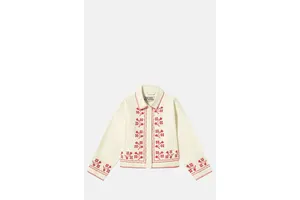
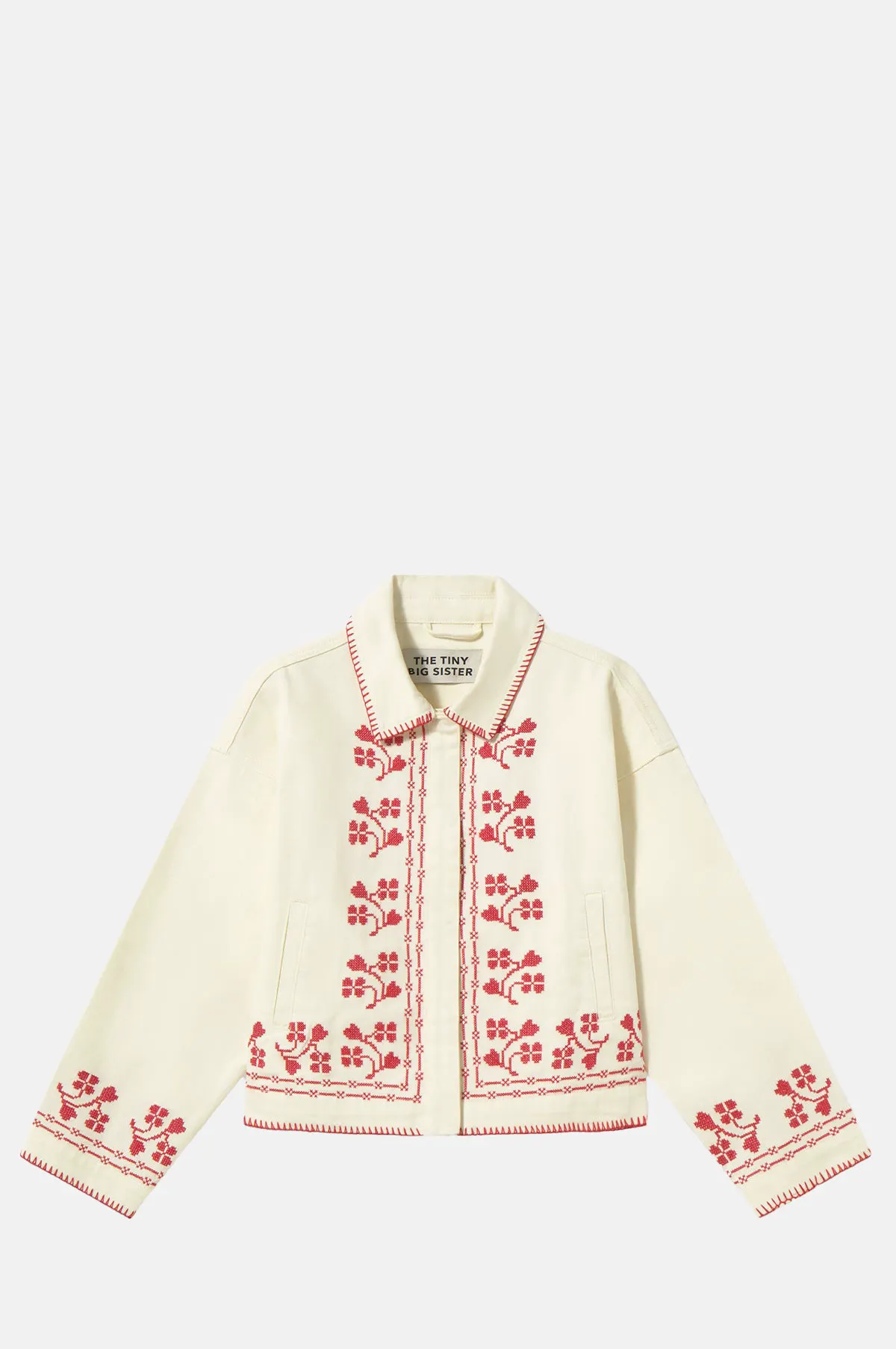

The Embroidery Denim Jacket from The Tiny Big Sister in light cream, made from a heavy cotton twill with contrast red cross stitch embroidery and decorative edge stitching, dropped shoulders and hidden snap fastening, listed at 178 GBP with three of five sizes left. It is the most useful garment this run has examined for one reason, and the reason is not the embroidery. Its chest grades perfectly. Fifty one, fifty three, fifty five, fifty seven, fifty nine: a clean two centimetres at every size, the kind of chart that looks beyond reproach. And its ease still falls, from about 9.16 inches at the smallest size to about 7.46 at the largest, at a perfectly steady rate of about 0.43 inches per size. That is the finding, and it is worth setting out slowly because it explains something this run has been seeing for many batches without understanding. A two centimetre step on a flat half measure is four centimetres of circumference, which is 1.57 inches. The body it is sized for grows two inches per size. So a garment graded two centimetres per size, however perfectly, gives back less than the body takes, and the shortfall has to come out of the ease, over and over, at every size. The grade needed to hold the ease steady is 2.54 centimetres, and two centimetres is about a fifth short of it. This garment is not badly graded. It is graded the way nearly everything is graded, and the arithmetic does the rest. The reference is the Embroidery Denim Jacket in Light Cream. Dongguan Bafinasa Garments Co., Ltd. develops comparable twill and denim outerwear on OEM and ODM terms, from cloth sourcing by weight and weave to retail or FBA ready packing. We publish this as a development reference and build your own version of it, and we do not supply the branded original or reproduce anyone else's label.
Key Features
- Chest 51, 53, 55, 57 and 59 cm, a clean and perfectly uniform two centimetre grade. See the note below
- Ease of about 9.16, 8.73, 8.31, 7.88 and 7.46 in, falling at a steady 0.43 in per size despite the perfect grade. See the note below
- Sleeve 48, 49, 50, 51 and 52 cm, a clean one centimetre grade, and length stepping 1, 1, 2 and 2. See the note below
- Heavy cotton twill as stated, with no weight given, and the title calls it denim. See the note below
- Real cross stitch embroidery as stated, with no stitch count, no thread and nothing about colourfastness. See the note below
- Hidden snap button fastening as stated, with no count, no size and no finish given. See the note below
- Machine wash cold as stated, a word where the same brand's other garments give a number. See the note below
Customisable Options
- Cloth: heavy cotton twill to the reference, with the weight in ounces stated, or a lighter twill, or an indigo denim, or a cotton canvas, each quoted separately
- Embroidery: contrast cross stitch to the reference, with the stitch count, the thread and the placement stated, or a tonal embroidery, or a printed motif, or no embroidery, each quoted separately
- Fit: boxy to the reference, with the ease at every size published and held steady, or a relaxed fit, or a regular fit, each quoted separately
- Grading: a grade that holds the ease steady across the range, or grading to the reference, or a custom grade to your own block, each quoted separately
- Shoulders: dropped to the reference, with the drop measurement given, or a set in shoulder, or a raglan, each quoted separately
- Closure: hidden snap fastening to the reference, with the count, the size and the finish stated, or exposed snaps, or buttons, or a zip, each quoted separately
- Cloth weight in ounces and grams per square metre, weave, stitch count and thread, embroidery placement, shoulder drop, snap count and finish, pocket count and depth, shoulder width, size set, colour development, private label and care labelling
Specifications
| Style | Boxy fit jacket with embroidery, dropped shoulders, side pockets and a hidden snap front |
| Reference | The Tiny Big Sister, Embroidery Denim Jacket, style AW26-784, light cream, sizes 34 to 42 |
| Composition | 100% cotton as stated in the panel |
| Cloth | Heavy cotton cream twill as stated, with no weight given, and the title calls it denim. See the note below |
| Cloth Weight | Not stated, though the description says heavy. See the note below |
| Weave | Twill as stated, with no weave specification such as three by one or two by one |
| Fit Word | Boxy fit in the bullet and a relaxed silhouette in the description, so two words. See the note below |
| Shoulders | Dropped shoulders as stated, with no shoulder width and no drop measurement. See the note below |
| Sleeves | Not named in the description, measured at 48 to 52 cm |
| Embroidery | Contrast red cross stitch embroidery as stated, with no stitch count, no thread and no placement. See the note below |
| Edge Stitching | Decorative edge stitching throughout as stated, with no stitch density and no thread given |
| Closure | Hidden snap button fastening as stated, with no count, no size, no finish and nothing about a storm flap. See the note below |
| Pockets | Side pockets as stated, with no count, no type and no depth given |
| Care | Machine wash cold, do not tumble dry, as stated, and cold is a word rather than a number. See the note below |
| Colourfastness | Not mentioned, on a red embroidery over a cream ground. See the note below |
| Shrinkage | Not stated, on a heavy cotton twill |
| Certification | None named |
| Sizes Offered | 34, 36, 38, 40 and 42, five sizes, with 38, 40 and 42 in stock at the time of writing. See the note below |
| Size Conversion | Given: 34 is XS, 36 is S, 38 is M, 40 is L and 42 is XL |
| Fit Guidance | None published beyond the fit words |
| Model | 173 cm, wearing a size 36, as stated |
| Measurements Published | Pit to pit, sleeve length and total length for all five sizes. See the note below |
| Published Chest | 51, 53, 55, 57 and 59 cm flat, a clean two centimetre grade. See the note below |
| Chest Around | 102, 106, 110, 114 and 118 cm, or 40.16, 41.73, 43.31, 44.88 and 46.46 in. See the note below |
| True Chest Grade | A clean two centimetres per size, and about a fifth short of what holds the ease steady. See the note below |
| Ease Against Body Bust | About 9.16, 8.73, 8.31, 7.88 and 7.46 in, falling at about 0.43 in per size. See the note below |
| Grade Needed To Hold Ease | About 2.54 cm of flat measure per size. See the note below |
| Published Sleeve | 48, 49, 50, 51 and 52 cm, a clean one centimetre grade |
| Published Length | 53, 54, 55, 57 and 59 cm, stepping 1, 1, 2 and 2. See the note below |
| Cloth Weight | Not stated. See the note below |
| Embroidery Specification | None. See the note below |
| Photographs | Five |
| Production | Made in China as stated, with no certification named |
| Reference Retail | 178 GBP as listed, quoted to show the price band this sits in, not as our price |
| Category | Filed by the reference under coats and jackets |
| Occasion | Autumn and spring, outerwear, casual |
| MOQ | 100 pcs per style per colourway, mixed sizes and colourways accepted |
| Sampling | 7-10 days after tech pack or reference sample confirmation |
| Bulk Lead Time | 20-30 days after sample approval and deposit |
| Service | OEM / ODM / private label, twill and denim sourcing by weight and weave, cross stitch embroidery development, snap and button sourcing, wash testing and shrinkage control, retail or FBA ready packing |
Size Chart as Published by the Reference
| Size | Pit To Pit (flat) | Sleeve Length | Total Length |
|---|---|---|---|
| 34 / XS | 51 cm | 48 cm | 53 cm |
| 36 / S | 53 cm | 49 cm | 54 cm |
| 38 / M | 55 cm | 50 cm | 55 cm |
| 40 / L | 57 cm | 51 cm | 57 cm |
| 42 / XL | 59 cm | 52 cm | 59 cm |
The chest figures are flat half measures taken with the jacket laid down, doubling to 102, 106, 110, 114 and 118 cm around, or 40.16, 41.73, 43.31, 44.88 and 46.46 in. Against a body bust of 31, 33, 35, 37 and 39 in across 34 to 42, the ease is about 9.16, 8.73, 8.31, 7.88 and 7.46 in, so it falls by about 0.43 in at every size. The chest grades a clean two centimetres per size, which no amount of rounding can hide: two centimetres of flat measure is 1.57 in of circumference against a body that gains 2 in per size. The sleeve grades a clean one centimetre. The length steps 1, 1, 2 and 2.
Our Proposed Body Chart
| Size | Body Bust | Sleeve | Body Waist | Body Hips | Length | Source |
|---|---|---|---|---|---|---|
| 34 | 31 in / 79 cm | 48 cm | 24 in / 61 cm | 34 in / 86 cm | 53 cm / 20.9 in | Our proposal |
| 36 | 33 in / 84 cm | 49 cm | 26 in / 66 cm | 36 in / 91 cm | 55 cm / 21.7 in | Our proposal |
| 38 | 35 in / 89 cm | 50 cm | 28 in / 71 cm | 38 in / 97 cm | 57 cm / 22.4 in | Our proposal |
| 40 | 37 in / 94 cm | 51 cm | 30 in / 76 cm | 40 in / 102 cm | 59 cm / 23.2 in | Our proposal |
| 42 | 39 in / 99 cm | 52 cm | 32 in / 81 cm | 42 in / 107 cm | 61 cm / 24 in | Our proposal |
Occasions and Styling
Suits autumn and spring and outerwear. A cream twill jacket with red embroidery is a light layer for the months either side of summer, and the boxy shape leaves room for a knit underneath.
Production and Quality Control
The reference publishes three columns for all five sizes, gives a size conversion for every size, gives a model height and the size worn, states the fibre, states the cloth and its weave, names the embroidery, the edge stitching, the shoulders, the closure and the pockets, gives a fit word, gives a two clause care instruction and names the country of production. It gives no cloth weight, no weave specification, no stitch count or thread, no embroidery placement, no snap specification, no pocket specification, no shoulder width, no shoulder drop, no colourfastness and no shrinkage figure, and publishes no fit guidance beyond the fit words. Three things follow: the grade that is perfect and still loses ease, the two names for one garment, and the embroidery that is real and unspecified.
Fifty one, fifty three, fifty five, fifty seven, fifty nine, and that is the first thing, and this run wants to be precise about why it matters, because on the face of it this is the best chart it has seen. Five sizes, a clean two centimetres at every single step, no wobble at all. Every test this run applies to a measurement column, this column passes. And yet the ease runs about 9.16, 8.73, 8.31, 7.88 and 7.46 inches from smallest to largest. It falls at every size. It falls by the same amount at every size, about 0.43 inches, which is the signature of a cause that is arithmetic rather than accidental. And here is the cause, and it is worth writing out because it explains a great deal that this run has been reporting for many batches without having the reason. A step of two centimetres on a flat half measure is four centimetres of circumference, and four centimetres is 1.57 inches. The body that this size is cut for gains two inches of bust per size. So the garment gives back 1.57 inches where the body has taken two, and the difference, 0.43 inches, has to come out of the ease. Every size. Forever. The grade that would hold the ease steady is the one that gives back exactly what the body takes: two inches of circumference, which is 5.08 centimetres of circumference, which is 2.54 centimetres of flat measure. Two centimetres is about a fifth short of that. So a two centimetre grade is not a neutral choice that happens to be convenient. It is a decision, made over and over across this industry, to let the fit get tighter as the sizes go up. Now this run has to own up to something here, because it got this partly wrong last batch. It examined two garments whose ease collapsed and went negative at the largest size, and it said the cause was that their grades lagged behind the body. That was true, but it was not the whole truth. The dress graded two, two, one and one centimetres and the skirt graded one centimetre, and both lagged badly, and that is why both went past zero. But this jacket does not lag. It grades a clean two centimetres throughout. And it still loses ease, just more slowly, and never crosses zero. So there are two things going on, and this run should have separated them. One is that almost no garment is graded at the rate that holds the fit steady. The other is that some garments are graded far slower still, and those are the ones that break. It is worth checking this against the run's own numbers, because it works exactly. The one garment this run found whose ease held steady across its range was a plain jersey tee, and it graded 2.6 centimetres, which is almost exactly the 2.54 that the arithmetic says is right. The skirt that went negative graded one centimetre, and the arithmetic predicts a loss of 1.21 inches of ease per size, and the measured loss was 1.21 inches. This jacket grades two centimetres, the arithmetic predicts 0.43, and the measured loss is 0.43. The rule holds, and this run will use it from here.
Denim in the title and twill in the description, and that is the second thing, and it is not quite a complaint because denim is a twill. But it is worth setting out what is happening, because a customer who reads the title is looking for one cloth and the description gives her another. The title says Embroidery Denim Jacket. The description says crafted from a heavy cotton cream twill. Now, denim is a warp faced twill, usually indigo, so calling a twill a denim is defensible in a technical sense. But a cream twill is not what anybody means by denim, and a customer searching for a denim jacket is not looking for this. And the word is doing something specific here: it is being used to describe a shape and a role, a collarless workwear style jacket with pockets and snaps, rather than a cloth. This run can say that with some confidence because the same brand does it a second time in the same batch, on a blouse titled denim that turns out to be 55% linen and 45% cotton with no denim in it at all. So within one brand, one season, two garments carry the word denim in the title and neither is made of denim. It is worth adding what is missing from the cloth description, which is the same omission this run has recorded on nearly every cloth it has met. Heavy is stated and the weight is not. This matters more than usual here, because there is a direct comparison available inside this run: another brand's denim jacket states its weight as 13.5 ounces in the proper unit, and does so on two separate products. So one brand tells a reader how heavy its heavy is and this one does not, and the reader has no way to know whether these two jackets are in the same league. There is no weave specification either, and twill comes in more than one arrangement, and no shrinkage figure, on a heavy cotton twill, which is a cloth that moves in the wash. It is worth closing this on the fit words, because the page uses two. The bullet says boxy fit and the description says a relaxed silhouette, and boxy and relaxed are different claims. Boxy describes a shape: wide in the body and short in the length. Relaxed describes how much room there is. And the numbers support boxy and do not quite support relaxed. The ease is about 9.16 inches down to 7.46, and on the scale this run has built by measuring garment after garment, relaxed sits around twelve to thirteen inches and regular sits around five to seven. So this sits between them. But the shape is right: a chest of about 40 to 46 inches on a garment only 53 to 59 centimetres long is wide relative to its length, and that is what boxy means. So one of the two words is supported by the chart and the other is a stretch, and the page does not distinguish them.
Cross stitch embroidery, and cross stitch effect, and that is the third thing, and it is a small triumph for reading pages carefully. This jacket has contrast red cross stitch embroidery, and it is real embroidery. The T-shirt from this same brand, published by this run one batch ago, has what it calls a subtle cross stitch effect. This run said at the time that the word effect implies a print imitating embroidery rather than actual embroidery, and that the page does not say which it is, and that the two are very different in cost and in how they wear. It could not prove that reading. Now it can. Here is the same brand, in the same season, in the same shop, describing actual embroidery, and it says embroidery. So the brand does distinguish the two in its own copy, and the word effect on the T-shirt was doing exactly the work this run suspected. The T-shirt's motif is a print. That is settled. It is worth adding what is missing from this one, because the embroidery is now known to be real and therefore worth specifying. There is no stitch count, no thread type, and no statement of where the embroidery is placed or how much of the garment it covers. Decorative edge stitching throughout is also named, which is a second real construction detail and worth crediting, and it too has no stitch density and no thread given. And there is nothing about colourfastness on a red embroidery sitting on a cream ground, which is the pairing most likely to bleed, and nothing in the care label about washing inside out to protect it. It is worth ending on the care label, because it contains a small thing this run has been circling. It says machine wash cold. Cold is not a temperature. Machines have temperatures, and a care label either gives one or gives a word that stands for one, and conventions differ about what cold means. The same brand's T-shirt, published one batch ago, says machine wash at thirty degrees, which is a number, and the same brand's blouse, published alongside this one, also says thirty degrees. So within one brand, one season, three garments: one says cold, two say thirty. There is no house standard for how a care instruction is written, even inside a single brand's own range. And what is missing around it is the usual short list: no cycle, no detergent, no ironing instruction on a heavy cotton twill, and no shrinkage figure. Every bulk shipment gets a measurement report against your approved chart.
Optional upgrades include quoting the cloth weight in ounces and grams per square metre, specifying the weave, grading the chest at about 2.54 cm per size so the ease holds steady across the range and publishing the ease at every size, giving the stitch count, the thread and the placement of the embroidery and the density of the edge stitching, giving a colourfastness grade for the embroidery thread, giving the shoulder width and the shoulder drop, giving the snap count, size, finish and whether there is a storm flap, giving the pocket count, type and depth, replacing cold with a temperature in degrees, adding cycle, detergent, ironing, wash inside out and shrinkage to the care label, adding fit guidance, a lighter twill, an indigo denim and a cotton canvas, tonal embroidery, a printed motif and no embroidery, relaxed and regular fit options, a set in shoulder and a raglan, exposed snaps, buttons and a zip, size set, colour development, private label, hangtag and care labelling.
Pre-production sample approval, in-line inspection during cutting and sewing, and a final AQL inspection before packing, with measurement reports and photos shared before shipment.
Send us your tech pack, a photo or a reference garment and we will quote within 24 hours. Contact bafinasa@bafinasa.com or WhatsApp +86 13827222469.