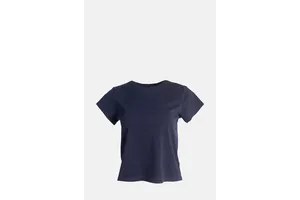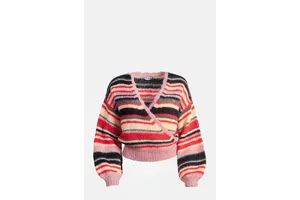
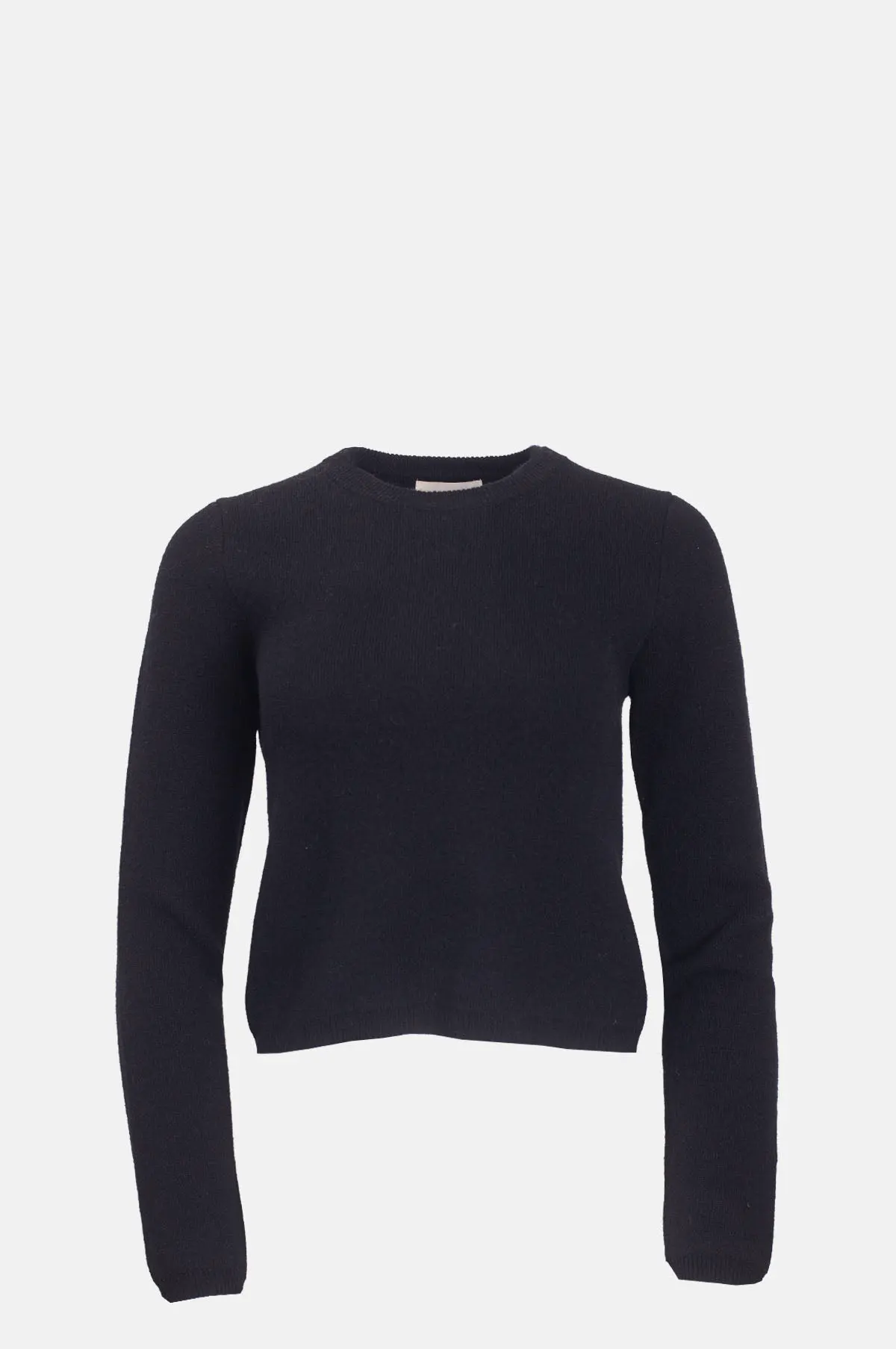

The Stretch Crew from Jumper 1234 in black, in an 88% cashmere and 12% spandex blend with a neat fit that hugs the body, listed at 199 GBP with all four sizes in stock, and sharing both its chart and its yarn colour reference with the other two garments in this batch. Since the charts are identical to the almond rice colourway, the interesting material here is the yarn rather than the numbers, and there is a great deal to say about it. Twelve per cent spandex is a shaping level of elastane rather than a comfort level, and it is the reason this garment can be called a neat fit while measuring only about two inches bigger than the body inside it. It is also the reason the care label matters more than usual, because heat destroys elastane, and the label here is one clause long. And the cashmere, which is 88% of the garment, has no specification of any kind behind it, on a fibre that is traded by weight. The reference is the Stretch Crew in Black. Dongguan Bafinasa Garments Co., Ltd. develops comparable knitwear on OEM and ODM terms, from yarn sourcing by ply, gauge, micron and elastane brand to retail or FBA ready packing. We publish this as a development reference and build your own version of it, and we do not supply the branded original or reproduce anyone else's label.
Key Features
- Identical chart to the almond rice colourway of the same style, and sharing a yarn colour reference with the cardigan alongside it. See the note below
- 88% cashmere and 12% spandex as stated, with 12% being a shaping level of elastane rather than a comfort level. See the note below
- No elastane brand named, on the one fibre where the branded version genuinely outperforms the generic. See the note below
- No ply, no gauge, no fibre length, no fineness, no grade and no gram weight, on a fibre that is traded by weight. See the note below
- Hand wash only as stated, which is the right first clause for a high-spandex knit, and the only clause. See the note below
- About 2.1 in of ease at the smallest rising to about 4.7 in at the largest, so it does not hug the same way at every size. See the note below
- One photograph, front only
Customisable Options
- Yarn: 88% cashmere and 12% spandex to the reference, with the ply, the gauge and the elastane brand stated, or a cashmere wool blend with elastane, or a merino with elastane, or a cotton with elastane, each quoted separately
- Elastane: 12% to the reference, with the brand named and the stretch and recovery stated, or a comfort stretch at 2 to 5% with a less close fit, each quoted separately
- Fit: neat and close to the reference, with the ease at every size published, or graded for constant ease, or a relaxed fit, each quoted separately
- Collar: crew neck to the reference, with the neck width and depth specified, or a V neck, or a roll collar, each quoted separately
- Trims: ribbed to the reference, with the rib structure and depth specified, or a plain hem and cuff, or a deeper rib
- Colourway: black to the reference, or the light brown this run also makes, or any colour from one approved chart
- Ply, gauge, micron and fibre length, garment weight in grams, elastane brand, stretch percentage and recovery, measurement tension, neck width and depth, rib depth, size set, colour development, private label and care labelling
Specifications
| Style | Neat fit crew neck jumper with ribbed trims |
| Reference | Jumper 1234, Stretch Crew, style #LAN26-4005, black, sizes 1 to 4 |
| Colourway | One of two colourways of this style, the other being almond rice, and sharing a yarn colour reference with the stretch cardigan. See the note below |
| Composition | 88% cashmere and 12% spandex as stated in the panel. See the note below |
| Yarn Specification | None: no ply, no gauge, no micron, no fibre length, no grade and no weight. See the note below |
| Elastane | 12% as stated, a shaping level, with no brand, no stretch percentage and no recovery given. See the note below |
| Fit Word | Neat fit as stated, described as hugging the body. See the note below |
| Shape | Classic shape as stated, with nothing behind it |
| Collar | Crew neck as stated, with no neck width and no neck depth given. See the note below |
| Sleeves | Not described, though the measured sleeve is a long one. See the note below |
| Trims | Ribbed trims as stated, with no rib structure and no rib depth given. See the note below |
| Measurement Tension | Not stated, on a cloth with 12% spandex. See the note below |
| Care | Hand wash only as stated, with no temperature, no detergent, no drying instruction and no warning against wringing. See the note below |
| Pilling | Not mentioned. See the note below |
| Certification | None named. See the note below |
| Sizes Offered | 1 to 4, four sizes, all four in stock at the time of writing |
| Size Conversion | Published: 1 is XS, 2 is S, 3 is M and 4 is L |
| Fit Guidance | None published beyond the fit word. See the note below |
| Model | None published |
| Measurements Published | Pit to pit, sleeve length and total length for all four sizes. See the note below |
| Published Chest | 42, 43, 48 and 53 cm flat, or 16.5 through 20.9 in. See the note below |
| Chest Around | 84, 86, 96 and 106 cm, or 33.1, 33.9, 37.8 and 41.7 in. See the note below |
| True Chest Grade | None: no uniform grade rounds to this column. See the note below |
| Ease Against Body Bust | About 2.1, 0.9, 2.8 and 4.7 in, which is not monotonic. See the note below |
| Published Sleeve | 61, 61, 62 and 64 cm, and no uniform grade rounds to this column. See the note below |
| Sleeve Measurement Origin | Not stated |
| Published Length | 51, 53, 54 and 57 cm, and no uniform grade rounds to this column either. See the note below |
| Neck Dimensions | None. See the note below |
| Rib Specification | None. See the note below |
| Cloth Weight | Not stated. See the note below |
| Photographs | One. See the note below |
| Production | Made in China as stated, with the fibre origin not stated, and differing from the country given for this brand's pure cashmere. See the note below |
| Reference Retail | 199 GBP as listed, quoted to show the price band this sits in, not as our price |
| Category | Filed by the reference under knitwear |
| Occasion | Autumn and winter, everyday, layering |
| MOQ | 100 pcs per style per colourway, mixed sizes and colourways accepted |
| Sampling | 7-10 days after tech pack or reference sample confirmation |
| Bulk Lead Time | 20-30 days after sample approval and deposit |
| Service | OEM / ODM / private label, cashmere and elastane yarn sourcing with ply, gauge, micron and elastane brand stated, stretch and recovery testing, grading for constant ease, measurement under stated tension, multi-colourway programmes from one approved chart, retail or FBA ready packing |
Size Chart as Published by the Reference
| Size | Pit To Pit (flat) | Sleeve Length | Total Length |
|---|---|---|---|
| 1 / XS | 42 cm | 61 cm | 51 cm |
| 2 / S | 43 cm | 61 cm | 53 cm |
| 3 / M | 48 cm | 62 cm | 54 cm |
| 4 / L | 53 cm | 64 cm | 57 cm |
The chest figures are flat half measures taken with the jumper laid down, doubling to 84, 86, 96 and 106 cm around, or 33.1, 33.9, 37.8 and 41.7 in. Against a body bust of 31, 33, 35 and 37 in across XS to L, the ease is about 2.1, 0.9, 2.8 and 4.7 in. The chart is identical to the almond rice colourway of this same style, and different from the cardigan alongside it, which is how this run knows the chart belongs to the pattern rather than to the yarn.
Our Proposed Body Chart
| Size | Body Bust | Sleeve | Body Waist | Body Hips | Length | Source |
|---|---|---|---|---|---|---|
| 1 / XS | 31 in / 79 cm | 61 cm | 24 in / 61 cm | 34 in / 86 cm | 51 cm / 20.1 in | Our proposal |
| 2 / S | 33 in / 84 cm | 62 cm | 26 in / 66 cm | 36 in / 91 cm | 53 cm / 20.9 in | Our proposal |
| 3 / M | 35 in / 89 cm | 63 cm | 28 in / 71 cm | 38 in / 97 cm | 55 cm / 21.7 in | Our proposal |
| 4 / L | 37 in / 94 cm | 64 cm | 30 in / 76 cm | 40 in / 102 cm | 57 cm / 22.4 in | Our proposal |
Occasions and Styling
Suits autumn and winter and everyday dressing. A close fitting black crew in a cashmere blend is the layer that goes under everything and with everything, and it is the version most people will reach for first.
Production and Quality Control
The reference publishes three columns for all four sizes, states the fibre blend to the percentage, describes the collar and the trims, gives a fit word and a shape word, gives a care instruction, names the country of production and publishes a size conversion. It gives no yarn specification beyond the blend, no elastane brand, no stretch or recovery figure, no measurement tension, no neck dimensions, no rib specification and no weight, and publishes no fit guidance beyond one word and no model information. Three things follow: the twelve per cent, the cashmere with nothing behind it, and the one clause care label.
Twelve per cent, and what it does to everything else on the page, and that is the first thing. Most stretch knitwear runs at two to five per cent elastane, and that range is comfort stretch: it lets a garment move with the body and recover. Twelve per cent is a different thing, and it is shaping stretch, which is why a garment measuring only about two inches bigger than the body inside it can still be called a neat fit and still be expected to hug. The elastane is doing the work that ease would otherwise do, and that has two consequences worth spelling out. The first is that the ease figures stop meaning what they mean elsewhere, and this run has to say so about its own numbers: it has been publishing ease as a measure of fit for many batches, and on a garment with this much elastane it is not the same quantity, because the cloth stretches to meet the body and the garment does not need to be bigger. So the run will not file 2.1 in here alongside the slim band it has recorded elsewhere, and it will flag that its own vocabulary does not reach this garment. The second consequence is that elastane is one of the very few fibres where the branded version genuinely outperforms the generic, because the whole value of the fibre is how long it keeps recovering, and that varies by manufacturer. Twelve per cent of this garment is an unnamed elastane. It is worth adding what is missing that a garment like this most needs published, which is not ease but behaviour: the stretch percentage, the recovery after wear, and what happens after a day on the body. None of the three is given. And it is worth saying why the care instruction matters more here than it would on a jumper with no stretch, which is that heat is what destroys elastane. A high-spandex knit loses its recovery permanently if it is machine washed warm or tumble dried, and it is the one fibre where the care label is not a nicety but the difference between a garment that keeps its shape and one that goes slack. The page says hand wash only, which is the right call and this run will credit it: the brand understood that a 12% spandex knit should not go in a machine.
The cashmere, which is 88% of the garment, and there is nothing behind it, and that is the second thing. The panel gives the blend to the percentage and stops. No ply, no gauge, no fibre length, no fineness in microns, no grade, and no weight in grams. This run made the same complaint about this brand's pure cashmere jumper last batch, so the gap is a house habit rather than an oversight on one listing, and it is worth saying what specifically is lost. Cashmere is traded by weight, so the gram weight of the finished garment is not a curiosity but the number that explains the price and the only number that lets a buyer compare a jumper at one price with one at twice the price. A brand that sells cashmere and never publishes a weight is asking the customer to take the price on trust. Fibre length is the other one worth naming, because length is what governs pilling, and pilling is the single most common complaint about cashmere, and there is no word about it on a garment whose surface will be held under tension by 12% elastane. It is also worth noting the origin, because it is a different answer from the one this brand gives elsewhere. The pure cashmere jumper this run published last batch was made in Mongolia, which is at least a place where cashmere is grown. This one is made in China, where the fibre certainly was not, so the origin of the cashmere in this garment is entirely unstated. This run will not lecture, but it will note that of every fibre it has examined, cashmere is the one where origin is a question about land as well as about animals, and the one where two named standards exist and are easy to print. Neither appears. And no certification of any kind is named on any of the three garments in this batch.
One clause, and it is the right clause, and then nothing, and that is the third thing. The care label reads hand wash only. That is correct for a 12% spandex knit and it is more than many pages in this run manage. What is not there is everything after it. No temperature, and a hand wash can be done hot enough to damage elastane and felt cashmere at once. No detergent, and both fibres want a pH neutral wool detergent rather than a standard one. No warning against wringing, which on a knit with this much elastane is close to essential, because wringing distorts the elastane and the stitches it sits in. And no drying instruction at all, which is the most consequential omission of the four: a cashmere and elastane knit must be dried flat and reshaped while damp, and it must not be hung wet, because hanging will stretch the elastane out of recovery in a single night. It is worth putting that beside the pure cashmere jumper this run published last batch from the same brand, because the comparison is instructive. That garment, 100% cashmere with no elastane, said machine wash at thirty degrees. This one, with 12% spandex added, says hand wash only. So the change in the blend moved the wash method, and moved it correctly. What did not change is the length of the label: one clause in both cases, and in both cases the missing clause is the one about drying. Four more words would make this label honest: cool, wool detergent, do not wring, dry flat. That is not a long label, and it is the whole difference between a garment that lasts and one that is damaged in its first wash. It is worth closing on the two smaller gaps that sit alongside it. The collar is a crew neck and neither its width nor its depth is published, and on a close fitting crew those two numbers decide whether the neckline sits flat. The trims are ribbed and neither the rib structure nor its depth is given, and on a garment this close the depth of the cuff rib is what stops the sleeve from riding up. And the sleeve, measured at 61 to 64 cm and plainly long, is not mentioned anywhere in the description, while the cardigan alongside it does say long sleeves. Every bulk shipment gets a measurement report against your approved chart.
Optional upgrades include stating the ply, the gauge, the fibre length and the fineness in microns, stating the garment weight in grams, naming the elastane brand and publishing the stretch percentage and the recovery, publishing the measurements with the tension stated, grading for constant ease so the fit is the same at every size, giving the neck width and depth, giving the rib structure and depth, describing the sleeve, extending the care label to give the temperature, the detergent, a warning against wringing and the drying method, adding a pilling note, naming the fibre origin and a standard, adding fit guidance and a model height, adding a back view photograph, a cashmere wool, merino and cotton elastane option, comfort stretch at 2 to 5 per cent, relaxed fit option, V neck, roll collar and funnel neck options, size set, colour development, private label, hangtag and care labelling.
Pre-production sample approval, in-line inspection during cutting and sewing, and a final AQL inspection before packing, with measurement reports and photos shared before shipment.
Send us your tech pack, a photo or a reference garment and we will quote within 24 hours. Contact bafinasa@bafinasa.com or WhatsApp +86 13827222469.