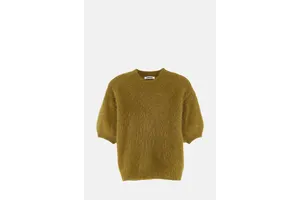
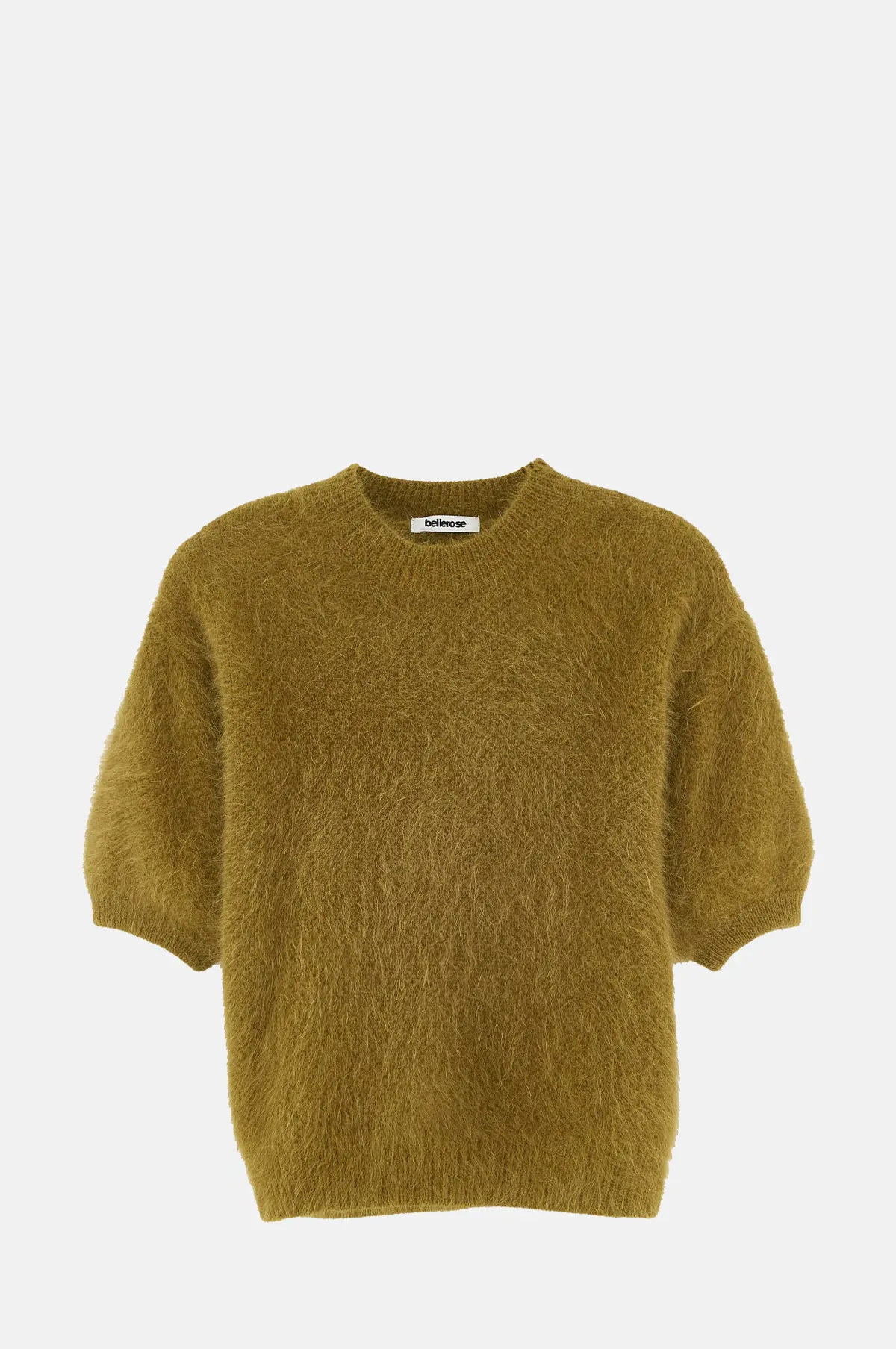

A knit from Bellerose in a warm golden olive tobacco, made from a soft and fluffy angora blend knitted in a heavy-gauge three-ply yarn with a honeycomb texture, softly puffed elbow-length sleeves and hand-linked cuffs, listed at 175 GBP with the M sold out. Its chest column solves something this run has been unable to settle for several batches. The figures are 50, 52, 55, 57 and 60 centimetres, which looks like a grade of two, then three, then two, then three, and an alternating grade like that is exactly the pattern this run has twice had to guess about and could not resolve. It can be resolved now, because these five numbers are precisely what a uniform grade of two and a half centimetres produces when each half centimetre is rounded down: fifty, fifty-two point five rounded to fifty-two, fifty-five, fifty-seven point five rounded to fifty-seven, sixty. The fit is perfect, figure for figure. So this garment's chest is in truth graded evenly, and its ease is in truth constant at about eight and three tenths inches across all five sizes, and the chart makes it look erratic when it is not. That is worth a great deal more than a curiosity, because it gives this run a rule it can apply to every chart it has already read. The other thing worth examining is the fibre, because angora is new to this run and it arrives with a sourcing question this run raised only in passing a few batches ago. The reference is the Darza Knit in Tabac. Dongguan Bafinasa Garments Co., Ltd. develops comparable knitwear on OEM and ODM terms, from yarn selection to retail or FBA ready packing. We publish this as a development reference and build your own version of it, and we do not supply the branded original or reproduce anyone else's label.
Key Features
- The published chest of 50, 52, 55, 57 and 60 cm is exactly a uniform 2.5 cm grade rounded down, so the apparent alternating grade is a rounding artifact and the true ease is constant. See the note below
- The same rule explains a jacket earlier in this run whose length graded 2, 3 and 2, which this run could only guess at the time. See the note below
- 65% angora, a fibre new to this run, with a sourcing question this run has already raised about wool and no statement here. See the note below
- Three-ply yarn as stated, the first ply count given anywhere in this run, on a garment a quarter of the price of the wool one that omits it. See the note below
- 35% polyamide alongside the angora, which is the first blend in this run with an evident technical reason. See the note below
- Hand-linked cuffs as stated, a specific and checkable construction claim, on one seam only. See the note below
- Elbow-length sleeves at 36 to 44 cm, which is the first sleeve length in this run that can be checked against the word describing it. See the note below
Customisable Options
- Yarn: angora blend to the reference, with the ply and the blend stated, or a wool, a mohair blend, an alpaca blend or a brushed acrylic, each quoted separately with its own provenance statement
- Fibre sourcing: angora to the reference, with the sourcing standard named, or a certified non-angora alternative for brands that prefer one, quoted separately
- Structure: honeycomb texture to the reference, with the gauge specified, or a plain knit, a rib or a waffle, each quoted separately
- Sleeve: softly puffed elbow length to the reference, with the gather ratio specified, or a straight elbow sleeve, a three quarter sleeve or a full length sleeve
- Cuffs: hand-linked to the reference, or cup-seamed, quoted separately, with the shoulder and armhole seams specified either way
- Fit: about 8 in of ease to the reference, held steady by grading at 2.5 cm a size, or a closer fit at about 4 or a looser fit at about 12
- Blend and ply, gauge, yarn provenance and standard, gather ratio, seam specification by position, sleeve length and grade, shedding and care guidance, drying instruction, size set, colour development, private label
Specifications
| Style | Angora blend knit with a honeycomb texture, puffed elbow sleeves and hand-linked cuffs |
| Reference | Bellerose, Darza Knit, style BW262901 K1014U-028, tobacco, sizes XS to XL |
| Composition | 65% angora, 35% polyamide or nylon, as stated in the panel. See the note below |
| Yarn | Heavy-gauge three-ply yarn as stated, the first ply count given in this run. See the note below |
| Structure | Honeycomb texture as stated, with no gauge given. See the note below |
| Handle | Soft and fluffy as stated, with no note about shedding. See the note below |
| Neck | Classic round neckline as stated, with no neck opening given |
| Sleeve | Softly puffed elbow-length sleeves as stated, with no gather ratio given. See the note below |
| Cuffs | Hand-linked cuffs as stated, with the other seams not specified. See the note below |
| Care | Hand wash cold as stated, with no drying instruction. See the note below |
| Sizes Offered | XS to XL, five sizes, with M sold out at the time of writing |
| Fit Guidance | None published |
| Model | None published. See the note below |
| Measurements Published | Pit to pit, sleeve length and total length for all five sizes. See the note below |
| Published Chest | 50, 52, 55, 57 and 60 cm flat, or 19.7 through 23.6 in. See the note below |
| Chest Around | 100, 104, 110, 114 and 120 cm, or 39.4, 40.9, 43.3, 44.9 and 47.2 in. See the note below |
| True Chest Grade | A uniform 2.5 cm per size, of which the published figures are the rounded-down image. See the note below |
| Ease Against Body Bust | About 8.4, 7.9, 8.3, 7.9 and 8.2 in as published, but a constant 8.2 to 8.4 in once the rounding is removed. See the note below |
| Published Sleeve | 36, 38, 40, 42 and 44 cm, grading two centimetres per size. See the note below |
| Published Length | 48, 50, 52, 54 and 56 cm, grading two centimetres per size. See the note below |
| Ply Count | Three-ply as stated. See the note below |
| Gauge | Heavy-gauge as stated, with no number. See the note below |
| Cloth Weight | Not stated. See the note below |
| Gather Ratio | None, on a puffed sleeve. See the note below |
| Fibre Provenance | None. See the note below |
| Shedding Guidance | None, on a fluffy angora knit. See the note below |
| Photographs | Five |
| Production | Made in China as stated, which is where most angora is spun. See the note below |
| Reference Retail | 175 GBP as listed, quoted to show the price band this sits in, not as our price |
| Category | Filed by the reference under knitwear |
| Occasion | Transitional dressing, autumn and spring, with denim or tailored trousers |
| MOQ | 100 pcs per style per colourway, mixed sizes and colourways accepted |
| Sampling | 7-10 days after tech pack or reference sample confirmation |
| Bulk Lead Time | 20-30 days after sample approval and deposit |
| Service | OEM / ODM / private label, angora and alternative blend sourcing with provenance, three-ply yarn development, honeycomb structure, hand-linked finishing, retail or FBA ready packing |
Size Chart as Published by the Reference
| Size | Pit to Pit (flat) | Sleeve Length | Total Length |
|---|---|---|---|
| XS | 50 cm | 36 cm | 48 cm |
| S | 52 cm | 38 cm | 50 cm |
| M (sold out) | 55 cm | 40 cm | 52 cm |
| L | 57 cm | 42 cm | 54 cm |
| XL | 60 cm | 44 cm | 56 cm |
The chest figures are flat half measures taken with the knit laid down, doubling to 100, 104, 110, 114 and 120 cm around, or 39.4, 40.9, 43.3, 44.9 and 47.2 in. The published steps are 2, 3, 2 and 3 cm, but those figures are exactly what a uniform grade of 2.5 cm produces when each half centimetre is rounded down: 50, 52.5 to 52, 55, 57.5 to 57, 60. So the true grade is even and the true ease is constant at about eight and three tenths inches across all five sizes. As published, the ease against a body bust of 31 to 39 in reads about 8.4, 7.9, 8.3, 7.9 and 8.2 in, and that wobble is entirely an artifact of the rounding. The sleeve grades two centimetres per size and the length does the same.
Our Proposed Body Chart
| Size | Body Bust | Sleeve | Body Waist | Body Hips | Length | Source |
|---|---|---|---|---|---|---|
| XS | 31 in / 79 cm | 36 cm | 24 in / 61 cm | 34 in / 86 cm | 48 cm / 18.9 in | Our proposal |
| S | 33 in / 84 cm | 37 cm | 26 in / 66 cm | 36 in / 91 cm | 50 cm / 19.7 in | Our proposal |
| M | 35 in / 89 cm | 38 cm | 28 in / 71 cm | 38 in / 97 cm | 52 cm / 20.5 in | Our proposal |
| L | 37 in / 94 cm | 39 cm | 30 in / 76 cm | 40 in / 102 cm | 54 cm / 21.3 in | Our proposal |
| XL | 39 in / 99 cm | 40 cm | 32 in / 81 cm | 42 in / 107 cm | 56 cm / 22 in | Our proposal |
Occasions and Styling
Suits transitional dressing in autumn and spring. An elbow sleeve in a fluffy yarn is a piece for the weeks between seasons, and the reference suggests denim or tailored trousers, which is right: the texture is the interest, so the rest should be plain.
Production and Quality Control
The reference publishes three columns for all five sizes, states a composition with percentages, gives a ply count, describes the yarn, the structure, the handle, the neck, the sleeve, the cuffs and the colour, gives a care instruction and names the country of production. It publishes no fit guidance and no model information, and gives no gauge, no weight, no gather ratio, no fibre provenance, no shedding guidance and no drying instruction. Three things follow: the two and a half centimetre grade hiding behind the published figures, the angora, and the hand-linked cuffs.
Two, three, two, three, and it is a perfect two and a half, and that is the first thing. The published chest runs 50, 52, 55, 57 and 60 cm, so the steps read two, three, two and three. An alternating grade of that kind is the puzzle this run has twice had to leave open. The first time was on a jacket from another house, whose body length graded two, three and two, and this run said then that it was probably a true grade of about two and a third being rounded, and said so as a guess. The second was a sleeve that read forty-four, forty-four, forty-four, forty-five, forty-five, which this run said was neither a frozen column nor a clean grade of a quarter or a half and could not take further. This garment settles both, because its five figures can be reproduced exactly. Take a uniform grade of two and a half centimetres from a base of fifty: fifty, fifty-two point five, fifty-five, fifty-seven point five, sixty. Now round each half centimetre down: fifty, fifty-two, fifty-five, fifty-seven, sixty. That is the published column, figure for figure, with nothing left over. So the grade is even, and the alternating two and three is an artifact of rounding and nothing else. It is worth setting out what follows, because it is more useful than the correction itself. The true ease is not the wobbly eight point four, seven point nine, eight point three, seven point nine, eight point two that the published figures give. Computed from the unrounded 100, 105, 110, 115 and 120 cm, it is eight point three seven, eight point three four, eight point three one, eight point two eight and eight point two four inches: constant to within a tenth of an inch across the whole range. So this is a garment graded correctly, with the same amount of ease on every size, and its chart makes it look as though it is not. And two and a half centimetres is not an arbitrary number. It is 1.97 inches of circumference, against a body bust that grades two inches per size, and this run identified it last batch as the grade that holds ease steady, on a cardigan that uses it and whose ease indeed does not move. So the signature to look for is now established on two garments from two different houses: a published column that alternates two and three, or three and two, is the fingerprint of a uniform two and a half centimetre grade rounded down, and the right conclusion is that the pattern is fine and the chart is lying. That is worth having, because the alternative reading, which this run has given more than once, is that the brand cannot grade. There is a caution that comes with it, and it is worth stating so the rule is not over-applied. The test only works when the alternation is regular. The other garment this brand published alongside this one, in the same batch, has a chest that grades three, three, two and two and a sleeve that grades two, two, one and one, and that is not an alternation but a step down, and this run checked it arithmetically and found that no uniform grade rounds to it. So one of these two garments really is graded unevenly and the other only looks as though it is, and the difference between them is visible only after doing the sums. Two garments, one brand, opposite diagnoses, and both provable.
Angora, and a sourcing question this run has already met, and that is the second thing. The composition is 65% angora and 35% polyamide, and this is the first angora in this run. Angora is rabbit hair, which is worth stating because the name is often confused with mohair, which comes from the angora goat, and the two are different fibres with different properties. Three things follow from the fibre itself and all three belong on the page. The first is that angora is exceptionally fine and smooth, with almost no crimp, which is what gives the halo the description calls soft and fluffy, and which is also why the fibre migrates out of the yarn and sheds onto whatever is worn underneath or next to it. The page sells the fluff and says nothing about what fluff does, and a garment that is sixty-five per cent angora will shed noticeably. The second is that because the fibre is smooth and has little crimp, it has poor cohesion and a yarn made wholly of it is weak and sheds badly, which is precisely why this yarn is thirty-five per cent polyamide: the polyamide is the binder that holds the angora in. That makes this the first blend in this run with an evident technical reason, and it should be credited, because most blends this run has looked at were unexplained. The third is the sourcing question. This run raised the provenance of animal fibre a few batches ago, on a Danish wool cardigan that traced its spinning and its knitting to Denmark and said nothing about the farm the fleece came from, and it said then that the country of origin of the fleece is the part of a wool story that carries the animal welfare question with it. Angora carries that question considerably more sharply, because rabbit fibre production has been the subject of sustained scrutiny in the trade for some years, there are welfare standards for it, and a number of large retailers stopped selling it outright. Whether a brand uses angora is a commercial decision, and this run is not going to tell a brand what to do. But sixty-five per cent of a garment is a decision a brand will be asked about, and the page gives no sourcing statement, no standard and no country for the fibre. Made in China is stated for the garment, which is coherent, since China is where the great majority of the world's angora is produced and spun, so the fibre and the knitting are likely in the same place and the transport is short. That is worth noting fairly. It is also worth crediting what the page does give, which is a ply count. Heavy-gauge three-ply yarn: three-ply is the number of strands twisted into the yarn, and it is one of the three specifications wool and specialty fibres are bought by, the others being the micron count and the gauge. This run has asked for a ply count on every wool garment it has examined and has not been given one on any of them, including a four hundred and thirty pound cardigan. Here it is, on a garment at a hundred and seventy-five pounds. So the cheaper garment tells a buyer more about its yarn than the expensive one does, which is worth knowing. What is still missing is the gauge as a number, since heavy-gauge is a word for a quantity rather than the quantity, and the weight in grams.
Hand-linked cuffs, on one seam, and that is the third thing. The description says the sleeves are finished with hand-linked cuffs, and that is a specific and checkable claim, which makes it rare and worth crediting. Hand linking is the way fine knitwear is joined loop by loop on a linking machine, rather than being cup-seamed or overlocked, and the difference is visible at the join: a linked seam follows the loop structure and lies flat, where a cup-seamed one is a cut edge held together. It is labour, it costs more, and it is the sort of thing a customer can see if she turns the cuff over, so stating it is genuinely useful and this run has not seen it stated before. But there is something worth noticing about how it is stated, which is that it is attached to one seam only. A knit has several joins: the shoulder, the armhole where the sleeve goes in, the side seams, and the cuff. The page names the cuff and says nothing about the others, which leaves a buyer unable to tell whether the whole garment is linked or whether the cuff was singled out because it is the one that shows. That is a specification that wants to be given by position rather than by example, and it is worth saying why it matters here in particular. Hand linking is normally associated with fine gauges, because a linking machine works point by point through the loops and a fine gauge has many loops to the inch. This is a heavy-gauge three-ply yarn, where the loops are large and few, so linking it is a different proposition and the claim is worth making precisely because a buyer would not assume it. Then the sleeve itself, which gets one thing right that no other sleeve in this run has. The published sleeve is 36 to 44 cm, and the description says elbow-length, and those two agree: an elbow-length sleeve on a woman measures roughly thirty-five to forty-five centimetres depending on the size. This is the first time in this run that a published sleeve figure can be checked against the word describing it, and it should be credited, because the run has spent a great deal of time on sleeves that cannot be placed at all: on a raglan sleeve with no shoulder seam to measure from, on a dropped shoulder whose seam is down the arm, on a cape sleeve with no armhole, and on two garments from one brand whose sleeves are thirty centimetres apart because they are measured from different points. Here the number means what it says. It is worth adding one small observation about the grade, which is that the sleeve grades two centimetres per size, and a short sleeve normally grades about one to one and a half, so this sleeve grows faster across the range than most. And it is worth noting what is not given for a puffed sleeve, which is the gather ratio: how much cloth is gathered into how much seam. This run has asked that question about gathered cap sleeves and about a gathered hem tier, and it is what decides whether a puff stands up or collapses, and on a heavy-gauge fluffy yarn a puff is working against the weight of the cloth, so the number matters more here than on a light cotton. Finally the care label, which reads hand wash cold and stops. On a fluffy angora blend that is the least adequate label this run has met, because the things that go wrong with it are all in the clauses that are missing: it must not be wrung or rubbed, since that mats the pile, it must be dried flat, and it wants reshaping while damp. Every bulk shipment gets a measurement report against your approved chart.
Optional upgrades include stating the fibre provenance and any standard applied to the angora, or offering a certified alternative for brands that prefer one, stating the gauge as a number and the weight in grams, specifying the seams by position rather than by example and quoting hand-linked against cup-seamed, specifying the puff by its gather ratio, grading the sleeve at about one to one and a half centimetres a size to match a short sleeve, adding do not wring, dry flat and reshape while damp to the care label, adding a note about shedding, publishing the figures without rounding so the true grade is visible, publishing fit guidance and a model height, a wool, mohair blend, alpaca blend and brushed acrylic option, plain knit, rib and waffle options, straight elbow, three quarter and full length sleeve options, a closer and a looser fit option, size set, colour development, private label, hangtag and care labelling.
Pre-production sample approval, in-line inspection during cutting and sewing, and a final AQL inspection before packing, with measurement reports and photos shared before shipment.
Send us your tech pack, a photo or a reference garment and we will quote within 24 hours. Contact bafinasa@bafinasa.com or WhatsApp +86 13827222469.