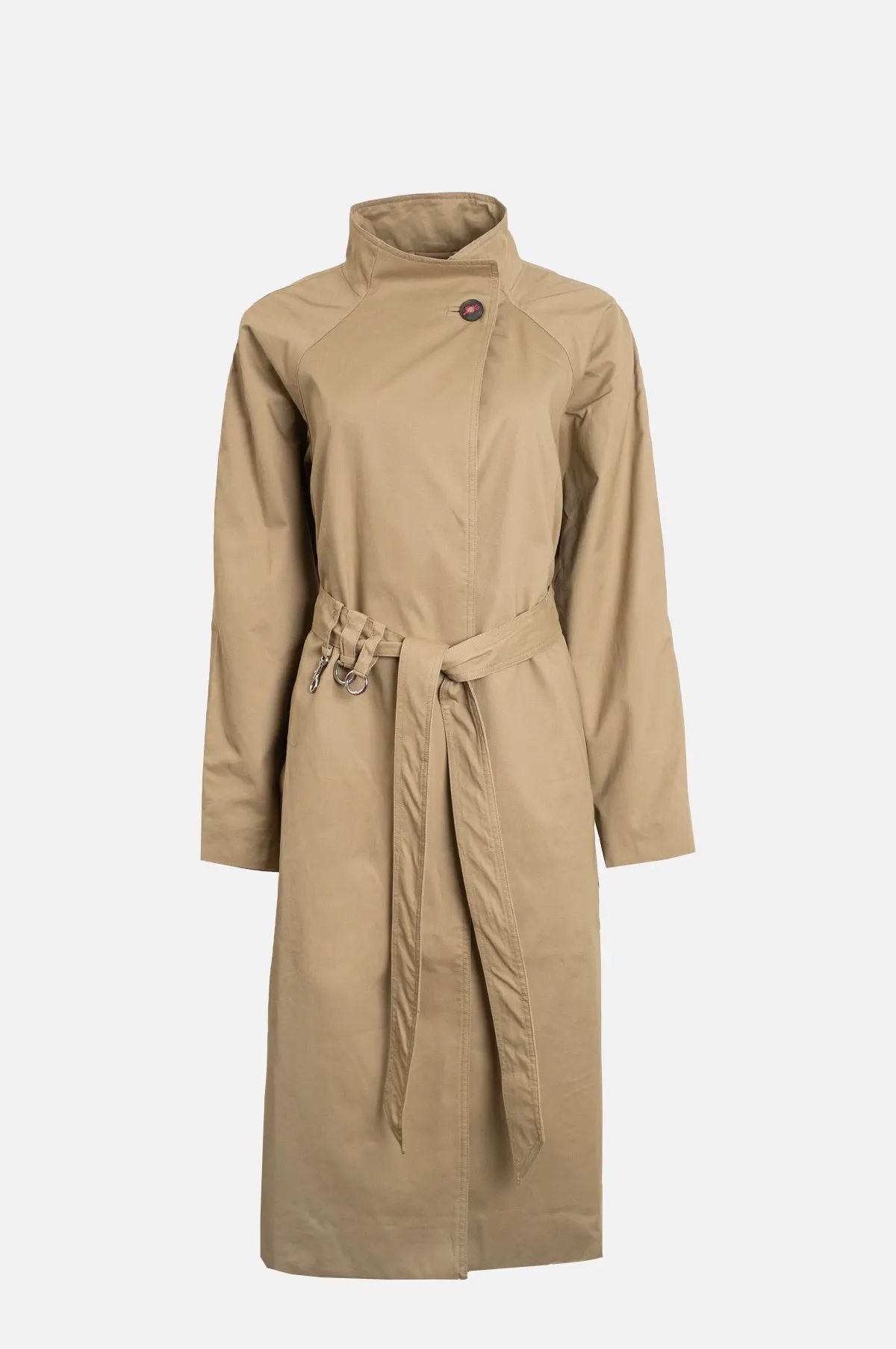

A barley check trench coat from Damson Madder with an organic cotton shell, a checked lining, a funnel neck with a button closure, an internal pocket and a detachable belt carried on lobster clips, listed at 145 GBP, the most expensive garment from this house in this run, with five of six sizes in stock and the 6 sold out. It publishes pit to pit, sleeve and length for all six sizes, and the length column is the finding: 115 cm on every one of the six, with no grading at all. On a mid length coat the total length is the measurement that decides where the hem falls and therefore what the coat is, and publishing one figure for six sizes means the garment is a different proportion in every size it is sold in. The chest column has a related problem running the other way, because it grades one centimetre flat per size and gives away about six inches of ease between the smallest size and the largest. The reference is the Jasmine Trench in Barley Check. Dongguan Bafinasa Garments Co., Ltd. develops comparable outerwear on OEM and ODM terms, from cloth and lining selection and hardware specification to retail or FBA ready packing. We publish this as a development reference and build your own version of it, and we do not supply the branded original or reproduce anyone else's label.
Key Features
- Three columns published for all six sizes, with the total length given as 115 cm on every one of them. See the note below
- Chest ease that runs from 8.4 inches at a UK 6 to 2.3 at a UK 16, which is the difference between a coat that fits over knitwear and one that does not. See the note below
- Organic cotton shell with a 100% recycled polyester check lining as stated, with no standard named for either claim. See the note below
- Funnel neck with a button closure, check lining, internal pocket and detachable belt on lobster clips as stated. See the note below
- Oversized silhouette and mid length as stated, with no shoulder width, no hem and no hip published. See the note below
- Care given as wash less and always inside out at 30 degrees, with no drying instruction and no shrinkage figure. See the note below
- 145 GBP as listed, five of six sizes in stock with the UK 6 sold out
Customisable Options
- Cloth: organic cotton shell to the reference, with the weight in grams per square metre set to your market since none is given, and a water resistant or shower proof finish quoted as an option
- Lining: checked recycled polyester to the reference, with GRS or RCS certification and a transaction certificate quoted as an option, or a cotton or cupro lining
- Length: mid at 115 cm to the reference, graded per size, with short, knee and long options
- Fit: oversized to the reference, with the ease held constant across the size set, or brought in for a slimmer trench
- Neck: funnel neck with button closure to the reference, or a classic trench collar and lapel, or a hood
- Belt: detachable belt on lobster clips to the reference, or a fixed belt with a buckle, or a plain self tie
- Cloth and lining weights, certification for both, hardware finish and pull testing, shoulder width, hem sweep, ease, body length, sleeve length, size set, colour development, private label and care labelling
Specifications
| Style | Mid length trench coat in organic cotton with a check lining and a detachable belt |
| Reference | Damson Madder, Jasmine Trench, style AW26-DM-4164, barley check, UK size 6 to 16 |
| Composition | Shell 100% organic cotton, lining 100% recycled polyester, as stated, with no certifying body named for either. See the note below |
| Cloth | Organic cotton shell in a barley check as stated, with no weight and no finish given. See the note below |
| Fit | Oversized silhouette, mid length, as stated. See the note below |
| Neck | Funnel neck with a button closure as stated |
| Lining | Check lining as stated. The listing under which it is filed reads reversible while the copy describes a lining, which are two different garments. See the note below |
| Internal pocket as stated | |
| Belt | Detachable belt with lobster clips for attachments as stated. See the note below |
| Care | Wash less, and always inside out at 30 degrees, as stated, with no drying instruction and no shrinkage figure. See the note below |
| Sizes Offered | UK 6 to 16, six sizes, five in stock with the UK 6 sold out |
| Measurements Published | Pit to pit, sleeve length and total length for all six sizes. See the note below |
| Published Chest | Pit to pit 50, 51, 52, 53, 54 and 55 cm flat, or 19.7 through 21.7 in. See the note below |
| Chest Around | 100, 102, 104, 106, 108 and 110 cm, or 39.4, 40.2, 40.9, 41.7, 42.5 and 43.3 in. See the note below |
| Ease Against Body Bust | About 8.4, 7.2, 5.9, 4.7, 3.5 and 2.3 in from smallest to largest. See the note below |
| Published Sleeve | 60, 61, 62, 63, 64 and 65 cm, grading one centimetre per size, origin not stated |
| Published Length | 115 cm on every one of the six sizes, with no grading at all. See the note below |
| Published Shoulder | None, on a coat described as oversized. See the note below |
| Published Hem Or Hip | None. See the note below |
| Model | None stated, no height and no body measurements |
| Photographs | Four |
| Cloth Weight | Not stated, for either the shell or the lining |
| Shrinkage | Not stated, on a cotton shell that is instructed to be washed. See the note below |
| Production | Made in China as stated |
| Reference Retail | 145 GBP as listed, the most expensive reference from this house in this run, quoted to show the price band this sits in, not as our price |
| Category | Filed by the reference under coats and jackets |
| Occasion | Autumn and winter, everyday, work, travel, over knitwear |
| MOQ | 100 pcs per style per colourway, mixed sizes and colourways accepted |
| Sampling | 7-10 days after tech pack or reference sample confirmation |
| Bulk Lead Time | 20-30 days after sample approval and deposit |
| Service | OEM / ODM / private label, shell and lining sourcing, certification, hardware specification and pull testing, bagged out lining construction, retail or FBA ready packing |
Size Chart as Published by the Reference
| Size | Pit to Pit (flat) | Sleeve Length | Total Length |
|---|---|---|---|
| UK 6 | 50 cm | 60 cm | 115 cm |
| UK 8 | 51 cm | 61 cm | 115 cm |
| UK 10 | 52 cm | 62 cm | 115 cm |
| UK 12 | 53 cm | 63 cm | 115 cm |
| UK 14 | 54 cm | 64 cm | 115 cm |
| UK 16 | 55 cm | 65 cm | 115 cm |
The chest figures are flat half measures taken with the coat laid down, doubling to 100, 102, 104, 106, 108 and 110 cm around, or 39.4 through 43.3 in. Against a body bust that runs 31, 33, 35, 37, 39 and 41 in, the ease is about eight and a half inches at a UK 6 and about two and a third at a UK 16, a loss of roughly six inches across the range, because a flat grade of one centimetre per size is two centimetres of circumference, or 0.79 in, against a body chart that moves two inches. The sleeve grades one centimetre per size with no origin stated, and the total length is published as 115 cm on all six sizes without grading.
Our Proposed Body Chart
| Size | Body Bust | Sleeve | Body Waist | Body Hips | Length | Source |
|---|---|---|---|---|---|---|
| UK 8 | 33 in / 84 cm | 61 cm | 26 in / 66 cm | 36 in / 91 cm | 115 cm / 45.3 in | Our proposal |
| UK 10 | 35 in / 89 cm | 62 cm | 28 in / 71 cm | 38 in / 97 cm | 117 cm / 46.1 in | Our proposal |
| UK 12 | 37 in / 94 cm | 63 cm | 30 in / 76 cm | 40 in / 102 cm | 119 cm / 46.9 in | Our proposal |
| UK 14 | 39 in / 99 cm | 64 cm | 32 in / 81 cm | 42 in / 107 cm | 121 cm / 47.6 in | Our proposal |
| UK 16 | 41 in / 104 cm | 65 cm | 34 in / 86 cm | 44 in / 112 cm | 123 cm / 48.4 in | Our proposal |
Occasions and Styling
Suits autumn and winter, everyday wear, work and travel. A checked trench at mid length is the coat that goes over everything else in the wardrobe, from a shirt to a chunky jumper, and the funnel neck is what lets it stand in for a scarf on the days that do not quite need one.
Production and Quality Control
The reference publishes three columns for all six sizes, states the composition of both the shell and the lining, describes the neck, the lining, the pocket and the belt, gives a care instruction and names the country of make. Three things follow: what a length that does not grade costs on a coat, why six inches of lost ease matters more on outerwear than anywhere else, and what a lined coat with hardware and two fibre claims needs specified.
One hundred and fifteen centimetres, six times, and that is the first thing. This run has met ungraded columns before, a sleeve of 64 repeated across six sizes and a sleeve of 62 repeated the same way, and it said each time that a column with no variation carries no information. This is the same fault in a more serious place, because on a coat the total length is the measurement that decides what the garment is. One hundred and fifteen centimetres from the shoulder of a woman of five foot ten ends below the knee, and the same 115 cm from the shoulder of a woman of five foot four ends at mid calf, which is a different coat with a different name: the first is a mid length trench and the second is a long one. Height is not the only variable either, because a coat is worn over other clothes, and the hem sits differently over a flat shoe and a heel, over trousers and over a dress. So the column is not merely uninformative, it is misleading, because it implies a consistency the garment does not have. The fix is not expensive. Coats are normally graded one to one and a half centimetres of length per size, which on this garment would take the range from about 115 at a UK 6 to about 120 at a UK 16, and that is a decision a pattern maker makes in minutes. There is a second problem in the same column, and it is the one this run has had to raise on nearly every garment with a length figure: the origin is not stated. One hundred and fifteen centimetres measured from the neck seam, from the shoulder seam and from the top of the collar are three different coats, and on a funnel neck, which stands up by five to eight centimetres above the shoulder line, the difference between a neck point and a shoulder point is not a rounding error, it is the difference between mid length and long. And there is no model height published, so even if the origin were given there is no body to place it on, which leaves the single most important measurement on the single most expensive garment in this batch as a number nobody can interpret.
Oversized at one end and fitted at the other, and that is the second thing. The chest doubles to 100 cm at a UK 6 and 110 at a UK 16, against a body bust of 31 and 41 inches, so the ease runs about 8.4, 7.2, 5.9, 4.7, 3.5 and 2.3 in. The loss of about six inches across six sizes is the largest drift this run has measured, and it comes from a flat grade of one centimetre per size, which is two centimetres of circumference, or 0.79 in, against a body chart moving two inches: 1.2 in of ease given away at every step. The reason it matters more here than on a blouse or a trouser is that outerwear is the one category where ease is the product. A coat is bought to go over other clothes, and the measure of whether it works is whether it fits over the thickest thing you intend to wear under it. Eight and a half inches over a 31 inch bust will take a chunky jumper comfortably. Two and a third inches over a 41 inch bust will take a shirt and not much else, and the sleeves of that coat will feel tight over anything with a sleeve in it. So the word oversized, which the page uses, describes the smallest sizes and stops being true by the largest, and the customer who reads oversized and orders a UK 16 receives a coat that behaves like a fitted one. It is worth adding that even the good end is not especially generous for outerwear: the hooded top published earlier in this run carried fifteen inches of ease, so eight and a half on a coat is modest rather than oversized, and a coat built to the oversized look this description implies would usually carry twelve or more. The remedy is the same as on the blouse and it is the routine we apply to every size set: decide the ease, grade from the body chart in inches rather than in round centimetres, hold the ease constant, and write the column out to check it before the grade is fixed. For a coat that means a flat chest grade of about 2.5 cm per size to hold the ease level, and about 4 cm per size if the oversized proportion is meant to be kept, and those are two different patterns and two different garments, which is exactly why the decision belongs in a tech pack and not in a grading rule. The sleeve, incidentally, grades one centimetre per size, or 0.4 in, which is less than half of what an arm grows across this range, so the sleeves get shorter relative to the body as the size goes up, and that compounds rather than cancels the problem in the chest.
Two fibre claims, a belt on clips, and the question of what this coat is, and that is the third thing. The shell is stated as organic cotton and the lining as 100% recycled polyester, and no certifying body and no standard is named for either, which is two claims where there could be two certificates. Organic cotton wants the Global Organic Textile Standard or the Organic Content Standard, recycled polyester wants the Global Recycled Standard or the Recycled Claim Standard, and each of them comes with a transaction certificate that ties the claim to the actual shipment. This run has met unverified fibre claims four times now, on a regenerative cotton, on a virgin wool, on an organic cotton in two places on one page, and here twice in one garment, and the recommendation does not change: name the standard and hold the certificate, because a claim you can produce paperwork for is worth more than one you cannot, and it is the first question a large retailer asks. Then there is the belt, which is the detail that makes the coat and the detail that fails. A detachable belt on lobster clips means four things have to be specified: the clip itself, which has to be rated for the load and pull tested, since a clip that opens under the weight of the belt hanging from it is the most common hardware failure on a coat of this kind; the finish, which has to be tested for rub and for nickel release if it sits against the skin or against the cloth; the attachment point, since a clip needs a loop or a D to clip into, and on an oversized coat the placement of that loop decides where the belt sits; and the belt itself, which on a checked cloth is cut either on the straight or on the bias and is a visible decision. The internal pocket is worth a line too, because it is the sort of detail that reads as one word and costs an operation: a pocket in a lined coat has to be set through the lining, usually as a welt or as a patch on the facing, and the lining has to be closed around it, which is why an internal pocket is dearer than an external one and why it is worth specifying which it is. Then there is the care instruction, which reads wash less and always inside out at 30 degrees. The first half of that is a sustainability message rather than a specification, and the second half is a washing instruction with no drying instruction and no shrinkage figure attached, which on a lined cotton coat is a real gap: a structured coat carries fused interlining in the front, the collar and the facings, and a fused panel washed at 30 and dried hard will bubble, and the page does not say dry clean and does not say do not dry clean either, so the customer has nothing to go on. And one question belongs at the top of any development of this garment. The listing under which it is filed reads reversible, while the copy describes a check lining and an internal pocket, and those are not the same coat: a reversible garment has two finished faces and no lining, and a lined garment has one face and a lining, and the difference changes the construction, the sewing and the cost substantially. We would build this as described, a lined coat with a checked lining, unless you tell us the reversibility is intended, in which case the internal pocket has to move or be constructed differently, because a pocket in a reversible garment is visible from both sides. Every bulk shipment gets a measurement report against your approved chart.
Optional upgrades include grading the total length across the size set, about one to one and a half centimetres per size, and stating the point the length is measured from, setting the chest grade so the ease holds across the range rather than losing six inches, grading the sleeve in line with the body rather than at 0.4 in per size, publishing the shoulder width, which is what makes an oversized coat oversized, publishing the hem sweep so the cloth consumption can be costed, naming the standard behind the organic cotton and behind the recycled polyester and holding both transaction certificates, adding a drying instruction and a shrinkage figure to the care label, pull testing and finishing the lobster clips to a stated standard and testing for nickel release, confirming whether the garment is lined or reversible before development starts, adding a model height so 115 cm can be placed on a body, a shower resistant finish, a classic collar and lapel option, a fixed belt option, short, knee and long lengths, size set, colour development, private label, hangtag and care labelling.
Pre-production sample approval, in-line inspection during cutting and sewing, and a final AQL inspection before packing, with measurement reports and photos shared before shipment.
Send us your tech pack, a photo or a reference garment and we will quote within 24 hours. Contact bafinasa@bafinasa.com or WhatsApp +86 13827222469.