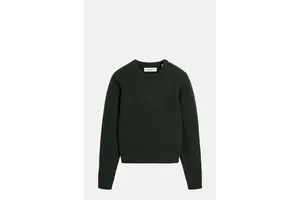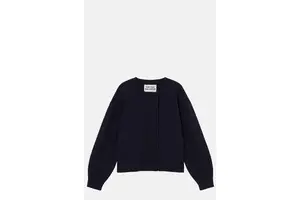
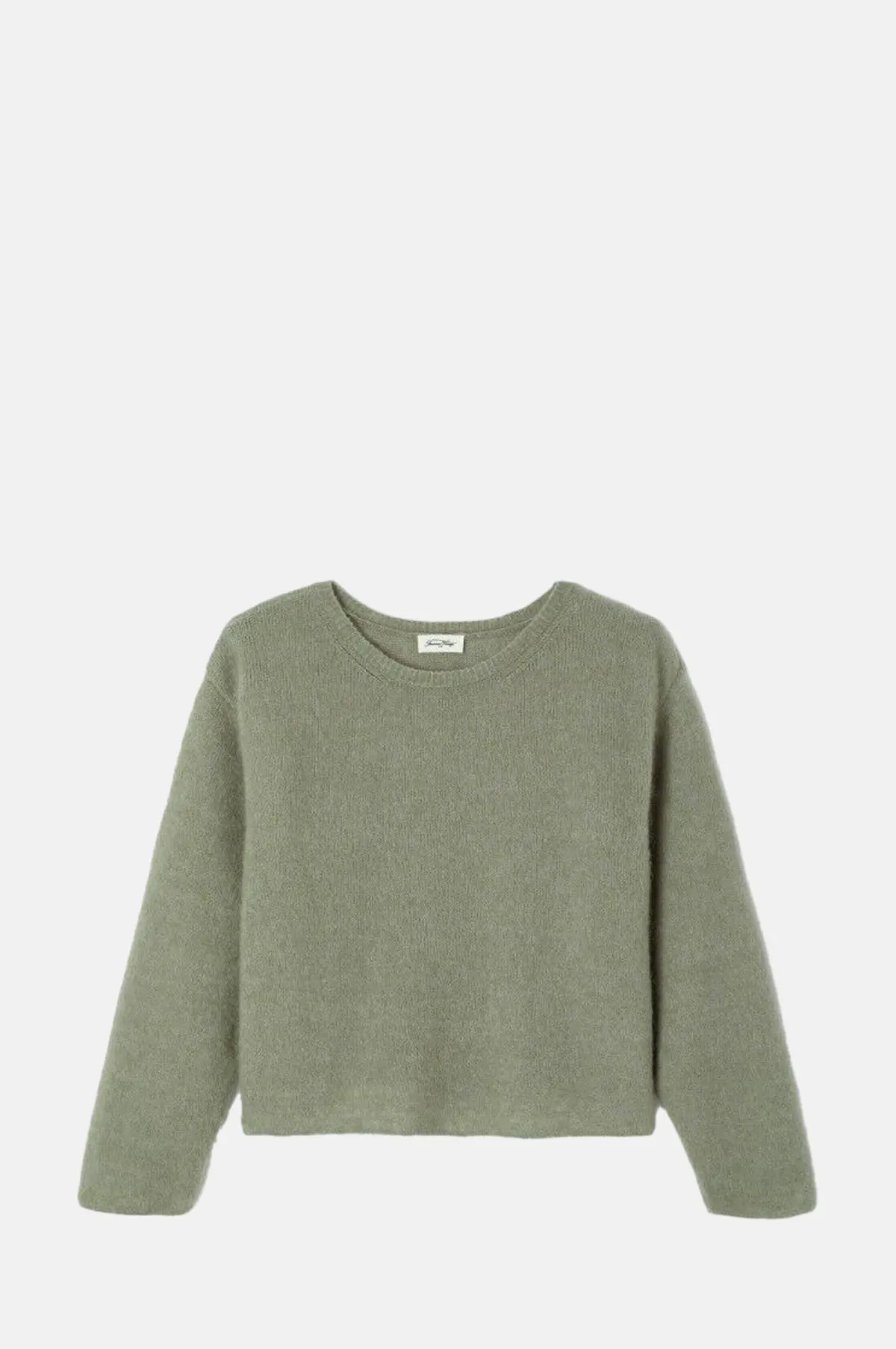

A soft green khaki jumper from American Vintage in a super soft alpaca and wool blend, with a boat neck, dropped shoulders, long sleeves with turn-up cuffs and ribbed edging, listed at 150 GBP with one of three sizes in stock and only the M available. It shares a style code with the black version of the same garment, which is the first thing worth saying, because a code that does not distinguish its colourways is a code that cannot be used to reorder one. The second is the yarn: multichine means a yarn spun from fibres of several shades, and on a blend that already contains alpaca, wool, polyamide and elastane, a multi shade yarn is the hardest kind to match, to control and to repeat. The third is the stock: a three size range reduced to its middle size, which is the second time in two batches this run has watched a three size range lose its middle. The reference is the Vitow Knit in Kaki Multichine. Dongguan Bafinasa Garments Co., Ltd. develops comparable knitwear on OEM and ODM terms, from yarn and gauge selection to retail or FBA ready packing. We publish this as a development reference and build your own version of it, and we do not supply the branded original or reproduce anyone else's label.
Key Features
- The same style code as the black version of this garment, with no colour suffix, so a reorder cannot specify the colour. See the note below
- One of three sizes in stock, the M only, the second three size range in this run to be reduced to its middle size. See the note below
- Multichine yarn as the colour name states, spun from several shades, which is the hardest kind to match and to repeat. See the note below
- Oversized with dropped shoulders as stated, and a chest of 124 cm around at the M, which supports the word. See the note below
- 34% alpaca, 34% wool, 29% polyamide and 3% elastane as stated, with no yarn count, no gauge and no pilling grade. See the note below
- Boat neck, turn-up cuffs and ribbed edging as stated, with no neck width and no sleeve origin given. See the note below
- Hand wash, iron on a low setting, do not tumble dry, as stated, and an identical description to the black version apart from the colour line
Customisable Options
- Yarn: an alpaca, wool, polyamide and elastane blend to the reference, in a multichine or in a plain shade, or a lambswool, merino, cotton or recycled alternative
- Gauge: to your market, with the machine gauge and the yarn count specified rather than described
- Colour: multichine shades developed to a lab dip with the fleck ratio specified and a retained physical standard held for repeats
- Shoulder: dropped to the reference, with the drop specified in centimetres, or a set-in shoulder
- Fit: oversized to the reference at about twelve inches of ease, or brought in for a closer jumper
- Neck: boat neck to the reference, with the width specified, or a crew, a V or a roll neck
- Yarn count and gauge, fibre blend, chin茅 shade matching and fleck ratio, shoulder drop and sleeve origin, ease, body length, sleeve length, size set, colour development, private label and care labelling
Specifications
| Style | Oversized boat neck jumper in a multichine alpaca and wool blend with dropped shoulders |
| Reference | American Vintage, Vitow Knit, style VITO18PH26, kaki multichine, a soft green, sizes S, M and L, with no colour suffix in the style code. See the note below |
| Composition | 34% alpaca, 34% wool, 29% polyamide and 3% elastane as stated. See the note below |
| Yarn | Described as super soft, in a multichine yarn as the colour name states, with no yarn count and no machine gauge given. See the note below |
| Fit | Oversized, loose cut, as stated, with the advice to buy your usual size |
| Neck | Boat neck as stated, with no neck width given |
| Shoulder | Dropped shoulders as stated, with the drop not specified. See the note below |
| Sleeves | Long sleeves as stated, measured at 50, 52 and 54 cm, with turn-up cuffs and no origin stated. See the note below |
| Edging | Ribbed edging as stated |
| Care | Hand wash, iron on a low setting, do not tumble dry, as stated |
| Sizes Offered | S, M and L, three sizes, one in stock, the M only. See the note below |
| Size Equivalence | None published, no UK, EU or US equivalent and no body measurements given |
| Measurements Published | Pit to pit, sleeve length and total length for all three sizes, identical to the black colourway. See the note below |
| Published Chest | Pit to pit 58, 62 and 66 cm flat, or 22.8, 24.4 and 26.0 in. See the note below |
| Chest Around | 116, 124 and 132 cm, or 45.7, 48.8 and 52.0 in. See the note below |
| Ease Against Body Bust | About 12.7, 11.8 and 11.0 in read as UK 8, 12 and 16, or about 12.7, 13.8 and 15.0 in read as UK 8, 10 and 12. See the note below |
| Published Sleeve | 50, 52 and 54 cm, grading two centimetres per size, with no origin stated |
| Published Length | 54, 56 and 58 cm, grading two centimetres per size |
| Published Shoulder Drop | None. See the note below |
| Published Neck Width | None. See the note below |
| Published Hem | None. See the note below |
| Model | None stated, no height and no body measurements |
| Photographs | Two |
| Yarn Count Or Gauge | Not stated, only the phrase super soft. See the note below |
| Fleck Ratio | Not stated, on a multichine yarn. See the note below |
| Production | Made in China as stated |
| Reference Retail | 150 GBP as listed, quoted to show the price band this sits in, not as our price |
| Category | Filed by the reference under knitwear |
| Occasion | Autumn and winter, everyday, weekend, work, travel, layering |
| MOQ | 100 pcs per style per colourway, mixed sizes and colourways accepted |
| Sampling | 7-10 days after tech pack or reference sample confirmation |
| Bulk Lead Time | 20-30 days after sample approval and deposit |
| Service | OEM / ODM / private label, yarn and gauge development, multichine shade matching, alpaca and wool sourcing, knitwear washing, pressing and pilling control, retail or FBA ready packing |
Size Chart as Published by the Reference
| Size | Pit to Pit (flat) | Sleeve Length | Total Length |
|---|---|---|---|
| S | 58 cm | 50 cm | 54 cm |
| M | 62 cm | 52 cm | 56 cm |
| L | 66 cm | 54 cm | 58 cm |
The chest figures are flat half measures taken with the jumper laid down, doubling to 116, 124 and 132 cm around, or 45.7, 48.8 and 52.0 in, and they are identical to the figures on the black colourway of the same garment. At the M, which is the only size in stock, the chest is 124 cm around, or 48.8 in, which is about eleven and four fifths inches of ease on a 37 in bust and about thirteen and four fifths on a 35 in one. The sleeve grades two centimetres per size with no origin stated and the length two centimetres from 54 to 58 cm.
Our Proposed Body Chart
| Size | Body Bust | Sleeve | Body Waist | Body Hips | Length | Source |
|---|---|---|---|---|---|---|
| M | 37 in / 94 cm | 52 cm | 30 in / 76 cm | 40 in / 102 cm | 56 cm / 22 in | Our proposal |
Occasions and Styling
Suits autumn and winter, everyday wear, weekends, work and travel. A soft khaki reads as a neutral in most wardrobes, which is what makes a colour like this easier to sell than it looks on a hanger, and it sits with denim, cream and navy without much thought.
Production and Quality Control
The reference publishes three columns for all three sizes, states a four part fibre blend with percentages, describes the fit, the neck, the shoulder, the sleeves, the cuffs and the edging, gives a care instruction with two useful additions and names the country of make. One of three sizes is in stock, the style code carries no colour suffix, and no equivalence, no yarn count, no gauge and no model are published. Three things follow: what a code without a colour suffix costs, what multichine means and why it is the hardest yarn to control, and what a three size range reduced to one size tells you.
One code, two colours, and how reorders actually go wrong, and that is the first thing. The black version of this jumper and this khaki one carry the same style code, VITO18PH26, with nothing in it to distinguish them. Compare that with the two other garments this run has examined from this same house in the last two batches. The Apoly tee carries APO02EH26GERANI, APO02EH26BLANC and APO02EH26AST, a base code with a colour suffix on each, and the Hoktown vest carries HOK16BH26SUNCHI, HOK16BH26BEUCHI and HOK16BH26MARROC, the same construction. So the house does know how to code a colourway, and on this style it has not done it. The consequence is concrete and it is worth spelling out, because it is exactly the kind of small clerical thing that costs a season. A reorder is placed against a style code. A buyer who wants forty more of the khaki and none of the black sends a code that identifies the style and not the colour, and what comes back depends on whoever reads the email. If it comes back wrong, the goods are not faulty and cannot be returned, and the cost lands on somebody. The fix is three characters at the end of a code, and it is worth adding that a colourway code should be stable: the same suffix for the same colour every season, agreed once and written down, which is the discipline this run has been recommending for fibre certificates and shade standards alike, holding the thing you approved rather than describing it again each time. There is a second thing in the same area and it is the one this run has now met three times in this house. The description on this listing is word for word the description on the black one, apart from the line naming the colour. The same is true of the Apoly tee in three colours and the Hoktown vest in three colours. So within one brand, on three different garments, colourways share a paragraph. That is efficient and it is standard practice, and it means that nothing colour specific is ever said: no opacity note on the white, no crocking note on the navy, no light fastness note on the orange, and on this one nothing about what a multichine yarn does in the wash or how it will match between batches. One sentence per colourway carries all of it, and it is the cheapest improvement available to any multi colour listing.
Multichine, and the yarn that is hardest to control, and that is the second thing. Multichine is a yarn effect and not a colour. The fibre is dyed in several shades before it is spun, or several differently coloured rovings are spun together, so that the finished yarn carries flecks of more than one tone and the cloth knitted from it has a broken, heathered surface rather than a flat one. It is popular on knitwear for the same reason it is popular on fleece: it hides regularity, it gives a synthetic blend a more natural look, and it makes a plain shade look considered. It is also, on a blend like this one, the most difficult yarn to specify, for four reasons, and each of them is a line in a tech pack. The first is the fleck ratio. A multichine is defined by the proportion of each shade in the yarn, and that proportion is a number the spinner works to, and if it is not specified then a repeat order can come back a different colour from the first, because the ratio drifted a little and nothing was there to hold it. The second is the standard. A flat shade can be approved against a reflectance reading, and a multichine cannot, because the reading averages the flecks and two yarns with the same average look different. So the standard has to be a retained physical sample, and the repeat has to be approved against it by eye under controlled light, which is the same conclusion this run reached on the fleece chin茅 two batches ago and which is worth repeating because it is the general rule for anything flecked. The third is matching. Every component next to this yarn has to be matched to a colour that is itself several colours, and on this garment that is the rib at the hem and the cuffs, which is a different construction with a different surface and will not take the flecks the same way, so a rib knitted from the same yarn reads as a different shade from the body. That is a known and unavoidable effect and it is dealt with by approving the rib and the body together rather than separately. The fourth is that the blend is already four fibres deep. Alpaca, wool, polyamide and elastane take dye differently, and dyeing them in several shades before spinning multiplies the number of variables, so a multichine on a blend is several times harder to land than a multichine on a single fibre. None of this is on the page, and none of it is expensive, and all of it is the difference between a colourway that repeats and one that does not. It is also worth noting what is not given that a mill would need to quote at all: no yarn count and no machine gauge, only the words super soft. On a woven this run asks for grams per square metre; on a knit the two numbers are count and gauge, and they decide the weight, the drape, the warmth and the price.
One of three sizes, and it is the middle one, and that is the third thing. This jumper is offered in S, M and L and only the M is available. Two batches ago this run watched a three size tee lose its M and noted that losing the middle of a three size range is not the same as losing an end, because the middle is the size most customers take and the size that holds a coarse range together. Here the range has been reduced to that middle size and nothing else, so the S and the L are both gone and the listing is offering a single size that happens to be the one most people want. On one reading that is the least damaging single size to have left, and on another it is worth a moment, because it tells you something about how the garment sold. If the S and the L sell out first, then the demand is at the ends of the range, and on a garment this oversized that is plausible and interesting: a very oversized garment is bought by people at the top of a size range who want the ease and by people at the bottom who want the slouch, and the middle is where it is least distinctive. But it is also possible that the S and the L were bought in smaller quantities in the first place, and the stock pattern says more about the buy than about the customers. There is a measurement point sitting underneath this, and it is the one that would settle it. The chest runs 116, 124 and 132 cm around, and at twelve or more inches of ease on any reading of S, M and L, all three sizes are oversized on almost anybody. So the garment does not discriminate by size in the way a fitted one does, and the reason a customer picks an S over an L is not whether it will fit but how long it will be and how wide the neck sits, which are the two measurements this page does not give in a usable form: the length is given but there is no model height to place it, and the sleeve is given from a shoulder seam that has been dropped and there is no drop figure to interpret it. So a customer choosing between three sizes that all fit is choosing on two figures, one of which is unplaceable and the other of which is ambiguous. That is the practical argument, once again, for a model height and for stating where a sleeve is measured from, and it is sharper on an oversized garment than on a fitted one, because on a fitted garment the chest does the work and on an oversized one nothing does. And there is the usual closing count, which applies to this garment as it does to the black one beside it: no equivalence for S, M and L, no yarn count or gauge, no pilling grade on an alpaca blend that will shed and pill, no fastness figure, no shoulder drop, no neck width, no model, and two photographs. Every bulk shipment gets a measurement report against your approved chart.
Optional upgrades include adding a colour suffix to the style code so a reorder can specify the shade, agreeing a stable suffix per colour and holding it across seasons, specifying the fleck ratio on the multichine and approving repeats against a retained physical sample under controlled light, approving the rib and the body together since a rib reads differently from the same yarn, stating the yarn count and the machine gauge, testing and publishing a pilling grade and a shedding note for the alpaca, stating the shoulder drop and giving the sleeve from the underarm or the neck, publishing the neck width on a boat neck, adding a model height so 54 to 58 cm can be placed on a body, publishing the body measurements each size is drafted for, a set-in shoulder option, a crew, V and roll neck option, lambswool, merino, cotton and recycled blend options, a plain shade alongside the multichine, size set, colour development, private label, hangtag and care labelling.
Pre-production sample approval, in-line inspection during cutting and sewing, and a final AQL inspection before packing, with measurement reports and photos shared before shipment.
Send us your tech pack, a photo or a reference garment and we will quote within 24 hours. Contact bafinasa@bafinasa.com or WhatsApp +86 13827222469.