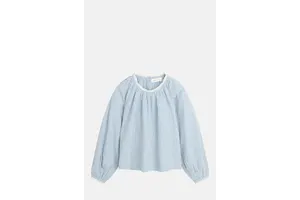
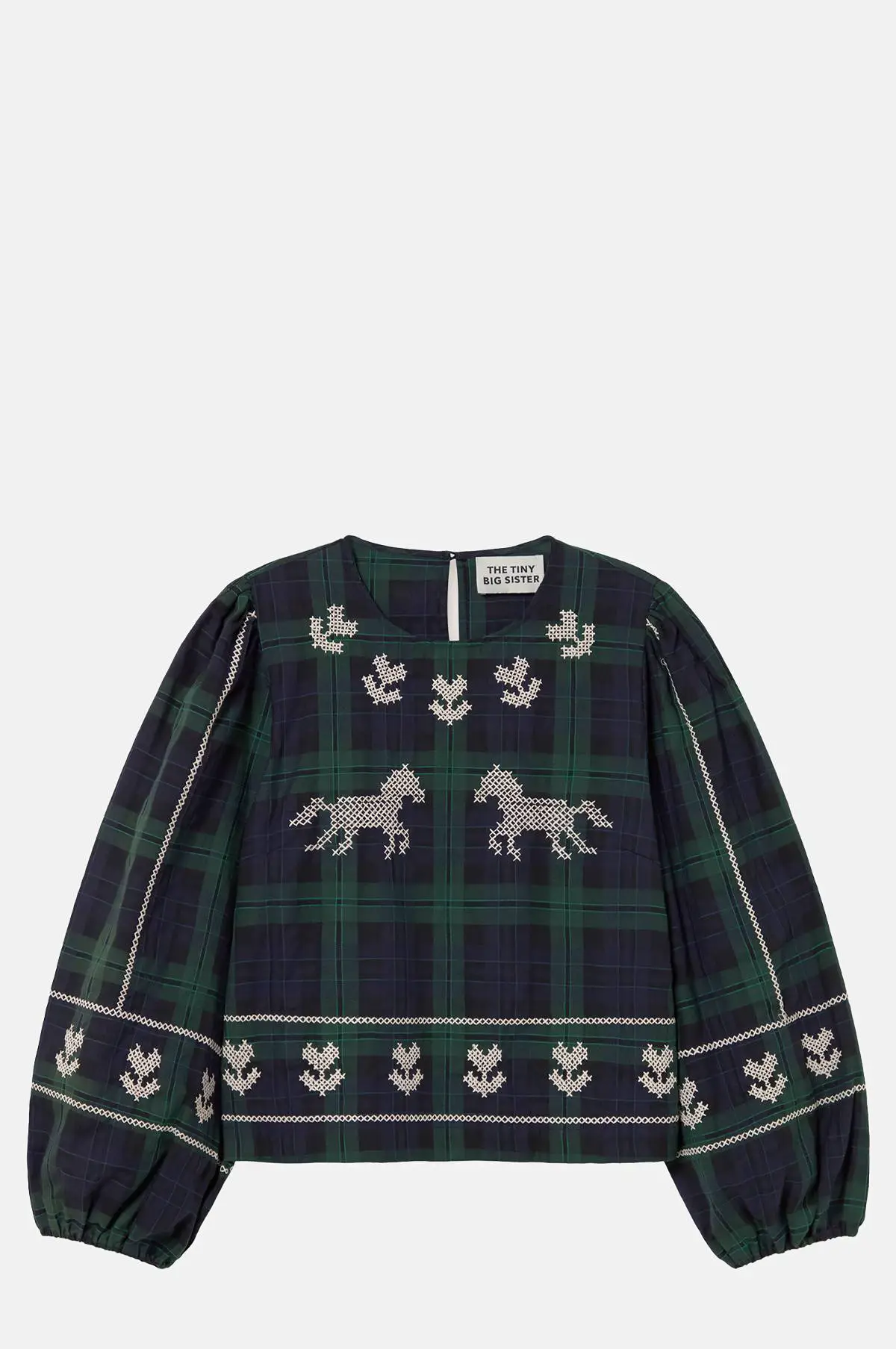

A lightweight cotton blouse from The Tiny Big Sister in a dark green and navy tartan, worked with cross-stitched prancing horses, floral motifs and decorative borders running across the body and the sleeves, with long puff sleeves gathered at the cuff, listed at 147 GBP with all five sizes in stock. It publishes a size conversion, every size is available, and the three columns are mostly tidy, so most of what this run usually complains about is not the issue here. What is interesting is the embroidery, and specifically what happens when you embroider onto a check. The motifs have to sit somewhere, and the check has a repeat, and those two things are fixed to different references: a motif is placed against the pattern piece, which grows with every size, and a check repeat is fixed to the cloth, which does not. So as the blouse gets bigger the motifs land in a different part of the check on every size, unless somebody has gone to the trouble of placing them against the repeat instead. There is no reason to think anybody has, and there is a second consequence of embroidering a check that is more practical still: the panels have to be embroidered before they are cut, and embroidered cloth shrinks differently from plain cloth. The reference is the Embroidered Check Puff Sleeves Blouse in Navy. Dongguan Bafinasa Garments Co., Ltd. develops comparable embroidered tops on OEM and ODM terms, from cloth selection and embroidery programming to retail or FBA ready packing. We publish this as a development reference and build your own version of it, and we do not supply the branded original or reproduce anyone else's label.
Key Features
- Cross-stitched motifs and borders running across the body and sleeves as stated, on a cloth that has its own repeat. See the note below
- Relaxed fit as stated, with the ease running from about four and two fifths inches down to about two and four fifths. See the note below
- Long puff sleeves gathered at the cuff as stated, with no cap height, no cuff width and no gather ratio given. See the note below
- Sleeve length of 55, 56, 58, 58 and 58 cm, so it stops grading at the third size. See the note below
- Total length grading a clean two centimetres per size from 46 to 54 cm
- A size conversion published, 34 is XS through 42 is XL, and all five sizes in stock
- Machine wash at 30 and do not tumble dry, with no instruction suited to embroidery. See the note below
Customisable Options
- Cloth: lightweight checked cotton to the reference, with the weight in grams per square metre and the check repeat in centimetres specified
- Embroidery: cross-stitch motifs and borders to the reference, placed against the check repeat or against the pattern piece, either quoted separately
- Embroidery build: a stitch count, a thread type, a stabiliser specified and a wash test carried out on the embroidered panel
- Sleeves: long puff sleeves to the reference, with the cap height, the cuff width and the gather ratio specified, or a plain gathered sleeve, or a bishop sleeve
- Fit: relaxed to the reference at four inches of ease, or a closer two inch version, or a fuller one
- Neck: round neck to the reference, with the opening given, or a V, a collar or a tie neck
- Cloth weight and check repeat, embroidery placement method, stitch count and thread, stabiliser and wash test, cap height and cuff and gather ratio, ease, body length, sleeve length, size set, colour development, private label and care labelling
Specifications
| Style | Relaxed blouse in checked cotton with cross-stitch embroidery and long puff sleeves |
| Reference | The Tiny Big Sister, Embroidered Check Puff Sleeves Blouse, style AW26-754, navy, sizes 34 to 42. See the note below |
| Composition | 100% cotton as stated, with no weight and no check repeat given. See the note below |
| Cloth | Lightweight cotton in a dark green and navy tartan check as stated, with no weight given. See the note below |
| Embroidery | Cross-stitched prancing horses, floral motifs and decorative borders across the body and sleeves, as stated, with no stitch count, no thread and no placement method given. See the note below |
| Fit | Relaxed fit as stated. See the note below |
| Neck | Round neck as stated, with no neck opening given. See the note below |
| Sleeves | Long puff sleeves as stated, softly gathered at the cuff, measured at 55 to 58 cm. See the note below |
| Care | Machine wash at 30 degrees, do not tumble dry, as stated. See the note below |
| Sizes Offered | 34 to 42, five sizes, all five in stock |
| Size Conversion | Published: 34 is XS, 36 is S, 38 is M, 40 is L and 42 is XL |
| Measurements Published | Pit to pit, sleeve length and total length for all five sizes. See the note below |
| Published Chest | Pit to pit 45, 47, 49, 51 and 53 cm flat, or 17.7 through 20.9 in. See the note below |
| Chest Around | 90, 94, 98, 102 and 106 cm, or 35.4, 37.0, 38.6, 40.2 and 41.7 in. See the note below |
| Ease Against Body Bust | About 4.4, 4.0, 3.6, 3.2 and 2.8 in from smallest to largest. See the note below |
| Published Sleeve | 55, 56, 58, 58 and 58 cm, grading one, two and then nothing. See the note below |
| Published Length | 46, 48, 50, 52 and 54 cm, grading two centimetres per size |
| Cuff Width | None, on a sleeve that is gathered into a cuff. See the note below |
| Gather Ratio | None. See the note below |
| Shoulder | None, on a puff sleeve where the cap height is most of the design. See the note below |
| Published Hem | None. See the note below |
| Embroidery Placement | Not stated, which on a checked cloth is the specification that matters. See the note below |
| Model | None stated, no height and no body measurements |
| Photographs | Six |
| Cloth Weight | Not stated, only the word lightweight. See the note below |
| Production | Made in China as stated |
| Reference Retail | 147 GBP as listed, the most expensive top in this house so far, quoted to show the price band this sits in, not as our price |
| Category | Filed by the reference under tops |
| Occasion | Autumn and winter, weekend, work, dressed up or down, layered under knitwear |
| MOQ | 100 pcs per style per colourway, mixed sizes and colourways accepted |
| Sampling | 7-10 days after tech pack or reference sample confirmation |
| Bulk Lead Time | 20-30 days after sample approval and deposit |
| Service | OEM / ODM / private label, checked cotton sourcing with the repeat specified, embroidery programming and sampling, wash testing on embroidered panels, retail or FBA ready packing |
Size Chart as Published by the Reference
| Size | Pit to Pit (flat) | Sleeve Length | Total Length |
|---|---|---|---|
| 34 / XS | 45 cm | 55 cm | 46 cm |
| 36 / S | 47 cm | 56 cm | 48 cm |
| 38 / M | 49 cm | 58 cm | 50 cm |
| 40 / L | 51 cm | 58 cm | 52 cm |
| 42 / XL | 53 cm | 58 cm | 54 cm |
The chest figures are flat half measures taken with the blouse laid down, doubling to 90, 94, 98, 102 and 106 cm around, or 35.4, 37.0, 38.6, 40.2 and 41.7 in. Against a body bust of 31, 33, 35, 37 and 39 in across XS to XL, the ease is about four and two fifths inches at the smallest and about two and four fifths at the largest, which supports the relaxed fit the page claims. The ease falls by about 0.43 in at every step because the flat grade of two centimetres is 1.57 in of circumference against a body grade of two inches. The sleeve grades one centimetre, then two, then nothing for the last three sizes, and the length grades a clean two centimetres throughout.
Our Proposed Body Chart
| Size | Body Bust | Sleeve | Body Waist | Body Hips | Length | Source |
|---|---|---|---|---|---|---|
| 34 / XS | 31 in / 79 cm | 55 cm | 24 in / 61 cm | 34 in / 86 cm | 46 cm / 18.1 in | Our proposal |
| 36 / S | 33 in / 84 cm | 56 cm | 26 in / 66 cm | 36 in / 91 cm | 48 cm / 18.9 in | Our proposal |
| 38 / M | 35 in / 89 cm | 57 cm | 28 in / 71 cm | 38 in / 97 cm | 50 cm / 19.7 in | Our proposal |
| 40 / L | 37 in / 94 cm | 58 cm | 30 in / 76 cm | 40 in / 102 cm | 52 cm / 20.5 in | Our proposal |
| 42 / XL | 39 in / 99 cm | 59 cm | 32 in / 81 cm | 42 in / 107 cm | 54 cm / 21.3 in | Our proposal |
Occasions and Styling
Suits autumn and winter, weekends and work, and it dresses up and down. A checked cotton blouse with embroidery on it is a piece that carries an outfit on its own, which is the argument for paying for the embroidery, and it layers under a knit or over a tee without bulk because the cloth is lightweight.
Production and Quality Control
The reference publishes three columns for all five sizes, states its fibre, describes the fit, the neck, the sleeves, the cloth and the embroidery in real detail, gives a care instruction, names the country of make, publishes a size conversion, has every size in stock and shows six photographs. It publishes no cloth weight, no check repeat, no stitch count and no cuff or shoulder measurement, and its sleeve column stops grading at the third size. Three things follow: what embroidering a check actually involves, what a puff sleeve needs specified, and the one number that is quietly missing from the whole house.
Embroidery on a check, and the two references it has to obey, and that is the first thing. The description is unusually good about what is on the cloth: cross-stitched prancing horses, floral motifs and decorative borders, running across the body and the sleeves. That is more detail than most pages in this run give about anything. But embroidery and check are both placements, and they are placed against different things. A motif is placed by the pattern: the embroidery file is set against the outline of the panel, so the horse sits so many centimetres from the armhole and so many from the side seam, and it stays there on every size because the panel and the placement grow together. A check repeat is placed by the cloth: it is woven at a fixed interval, say eight centimetres, and it does not care where the panel is cut from it. So the two are anchored to different references, and the consequence follows from that and cannot be avoided: as the panel gets wider through the size range, a motif held at a fixed distance from the armhole lands at a changing distance into the check repeat, so on the 34 the horse may sit in a plain square of the tartan and on the 42 it may sit across a stripe. That may be acceptable, and folk embroidery on tartan is forgiving, but it is a decision and not an accident, and there are only two ways to make it. You place against the pattern and accept that the motifs move relative to the check, which is what most production does and what has almost certainly happened here. Or you place against the check, which means a separate placement for every size so the motif always falls in the same part of the repeat, and a jig or a registration mark to hold it, and a cost for both. This run has met the general question before, on the welt pocket that had to be matched to a check and on the ruffle that broke one, and it is the same problem each time: two patterns on one garment, and only one of them can be matched. Here the second pattern is embroidery rather than a seam, which makes it harder rather than easier, because a seam can be moved by a few millimetres and a motif cannot. Then the practical consequences of embroidering at all, and there are three. The first is order of work: panels are embroidered before they are cut, not after, because a cut panel cannot be hooped reliably and because the hoop and the stitching distort the cloth slightly, so the pattern outline has to allow for it. That means placement marks on the panel, and a tolerance for the cutting. The second is differential shrinkage: cotton cloth and embroidery thread do not shrink at the same rate, and an area covered densely with stitches pulls in around them, so a heavily embroidered panel puckers after washing unless the cloth is pre shrunk, the stitch density is controlled and a backing is used behind the stitches and removed afterwards. The third is that the stitches stiffen the cloth, so a border that runs across the body changes how that band of the blouse drapes compared with the plain cloth above and below it, and on a lightweight cotton that difference is visible. None of this is on the page, and all of it belongs in a tech pack: a stitch count, a thread type, a backing specification and a wash test on the embroidered panel before bulk. It is worth adding what the care label says in the light of all that: machine wash at 30 degrees and do not tumble dry, which is a perfectly ordinary cotton instruction and which says nothing about the embroidery, and a garment whose defining feature is thread on cloth should be washed inside out to protect the stitches from abrasion. That is one clause and it is not here.
A puff sleeve, and the three numbers it has not got, and that is the second thing. A puff sleeve is made by cutting the sleeve head fuller than the armhole it goes into and gathering the difference, so the fullness is the difference between two numbers, and neither is published. The first missing number is the cap height, which is the height of the sleeve head above the armhole line, and it is what decides whether the sleeve stands up in a dome or lies flat as a gentle gather. The second is the gather ratio, which is how much cloth is being pulled into how much space, usually written as something like one and a half to one, and it is the number a factory actually needs in order to sew the sleeve in evenly rather than bunching it at one point. The third is the cuff width, which is what the sleeve is gathered into, and it decides whether the cuff sits on the forearm or grips it, and whether a hand goes through. With none of the three, a factory developing a version of this has to reverse engineer the sleeve from a photograph, and a customer has no way to know whether the cuff is comfortable. It is worth saying what this costs in practice, because the gather is the part that goes wrong. A sleeve gathered without a stated ratio is a sleeve whose fullness is decided by whoever is sewing it, and the same size will come out with different amounts of puff in different pieces, which is the sort of inconsistency customers notice as one sleeve being fuller than the other. The remedies are ordinary: mark the gather points on the pattern, state the ratio, and use two rows of gathering stitches rather than one so the fullness distributes. Then the sleeve column itself, which reads 55, 56, 58, 58 and 58, so it grades one, then two, then nothing at all for the three largest sizes. This run has now met a fair number of columns that do not grade, and it is worth saying what makes this one different: the girth column on this same table grades a clean two centimetres throughout and the length grades a clean two throughout, so whoever built this table graded two of its three columns properly and left the third flat at the top. An arm grows between a 38 and a 42 by more than nothing, and on a puff sleeve the sleeve is already shorter than the arm because the fullness takes up length, so the biggest sizes get the least sleeve on a garment that was short in the sleeve to begin with. And it is worth noting this is not an isolated case in this house, and the evidence is now three garments thick: the velvet trousers published two batches ago hold their inside leg at 80 for four of five sizes, the geese sweater published alongside this one holds its sleeve at 52 for all five, and this one holds its sleeve at 58 for the top three. The girth and the body length always grade; the limb does not. That is a house habit rather than a slip, and habits are fixable in a way that slips are not, because one person can change a template.
The ease, the weight, and the code, and that is the third thing. The chest gives about four and two fifths inches of ease at the 34 and about two and four fifths at the 42, so the blouse is genuinely relaxed at the small end and merely comfortable at the large end, and it is worth noting why it narrows: two centimetres of flat width per size is three and a fifth inches of circumference against a body grade of two inches, so about 0.43 in of ease is given up at every step, which is the same drift this run has measured on nearly every graded garment it has looked at. The word relaxed is doing a lot of work across a four inch range. It is worth setting that beside the bow blouse from the same house published alongside this one, which is also described as relaxed and which measures eight and two fifths inches of ease at the same size, so within one house, in one season, on two cotton blouses both called relaxed, the actual ease differs by four inches. That is the clearest demonstration yet in this run that a fit word on its own carries almost no information, and the remedy is the one this run keeps arriving at: print the ease, or print the body measurements the size was drafted for, and let the customer do the arithmetic. Then the cloth, which is described as lightweight and which is the nineteenth or twentieth unnumbered cloth description in this run, and there is a specific reason it matters on this garment. The blouse is embroidered densely enough to have borders running across the body, and a lightweight cloth carrying that much thread is the case where the cloth is most likely to be overwhelmed by the stitching: the stitches are heavier and stiffer than the ground cloth and they will pull it out of flat unless the weight is enough to resist them. So the weight is not a nicety here, it is the thing that decides whether the embroidery sits flat or puckers. No weight is given, and no backing is mentioned. Then the hem, which is not published on a relaxed blouse, and which is the number that decides whether it hangs away from the body or swings with it. And then the style code, which is worth flagging hard because it can be checked: this blouse is AW26-754, and the bow blouse from the same house published alongside it is also AW26-754. Two different garments, one code. That is worse than the codes without colour suffixes this run has criticised, because at least those identify a style; this pair does not distinguish one style from another. It is almost certainly a copy and paste, and it is the sort of thing that is invisible until the day someone orders fifty of one thing and receives the other. Every bulk shipment gets a measurement report against your approved chart.
Optional upgrades include deciding and stating whether the embroidery is placed against the pattern or against the check repeat, and quoting a per size placement if the latter, specifying the stitch count, the thread type and the backing, and wash testing an embroidered panel before bulk, stating the cloth weight so it can be judged against the weight of thread it has to carry, stating the check repeat in centimetres, specifying the cap height, the gather ratio and the cuff width on the puff sleeve, grading the sleeve through the top three sizes, publishing the hem width, publishing the ease or the body measurements each size is drafted for, adding a wash inside out instruction to protect the embroidery, reconciling the duplicated style code, a bishop and a plain gathered sleeve option, closer and fuller fit options, V neck, collar and tie neck options, size set, colour development, private label, hangtag and care labelling.
Pre-production sample approval, in-line inspection during cutting and sewing, and a final AQL inspection before packing, with measurement reports and photos shared before shipment.
Send us your tech pack, a photo or a reference garment and we will quote within 24 hours. Contact bafinasa@bafinasa.com or WhatsApp +86 13827222469.