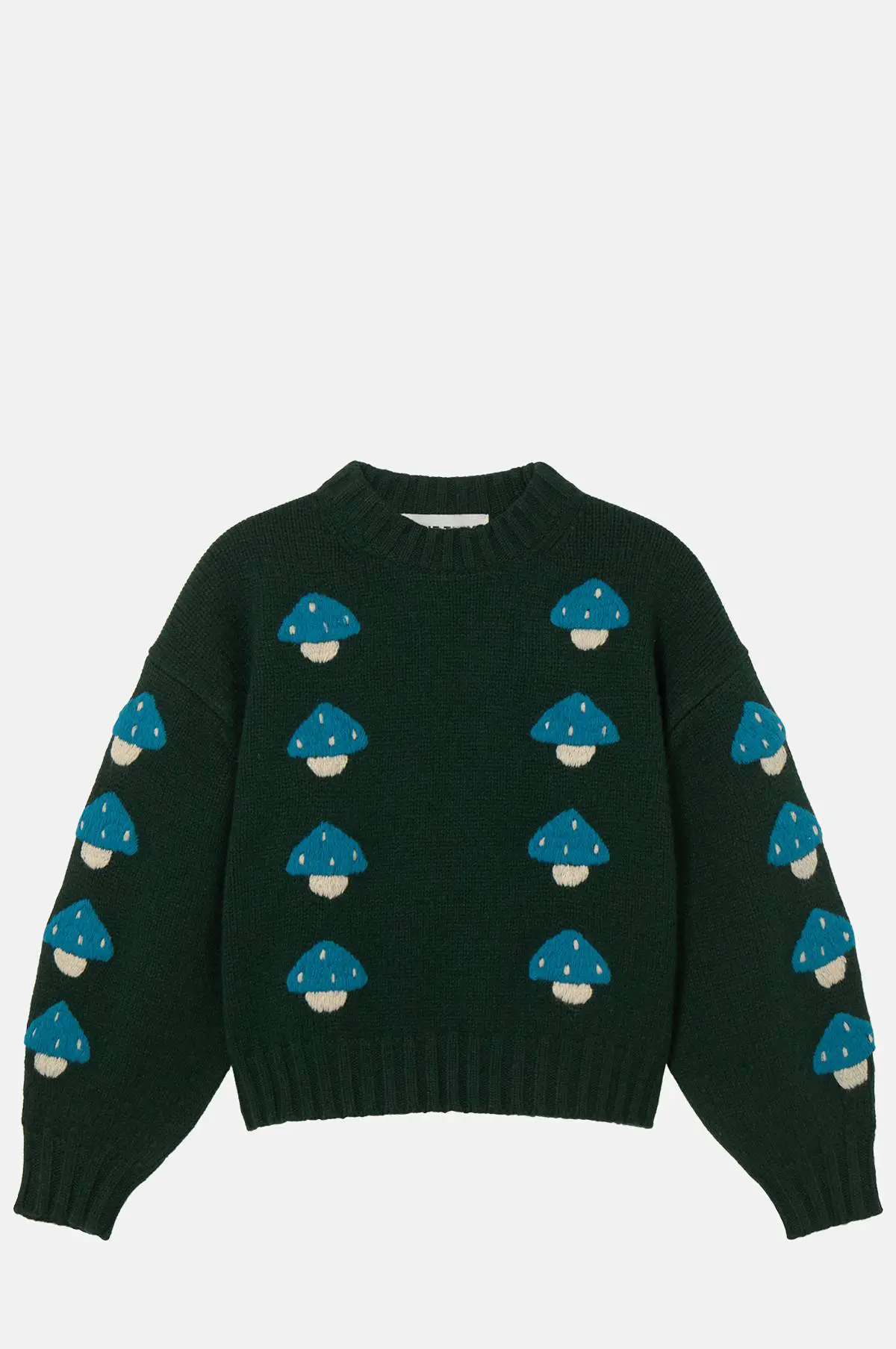

A thick merino jumper from The Tiny Big Sister, embroidered with blue capped mushrooms across the body and sleeves, with dropped shoulders, ribbed neck, cuffs and hem and a loose boxy cropped fit, listed at 210 GBP with three of four sizes in stock. The seller calls it Ink Blue and the description calls it dark green, and that is worth a paragraph rather than a footnote because it is the second time this has happened in this house in two batches: the geese sweater is also titled Ink Blue and also described in its own text as deep green. Two garments, same mismatch, same direction, which is the signature of a colour field copied between products and not of a typo. There is a second thing here that is more interesting than the colour and it is about the embroidery, because embroidering a knit is a different operation from embroidering a woven cloth, and this run examined the woven version two batches ago on the embroidered check blouse. A knit is extensible and embroidery is not, so every stitch is a small area where the garment stops stretching, and the looser and chunkier the knit the more visible that becomes. The reference is the Mushrooms Sweater in Ink Blue. Dongguan Bafinasa Garments Co., Ltd. develops comparable embroidered knitwear on OEM and ODM terms, from yarn and gauge selection to retail or FBA ready packing. We publish this as a development reference and build your own version of it, and we do not supply the branded original or reproduce anyone else's label.
Key Features
- Embroidered mushrooms across the body and sleeves as stated, which on a knit means every stitch is an area that no longer stretches. See the note below
- Titled ink blue and described in its own text as dark green, the second time this house has done that in two batches. See the note below
- Oversized and cropped as stated, with about ten and seven tenths inches of ease and a length of 50 cm, so the claim holds
- Four sizes rather than the five every other garment in this house offers, which on an oversized garment is defensible. See the note below
- Dropped shoulders as stated, which moves the point a sleeve would be measured from. See the note below
- Thick and insulating merino wool as described, with no micron count, no ply, no gauge and no thermal test. See the note below
- Hand wash only as stated, with no drying instruction, as on every wool in this house. See the note below
Customisable Options
- Yarn: thick merino to the reference, with the micron count, the ply, the yarn count and the gauge specified, or a lambswool or a merino blend, each quoted separately
- Embroidery: mushrooms on the body and sleeves to the reference, with the stitch count, the thread and the backing specified and the stretch tested, or placed on the body only, or a knitted motif instead
- Fit: oversized and cropped to the reference at about eleven inches of ease and 50 cm, or a longer body, or a closer fit
- Shoulders: dropped to the reference, with the drop specified, or a set-in sleeve
- Trims: ribbed neck, cuffs and hem to the reference, with the rib width and construction specified
- Care: hand wash to the reference, or a machine washable superwash merino quoted as an option
- Micron count, ply, yarn count and gauge, cloth weight, embroidery stitch count and thread, backing and stretch test, drop measurement, ease, body length, sleeve length, size set, colour development, private label and care labelling
Specifications
| Style | Oversized cropped merino jumper with embroidered mushrooms and dropped shoulders |
| Reference | The Tiny Big Sister, Mushrooms Sweater, style AW26-691, titled ink blue and described as dark green, sizes 34 to 40. See the note below |
| Composition | 100% merino wool as stated, with no micron count, no ply and no yarn count given. See the note below |
| Yarn | Thick and insulating merino wool as stated, with no gauge and no cloth weight given. See the note below |
| Embroidery | Embroidered with blue capped mushrooms on the body and sleeves, as stated, with no stitch count, no thread and no backing given. See the note below |
| Fit | Designed for a loose, boxy fit as stated, and listed as oversized and cropped. See the note below |
| Neck | High round neck as stated, with no neck opening given |
| Shoulders | Dropped shoulders as stated, with no drop measurement given. See the note below |
| Trims | Ribbed neck, cuffs and hem as stated, with no rib width and no rib construction given |
| Care | Hand wash only as stated, with no drying instruction. See the note below |
| Sizes Offered | 34 to 40, four sizes, three in stock with the 40 sold out. See the note below |
| Size Conversion | Published: 34 is XS, 36 is S, 38 is M and 40 is L |
| Measurements Published | Pit to pit, sleeve length and total length for all four sizes. See the note below |
| Published Chest | Pit to pit 53, 55, 57 and 59 cm flat, or 20.9 through 23.2 in. See the note below |
| Chest Around | 106, 110, 114 and 118 cm, or 41.7, 43.3, 44.9 and 46.5 in. See the note below |
| Ease Against Body Bust | About 10.7, 10.3, 9.9 and 9.5 in from smallest to largest. See the note below |
| Published Sleeve | 44, 46, 48 and 50 cm, grading two centimetres per size. See the note below |
| Published Length | 50, 52, 54 and 56 cm, grading two centimetres per size |
| Colour | Titled ink blue and described as dark green, as on the geese sweater from this house. See the note below |
| Published Hem | None. See the note below |
| Cloth Weight | Not stated |
| Gauge | Not stated. See the note below |
| Model | None stated, no height and no body measurements |
| Photographs | Six |
| Production | Made in China as stated |
| Reference Retail | 210 GBP as listed, the joint most expensive garment in this house alongside the embroidered vest, quoted to show the price band this sits in, not as our price |
| Category | Filed by the reference under knitwear |
| Occasion | Winter, casual weekends, evenings, outdoors, as the reference suggests |
| MOQ | 100 pcs per style per colourway, mixed sizes and colourways accepted |
| Sampling | 7-10 days after tech pack or reference sample confirmation |
| Bulk Lead Time | 20-30 days after sample approval and deposit |
| Service | OEM / ODM / private label, merino yarn sourcing with micron specified, gauge development, embroidery on knit with stretch testing, retail or FBA ready packing |
Size Chart as Published by the Reference
| Size | Pit to Pit (flat) | Sleeve Length | Total Length |
|---|---|---|---|
| 34 / XS | 53 cm | 44 cm | 50 cm |
| 36 / S | 55 cm | 46 cm | 52 cm |
| 38 / M | 57 cm | 48 cm | 54 cm |
| 40 / L | 59 cm | 50 cm | 56 cm |
The chest figures are flat half measures taken with the jumper laid down, doubling to 106, 110, 114 and 118 cm around, or 41.7, 43.3, 44.9 and 46.5 in. Against a body bust of 31, 33, 35 and 37 in across XS to L, the ease is about ten and seven tenths inches at the smallest and about nine and a half at the largest, which is genuinely oversized and which supports the description. The sleeve grades two centimetres per size from 44 to 50 cm, which makes this one of only two garments in this house whose sleeve moves through the whole range, and the length grades two centimetres from 50 to 56 cm.
Our Proposed Body Chart
| Size | Body Bust | Sleeve | Body Waist | Body Hips | Length | Source |
|---|---|---|---|---|---|---|
| 34 / XS | 31 in / 79 cm | 44 cm | 24 in / 61 cm | 34 in / 86 cm | 50 cm / 19.7 in | Our proposal |
| 36 / S | 33 in / 84 cm | 45 cm | 26 in / 66 cm | 36 in / 91 cm | 52 cm / 20.5 in | Our proposal |
| 38 / M | 35 in / 89 cm | 46 cm | 28 in / 71 cm | 38 in / 97 cm | 54 cm / 21.3 in | Our proposal |
| 40 / L | 37 in / 94 cm | 47 cm | 30 in / 76 cm | 40 in / 102 cm | 56 cm / 22 in | Our proposal |
Occasions and Styling
Suits winter, casual weekends and evenings. A thick oversized jumper with embroidery on it is an indoor piece for cold weather rather than a layer for going out, and the cropped length is what makes it work over a dress or a high waisted trouser rather than making it look like a sack.
Production and Quality Control
The reference publishes three columns for all four sizes, states its fibre, describes the yarn, the embroidery, the fit, the neck, the shoulders and the trims, gives a care instruction, names the country of make, publishes a size conversion and shows six photographs. Its title and its description disagree about the colour, as the geese sweater from the same house also does, and it gives no micron count, no gauge, no cloth weight, no stitch count and no drying instruction. Three things follow: what embroidery does to a knit, the colour mismatch as a house pattern, and the size range.
Embroidery on a knit, and the stretch it removes, and that is the first thing. This run examined embroidery on a woven cloth two batches ago, on the checked blouse, and the problems there were about registration against a check and about differential shrinkage in the wash. Embroidering a knit is a different set of problems, and they all come from one fact: a knitted cloth is extensible and an embroidered area is not. A plain knit stretches because its loops can change shape; a satin stitch or a chain of cross stitches holds its thread in place and the cloth underneath it can still move, so an embroidered area does not. Three consequences follow. The first is that the embroidered area becomes the stiffest and least giving part of the garment, and on a garment that is oversized and meant to envelop, the mushrooms will sit as fixed patches on a surface that otherwise moves, which is visible as the cloth pulling slightly around each motif. The second is that it changes how the garment goes on, because a jumper pulled over the head stretches at the shoulders and the upper arms, and the description says the mushrooms are on the body and the sleeves, which includes the sleeve, which is exactly the part that has to stretch as it goes over the arm. The third is that hooping a knit distorts it, because the frame grips the loops and pulls them, and when the hoop comes off the cloth relaxes back and the embroidery puckers, so a knit has to be hooped with a heavier backing than a woven and has to be allowed to recover before it is cut, and the backing has to be chosen so it supports the stitches in wear without making the area rigid. None of that is on this page, and all of it is a line in a specification: a stitch count, a thread type, a backing specification, and one test, which is to stretch the embroidered panel and see whether the stitches break or the cloth tears. There is a fourth point that belongs here and it is about the yarn, because the thicker and chunkier the knit the more pronounced all of the above is. A dense finely knitted jumper takes embroidery well; a thick chunky one has a coarse surface with visible loops, so the stitches sit on top of it rather than into it and any distortion shows. This is described as thick and insulating, at a low gauge, which is the harder case, and no gauge is given. There is one more thing worth saying about the embroidery and it is the homely version of it: the phrase homespun classic in the description is a claim about how the garment was made, and it sits beside a garment that is machine knitted in China and machine embroidered, and the words are doing the same job that relaxed does for the fit. It is worth being fair, because there is a real argument in it: hand embroidery on a knit is a different thing and it costs a great deal more, and at 210 pounds, which is 53 more than the plain geese sweater from the same house in the same yarn, a customer might reasonably expect to be told which she is buying. No stitch count, no thread and no method are given, so she cannot.
Ink blue, dark green, twice, and that is the second thing. The product is titled Mushrooms Sweater Ink Blue, and the first sentence of its own description reads this dark green jumper. The geese sweater from the same house, published two batches ago, is titled Ink Blue and its description reads a lovely deep green shade. Two garments, both titled ink blue, both described in their own prose as green, and both in the same season. That is not two typos, it is one template: the colour lives in a field that was filled in once and copied, and the prose was written by someone looking at the garment. It is worth setting out what this costs, because a colour field is more load bearing than most fields on a page. It drives search, so a customer filtering for green will never see these two and a customer filtering for blue will find garments that are not blue. It drives the photograph and the swatch on a listing, and if the two disagree with the prose the customer has no way to resolve it. And it drives returns, because a customer who buys blue and receives green is entitled to send it back, and the return reason will be recorded against the garment rather than against the data. There is a second mismatch in the same family on this page, smaller and worth naming, because it is the same sort of thing: no shade name is given anywhere for the mushrooms, which are described as blue capped, so the garment has at least two colours in it and only one of them appears in any structured field. This run has met colour problems before, on the wooden buttons that were described as real wood and on the ivory and navy trim whose shade was never named, and the pattern is always the same: the prose knows the colour and the data does not. The fix is one field and one rule, which is never to let the prose and the structured data disagree. And it is worth adding the third absence of the same kind, because it belongs with the first two and it is the one that matters most on this garment: no drying instruction. Hand wash only, full stop, on a thick chunky merino with ten inches of ease. A wet jumper like this is heavy, and a heavy wet knit hung on a line stretches under its own weight and does not come back, and the three words every wool label needs are dry flat. This run has now found that omission on the wool trouser, on the geese sweater, and now here, and it is the single most damaging thing missing from any wool page in this run.
Four sizes, on the one garment where that is right, and that is the third thing. Everything else in this house comes in five sizes, 34 to 42. This comes in four, 34 to 40, and the 40 is sold out, so three are actually available. It is worth saying plainly that this is defensible, and why, because this run has spent a lot of batches arguing for wider size ranges and it should be fair when a narrow one makes sense. Ease and size range are substitutes: the looser a garment is cut, the more bodies one size fits, because a garment with ten inches of ease at the chest will accommodate a body several inches larger than the one it was drafted for without changing shape. So an oversized garment genuinely needs fewer sizes than a fitted one, and a designer who has cut something this loose is not being lazy by offering four. The same logic has been behind several of the arguments in this run about how many sizes a page should publish and how far an extended range should go. But there are two things that follow and both are worth stating. The first is that the substitution only works if the customer can see the ease, and this page does not publish it, so a customer who is a 42 has no way of knowing that the 40 will fit her comfortably, and she will assume the garment does not come in her size. Publishing the ease, or the body measurements, would sell the fourth size to the woman who needs it. The second is that the top of the range is the size that has sold out, and this run has now noted that pattern so often that it is worth saying what is behind it: small brands buy sizes in a ratio that reflects what they expect to sell, and they consistently underestimate the larger sizes, so the top size sells out first on garment after garment. It is a buying decision rather than a specification one, and it is self correcting if anybody looks at the numbers. Then the sleeve, which is worth a line because it is the good news. It grades: 44, 46, 48 and 50, two centimetres per size, and the length grades two as well, so both length columns move. This is one of only two garments in this house whose sleeve is graded through the whole range, the other being the bow blouse, against four whose limb measurement does not move at all. So the house habit this run identified is real but it is not universal, and the two garments that escape it are both embroidered ones, which suggests the embroidery styles are specified with slightly more care than the plain ones. Finally the yarn, which is described as thick and insulating and which gives no micron count, no ply, no yarn count, no gauge and no cloth weight, so the one claim that would be easy to test and easy to publish, which is how warm it is, is left as an adjective. Every bulk shipment gets a measurement report against your approved chart.
Optional upgrades include reconciling the colour in the title with the colour in the description, which affects two garments in this house, naming the shade of the mushroom caps, adding dry flat, reshaped, away from direct heat to the care label, specifying the merino by micron count, ply, yarn count and gauge and stating the cloth weight, specifying the embroidery by stitch count, thread and backing and stretch testing an embroidered panel before bulk, stating whether the embroidery is by hand or by machine and quoting both, publishing the ease so the 40 can be sold to the customer who needs it, offering a fifth size or extending the range, stating the shoulder drop and the point the sleeve is measured from, publishing the hem width and a model height, a longer body and a closer fit option, a knitted motif instead of an embroidered one, body only embroidery placement, a machine washable superwash option, size set, colour development, private label, hangtag and care labelling.
Pre-production sample approval, in-line inspection during cutting and sewing, and a final AQL inspection before packing, with measurement reports and photos shared before shipment.
Send us your tech pack, a photo or a reference garment and we will quote within 24 hours. Contact bafinasa@bafinasa.com or WhatsApp +86 13827222469.