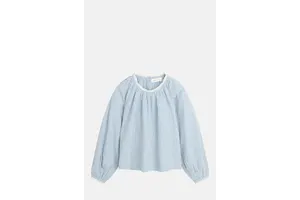
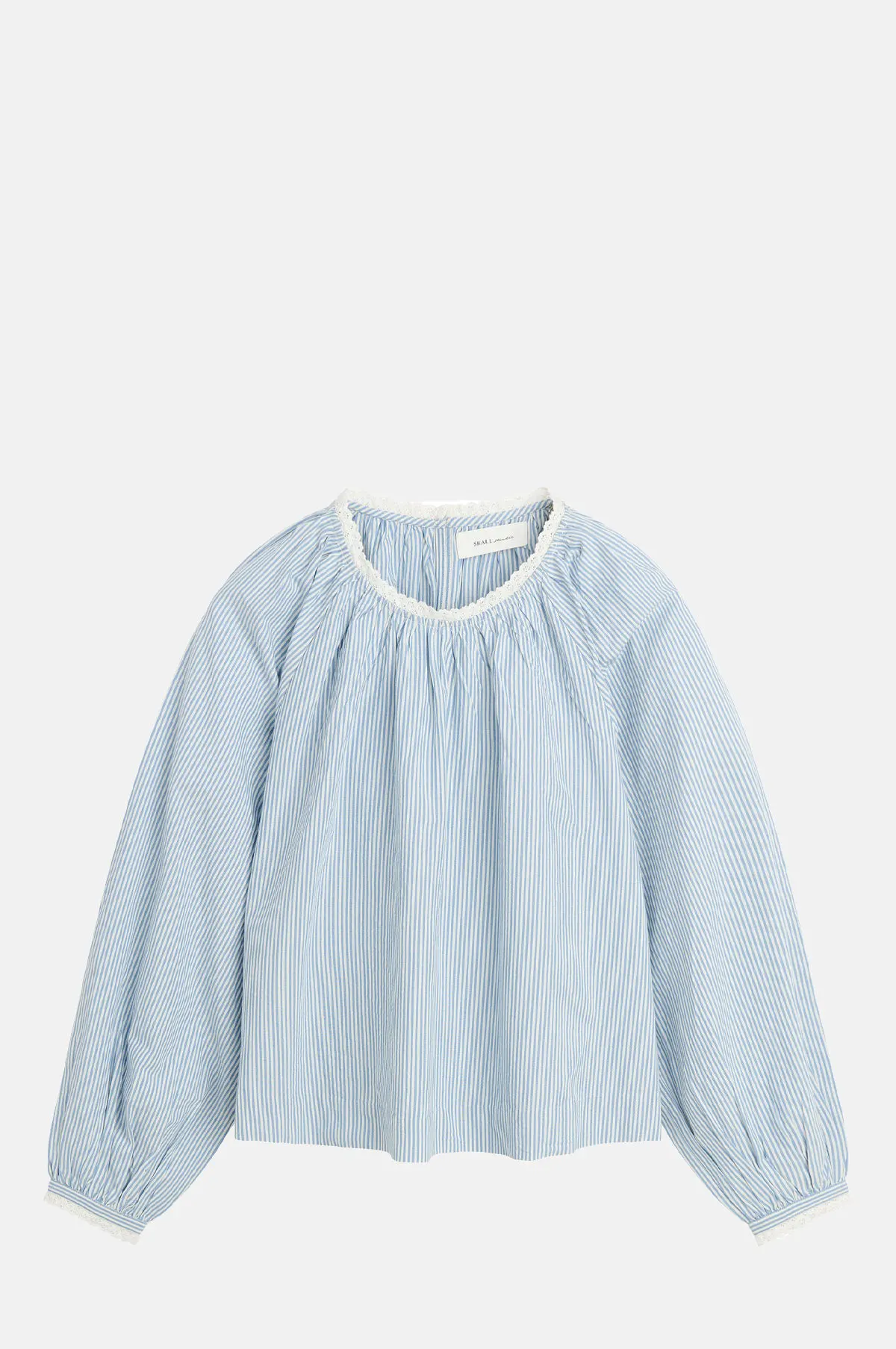

A blouse from Skall Studio in a heavy organic cotton printed with a thin blue and white stripe, with long ballooning raglan sleeves, a gathered round neck trimmed with a lace frill that is echoed at the cuffs, and a button-and-loop fastening at the back of the neck, listed at 165 GBP with two of the four sizes left. Its chart is worth a close look because the two length columns behave in opposite ways and only one of them is what it appears to be. The sleeve reads 60, 61, 62 and 64 centimetres, which looks like a grade of one, one and then a jump of two at the top, and it is not: those four figures are exactly what a uniform grade of about 1.2 centimetres produces once it is rounded, so the sleeve is evenly graded and the chart hides it. The total length reads 55, 55, 57 and 57, which looks like the same kind of thing and is not either, and this run can show that no uniform grade rounds to it, so the length genuinely steps in pairs and the two smaller sizes share a length and the two larger share another. It is worth saying what the blouse has in common with the two garments published alongside it, which is that all three claim organic cotton and all three carry the GOTS word, and this run has been waiting several batches to see a certification named. The reference is the Karlie Blouse in Light Blue and White Stripe. Dongguan Bafinasa Garments Co., Ltd. develops comparable blouses on OEM and ODM terms, from cloth and print development to retail or FBA ready packing. We publish this as a development reference and build your own version of it, and we do not supply the branded original or reproduce anyone else's label.
Key Features
- Sleeve 60, 61, 62 and 64 cm, which is exactly a uniform 1.2 cm grade rounded, so the apparent jump at the top is an artifact. See the note below
- Total length 55, 55, 57 and 57 cm, which no uniform grade rounds to, so the length genuinely steps in pairs. See the note below
- Raglan sleeve as stated, which is the construction where the sleeve measurement has no shoulder seam to start from. See the note below
- Balloon sleeves as stated, with no gather ratio given, on a heavy cloth. See the note below
- Lace frill at the neck and cuffs as stated, with no fibre given and no line in the composition panel. See the note below
- Button-and-loop closure at the back of the neck as stated, which is the only opening, with no neck opening measurement. See the note below
- Thin blue and white stripe as stated, with no stripe width and no repeat, as on the only other striped garment in this run. See the note below
Customisable Options
- Cloth: heavy organic cotton to the reference, with the weight stated, or a lighter cotton, a cotton lawn or a cotton linen, each quoted separately
- Stripe: thin blue and white to the reference, with the width of each colour and the repeat published in centimetres, or a wider stripe, or a woven yarn-dyed stripe, or a plain cloth, each quoted separately
- Sleeve: ballooning raglan to the reference, with the gather ratio specified and the sleeve measured from a named point, or a set-in sleeve, or a straight full sleeve, or a bishop sleeve
- Neck: gathered round neck with a lace frill to the reference, with the neck opening and the lace width specified, or a plain neck, or a V neck, or a collar
- Closure: button-and-loop at the back to the reference, with the button size and the neck opening specified, or a back zip, or a front placket, each quoted separately
- Trims: lace frill to the reference, with the fibre named and declared in the panel, or a plain frill, or a broderie trim, or no trim, each quoted separately
- Cloth weight, stripe width and repeat, gather ratio, neck opening, lace fibre and width, button size, sleeve measurement origin, length grading, drying instruction, certification and licence number, size set, colour development, private label
Specifications
| Style | Relaxed blouse with ballooning raglan sleeves, a lace frill collar and a back neck closure |
| Reference | Skall Studio, Karlie Blouse, style 10555-26735, GOTS, light blue and white stripe, sizes 34 to 40 Danish |
| Composition | 100% organic cotton as stated in the panel. See the note below |
| Certification | GOTS as stated in the style code line, with no certifier and no licence number. See the note below |
| Cloth | Heavy cotton patterned in a thin blue and white stripe as stated, with no weight given. See the note below |
| Pattern | Thin blue and white stripe as stated, with no stripe width and no repeat given. See the note below |
| Fit | Relaxed fit, soft and airy with a voluminous silhouette, as stated. See the note below |
| Sleeve | Ballooning raglan sleeves as stated, with no gather ratio given. See the note below |
| Neck | Gathered round neckline trimmed with a lace frill as stated, with no neck opening and no lace width given. See the note below |
| Cuffs | Buttoned cuffs with a frilled trim as stated, with no cuff circumference given |
| Closure | Button-and-loop closure at the back of the neck as stated, with no button size given. See the note below |
| Trims | Frilled trims and a lace frill as stated, with no fibre and no width given. See the note below |
| Care | Machine wash at 30 degrees as stated, with no drying instruction. See the note below |
| Sizes Offered | 34 to 40 Danish, four sizes, with 36 and 40 in stock at the time of writing |
| Size Conversion | Published: 34 is XS, 36 is S, 38 is M and 40 is L |
| Fit Guidance | None published |
| Model | None published |
| Measurements Published | Pit to pit, sleeve length and total length for all four sizes. See the note below |
| Published Chest | 56, 58, 60 and 62 cm flat, or 22.0 through 24.4 in. See the note below |
| Chest Around | 112, 116, 120 and 124 cm, or 44.1, 45.7, 47.2 and 48.8 in. See the note below |
| Ease Against Body Bust | About 13.1, 12.7, 12.2 and 11.8 in, which matches this brand's relaxed band. See the note below |
| Published Sleeve | 60, 61, 62 and 64 cm, which is a uniform 1.2 cm grade rounded. See the note below |
| Sleeve Measurement Origin | Not stated, and a raglan sleeve has no shoulder seam. See the note below |
| Published Length | 55, 55, 57 and 57 cm, stepping in pairs. See the note below |
| Gather Ratio | None, on a balloon sleeve. See the note below |
| Neck Opening | None, on a garment whose only opening is at the neck. See the note below |
| Stripe Width and Repeat | None. See the note below |
| Lace Specification | None, and the lace is not in the panel. See the note below |
| Cloth Weight | Not stated, on a cloth described as heavy. See the note below |
| Photographs | Three |
| Production | Made in India as stated. See the note below |
| Reference Retail | 165 GBP as listed, quoted to show the price band this sits in, not as our price |
| Category | Filed by the reference under tops |
| Occasion | Autumn and spring, everyday, with denim or tailored trousers |
| MOQ | 100 pcs per style per colourway, mixed sizes and colourways accepted |
| Sampling | 7-10 days after tech pack or reference sample confirmation |
| Bulk Lead Time | 20-30 days after sample approval and deposit |
| Service | OEM / ODM / private label, GOTS certified organic cotton sourcing, yarn-dyed and printed stripe development, balloon sleeve and lace trim development, retail or FBA ready packing |
Size Chart as Published by the Reference
| Size | Pit To Pit (flat) | Sleeve Length | Total Length |
|---|---|---|---|
| 34 / XS (sold out) | 56 cm | 60 cm | 55 cm |
| 36 / S | 58 cm | 61 cm | 55 cm |
| 38 / M (sold out) | 60 cm | 62 cm | 57 cm |
| 40 / L | 62 cm | 64 cm | 57 cm |
The chest figures are flat half measures taken with the blouse laid down, doubling to 112, 116, 120 and 124 cm around, or 44.1, 45.7, 47.2 and 48.8 in. Against a body bust of 31, 33, 35 and 37 in across XS to L, the ease is about 13.1, 12.7, 12.2 and 11.8 in, which is relaxed. The sleeve reads 60, 61, 62 and 64 cm, and a uniform grade of about 1.2 cm per size rounds to exactly those figures, so the apparent jump of two at the top is an artifact of rounding. The total length reads 55, 55, 57 and 57 cm, and no uniform grade rounds to it, so the length genuinely steps in pairs: the two smaller sizes share one length and the two larger share another.
Our Proposed Body Chart
| Size | Body Bust | Sleeve | Body Waist | Body Hips | Length | Source |
|---|---|---|---|---|---|---|
| 34 / XS | 31 in / 79 cm | 60 cm | 24 in / 61 cm | 34 in / 86 cm | 55 cm / 21.7 in | Our proposal |
| 36 / S | 33 in / 84 cm | 61 cm | 26 in / 66 cm | 36 in / 91 cm | 57 cm / 22.4 in | Our proposal |
| 38 / M | 35 in / 89 cm | 62 cm | 28 in / 71 cm | 38 in / 97 cm | 59 cm / 23.2 in | Our proposal |
| 40 / L | 37 in / 94 cm | 63 cm | 30 in / 76 cm | 40 in / 102 cm | 61 cm / 24 in | Our proposal |
Occasions and Styling
Suits autumn and spring and everyday dressing. A voluminous blouse with a frill is a piece that carries an outfit on its own, so it wants something plain and close below it, and the reference is right to suggest denim or tailored trousers.
Production and Quality Control
The reference publishes three columns for all four sizes, states a single fibre, names a certification, describes the cloth, the pattern, the fit, the sleeve, the neck, the cuffs, the closure and the trims, gives a care instruction, names the country of production and publishes a size conversion. It publishes no fit guidance and no model information, and gives no gather ratio, no neck opening, no stripe width or repeat, no lace specification, no cloth weight and no drying instruction. Three things follow: the two columns that behave in opposite ways, the only opening on the garment, and the lace.
Sixty, sixty-one, sixty-two, sixty-four, and that is the first thing. The sleeve reads 60, 61, 62 and 64 cm, so the steps are one, one and then two, and a jump of two at the top of a range after two ones is exactly the kind of irregularity this run has learned to check rather than accept. The check is the same one it has used twice now, and it is worth setting out because it is quick. Ask whether any single uniform grade, rounded to whole centimetres, would produce this column. For that to happen, the grade would have to be small enough to leave 60 unchanged at the first step, large enough to add two by the second, and large enough again to add four by the third. Working it through, a grade between about 1.17 and 1.25 satisfies all three conditions at once, and 1.2 is inside that range: 60, 61.2, 62.4 and 63.6, which round to 60, 61, 62 and 64, exactly as published. So the sleeve is evenly graded at about 1.2 centimetres per size and the chart conceals it. This run has now found this three times, and the three cases are worth putting side by side because they show how much a published chart can mislead in both directions. One garment published a chest that alternated two and three, and that turned out to be a uniform two and a half rounded down, so an apparently erratic pattern was in fact perfect. Another published a chest that stepped three, three, two and two and a sleeve that stepped two, two, one and one, and no uniform grade rounds to either, so that one is genuinely uneven. And now this sleeve, which looks uneven and is not. The rule this run would offer is that a chart rounded to whole centimetres is a lossy image of the pattern and cannot be used to check it, and the remedy is what one page in this run already does, which is to publish the figures as they are. Now the length column, which is the interesting one, because it fails the same test in the opposite direction. It reads 55, 55, 57 and 57. For a uniform grade to produce that, it would have to be under half a centimetre to leave the second size at 55, and at the same time over three quarters of a centimetre to reach 57 by the second step, and over half a centimetre again to stay at 57 for the fourth. Those conditions cannot all hold, so no uniform grade rounds to this column either, and the length genuinely steps in pairs. That is a different thing from anything this run has met, which is worth saying because the run has spent a great deal of time on lengths that do not move. It has found skirts and dresses and knits whose length is one figure for every size, and it has argued that on a garment hanging from the waist a frozen length is defensible though not ideal. What it has not met before is a length that half moves: 55 for the two smaller sizes and 57 for the two larger, so the garment gets longer in two jumps rather than four. The consequence is that the size 36 is a slightly shorter blouse in proportion than the size 34, and the size 38 jumps two centimetres. Whether that is a deliberate decision to make two length blocks or a figure that has been mistyped, nothing on the page distinguishes, and there is no model height to check it against. It is worth adding what the chest does, which is straightforward and good: 112 to 124 cm around against a body bust of 79 to 94 cm gives an ease of about thirteen point one inches falling to about eleven point eight, and that puts it squarely in the band this brand uses for the word relaxed, which across two garments now runs from about eleven point eight to thirteen point nine. The word is earned.
The only opening is at the back of the neck, and it is not measured, and that is the second thing. The description says the blouse is fastened at the back of the neck with a button-and-loop closure. That is a specific and unusual arrangement, and it is worth thinking through what it means, because it makes one measurement decisive. A blouse goes on over the head, and what decides whether it will go on is the size of its opening. A shirt with a button-through front has an opening the length of the body, so the question never arises. A blouse with a zip at the side or at the back has an opening that can be as long as the maker wants. This one has a single fastening at the back of the neck, so its opening is the neck opening and nothing else, and the neck opening is not published. The ease helps, and it helps a lot: the chest has about twelve inches of ease, so there is a great deal of cloth to spare and the blouse will pull on over most heads without difficulty. But a customer cannot know that from the chart, because the ease is not published either, and what she is given is a chest width and a length and nothing about the one dimension that governs getting it on. It is worth adding what the fastening itself needs, which is the specification this run has found missing on every closure it has examined and which is missing here too: no button size, no statement of how the loop is made or anchored, and nothing about what keeps the button from pulling back through it. A loop closure works by the button being larger than the loop and the loop being strong enough to take the pull, and both are decisions. There is also a second consequence of a back neck fastening that is worth mentioning, which is that it has to be done up behind your own head, and a small button and a soft loop are fiddly to close without seeing them. Then the sleeve, which is where this garment is most interesting technically and least specified. The sleeve is a raglan, which means the seam runs from the neck down to the underarm in a curve rather than sitting on the shoulder point. That has one important consequence for measurement, and this run has met it before: a raglan sleeve has no shoulder seam, so there is no obvious place to start measuring from, and the convention in the trade is to measure from the centre back neck, which is precisely why the page should say so and does not. And the sleeve is ballooning, which means it is gathered and full, and a balloon is specified by its gather ratio, which is how much cloth is drawn into how much seam. There is none. It is worth saying why that matters more here than on a light blouse: the description says the cloth is heavy cotton, and a heavy cloth does not hold a balloon as crisply as a light one, because the weight of it pulls the gathers down. So the gather ratio and the cloth weight are the two numbers that would tell a buyer how this sleeve will actually behave, and neither is given. The word heavy is doing a lot of work on all three garments in this batch and the one before it, and it is worth noting that this run has now met heavy used to describe a knit, a yarn and now a cloth, and has not been given a weight on any of them.
A lace frill on a hundred per cent claim, and that is the third thing. The description says the round neck is trimmed with a lace frill, echoed at the buttoned cuffs, and the bullets list frilled trims. The composition panel reads made from 100% organic cotton and says nothing else. So the garment is declared wholly of one fibre and it carries a trim whose fibre is not stated. It is worth saying why that is a real question rather than a technicality. Lace is very often not cotton: it is made in nylon, in polyester, in viscose, and in blends, and any of those is a plausible choice for a decorative frill. If the whole garment is genuinely 100% organic cotton then the lace is too, and that is worth saying, because it is unusual and because a buyer would want to know. If it is not, then the claim is wrong as stated, and the trim needs its own line. Either way the information is one line, and this run has been recommending exactly that since it found a lace dress whose panel declared a nylon trim separately, which remains the example to follow. It is worth connecting this to the certification, because it is what a certification is for. All three garments from this brand in this batch carry the GOTS word, which this run credited on the denim skirt as the first named standard it has met after four claims without one. And one of the things a standard like that is doing, beyond the fibre in the field, is covering the rest of the garment: the accessories, the sewing thread, the trims. So the undeclared lace on a certified garment is precisely the sort of gap an auditor is meant to close, and it is the gap this page leaves open. The same point applies to the stripe, which is the second striped garment in this run, and which repeats the first one's omission exactly. The cloth is a thin blue and white stripe: thin is a word for the width, and neither the width of each colour nor the repeat is given, and there is no statement about whether the stripes are matched at the seams. This run said of the first striped garment that a stripe is specified by numbers or not at all, because the width decides how many stripes appear across the chest and the repeat decides whether they can be matched and how much cloth is wasted, and it is worth noting now that two garments from two different houses have both described their stripe with an adjective and stopped. Then two smaller things. The care label reads machine wash at thirty degrees and stops, and the two garments published alongside this one, of the same fibre and the same brand, both add do not tumble dry. So the same brand, in the same batch, on the same fibre, gives three different care labels, which is worth remarking on because it shows the labels are not being derived from the composition. And a light blue and white striped cloth with no wash with like colours clause is the garment where that clause matters most. Finally the country: made in India, which across this brand's seven garments now gives Denmark for its wool cardigan, Italy for its two merino knits, Romania for its printed cotton, Turkey for its two denim pieces and India for this striped cotton. That is a sourcing pattern that tracks the product type, and it is legible from the pages, which is more than can be said for most of the information on them. Every bulk shipment gets a measurement report against your approved chart.
Optional upgrades include publishing the figures without rounding so the true sleeve grade is visible, grading the length at one centimetre per size or stating that two length blocks are deliberate, stating where the raglan sleeve is measured from, specifying the balloon by its gather ratio, stating the neck opening on a garment whose only opening is at the neck, specifying the button-and-loop by button size, declaring the lace trim by fibre in the composition panel, publishing the stripe width and repeat and stating whether the stripes are matched, stating the cloth weight, adding a drying instruction and a wash with like colours clause to match the garments published alongside it, stating the certifier and licence number beside the claim, publishing a model height, a lighter cotton, cotton lawn and cotton linen option, wider stripe, yarn-dyed stripe and plain cloth options, set-in, straight and bishop sleeve options, plain neck, V neck and collar options, back zip and front placket options, plain frill, broderie trim and no trim options, size set, colour development, private label, hangtag and care labelling.
Pre-production sample approval, in-line inspection during cutting and sewing, and a final AQL inspection before packing, with measurement reports and photos shared before shipment.
Send us your tech pack, a photo or a reference garment and we will quote within 24 hours. Contact bafinasa@bafinasa.com or WhatsApp +86 13827222469.