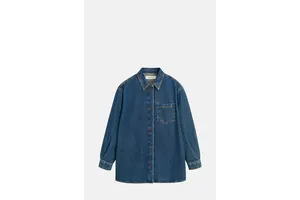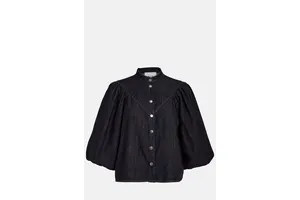
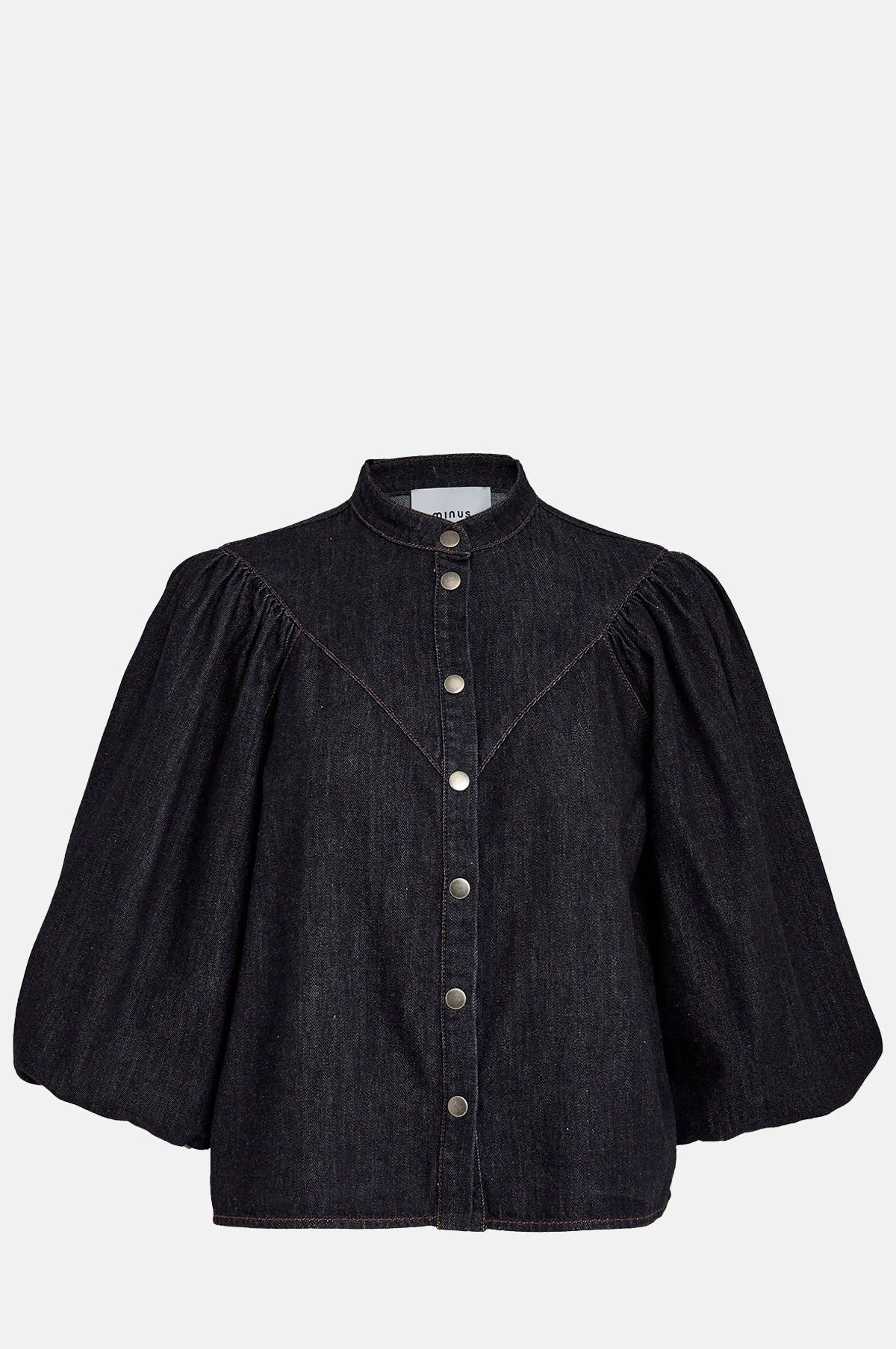

A denim shirt from Minus in a deep indigo cotton and lyocell blend, with balloon sleeves gathered at the shoulder, a v-shaped western yoke, a mandarin collar and metal poppers through the front, listed at 110 GBP with four of five sizes in stock. Its chest column grades by one centimetre per size, which is half the step most garments in this run use, and that single fact has a consequence worth spelling out. The chest works out at 98 centimetres around at the smallest size and 106 at the largest, against a body bust that grows by about ten inches over the same range, so the ease falls from roughly seven and a half inches to under three. In other words, the 34 is a genuinely boxy shirt and the 42 is a fairly close one, and they are the same garment. It is worth setting that beside the shirt published alongside this one from another brand, whose chest grades by four centimetres per size and whose ease therefore does the opposite and grows. Two shirts, one batch, opposite behaviours, and both entirely determined by whether the grading step is bigger or smaller than the body step. The reference is the Larissa Blouse in Dark Denim. Dongguan Bafinasa Garments Co., Ltd. develops comparable shirts on OEM and ODM terms, from cloth selection to retail or FBA ready packing. We publish this as a development reference and build your own version of it, and we do not supply the branded original or reproduce anyone else's label.
Key Features
- Boxy fit as stated, with the ease falling from about seven and a half inches at the smallest size to under three at the largest. See the note below
- Chest grading one centimetre per size, which is half the step most garments in this run use and is what makes the ease collapse. See the note below
- Voluminous balloon sleeves with gathered shoulders as stated, which need two gather ratios and a cuff width, and none is given. See the note below
- Polished metal popper fastenings as stated, with no count, no size, no type and no reinforcement described. See the note below
- Mandarin collar as stated, with no collar height given, which on a stand collar is the measurement that decides the look
- Western-inspired v-shaped yoke as stated, with no yoke depth given
- Dark indigo wash as stated, with no instruction about the indigo rubbing off or bleeding. See the note below
Customisable Options
- Cloth: cotton lyocell indigo to the reference, with the weight specified, or a cotton denim, a lyocell twill, a chambray or a piece dyed indigo, each quoted separately
- Fit: boxy to the reference with the ease held constant across the range by grading two centimetres, or boxy throughout at about seven inches, or a closer fit
- Sleeves: balloon to the reference, with the shoulder gather, the cuff gather and the cuff width specified, or a plain sleeve, a bishop sleeve or a short sleeve
- Closure: metal poppers to the reference, with the count, the size in ligne and the placket reinforcement specified, or a button placket, or a concealed placket
- Collar: mandarin to the reference, with the collar height specified, or a shirt collar, a band collar or a v neck
- Yoke: v-shaped western yoke to the reference, with the depth specified, or a straight yoke, a rounded yoke or no yoke
- Cloth weight, ease held or grading step, sleeve gather and cuff specification, popper count and size and reinforcement, collar height, yoke depth, indigo fastness and care, size set, colour development, private label and care labelling
Specifications
| Style | Boxy indigo shirt with balloon sleeves, a western yoke, a mandarin collar and popper fastenings |
| Reference | Minus, Larissa Blouse, style MI7244 006, dark denim, sizes 34 to 42 Danish. See the note below |
| Composition | 85% cotton and 15% lyocell as stated, in both the bullets and the panel, with no weight given. See the note below |
| Cloth | Soft cotton and lyocell blend in a deep indigo wash as stated, with no weight given. See the note below |
| Fit | Boxy fit with a straight hem as stated. See the note below |
| Collar | Mandarin collar as stated, with no collar height given. See the note below |
| Yoke | Western-inspired v-shaped yoke stitching as stated, with no depth given. See the note below |
| Sleeves | Voluminous balloon sleeves with gathered shoulders as stated, measured at 44 to 45 cm. See the note below |
| Closure | Polished metal popper fastenings through the front as stated, with no count, size or type given. See the note below |
| Stitching | Contrast stitching as stated, with no shade named |
| Care | Machine wash on gentle at 30, do not tumble dry, as stated. See the note below |
| Sizes Offered | 34 to 42 Danish, five sizes, four in stock with the 38 sold out. See the note below |
| Size Conversion | Published: 34 is XS, 36 is S, 38 is M, 40 is L and 42 is XL |
| Model | None stated, no height and no body measurements |
| Measurements Published | Pit to pit, sleeve length and total length for all five sizes, with the sleeve column headed Sleve. See the note below |
| Published Chest | Pit to pit 49, 50, 51, 52 and 53 cm flat, or 19.3 through 20.9 in. See the note below |
| Chest Around | 98, 100, 102, 104 and 106 cm, or 38.6, 39.4, 40.2, 40.9 and 41.7 in. See the note below |
| Ease Against Body Bust | About 7.6, 6.4, 5.2, 3.9 and 2.7 in from smallest to largest, a fall of nearly five inches. See the note below |
| Published Sleeve | 44, 44, 44, 45 and 45 cm, stepping once in the middle. See the note below |
| Published Length | 55, 55, 56, 57 and 58 cm, grading zero, one, one and one |
| Gather Ratio | None, on a sleeve gathered at both the shoulder and the cuff. See the note below |
| Cuff Width | None. See the note below |
| Collar Height | None, on a stand collar. See the note below |
| Popper Specification | None. See the note below |
| Yoke Depth | None |
| Published Hem | None, on a garment described as boxy with a straight hem |
| Cloth Weight | Not stated. See the note below |
| Photographs | One. See the note below |
| Production | Made in China as stated |
| Reference Retail | 110 GBP as listed, quoted to show the price band this sits in, not as our price |
| Category | Filed by the reference under blouses and shirts |
| Occasion | Autumn, winter and spring, everyday, weekend, work, with high-waisted trousers as the reference suggests |
| MOQ | 100 pcs per style per colourway, mixed sizes and colourways accepted |
| Sampling | 7-10 days after tech pack or reference sample confirmation |
| Bulk Lead Time | 20-30 days after sample approval and deposit |
| Service | OEM / ODM / private label, indigo cloth sourcing with weight and fastness specified, balloon sleeve development, popper and placket specification, retail or FBA ready packing |
Size Chart as Published by the Reference
| Size | Pit to Pit (flat) | Sleeve Length | Total Length |
|---|---|---|---|
| 34 DK / XS | 49 cm | 44 cm | 55 cm |
| 36 DK / S | 50 cm | 44 cm | 55 cm |
| 38 DK / M | 51 cm | 44 cm | 56 cm |
| 40 DK / L | 52 cm | 45 cm | 57 cm |
| 42 DK / XL | 53 cm | 45 cm | 58 cm |
The chest figures are flat half measures taken with the shirt laid down, doubling to 98, 100, 102, 104 and 106 cm around, or 38.6, 39.4, 40.2, 40.9 and 41.7 in. Against a body bust of 31, 33, 35, 37 and 39 in across XS to XL, the ease is about seven and three fifths inches at the smallest and about two and seven tenths at the largest, so the shirt is very boxy at the small end and close fitting at the large end. That is because the chest grades one centimetre per size, which is 0.79 in of circumference against a body grade of two inches, so about 1.2 in of ease is given up at every step. The sleeve steps once, from 44 to 45, and the length grades one centimetre after a flat first step.
Our Proposed Body Chart
| Size | Body Bust | Sleeve | Body Waist | Body Hips | Length | Source |
|---|---|---|---|---|---|---|
| 34 DK / XS | 31 in / 79 cm | 44 cm | 24 in / 61 cm | 34 in / 86 cm | 55 cm / 21.7 in | Our proposal |
| 36 DK / S | 33 in / 84 cm | 45 cm | 26 in / 66 cm | 36 in / 91 cm | 57 cm / 22.4 in | Our proposal |
| 38 DK / M | 35 in / 89 cm | 46 cm | 28 in / 71 cm | 38 in / 97 cm | 59 cm / 23.2 in | Our proposal |
| 40 DK / L | 37 in / 94 cm | 47 cm | 30 in / 76 cm | 40 in / 102 cm | 61 cm / 24 in | Our proposal |
| 42 DK / XL | 39 in / 99 cm | 48 cm | 32 in / 81 cm | 42 in / 107 cm | 63 cm / 24.8 in | Our proposal |
Occasions and Styling
Suits autumn, winter and spring, everyday and weekends. A denim shirt with a western yoke reads as casual but considered, and the boxy cut is what lets it go over a tee or under a knit, and the reference is right that it wants a high waist underneath, because the boxiness needs a defined waist somewhere.
Production and Quality Control
The reference publishes three columns for all five sizes, states a two-fibre composition with percentages and repeats it in the bullets so the two agree, describes the fit, the collar, the yoke, the sleeves, the closure and the stitching, gives a care instruction with two parts, names the country of make and publishes a size conversion. It gives no weight, no collar height, no yoke depth, no sleeve specification, no popper specification and no hem width, and it shows one photograph for a garment with five described details. Three things follow: the collapsing ease, the balloon sleeve, and the poppers and the indigo.
Seven and a half inches becoming two and a half, and that is the first thing. The chest measures 98 cm around at the 34 against a body bust of 79 cm at an XS, so there is about seven and three fifths inches of ease, and the shirt is genuinely boxy, which supports the word on the page. At the 42 the chest is 106 cm against a body bust of 99 cm, so the ease is about two and seven tenths, and a shirt with under three inches of ease is not boxy at all, it is a shirt that sits fairly close. So the same garment is two different garments at the two ends of its range, and the cause is arithmetic and worth setting out precisely, because it is the clearest case in this run. The chest column grades one centimetre per size. One centimetre of flat width is two centimetres of circumference, which is 0.79 inches. The body bust, meanwhile, grades two inches per size, because that is how bodies are graded. So at every step the garment gains 0.79 in of circumference and the body gains 2 in, which means about 1.2 in of ease is lost at every single size. Over four steps that is nearly five inches, and that is exactly the fall from 7.6 to 2.7. This run has measured this drift on almost every graded garment it has looked at, because a two centimetre flat grade is 1.57 in of circumference against the same 2 in body grade, and the loss there is about 0.43 in per size. Here the grade is half that, so the loss is nearly three times as steep. And the shirt published alongside this one, from another brand, is the mirror image and proves the point: its chest grades four centimetres per size, which is 3.15 in of circumference against the 2 in body grade, so it gains about 1.15 in of ease at every step, and its ease grows from twelve and a half to fifteen inches across three sizes. Two shirts, one batch, one grade too small and one too large, and the fit character changes across the range in opposite directions in each. It is worth saying what that means for the word boxy, which is the practical conclusion. A fit word describes a relationship between the garment and the body, and if that relationship changes by five inches across five sizes, then the word describes only one of the sizes and the customer has no way of knowing which. This run has said on garment after garment that a fit word cannot be checked without a body measurement, and has recommended publishing either the ease or the body measurements each size was drafted for. Here is the sharpest version of that argument yet, because the ease is not merely unpublished, it is different at every size by an amount that changes the garment. There are two fixes and they are both simple. Grade the chest at two centimetres, which is what most of the trade does, and the ease will fall by the usual 0.43 in per size and stay within a range the word boxy can cover. Or hold the ease constant, which means grading the chest by about two and a half centimetres per size, and then every size is as boxy as every other. Either is better than a grade that changes the garment. It is worth adding what the page does get right, because it is not nothing: the composition appears twice, in the bullets and in the panel, and both say 85% cotton and 15% lyocell, which is the consistency this run has asked for on page after page where the prose claimed organic or a wool mix and the panel said otherwise.
A balloon sleeve, and the four numbers it has not got, and that is the second thing. A balloon sleeve is gathered where it meets the armhole and gathered again where it meets the cuff, and it is fuller between the two than either, which is what gives it the shape of a balloon rather than a cone. A puff sleeve, which this run examined on two garments from another house, is gathered at the shoulder and at the cuff too but is shorter and rounder. So the two are close cousins and they are missing the same measurements, with one extra in this case. The first missing number is the gather ratio at the shoulder, which is how much sleeve cloth is being pulled into how much armhole, and it is the number a factory needs in order to sew the sleeve in evenly rather than bunching the fullness at one point. The second is the gather ratio at the cuff, which is the same question at the other end and which decides whether the cuff sits flat or ruches. The third is the cuff width itself, which decides whether the cuff grips the forearm or sits loosely on it, and whether a hand goes through. The fourth, which is specific to a balloon rather than a puff, is the length over which the fullness is held, or put differently, how much of the sleeve is balloon and how much is plain above and below it, because a sleeve that is full from the shoulder to the elbow is a different sleeve from one that is full only in the middle. None of the four is on this page. With none of them, a factory developing a version of this has to reverse engineer the sleeve from a single photograph, and a customer has no way to know how full the sleeve is or how the cuff will feel. It is worth saying what goes wrong without a stated ratio, because it is the same as on a puff sleeve and it is worth repeating: a sleeve gathered without one is a sleeve whose fullness is decided by whoever is sewing it, and the same size will come out fuller on one arm than the other, which is exactly the sort of inconsistency a customer notices and returns a garment for. The remedies are ordinary: mark the gather points on the pattern, state both ratios, and use two rows of gathering stitches so the fullness distributes. Then the sleeve column itself, which reads 44, 44, 44, 45 and 45, so it holds for three sizes, steps once by a centimetre, and holds again. This run has now met a great many columns that do not grade and has stopped expecting them to, but it is worth noting the particular shape of this one, because it is not a frozen column and it is not a graded one either: it is a graded column that has been rounded to whole centimetres and collapsed. A real grade of about a quarter of a centimetre per size, rounded, gives 44, 44, 45, 45, 45, and a real grade of half a centimetre gives 44, 44, 45, 45, 46. What is published is 44, 44, 44, 45, 45, which is neither. So the sleeve does grade, in the pattern, and the chart simply does not show it. That is a different fault from a frozen column and it is worth distinguishing, because the fix is only to publish the real figures rather than to change the pattern. It is also worth recording the small thing sitting next to it, which is the sort of detail that tells you how a page was made: the column is headed Sleve Length, without the second e. The shirt published alongside this one, from a different brand, has the same heading with the same missing letter. Two different brands, one shop, one misspelling, which means the size charts on this shop are produced from a shared template and that nobody has read it. That is worth knowing, because a template is the reason a fault repeats and it is also the reason a fix propagates.
Poppers, indigo, and one photograph, and that is the third thing. The shirt fastens through the front with polished metal poppers, and at the collar with silver-tone ones. A popper, or snap fastener, is a component with a specification, and this run has now found the same gap on every closure it has looked at, so it is worth setting the list out once rather than repeating it. A popper is specified by its type, which is how it is attached, whether by prongs driven through the cloth or by a post and socket set with a machine. By its size, which the trade gives in ligne, with a shirt placket usually taking something around sixteen ligne. By its finish, which is a plating over a base metal and which is what the word silver-tone is describing without naming. And by its count, which decides the spacing down the placket and therefore whether the placket lies flat or gaps. Not one of those four is here, and there is a fifth that matters more on this cloth than on most. Each popper is set through the cloth individually, and every one of them is a point where a pull is concentrated into a few square millimetres. On a firm shirting that is fine. On a soft cloth, and this one is described as soft, a popper under the pull of a placket will gradually tear its way out, so the placket needs reinforcing behind it, usually with an interlining or a second layer let in. No reinforcement is mentioned and no cloth weight is given, and those two absences together mean a factory cannot judge whether the placket as described will hold. It is worth noting this is the sixth or seventh garment in this run whose closure is named and never specified, after the double button placket, the tie up bow, the button through front, the invisible side zip and the button closure on the jacket, and the pattern is now consistent enough across brands to be worth naming as an industry habit rather than a series of accidents. Then the indigo. The cloth is a deep indigo wash, and indigo is unusual among dyes in that it sits on the surface of the yarn rather than penetrating it, which is why denim fades with wear and why it rubs off. Two consequences follow and the care label addresses neither. The first is crocking, which is the trade word for the dye rubbing off onto whatever the garment touches: a dark indigo shirt will mark a pale bag strap, a pale car seat and the lining of a pale coat. The second is bleeding in the wash, which is why indigo is washed cold, inside out and with like colours. This label says machine wash on gentle at thirty and do not tumble dry, and mentions none of it. It is worth setting that beside the jean published two batches ago, which got this exactly right: machine wash cold, inside out, with like colours. Two indigo garments in this run, one with the right instruction and one with an instruction that would be correct for a pale cotton and is incomplete for indigo. Then the collar and the yoke, briefly, because both are described and neither is measured. A mandarin collar is a stand collar with no fold, and it is specified entirely by its height, since a band of one and a half centimetres and one of four are different shirts, and no height is given. A western yoke is a shaped panel across the shoulders with a point, and it is specified by how deep it comes down the body, and no depth is given, and on a garment where the sleeves are gathered into it, the yoke has to be cut to carry those gathers. And then the photographs, which is the last thing and the shortest. The page describes a mandarin collar, a v-shaped western yoke, balloon sleeves gathered at the shoulder, contrast stitching and metal poppers, which is five distinct details, and it shows one picture, from the front. A customer can see roughly two of the five. This run has complained about low image counts before, at two and at three, and one is the lowest yet, and it is worth noting that the detail most likely to sell this shirt, which is the sleeve, is the one a single front view shows least well. Every bulk shipment gets a measurement report against your approved chart.
Optional upgrades include grading the chest at two centimetres or holding the ease constant so every size is as boxy as every other, publishing the ease or the body measurements each size is drafted for, specifying the balloon sleeve by the shoulder gather, the cuff gather, the cuff width and the length over which the fullness is held, publishing the real sleeve figures rather than a collapsed rounding, specifying the poppers by type, size in ligne, finish and count, reinforcing the placket behind them, stating the cloth weight, adding wash inside out, cold and with like colours to the care label and testing the indigo for crocking, specifying the collar height and the yoke depth, publishing the hem width, correcting the shared chart heading and the inconsistent size label, a button placket and a concealed placket option, plain, bishop and short sleeve options, a shirt collar and a band collar option, more photographs including the back and a sleeve detail, size set, colour development, private label, hangtag and care labelling.
Pre-production sample approval, in-line inspection during cutting and sewing, and a final AQL inspection before packing, with measurement reports and photos shared before shipment.
Send us your tech pack, a photo or a reference garment and we will quote within 24 hours. Contact bafinasa@bafinasa.com or WhatsApp +86 13827222469.