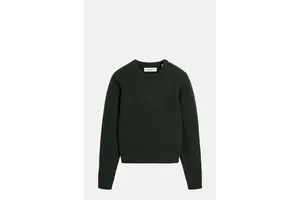
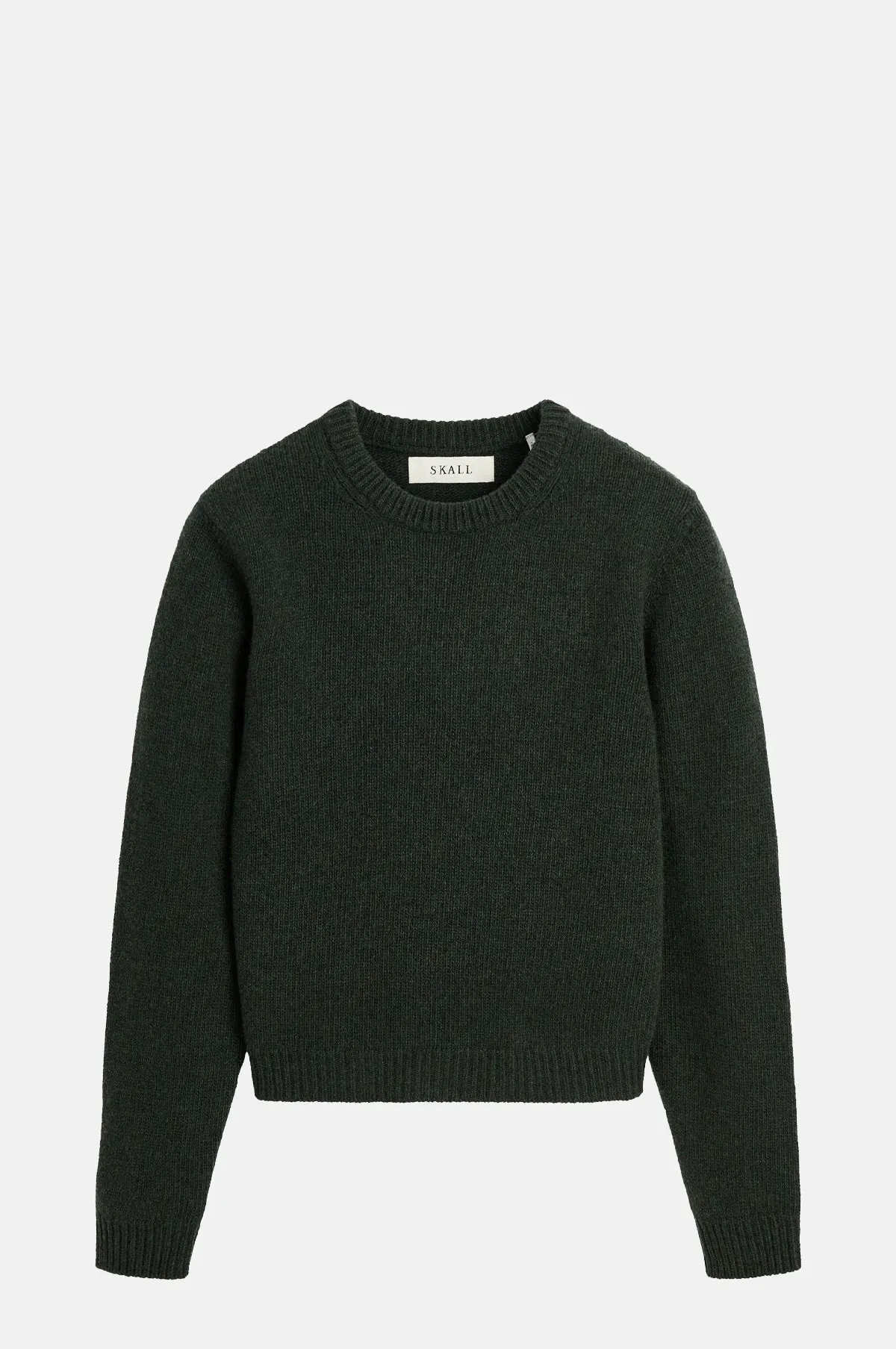

A slim jumper from Skall Studio in dark green, knitted in soft merino wool with a round neckline and ribbed trims at the collar, the cuffs and the hem, listed at 315 GBP with all four sizes in stock. Its sleeve column is the most interesting thing this run has found on a size chart, and it is interesting for one reason: it is published to two decimal places. The sleeve runs 80.25, 82, 83.75 and 85.5 centimetres. Every other chart in this run rounds to whole centimetres, and rounding is the reason this run has repeatedly been unable to tell a real grade from a smoothing artifact. These four figures grade by exactly 1.75 centimetres per size, without a single exception, and 1.75 is not a number you would ever guess from a chart that had been rounded, because rounded it would read 80, 82, 84 and 86, which looks like a grade of two. So this page has settled an argument this run has been having with itself for several batches: the true grades are not round numbers, and a chart rounded to integers hides them. The other thing worth a look is what an 80 centimetre sleeve means on a garment whose body is 53 centimetres long, because it cannot mean what a reader would assume. The reference is the Rio Jumper in Dark Green. Dongguan Bafinasa Garments Co., Ltd. develops comparable knitwear on OEM and ODM terms, from yarn selection to retail or FBA ready packing. We publish this as a development reference and build your own version of it, and we do not supply the branded original or reproduce anyone else's label.
Key Features
- Sleeve length published to two decimal places at 80.25, 82, 83.75 and 85.5 cm, grading a perfect 1.75 cm per size. See the note below
- The decimal figures prove that a rounded chart hides the real grade, which is the argument this run has made about every rounded table. See the note below
- 80 cm cannot be a shoulder-to-cuff measurement on a garment 53 cm long, so it is almost certainly taken from the centre back neck, and the page does not say. See the note below
- Slim fit as stated, with about 3.6 in of ease at the smallest size and 2.4 in at the largest, which genuinely supports the word
- 100% merino wool as stated, with no micron count, which is the specification merino is bought by. See the note below
- Soft and lightweight as stated, with no weight and no gauge given. See the note below
- Handwash only as stated, with no drying instruction, on a slim jumper that will lose its shape if hung up wet. See the note below
Customisable Options
- Yarn: merino wool to the reference, with the micron count and the ply specified, or a lambswool, a merino cashmere or a fine wool blend, each quoted separately
- Fit: slim to the reference at about three inches of ease, or a regular fit at about six, or a relaxed fit, with the grading step set to hold the ease steady
- Gauge: fine gauge to the reference, with the gauge specified, or a mid gauge or a chunky gauge, each quoted separately
- Neck: round neck to the reference, with the neck opening specified, or a v neck, a boat neck or a roll neck
- Trims: rib at the collar, cuffs and hem to the reference, with the rib depth specified, or a plain hem, or a deeper rib
- Measurement standard: publish the sleeve from a named point, shoulder seam or centre back neck, in decimals as the reference does, and apply the same to every style
- Micron count and ply, gauge and weight, ease and grading step, sleeve measured from a named point and published in decimals, rib depth, drying instruction, size set, colour development, private label and care labelling
Specifications
| Style | Slim fit round neck jumper in merino wool with ribbed trims |
| Reference | Skall Studio, Rio Jumper, style 10052-26460, dark green, sizes XS to L |
| Composition | 100% merino wool as stated in both the bullets and the panel, with no micron count given. See the note below |
| Handle | Soft and lightweight knit quality as stated, with no weight and no gauge given. See the note below |
| Fit | Slim fit as stated, with the fit guidance published. See the note below |
| Neck | Classic round neckline as stated, with no neck opening given |
| Trims | Traditional ribbed trims at the collar, cuffs and hem as stated, with no rib depth given |
| Care | Handwash only as stated, with no drying instruction. See the note below |
| Sizes Offered | XS to L, four sizes, all four in stock |
| Fit Guidance | Published: designed with a slim fit, size up if you prefer it less fitted |
| Model | Published: 179 cm tall, wearing a size S |
| Measurements Published | Chest pit to pit, length and sleeve length for all four sizes, with the sleeve in decimals. See the note below |
| Published Chest | 44, 46, 48 and 50 cm flat, or 17.3 through 19.7 in. See the note below |
| Chest Around | 88, 92, 96 and 100 cm, or 34.6, 36.2, 37.8 and 39.4 in. See the note below |
| Ease Against Body Bust | About 3.6, 3.2, 2.8 and 2.4 in from smallest to largest, which supports the slim fit. See the note below |
| Published Sleeve | 80.25, 82, 83.75 and 85.5 cm, grading exactly 1.75 cm per size. See the note below |
| Sleeve Measurement Point | Not stated, and the figures imply it is not the shoulder seam. See the note below |
| Published Length | 53, 54, 55 and 56 cm, grading one centimetre per size |
| Micron Count | None. See the note below |
| Gauge | None. See the note below |
| Cloth Weight | Not stated. See the note below |
| Published Hem | None |
| Photographs | Three |
| Production | Produced in Italy as stated. See the note below |
| Reference Retail | 315 GBP as listed, quoted to show the price band this sits in, not as our price |
| Category | Filed by the reference under knitwear |
| Occasion | Autumn, winter and spring, layering, work, everyday, under a jacket or a coat |
| MOQ | 100 pcs per style per colourway, mixed sizes and colourways accepted |
| Sampling | 7-10 days after tech pack or reference sample confirmation |
| Bulk Lead Time | 20-30 days after sample approval and deposit |
| Service | OEM / ODM / private label, merino sourcing by micron and ply, gauge development, rib trim specification, retail or FBA ready packing |
Size Chart as Published by the Reference
| Size | Chest Pit to Pit (flat) | Length | Sleeve Length |
|---|---|---|---|
| XS | 44 cm | 53 cm | 80.25 cm |
| S | 46 cm | 54 cm | 82 cm |
| M | 48 cm | 55 cm | 83.75 cm |
| L | 50 cm | 56 cm | 85.5 cm |
The chest figures are flat half measures taken with the jumper laid down, doubling to 88, 92, 96 and 100 cm around, or 34.6, 36.2, 37.8 and 39.4 in. Against a body bust of 31, 33, 35 and 37 in across XS to L, the ease is about three and three fifths inches at the smallest and about two and two fifths at the largest, which is slim and which supports the description. The length grades one centimetre per size. The sleeve is published in decimals at 80.25, 82, 83.75 and 85.5 cm, grading exactly 1.75 cm per size, and an 80 cm sleeve on a garment whose body is 53 cm long cannot be a shoulder-to-cuff measurement.
Our Proposed Body Chart
| Size | Body Bust | Sleeve | Body Waist | Body Hips | Length | Source |
|---|---|---|---|---|---|---|
| XS | 31 in / 79 cm | 80.25 cm | 24 in / 61 cm | 34 in / 86 cm | 53 cm / 20.9 in | Our proposal |
| S | 33 in / 84 cm | 81.25 cm | 26 in / 66 cm | 36 in / 91 cm | 55 cm / 21.7 in | Our proposal |
| M | 35 in / 89 cm | 82.25 cm | 28 in / 71 cm | 38 in / 97 cm | 57 cm / 22.4 in | Our proposal |
| L | 37 in / 94 cm | 83.25 cm | 30 in / 76 cm | 40 in / 102 cm | 59 cm / 23.2 in | Our proposal |
Occasions and Styling
Suits autumn, winter and spring. A slim merino jumper is a layering piece rather than a statement, which is what the reference means by a clean silhouette, and the fine gauge is what lets it go under a jacket or a coat without adding bulk.
Production and Quality Control
The reference publishes three columns for all four sizes and publishes one of them to two decimal places, states a single fibre in both the bullets and the panel, describes the handle, the fit, the neck and the trims, gives a care instruction, names the country of production, publishes fit guidance and gives the height of the model and the size she wears. It gives no micron count, no gauge, no weight, no neck opening and no drying instruction, and it does not say where the sleeve is measured from. Three things follow: the decimals, what an eighty centimetre sleeve tells you, and the merino.
Eighty point two five, and what rounding has been hiding, and that is the first thing. The sleeve column reads 80.25, 82, 83.75 and 85.5 centimetres. Subtracting gives 1.75, 1.75 and 1.75, so the sleeve grades by exactly 1.75 centimetres at every size, without exception. No other chart in this run publishes a decimal, and it is worth setting out precisely why that one difference matters, because it settles an argument this run has been having with itself since it started reading these tables. When a chart is rounded to whole centimetres, an uneven-looking grade can be one of two things: a real grade that is not a whole number, or a mistake. This run has met that ambiguity repeatedly and has had to guess which it was. On a jacket from another house the body length graded two, three and two, and this run argued it was probably a real grade of about two and a third rounded, and said so as a guess. On a shirt the sleeve read 44, 44, 44, 45, 45, and this run said that was neither a frozen column nor a clean grade of a quarter or a half, and could not go further. On trousers from another brand two columns disagreed, and this run could not tell which column held the error. In every one of those cases the rounding was the obstacle, and a decimal would have settled it. Here is the proof of the principle. A true grade of 1.75, rounded to whole centimetres from a base of 80.25, gives 80, 82, 84 and 86, which reads as a grade of exactly two and which gives no hint at all that the pattern is grading at one and three quarters. So a garment can be published with a sleeve grade that looks like two and is in fact 1.75, and the difference across four sizes is a centimetre, which is enough to matter on a sleeve. It is worth saying what this means for anyone reading these charts, which is that a rounded table is a lossy picture of the pattern and cannot be used to check it. If a factory is given a chart rounded to integers and asked to reproduce the garment, it will produce something a centimetre different at the ends of the range, and nobody will be able to say who was wrong. The remedy is what this page already does, and it costs nothing: publish the figures as they are. It is worth adding one observation about the size of the grade itself, which the decimals make visible. One and three quarters of a centimetre per size is a large sleeve grade. A shoulder-to-cuff sleeve normally grades about one to one and a quarter centimetres a size, because arms do not get that much longer as bodies get wider. A grade of 1.75 is what you would expect from a sleeve measured from further inboard, which is the second thing.
Eighty centimetres on a fifty-three centimetre garment, and that is the second thing. The body length of this jumper is 53 to 56 cm and the sleeve is 80.25 to 85.5 cm. Those two numbers cannot both be measuring what a reader would assume they measure. A sleeve measured from the shoulder seam to the cuff on a women's jumper of this size is somewhere around fifty-five to sixty-two centimetres; eighty centimetres from the shoulder would be an arm roughly half as long again as the body is tall, which is not a human proportion. So the 80 is not a shoulder-to-cuff figure. There is a standard measurement that gives this kind of number, and it is the one the knitwear trade commonly uses for a set-in sleeve: from the centre back neck, across the shoulder, down the arm to the cuff. That measurement includes half the neck width and the whole shoulder width before the arm even begins, which adds something in the region of fifteen to twenty centimetres to the arm length, and it lands squarely in the seventies and eighties for a women's garment. And the grade corroborates it, which is the satisfying part: a sleeve measured from the centre back neck includes the shoulder, and the shoulder is one of the things that grows as bodies get bigger, so a centre-back-neck sleeve grades by more than an arm alone does. A shoulder-to-cuff sleeve grades about one to one and a quarter centimetres a size; this one grades one and three quarters, and the extra roughly half centimetre is the shoulder. So two independent figures, the absolute length and the grade, point to the same answer. It is worth being clear about what that means for the customer, because it is not a technicality. A woman reading this chart who wants to know whether the sleeves will be long enough will compare 80 cm with her own arm, and her arm is about fifty-five centimetres from shoulder to wrist, and she will conclude that this jumper has sleeves twenty-five centimetres too long, and she will be wrong. That is a customer lost by an unlabelled column heading, and it is worth setting beside the other sleeve origins this run has met, because the list is now long and every entry on it is the same fault. A raglan sleeve has an armhole but no shoulder seam, so the start point is ambiguous. A dropped shoulder puts the seam down the upper arm, so the start point is not on the body at all. A cape sleeve has no armhole whatsoever. And now a sleeve that is plainly measured from the centre back neck and is not said to be. Four constructions, four different origins, none of them declared. The remedy is three words in the column heading, measured from centre back neck, and this page is already close enough to doing it that the omission is a shame. It is worth adding that the same brand's cardigan, published alongside this one, publishes a sleeve of 55 cm on a body of 57 cm, which is perfectly consistent with a shoulder-to-cuff measurement. So the same brand, in the same season, appears to measure its sleeves from two different places on two garments, and says which on neither.
Merino with no number, and a slim fit that is genuinely slim, and that is the third thing. The composition is 100% merino wool, stated in both the bullets and the specification panel, so the two halves agree, which is better than the several garments in this run where the prose claimed organic or a wool mix and the panel said something else. Merino is a breed rather than a grade, and it is worth saying what that means, because the word does a lot of work on a product page and less than customers think. Merino sheep grow a finer fleece than most breeds, which is why the word is associated with softness, but merino wool is sold across a wide range of fibre thickness, from about eleven and a half micron at the very finest to over twenty-four at the coarsest, and that is the difference between a jumper you can wear next to the skin and one you cannot. The specification that fixes it is the micron count, and there is none. This run has now met merino twice and neither gave one, and it is worth noting that the same absence applies to the ply, which is how many strands are twisted together, and to the gauge, which is how fine the stitch is. So the page says soft and lightweight, which is a description of the result, and gives none of the three numbers that produce it. It is worth being fair about the fit, because here the page is unusually honest and the numbers back it up. The chest measures 88 cm around at the XS against a body bust of 79 cm, so there is about three and three fifths inches of ease, falling to about two and two fifths at the L. That is genuinely slim, and this run has spent a great deal of time on garments whose fit word the numbers contradict, on a boxy shirt whose ease collapsed from seven and a half to under three, on a relaxed knit with twelve inches, on a house where the word relaxed spanned eight inches across three garments. Here the word slim means what it says and the customer can rely on it, which is worth crediting. It is also worth checking the fit guidance, which says size up if you prefer it less fitted, and which is correct: a woman who is an XS and takes an S gets 92 cm against her 79 cm, which is about five inches of ease instead of three and a half. The guidance is sound. Then the care label, which reads handwash only and stops. There is no drying instruction, and on this garment the omission is worse than on most, and the reason is specific to the fit. Wool stretches when it is wet and does not recover fully, and this is a slim jumper, so the thing that wet stretching destroys here is precisely the thing being sold: hung up wet, it will lengthen and widen, and it will come out of the wash no longer slim. A relaxed garment can survive that; a slim one cannot. Two words, dry flat, and this run has now said them about a wool trouser, two sweaters, a handwash knit and an expensive cardigan, and in every case the missing clause is the one that does the damage, because washing is the instruction everybody remembers to write and drying is the one nobody does. It is worth finishing on one small thing about the brand rather than the garment. The cardigan published alongside this one is spun and knitted in Denmark and says so, with the fleece origin unstated. This jumper is produced in Italy and says nothing about the yarn. So the provenance claim the brand makes on one garment is not made on the other, which is worth noting for anyone reading the brand as a whole: it is not a house-wide policy, it is a claim about one product. Every bulk shipment gets a measurement report against your approved chart.
Optional upgrades include stating the micron count, the ply and the gauge of the merino, stating the weight, publishing the sleeve from a named point and applying one standard across every style, publishing every column in decimals as the sleeve already is, adding dry flat to the care label, stating the neck opening and the rib depth, holding the ease steady or publishing the ease so the size up advice can be judged, a lambswool, merino cashmere and fine wool blend option, mid and chunky gauge options, v neck, boat neck and roll neck options, a fourth and fifth size if the ease is raised, more photographs including the back, size set, colour development, private label, hangtag and care labelling.
Pre-production sample approval, in-line inspection during cutting and sewing, and a final AQL inspection before packing, with measurement reports and photos shared before shipment.
Send us your tech pack, a photo or a reference garment and we will quote within 24 hours. Contact bafinasa@bafinasa.com or WhatsApp +86 13827222469.