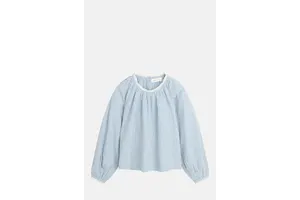
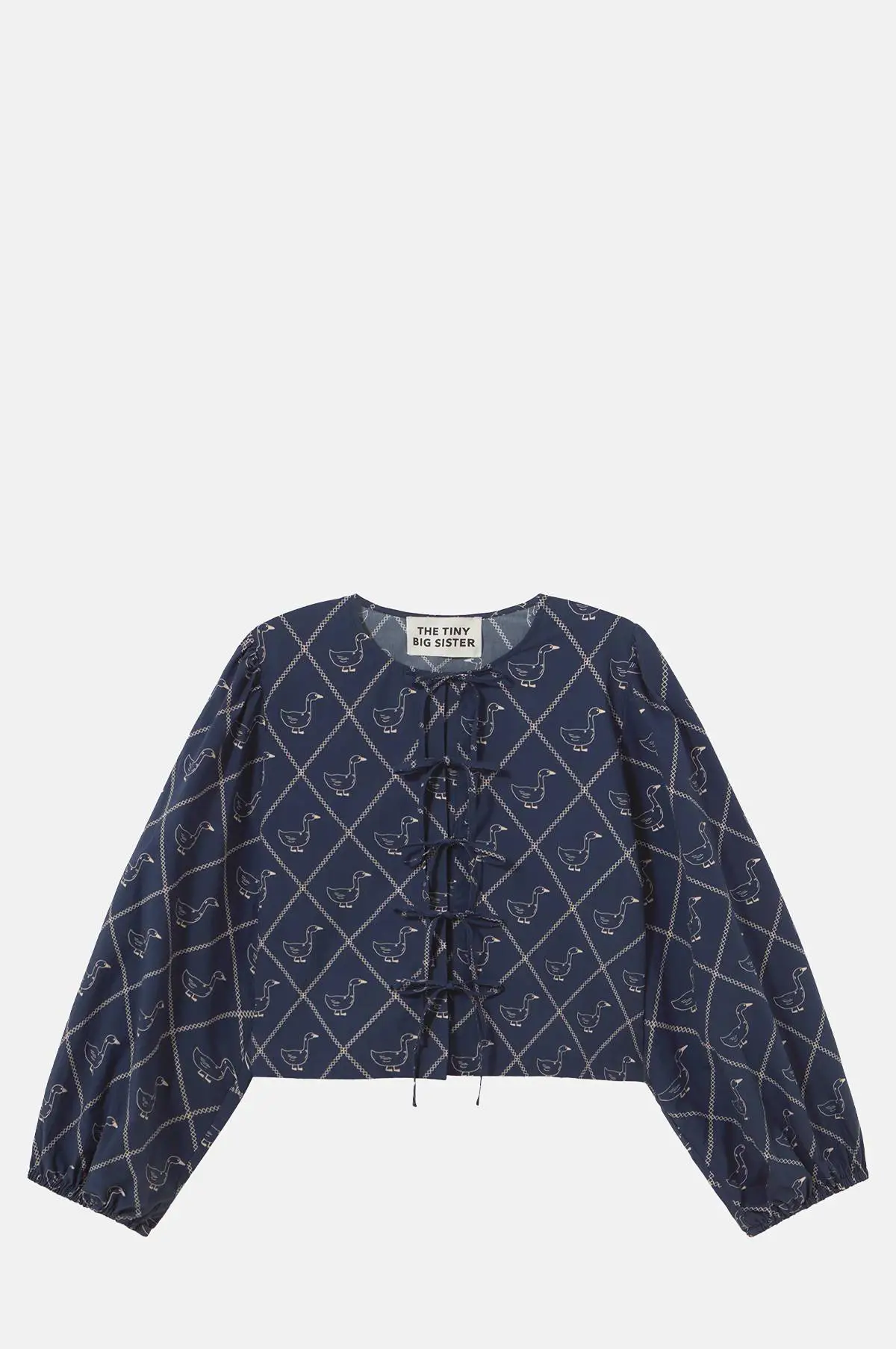

A navy cotton blouse from The Tiny Big Sister with long puff sleeves, a round neck and a tie up bow fastening, in a contrasting diamond geese pattern, listed at 136 GBP with all five sizes in stock. Its size table is the tidiest in this house and one of the tidiest in this run: the chest grades two centimetres per size, the sleeve grades one, the length grades two, and every column is complete for all five sizes. So there is nothing wrong with the arithmetic. What is worth noticing is what the arithmetic says. The chest works out at 100 centimetres around at the smallest size, which against a body bust of 31 inches is about eight and two fifths inches of ease. The blouse is described as relaxed, and so is the embroidered blouse published alongside it from the same house, and that one measures four and two fifths inches of ease at the same size. So one word, one house, one season, and a difference of four inches between the two things it describes. That is the clearest measure this run has produced of how much information a fit word carries, and the answer is very little. There is a second thing here that is worth more than the first, and it is on the specification panel: the style code is AW26-754, which is the same code as the embroidered blouse. Two different garments, one number. The reference is the Geese Bow Blouse in Navy. Dongguan Bafinasa Garments Co., Ltd. develops comparable blouses on OEM and ODM terms, from cloth selection to retail or FBA ready packing. We publish this as a development reference and build your own version of it, and we do not supply the branded original or reproduce anyone else's label.
Key Features
- Relaxed fit as stated, with about eight and two fifths inches of ease at the smallest size, against four and two fifths on the other relaxed blouse in this house. See the note below
- Tie up bow fastening as stated, with no tie length, no bow specification and nothing about how the bow is anchored. See the note below
- Long puff sleeves as stated, with no cap height, no cuff width and no gather ratio given. See the note below
- A clean and complete size table, grading two centimetres in the chest, one in the sleeve and two in the length. See the note below
- Contrasting diamond geese pattern as stated, with no repeat and no contrast colour named. See the note below
- The same style code as the embroidered blouse from this house, AW26-754 on both. See the note below
- Machine wash at 30 and do not tumble dry, with nothing about the bow or the gathers
Customisable Options
- Cloth: cotton to the reference, with the weight in grams per square metre and the pattern repeat specified
- Fit: relaxed to the reference at about eight inches of ease, or a closer four inch version, or a two inch one for a blouse that sits nearer the body
- Fastening: tie up bow to the reference, with the tie length and the bow specified and the bow anchored to the garment, or a covered button placket, or a concealed zip, or a drawstring channel
- Sleeves: long puff sleeves to the reference, with the cap height, cuff width and gather ratio specified, or a bishop sleeve, or a plain long sleeve
- Neck: round neck to the reference with the opening given, or a V, a collar or a band
- Pattern: contrasting diamond geese to the reference, woven or printed, with the repeat specified and the contrast shade named
- Cloth weight and pattern repeat, ease, tie length and bow specification, cap height and cuff and gather ratio, neck opening, body length, sleeve length, size set, colour development, private label and care labelling
Specifications
| Style | Relaxed blouse in cotton with a tie bow fastening and long puff sleeves |
| Reference | The Tiny Big Sister, Geese Bow Blouse, ref. AW26-754, navy, sizes 34 to 42. See the note below |
| Composition | 100% cotton as stated, with no weight and no pattern repeat given. See the note below |
| Pattern | A contrasting diamond geese pattern as stated, with no repeat and no contrast shade named. See the note below |
| Fit | Relaxed fit as stated. See the note below |
| Neck | Round neck as stated, with no neck opening given. See the note below |
| Fastening | Tie up bow fastening as stated, with no tie length and no bow specification. See the note below |
| Sleeves | Long puff sleeves as stated, measured at 57 to 61 cm. See the note below |
| Care | Machine wash at 30 degrees, do not tumble dry, as stated. See the note below |
| Sizes Offered | 34 to 42, five sizes, all five in stock |
| Size Conversion | Published: 34 is XS, 36 is S, 38 is M, 40 is L and 42 is XL |
| Measurements Published | Pit to pit, sleeve length and total length for all five sizes. See the note below |
| Published Chest | Pit to pit 50, 52, 54, 56 and 58 cm flat, or 19.7 through 22.8 in. See the note below |
| Chest Around | 100, 104, 108, 112 and 116 cm, or 39.4, 40.9, 42.5, 44.1 and 45.7 in. See the note below |
| Ease Against Body Bust | About 8.4, 7.9, 7.5, 7.1 and 6.7 in from smallest to largest. See the note below |
| Published Sleeve | 57, 58, 59, 60 and 61 cm, grading one centimetre per size |
| Published Length | 51, 53, 55, 57 and 59 cm, grading two centimetres per size |
| Tie Length | None. See the note below |
| Cuff Width | None, on a sleeve gathered into a cuff. See the note below |
| Gather Ratio | None. See the note below |
| Published Hem | None. See the note below |
| Model | None stated, no height and no body measurements |
| Photographs | Three |
| Cloth Weight | Not stated |
| Production | Made in China as stated |
| Reference Retail | 136 GBP as listed, the same as the velvet trousers and the checked skirt from this house, quoted to show the price band this sits in, not as our price |
| Category | Filed by the reference under blouses and shirts |
| Occasion | Autumn and winter, work, weekend, evening, dressed up as the reference suggests |
| MOQ | 100 pcs per style per colourway, mixed sizes and colourways accepted |
| Sampling | 7-10 days after tech pack or reference sample confirmation |
| Bulk Lead Time | 20-30 days after sample approval and deposit |
| Service | OEM / ODM / private label, cotton sourcing with weight specified, bow and tie development, puff sleeve construction, retail or FBA ready packing |
Size Chart as Published by the Reference
| Size | Pit to Pit (flat) | Sleeve Length | Total Length |
|---|---|---|---|
| 34 / XS | 50 cm | 57 cm | 51 cm |
| 36 / S | 52 cm | 58 cm | 53 cm |
| 38 / M | 54 cm | 59 cm | 55 cm |
| 40 / L | 56 cm | 60 cm | 57 cm |
| 42 / XL | 58 cm | 61 cm | 59 cm |
The chest figures are flat half measures taken with the blouse laid down, doubling to 100, 104, 108, 112 and 116 cm around, or 39.4, 40.9, 42.5, 44.1 and 45.7 in. Against a body bust of 31, 33, 35, 37 and 39 in across XS to XL, the ease is about eight and two fifths inches at the smallest and about six and seven tenths at the largest. That is a very full blouse, and it is worth setting beside the embroidered blouse from the same house, which is also called relaxed and which measures about four and two fifths inches of ease at the 34. The sleeve grades a clean one centimetre per size and the length a clean two, and both columns are complete.
Our Proposed Body Chart
| Size | Body Bust | Sleeve | Body Waist | Body Hips | Length | Source |
|---|---|---|---|---|---|---|
| 34 / XS | 31 in / 79 cm | 57 cm | 24 in / 61 cm | 34 in / 86 cm | 51 cm / 20.1 in | Our proposal |
| 36 / S | 33 in / 84 cm | 58 cm | 26 in / 66 cm | 36 in / 91 cm | 53 cm / 20.9 in | Our proposal |
| 38 / M | 35 in / 89 cm | 59 cm | 28 in / 71 cm | 38 in / 97 cm | 55 cm / 21.7 in | Our proposal |
| 40 / L | 37 in / 94 cm | 60 cm | 30 in / 76 cm | 40 in / 102 cm | 57 cm / 22.4 in | Our proposal |
| 42 / XL | 39 in / 99 cm | 61 cm | 32 in / 81 cm | 42 in / 107 cm | 59 cm / 23.2 in | Our proposal |
Occasions and Styling
Suits autumn and winter, work and weekends, and it dresses up. A blouse that ties at the neck reads smarter than one that buttons, so it is the version of this shape that goes to a dinner rather than to an office, and the fullness is what lets it be worn over trousers or tucked.
Production and Quality Control
The reference publishes three complete columns for all five sizes, states its fibre, describes the fit, the neck, the fastening and the sleeves, gives a care instruction with two parts, names the country of make, publishes a size conversion and has every size in stock. Its table is arithmetically clean. It shares a style code with a different garment from the same house, and it gives no cloth weight, no tie length, no cuff or gather measurement and no hem width. Three things follow: what the word relaxed is worth, what a bow that fastens has to have, and the duplicated code.
Eight and two fifths inches, four and two fifths, one word, and that is the first thing. The chest measures 100 cm around at the 34 against a body bust of 79 cm at an XS, so there is about eight and a half inches of ease in this blouse, and the ease is still about six and seven tenths at the 42. That is a very full garment, and it is a deliberate one, and there is nothing wrong with it. The embroidered blouse published alongside this one, from the same house, in the same season, in the same size set, is also described as a relaxed fit, and it measures about four and two fifths inches of ease at the same 34. So the same word on two garments from one designer describes ease figures four inches apart, and four inches of ease is the difference between a blouse that skims and a blouse that tents. This run has complained about fit words before, on the Thompson jumper whose oversized was only an inch and a half of ease, and on the cotton dress whose relaxed was a half inch at the waist, and the complaint has always been that the word cannot be checked. Now it can be quantified, and the answer is worth stating plainly: across the garments in this run described as relaxed, the measured ease has ranged from under half an inch to over eight inches. A word with a range that wide is not a specification, it is a mood. There are two honest alternatives and both are cheap. Print the ease, which is the difference between the garment measurement and the body measurement, so a customer can see that this one is eight inches and the other is four and choose. Or print the body measurements each size was drafted for, which is what the size chart on a pattern envelope does, and which lets the customer do her own arithmetic. This run has been recommending the second for fifteen batches and has seen it once, on the linen jumpsuit, and it is worth saying again how little it costs: three rows of numbers that the designer has in her head anyway. There is a second point inside the ease figure that belongs to the customer rather than the designer, and it is about what eight inches does. A blouse with eight inches of ease has no defined waist, no defined bust point and no defined shoulder, so it fits by draping rather than by matching the body, and it will look completely different on two women of the same bust measurement but different shoulder widths. That is fine, but it means the photograph matters more than the numbers, and the garment is shown in three images with no model height, so a customer has three pictures and one set of measurements that describe a shape she cannot see in full.
A bow that fastens, and what it has to hold, and that is the second thing. The description says tie up bow fastening, which means the bow is the closure: the blouse opens at the neck and the tie is what holds it shut. That is a different thing from a decorative bow stitched onto a finished garment, and it makes three demands that a decorative bow does not. The first is length. A tie has to be long enough to tie a bow, and a bow takes a surprising amount of length, and no tie length is published, so there is no way to know whether the bow in the photograph is the bow you will get or whether it depends on how tightly you pull. If the tie is too short the bow comes out small and mean, and if it is too long it flops, and both are a customer complaint about a garment that is otherwise correct. The second is anchoring. A tie that carries the load of closing the garment is being pulled every time the wearer moves, so it cannot be stitched to the facing at one point, which is how decorative bows are attached; it has to be anchored into the structure of the garment, usually at the seam or to a stay, or the pulling will tear it out or distort the neckline. The third is that a tie closure makes the neck opening adjustable, so the round neck has no fixed circumference at all, and a blouse that can be tied tight or loose is a blouse with a neckline that varies by wearer. That is a feature and it is worth saying so, but it also means the neck cannot be specified by one number, and no opening measurement is published here. There is a production point too, and it is the ordinary one: ties are the part of a garment that gets caught in the machine, in the packing and in the washing, so they want to be pressed flat, tacked down for transit, and covered in the carton, and none of that appears on a page. It is worth adding what the label says about the bow: machine wash at 30 degrees and do not tumble dry, which is right for cotton and silent about the one part of the garment that does not survive a wash untouched. A tie washed loose comes out twisted and has to be pressed back into a flat band before it will tie properly again, and one clause, wash with the tie undone or tie loosely before washing, is the whole instruction. Then the sleeves, which are long puff sleeves with the same three missing numbers as on the embroidered blouse: no cap height, so nobody knows whether the puff stands up or lies flat; no gather ratio, so the fullness is decided by whoever sews it; and no cuff width, so nobody knows whether the cuff grips the forearm. It is worth noting the one thing this table does better than its neighbours, which is that the sleeve grades: 57, 58, 59, 60 and 61, a clean centimetre per size, which makes it the only garment in this house whose limb length moves through the whole range. That is the standard, and the fact that it is unusual enough to remark on is the point.
One code, two garments, and what a code is for, and that is the third thing. The specification panel on this page reads Ref. AW26-754. The specification panel on the embroidered blouse from the same house reads AW26-754. They are different garments: different cloth, different pattern, different sleeve detail, different neck, different fastening, different price, different measurements, and the embroidered one has a chest of 45 cm at the 34 where this one has 50. So one number identifies two styles. This run has spent fifteen batches on codes that are incomplete, and it is worth setting out the scale of what is wrong here, because it is a different order of problem. A code without a colour suffix, which this run has met four or five times, still tells you which style you are ordering and fails only to tell you which shade. A code with no suffix at all, or with a mismatch between the number in the product data and the number in the image file name as on the American Vintage tee two batches ago, still identifies the style and fails only to be consistent. A code shared by two styles fails at the first step: it does not identify the garment. And the failure is invisible until the moment it costs something, because both garments are listed correctly on the shop, both have correct photographs, and both will be picked and packed correctly by anyone working from the picture. It surfaces in a reorder, in a factory communication, in a stock count, or in a season where one style is dropped and the other is carried, and then a number that was always ambiguous becomes a number that is now wrong. It is worth guessing at the cause, because the clue is in the formatting: one page says AW26-754 and the other says Ref. AW26-754, with a prefix, which is the shape of a field copied from one product record to another and not retyped. The fix is not a system, it is a habit, and it is the same habit this run keeps arriving at: treat the code as the thing you approve and hold it, rather than writing it afresh on every page. And there is one more absence that belongs with it, though it is smaller: nothing on this page states the weight of the cloth, nothing states the repeat of the diamond pattern, nothing states the contrast shade the geese are worked in, and nothing states the hem width on a blouse this full, where the hem is most of the silhouette. Every bulk shipment gets a measurement report against your approved chart.
Optional upgrades include issuing this garment its own style code and reconciling the duplication with the embroidered blouse, publishing the ease or the body measurements each size is drafted for, specifying the tie length and the bow and anchoring the tie into the structure rather than to the facing, stating the neck opening range that a tie closure allows, specifying the cap height, the gather ratio and the cuff width on the puff sleeve, stating the cloth weight and the diamond repeat, naming the contrast shade, publishing the hem width, adding a washing instruction that covers the tie, a closer four inch and a two inch ease version, a button placket, a concealed zip and a drawstring channel option, a bishop and a plain long sleeve option, V neck, collar and band options, more photographs and a model height, size set, colour development, private label, hangtag and care labelling.
Pre-production sample approval, in-line inspection during cutting and sewing, and a final AQL inspection before packing, with measurement reports and photos shared before shipment.
Send us your tech pack, a photo or a reference garment and we will quote within 24 hours. Contact bafinasa@bafinasa.com or WhatsApp +86 13827222469.