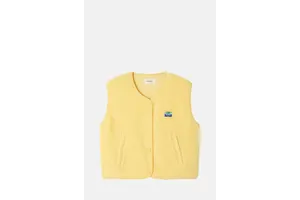
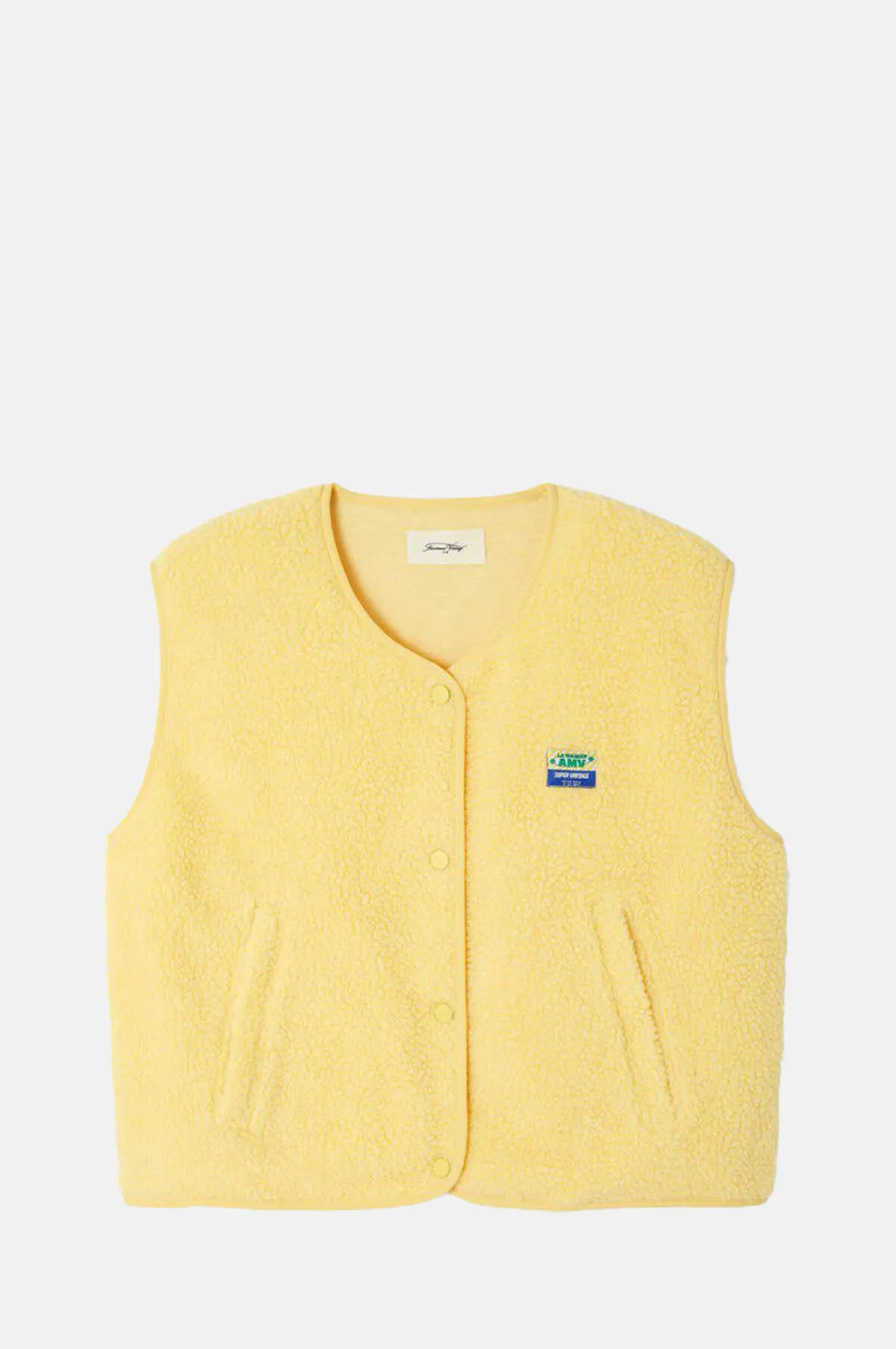

A buttery yellow fleece vest from American Vintage, slightly padded, with a small V-neck, popper closures down the front, zippered side pockets and a small logo badge on the chest, listed at 180 GBP in one size and shown with six photographs where the orange and the chestnut versions of the same garment are shown with two each. The yellow is the colourway worth examining closely, and not only because it is the best documented of the three. All three names end in chine, which is a yarn effect rather than a colour: a chin茅 is a flecked or heathered yarn, spun from fibres of more than one shade, and that single word carries more specification consequence than any other on the page, because a flecked fleece is harder to match, harder to shade control and harder to repeat between batches than a plain one. The rest of the specification is thin in the way this run has come to expect: 100% polyester with no fleece weight and no padding weight, on a garment whose warmth and price are decided almost entirely by those two numbers. The reference is the Hoktown Vest in Beurre Chine. Dongguan Bafinasa Garments Co., Ltd. develops comparable padded and fleece outerwear on OEM and ODM terms, from cloth and wadding selection to hardware specification and retail or FBA ready packing. We publish this as a development reference and build your own version of it, and we do not supply the branded original or reproduce anyone else's label.
Key Features
- Six photographs, against two on each of the other two colourways of the same vest. See the note below
- Chin茅 or flecked yarn as the colour name implies, which is a yarn construction rather than a shade and which complicates matching. See the note below
- 100% polyester fleece as stated, with no fleece weight and no anti pill finish given. See the note below
- Slightly padded as stated, with no wadding weight and no quilting or stabilising described. See the note below
- One size, XS/S, with a chest of 126 cm around and a length of 56 cm, so it is more than twice as wide as it is long. See the note below
- Popper closures down the front and zippered side pockets as stated, with no hardware specification. See the note below
- 180 GBP as listed, the most expensive polyester garment in this run, on a fibre that is among the cheapest to buy
Customisable Options
- Cloth: polyester fleece to the reference, in a chin茅 or in a plain yarn, with the weight in grams per square metre set to your market since none is given
- Finish: anti pill to your market, with a pilling grade tested and held, or a standard fleece at a lower price
- Padding: slightly padded to the reference, with the wadding weight specified, or a heavier wadding, or an unpadded version
- Size: one size to the reference, or a graded set from XS to XL, or two sizes covering XS/S and M/L
- Front: poppers to the reference, or a zip, or a zip with a popper storm flap, or an open front
- Colour: chin茅 shades developed to a lab dip, with a shade band agreed and the fleck ratio specified
- Fleece weight and finish, wadding weight and quilting, chin茅 shade matching, hardware specification, shoulder and armhole measurements, body length, size set, colour development, private label and care labelling
Specifications
| Style | Padded fleece vest in a chin茅 polyester with popper closures and zippered side pockets |
| Reference | American Vintage, Hoktown Vest, style HOK16BH26BEUCHI, beurre chine, a buttery yellow, one size XS/S |
| Composition | 100% polyester as stated, with the padding composition not given separately. See the note below |
| Cloth | Polyester fleece as stated, in a chin茅 or flecked yarn, with no weight, no pile height and no anti pill finish given. See the note below |
| Padding | Slightly padded as stated, with no wadding weight and no quilting or stabilising described. See the note below |
| Fit | Oversized and very boxy as stated, with the advice to take your usual size on a garment that comes in one size. See the note below |
| Neck | Small V-neck as stated |
| Front | Popper button closures down the front as stated, with the number and the spacing not given. See the note below |
| Pockets | Zippered side pockets as stated |
| Branding | Small AMV logo badge on the chest as stated |
| Care | Wash at 30 degrees, do not tumble dry, bleach, iron or dry clean, as stated |
| Sizes Offered | One size, XS/S, in stock. See the note below |
| Measurements Published | Pit to pit and total length, one column only. See the note below |
| Published Chest | 63 cm flat, or 24.8 in, doubling to 126 cm around, or 49.6 in. See the note below |
| Ease Against Body Bust | About 18.6 in on a 31 in bust, about 16.6 on a 33 in bust, and about 8.6 on a 41 in bust. See the note below |
| Published Length | 56 cm, or 22.0 in |
| Proportion | 126 cm of chest against 56 cm of length, a width to length ratio of about 2.25 to 1 |
| Published Shoulder | None. See the note below |
| Published Armhole | None, on a sleeveless garment whose fit depends on it |
| Published Hem | None. See the note below |
| Model | None stated, no height and no body measurements |
| Photographs | Six, against two on each of the other two colourways. See the note below |
| Fleece Weight | Not stated. See the note below |
| Pilling Grade | Not stated, on a cloth that pills by nature. See the note below |
| Padding Weight | Not stated, only the word slightly |
| Production | Made in China as stated |
| Reference Retail | 180 GBP as listed, quoted to show the price band this sits in, not as our price |
| Category | Filed by the reference under coats and jackets, and under tops |
| Occasion | Autumn and winter, weekend, travel, walking, layering over knitwear |
| MOQ | 100 pcs per style per colourway, mixed sizes and colourways accepted |
| Sampling | 7-10 days after tech pack or reference sample confirmation |
| Bulk Lead Time | 20-30 days after sample approval and deposit |
| Service | OEM / ODM / private label, fleece and wadding sourcing, chin茅 shade development and matching, anti pill finishing, hardware specification, retail or FBA ready packing |
Size Chart as Published by the Reference
| Size | Pit to Pit (flat) | Total Length |
|---|---|---|
| XS/S | ||
| 63 cm | ||
| 56 cm |
The chest figure is a flat half measure taken with the vest laid down, doubling to 126 cm around, or 49.6 in, and it is identical on all three colourways. Against the body chart that is about eighteen and a half inches of ease on a 31 in bust, about sixteen and a half on a 33 in bust, and still about eight and a half on a 41 in bust, so a single size covers bodies well outside the XS and S it is named for. The length is 56 cm, which makes the garment about two and a quarter times as wide as it is long. No shoulder, no armhole and no hem width is published, and on a sleeveless garment with an open front those are the measurements that decide who it fits.
Our Proposed Body Chart
| Size | Body Bust | Body Waist | Body Hips | Length | Source |
|---|---|---|---|---|---|
| XS/S | 31 in / 79 cm | 24 in / 61 cm | 34 in / 86 cm | 56 cm / 22 in | Our proposal |
Occasions and Styling
Suits autumn and winter, weekends, travel and walking, over a jumper or a long sleeve tee. A pale yellow fleece is an easier colour to wear than it looks on a screen, since it behaves like a neutral next to denim, navy and grey, which is the reason a butter shade keeps coming back in outerwear.
Production and Quality Control
The reference publishes two measurements for its single size, states its fibre, describes the padding, the neck, the closures, the pockets and the fit, gives a full care instruction and shows six photographs, more than any other garment in this batch. Three things follow: what a chin茅 yarn is and why it is harder to specify than a plain one, why two missing weights matter more on a padded fleece than on anything else in this run, and what the photographs tell you about how the three colourways were handled.
Chine, and the specification that comes with a flecked yarn, and that is the first thing. All three colourways of this vest carry the word chine in their name, and chine is not a colour. A chin茅 is a yarn effect: the fibre is dyed in two or more shades before it is spun, or two differently coloured rovings are spun together, so that the finished yarn carries flecks of more than one tone and the cloth made from it has a heathered, slightly broken surface rather than a flat one. It is a very common finish on fleece, because it hides the mechanised regularity of a knitted pile and makes a synthetic cloth look a little more like a natural one. It is also, and this is the point, considerably harder to specify and to control than a plain shade, for three reasons. The first is matching. A chin茅 has to be matched by eye and by the ratio of the flecks, not by a single reflectance reading, so a lab dip is approved against a physical standard rather than a number, and every component that sits next to it, the rib at the neck if there is one, the zip tape in the pockets, the tape behind the popper placket, has to be matched to a yarn that is itself two colours. On a plain shade those components are matched to one colour and the job takes an afternoon; on a chin茅 it takes longer and it never matches perfectly, so the decision has to be made about how close is close enough. The second is panel to panel variation. A flecked yarn has a random element in it, so two panels cut from the same roll can read slightly differently, and on a garment this size, with a front that is one wide panel, that is visible. The remedy is cutting all the panels of one garment from the same roll and sequencing them, which is a marker instruction rather than a cost. The third is repeatability. A chin茅 depends on the ratio of the shades in the spinning, and a repeat order six months later can come back a slightly different colour if the ratio drifts, so the standard has to be a retained sample rather than a description, which is the same discipline this run has been recommending for fibre certificates: hold the physical thing you approved. None of that is on this page, and none of it is expensive, and all of it is the difference between a colourway that looks as intended and one that looks like a different product.
Two weights, and the garment that is built out of them, and that is the second thing. This vest is made of two materials: a polyester fleece and a wadding, and the page gives the fibre of the first, says nothing about the second, and gives no weight for either. On most garments in this run a missing cloth weight is an annoyance, because you cannot judge the hand or the drape or the price. On a padded fleece it is more than that, because those two numbers are close to the entire product. Fleece is bought and specified by weight in grams per square metre, and the range is wide: a light microfleece might be 160, a standard one 200 to 280, and a heavy pile 320 or more. The weight decides the warmth, the bulk, the drape and the price in roughly equal measure, and it decides how the garment hangs, since a heavy pile stands away from the body and a light one clings. Then there is the anti pill question, which is peculiar to this cloth: polyester fleece pills, because the surface fibres work loose and roll into balls, and the industry answer is an anti pill finish and a pilling test, usually to a grade on a one to five scale after a stated number of cycles. No finish is mentioned and no grade is published, and a fleece vest that pills after three washes is a garment that gets returned or, more likely, quietly stops being worn. The wadding is the second number and it is described only as slight. Wadding is specified by weight too, and the range for a garment like this runs from about 40 grams per square metre, which is a light layer, to 200, which is a winter coat. Slight could be any of them, and it decides whether this vest is an autumn layer or a piece of winter outerwear, which are two different products at two different prices sold to two different customers. There is a third decision that the word slight leaves open, and it is the one that most often goes wrong in production: how the wadding is held. Loose wadding in a panel migrates. It shifts downwards over time, it bunches into the corners in the wash and it leaves cold flat spots, and the three fixes are quilting lines, which are visible and are therefore a design decision that belongs on a sketch rather than in a factory; a bonded or laminated construction, where the wadding is fused to the shell; or a scrim, which is a light open cloth stitched over the wadding to hold it in place. The page mentions none of them, so anyone developing this has to choose, and the three give three different garments. This run has now met nine unnumbered cloth or fill descriptions, and the reason it keeps counting them is this garment: a padded piece is the case where the missing number is not a detail but the specification.
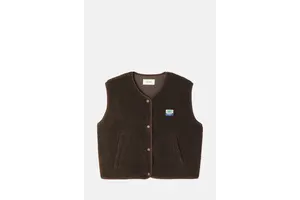
Six photographs on one colourway and two on the others, and what that says, and that is the third thing. This vest is listed three times, in orange, in this yellow and in chestnut, at the same price, with the same two measurements and with the same description apart from the phrase naming the colour. The yellow carries six photographs, the orange two and the chestnut two. This is the second time this run has met the pattern in consecutive batches: the Apoly tee from the same house showed six on the white and two each on the pink and the navy. So within one brand, on two different garments, one colourway of each has been photographed properly and the other two have been given two views each, and it is worth saying what that means in practice, because it is not a small thing. A customer choosing between three colours of one garment gets three different amounts of evidence depending on which she clicks, and the two that are under-photographed are the two where she cannot see the detail, the drape, the back, or the garment on a body, and she either buys on faith or does not buy. It is the kind of inconsistency that shows up as a lower conversion rate on two of three listings rather than as a complaint, and it is very cheap to fix: shoot every colourway the same way, or at least shoot the same number of views. There is a version of the same point in the copy. The three descriptions are the same paragraph with the colour phrase swapped, which is efficient and which means nothing colour specific is said about any of them. On this cloth that matters, because a pale butter yellow and a deep chestnut have different risks: a pale shade shows soiling and shade variation more, a dark one shows fade and rub more, and a bright orange has a light fastness question that neither of the others does. One sentence per colourway would carry all of it. And it is worth closing on the price, because it is the number a developer looks at first and it is instructive here. One hundred and eighty pounds for a padded polyester vest is the most expensive polyester garment in this run and the second most expensive garment of any kind, after the Italian corduroy skirt at 212. Set that beside the cotton tee from the same house at 45, or the organic cotton trench coat from another house at 145 with a lining and hardware, and the conclusion is the one this run keeps arriving at: the number on the label is a brand price and not a material price. It tells you what the market will pay for the name and the design, and it says almost nothing about what the garment costs to make, which is why we quote it as a price band and never as a cost. Every bulk shipment gets a measurement report against your approved chart.
Optional upgrades include stating the fleece weight in grams per square metre and the wadding weight, which between them are most of this garment, specifying an anti pill finish and testing to a pilling grade, choosing between quilting, bonding and a scrim to hold the wadding, approving the chin茅 against a retained physical standard with the fleck ratio specified and matching the zip tape and the placket tape to it, cutting all panels of one garment from the same roll and sequencing them, publishing the shoulder and the armhole, restating the single size as the range of bodies it covers, offering a second size, specifying the popper count and spacing and the pocket zips, shooting every colourway to the same number of views, adding a colour specific line of copy to each listing, a heavier and an unpadded version, a recycled polyester option with certification, size set, colour development, private label, hangtag and care labelling.
Pre-production sample approval, in-line inspection during cutting and sewing, and a final AQL inspection before packing, with measurement reports and photos shared before shipment.
Send us your tech pack, a photo or a reference garment and we will quote within 24 hours. Contact bafinasa@bafinasa.com or WhatsApp +86 13827222469.