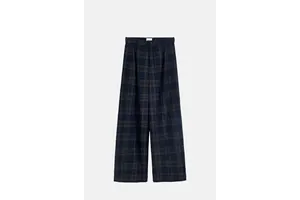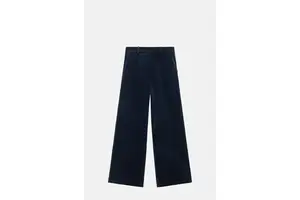
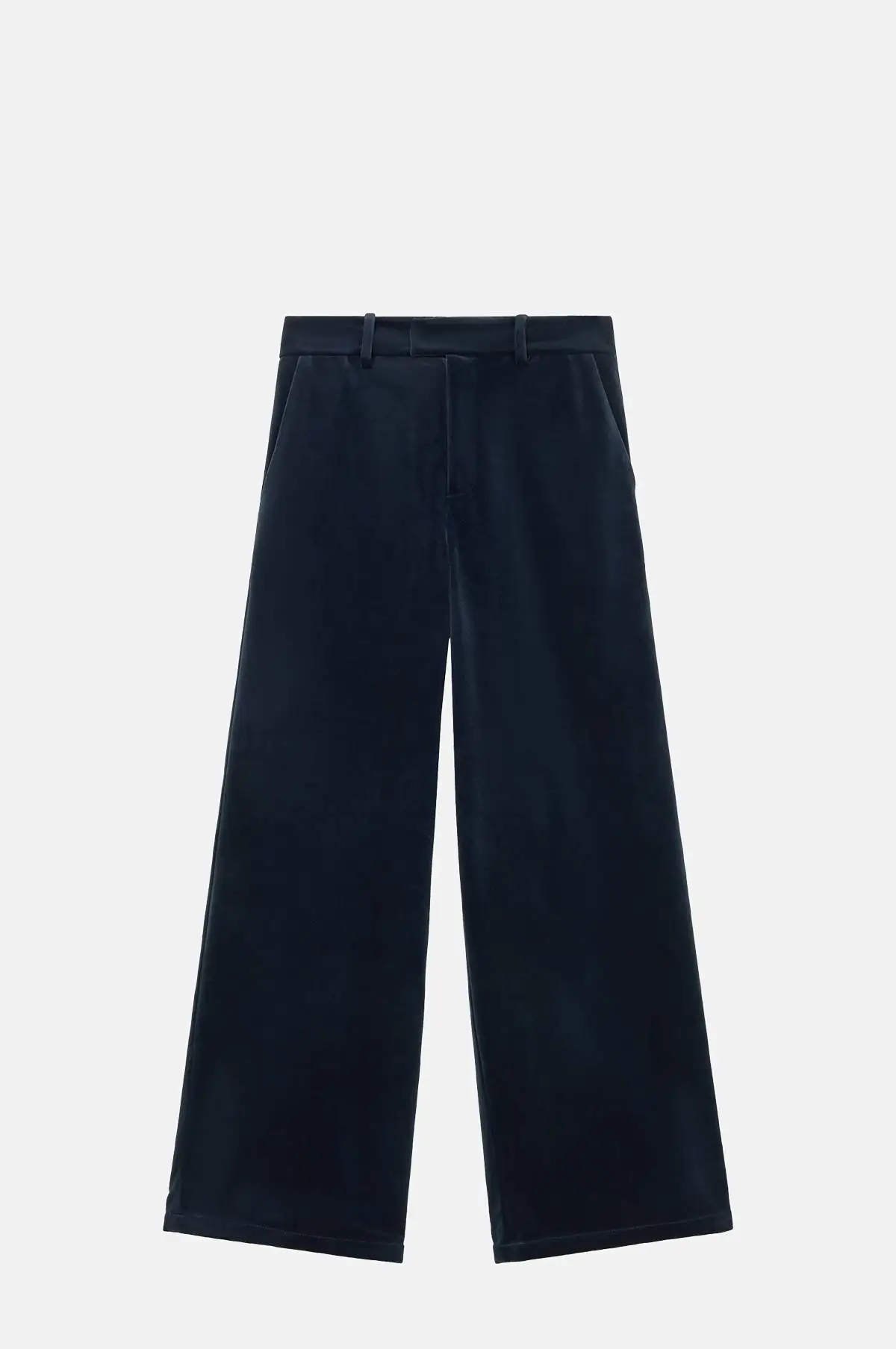

A pair of wide leg trousers from The Tiny Big Sister in a rich inky blue velvet, with a mid rise, a zip fly and a bar and hook fastening, slashed front pockets and welt pockets at the back, listed at 136 GBP with all five sizes in stock. The house publishes a size conversion, 34 is an XS through 42 is an XL, which is the second time this run has been able to place sizes against a body chart without guessing, and it is worth saying so before anything else. What the conversion then lets you do is read the two length columns properly, and that is where this garment gets interesting, because they contradict each other. The inside leg reads 79, 80, 80, 80 and 80, so it grades one centimetre and then stops dead for four sizes. The total length reads 108 to 112, grading a neat centimetre per size throughout. Subtract one from the other and the rise works out at 29, 29, 30, 31 and 32 centimetres, which means the entire length grade has gone into the rise and none of it into the leg. That is the wrong way round, and for a taller customer it is the difference between trousers that fit and trousers that do not. The reference is the Velvet Pants in Ink Blue. Dongguan Bafinasa Garments Co., Ltd. develops comparable trousers on OEM and ODM terms, from cloth selection and pocketing to hardware and retail or FBA ready packing. We publish this as a development reference and build your own version of it, and we do not supply the branded original or reproduce anyone else's label.
Key Features
- Inside leg of 79, 80, 80, 80 and 80 cm, so it grades once and then stops for four sizes. See the note below
- Total length grading one centimetre per size, which means the whole grade goes into the rise, derived at 29 to 32 cm. See the note below
- A size conversion published, 34 is XS through 42 is XL, so the waist figures can be read against a body chart. See the note below
- Waist ease running from about one and a fifth inches to about minus one half at the largest size. See the note below
- Wide leg with a mid rise as stated, with no hip, no thigh and no hem width published. See the note below
- Zip fly with a bar and hook fastening, slashed front pockets and back welt pockets as stated, all four of them difficult in velvet. See the note below
- Hand wash only and iron on low, as stated, which is right about the washing and wrong about the ironing. See the note below
Customisable Options
- Cloth: polyester velvet to the reference, with the weight and the pile height specified, or a cotton velvet, a corduroy or a plain woven, each quoted separately
- Construction: nap cut one way throughout, with the marker planned for it and the extra cloth allowed
- Rise: mid rise to the reference, with the front and back rise given separately, or a high rise, or a low rise
- Length: graded in the leg rather than the rise, with a short, regular and long leg option
- Waist: a fixed waistband with a zip fly and a hook and bar, or an elasticated back, or a partly elasticated waist
- Pockets: slashed front and welt back to the reference, or patch pockets, or a clean front with welt pockets
- Cloth weight and pile height, nap direction and cutting allowance, rise and leg grading, hip and thigh and hem measurements, hardware, pocketing and interlining, size set, colour development, private label and care labelling
Specifications
| Style | Wide leg trousers in polyester velvet with a zip fly and welt pockets |
| Reference | The Tiny Big Sister, Velvet Pants, style AW26-819, ink blue, sizes 34 to 42 |
| Composition | 100% polyester as stated, with no weight and no pile height given. See the note below |
| Cloth | A rich inky blue velvet as stated, with no pile height, no weight and no nap direction noted. See the note below |
| Rise | Mid rise as stated, with no rise measurement published and the rise derivable from the two lengths. See the note below |
| Leg | Wide leg as stated, with no thigh and no hem width given. See the note below |
| Fastening | Zip fly with a bar and hook fastening as stated. See the note below |
| Pockets | Slashed front pockets and back welt pockets as stated. See the note below |
| Care | Hand wash only, do not tumble dry, iron on low, as stated. See the note below |
| Sizes Offered | 34 to 42, five sizes, all five in stock |
| Size Conversion | Published: 34 is XS, 36 is S, 38 is M, 40 is L and 42 is XL |
| Measurements Published | Waist, inside leg and total length for all five sizes. See the note below |
| Published Waist | 32, 34, 36, 38 and 40 cm, headed waist with no indication of whether it is the flat half or the full circumference. See the note below |
| Waist Around | 64, 68, 72, 76 and 80 cm, or 25.2, 26.8, 28.3, 29.9 and 31.5 in, read as flat halves. See the note below |
| Waist Ease | About 1.2, 0.8, 0.3, minus 0.1 and minus 0.5 in from smallest to largest. See the note below |
| Published Inside Leg | 79, 80, 80, 80 and 80 cm, or about 31.1 and 31.5 in. See the note below |
| Published Total Length | 108, 109, 110, 111 and 112 cm, or 42.5 through 44.1 in |
| Derived Rise | 29, 29, 30, 31 and 32 cm, being the total length less the inside leg. See the note below |
| Published Hip | None. See the note below |
| Published Thigh | None. See the note below |
| Published Hem Width | None, on a wide leg trouser. See the note below |
| Published Front Rise | None, only a mid rise description |
| Model | None stated, no height and no body measurements |
| Photographs | Six, the most in this batch |
| Cloth Weight | Not stated |
| Production | Made in China as stated |
| Reference Retail | 136 GBP as listed, quoted to show the price band this sits in, not as our price |
| Category | Filed by the reference under trousers |
| Occasion | Autumn and winter, evening, work, weekend, dressed up or down as the reference claims |
| MOQ | 100 pcs per style per colourway, mixed sizes and colourways accepted |
| Sampling | 7-10 days after tech pack or reference sample confirmation |
| Bulk Lead Time | 20-30 days after sample approval and deposit |
| Service | OEM / ODM / private label, velvet sourcing with pile specified, nap planning and one way cutting, trouser construction and pocketing, hardware specification, retail or FBA ready packing |
Size Chart as Published by the Reference
| Size | Waist (cm) | Inside Leg (cm) | Total Length (cm) |
|---|---|---|---|
| 34 / XS | 32 cm | 79 cm | 108 cm |
| 36 / S | 34 cm | 80 cm | 109 cm |
| 38 / M | 36 cm | 80 cm | 110 cm |
| 40 / L | 38 cm | 80 cm | 111 cm |
| 42 / XL | 40 cm | 80 cm | 112 cm |
The waist figures are headed waist with no indication of whether they are the flat half or the full circumference, and 32 cm cannot be a full waist, so they must be flat halves doubling to 64, 68, 72, 76 and 80 cm around, or 25.2 through 31.5 in. Against a body waist that runs 24, 26, 28, 30 and 32 in across XS to XL, the ease is about one and a fifth inches at the 34 and about minus one half at the 42. The inside leg is 79 cm at the smallest and then 80 on all four larger sizes, and the total length grades one centimetre per size from 108 to 112, so the rise, being the difference between them, runs 29, 29, 30, 31 and 32 cm.
Our Proposed Body Chart
| Size | Body Bust | Body Waist | Body Hips | Length | Source |
|---|---|---|---|---|---|
| 34 / XS | 31 in / 79 cm | 24 in / 61 cm | 34 in / 86 cm | 108 cm / 42.5 in | Our proposal |
| 36 / S | 33 in / 84 cm | 26 in / 66 cm | 36 in / 91 cm | 110 cm / 43.3 in | Our proposal |
| 38 / M | 35 in / 89 cm | 28 in / 71 cm | 38 in / 97 cm | 112 cm / 44.1 in | Our proposal |
| 40 / L | 37 in / 94 cm | 30 in / 76 cm | 40 in / 102 cm | 114 cm / 44.9 in | Our proposal |
| 42 / XL | 39 in / 99 cm | 32 in / 81 cm | 42 in / 107 cm | 116 cm / 45.7 in | Our proposal |
Occasions and Styling
Suits autumn and winter, and the reference is right that it dresses up and down. Velvet wide leg trousers are an evening piece with a silk shirt and a weekday one with a knit, and an inky blue is dark enough to pass for navy in daylight and to read as a colour under artificial light.
Production and Quality Control
The reference publishes three columns for all five sizes, states its fibre, describes the rise, the leg, the fastening and both kinds of pocket, gives a care instruction with three parts, names the country of make, publishes a size conversion and shows six photographs. It publishes no hip, no thigh, no hem width, no rise of its own and no cloth weight, and its inside leg does not grade. Three things follow: what a frozen inside leg does to a length grade, what a waist column with no qualifier means, and what velvet asks of a factory that no other cloth does.
A leg that does not grow and a rise that does, and that is the first thing. The inside leg reads 79, 80, 80, 80 and 80, so it gains one centimetre between the first two sizes and then nothing at all for four sizes. The total length reads 108, 109, 110, 111 and 112, grading a clean centimetre throughout. Subtract one from the other, which is the check this run recommends on any table with two length columns, and the rise falls out at 29, 29, 30, 31 and 32 centimetres. So the garment gets longer as it gets bigger, and every millimetre of that extra length goes above the crotch and none of it goes below. That is the wrong way round, and it is worth setting out why, because the two measurements do different jobs. A leg length answers to the height of the wearer and to nothing else: it is the distance from the crotch to the hem, and a taller woman needs more of it regardless of her waist. A rise answers to the shape of the body and to where the wearer likes a trouser to sit, and it changes very little across a size range, since a larger waist does not by itself mean a longer body. The normal grade therefore puts most of the length into the leg and a little into the rise. This table puts all of it into the rise. The consequence is specific and it is worth stating: a customer who takes a 42 because she needs the waist gets the same leg as the customer who takes a 38, and if she is taller as well as larger, which is the usual correlation, then the trousers will be too short in the leg and too long in the body, and the waistband will sit higher on her than it was designed to. That is a fit failure that no amount of trying on in a shop will explain to her, because nothing about the garment looks wrong on the hanger. It is worth asking how it happens, and there are two plausible answers. The first is that the leg is deliberately held, because the house wants the hem to fall at the same place on every customer, which is a decision some brands make and which is defensible if you say so. The second is that the column was set once and never graded, which is the pattern this run has met on sleeves and on lengths and on a chest, and which is the shape of a figure filled in rather than calculated. Either way the page does not say, and the remedy is the same: publish the front and the back rise as their own line, which is what a trouser spec has anyway, and grade the leg. There is one more thing in these numbers that belongs to the customer rather than the factory. A total length of 108 cm and an inside leg of 80 cm are both long figures, and with no model height published there is no way to place either of them on a body, so a customer cannot tell whether these trousers are full length, floor length or intended to break on the shoe.
A waist with no qualifier, and an ease that reaches zero, and that is the second thing. The column is headed waist and nothing else, and the figures are 32, 34, 36, 38 and 40. There is no indication whether that is the flat half, measured across the waistband with the garment laid down, or the full circumference, and the two differ by a factor of two. It has to be the flat half, since a waist of 32 cm around is not a waist anyone can wear, but a table should not require the reader to work that out from first principles, and this run has met the same ambiguity repeatedly in the other direction, where pages say pit to pit and mean the flat half and others say chest and mean the same thing. One word fixes it. Reading them as flat halves, the waist doubles to 64, 68, 72, 76 and 80 cm, or 25.2 through 31.5 in, and against a body waist that runs 24, 26, 28, 30 and 32 in across XS to XL the ease is about one and a fifth, four fifths, three tenths, minus one tenth and minus one half of an inch. So by the largest size the published waist is smaller than the body it is labelled for, and on a trouser that closes with a zip and a hook and bar, in a woven polyester velvet with no elastane in it and no stretch to speak of, a waist half an inch under the body does not close. That is worth saying plainly, and it is worth noting how it happened, because it is the same arithmetic this run has now found on a dozen garments: the grade is two centimetres of flat width per size, which is four centimetres of circumference, or 1.57 in, against a body chart moving two inches per size, so about 0.43 in of ease is lost at every step and about 1.7 in across four steps, which is the whole distance from one and a fifth to minus one half. The grade that would hold it is 2.54 cm of flat width per size. It is also worth saying what the waist means on this garment as opposed to the skirt published alongside it, because the two pages give the identical column and the identical figures, and the same number does not mean the same thing on the two: on these trousers the waist is a fixed waistband with a metal fastening, so it is a hard limit, and on the skirt it is elasticated, so it is a starting point. That comparison is taken up in the article on the skirt, and it is the most useful thing these two pages have to say to each other. Finally the absences in the girths, which on a trouser matter more than on anything else in this run: no hip, no thigh and no hem width. A wide leg trouser is defined by its hem, and the hem width is the single number that decides whether it reads as a wide leg, a straight leg or a flare, and it is not published. And a trouser that must close at the waist has to pass over the hip to get there, so the hip is the measurement that decides whether the size you can fasten is the size you can wear, and it is not published either.
Velvet, and what it asks of a factory, and that is the third thing. Velvet is not a colour or a finish, it is a construction: a cloth with a pile standing up from the surface, and everything difficult about it follows from the pile. There are four consequences and all four belong in a tech pack. The first is nap. A velvet has a direction, and the pile lies differently depending on which way you brush it, so two panels cut in opposite directions read as two different shades of the same colour under the same light. That means every panel of the garment has to be cut the same way, which is called cutting one way or cutting to nap, and it increases cloth consumption, sometimes by ten per cent and sometimes by more, depending on the pattern and the width of the cloth. That is a cost, and it has to be allowed for in the marker and in the price, and no page in this run mentions it. The second is crushing. The pile flattens under pressure and under heat, and once flattened it does not always come back, which is why velvet is packed with tissue along every fold, or hung, and why a velvet garment that has been folded hard in a container arrives with lines in it that no amount of steaming will fully remove. The third is that the pile hides everything, including your own work. A pocket mouth, a welt line and a topstitch all but disappear into a velvet surface, and a slashed pocket opening in velvet frays at the slash because there is no weave to hold the cut, so it has to be reinforced from behind with an interlining or a stay before it is slashed at all. A welt pocket in velvet is the hardest pocket there is, for the same reason: the welt has to sit crisp on a surface that swallows definition, and the mouth has to be stabilised before it is cut. This garment has both. The fourth is pressing. You cannot press velvet flat, because the iron crushes the pile, and the correct way to finish it is to steam it over a board with the pile face down, or to use a needle board that lets the pile sit into holes rather than against a flat surface. Now the care label, which gets two of these right and one wrong. Hand wash only is correct for velvet, since agitation and a machine both disturb the pile, and do not tumble dry is correct for the same reason. Iron on low is the one that is wrong, because low heat applied with weight is still an iron crushing a pile, and the instruction a velvet garment should carry is to steam rather than to iron, and to do it from the wrong side. It is a small thing and it is the sort of thing that ruins a garment irreversibly, and this run has now met several labels that follow habit rather than material: wool always dry clean, corduroy always thirty degrees, and here a label that understands the washing of velvet and not the pressing of it. Then the hardware, which is the last of it: a zip fly and a bar and hook in a velvet need a fly guard behind the zip so the teeth do not sit against the pile, a stay behind the hook and bar so it does not tear out of a cloth with no structure, and a test on both, since a hook pulled through velvet does not fail gradually, it comes out. Every bulk shipment gets a measurement report against your approved chart.
Optional upgrades include grading the inside leg instead of holding it at 80 and putting the length grade where it belongs, publishing the front and the back rise as their own line, publishing the hip, the thigh and the hem width, which on a wide leg trouser is the number that defines it, stating whether the waist column is the flat half or the circumference, adjusting the waist grade so the ease does not reach minus one half at the 42, specifying the velvet by weight and pile height and allowing for one way cutting in the marker, reinforcing the slashed pocket mouths and stabilising the welt mouths before cutting, adding a fly guard behind the zip and a stay behind the hook and bar, changing the iron instruction to steam from the wrong side, packing with tissue or hanging so the pile is not crushed, adding a model height so 108 cm can be placed on a body, short, regular and long leg options, a cotton velvet, a corduroy and a plain woven alternative, a partly elasticated waist option, size set, colour development, private label, hangtag and care labelling.
Pre-production sample approval, in-line inspection during cutting and sewing, and a final AQL inspection before packing, with measurement reports and photos shared before shipment.
Send us your tech pack, a photo or a reference garment and we will quote within 24 hours. Contact bafinasa@bafinasa.com or WhatsApp +86 13827222469.