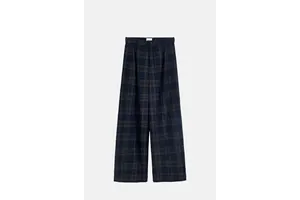
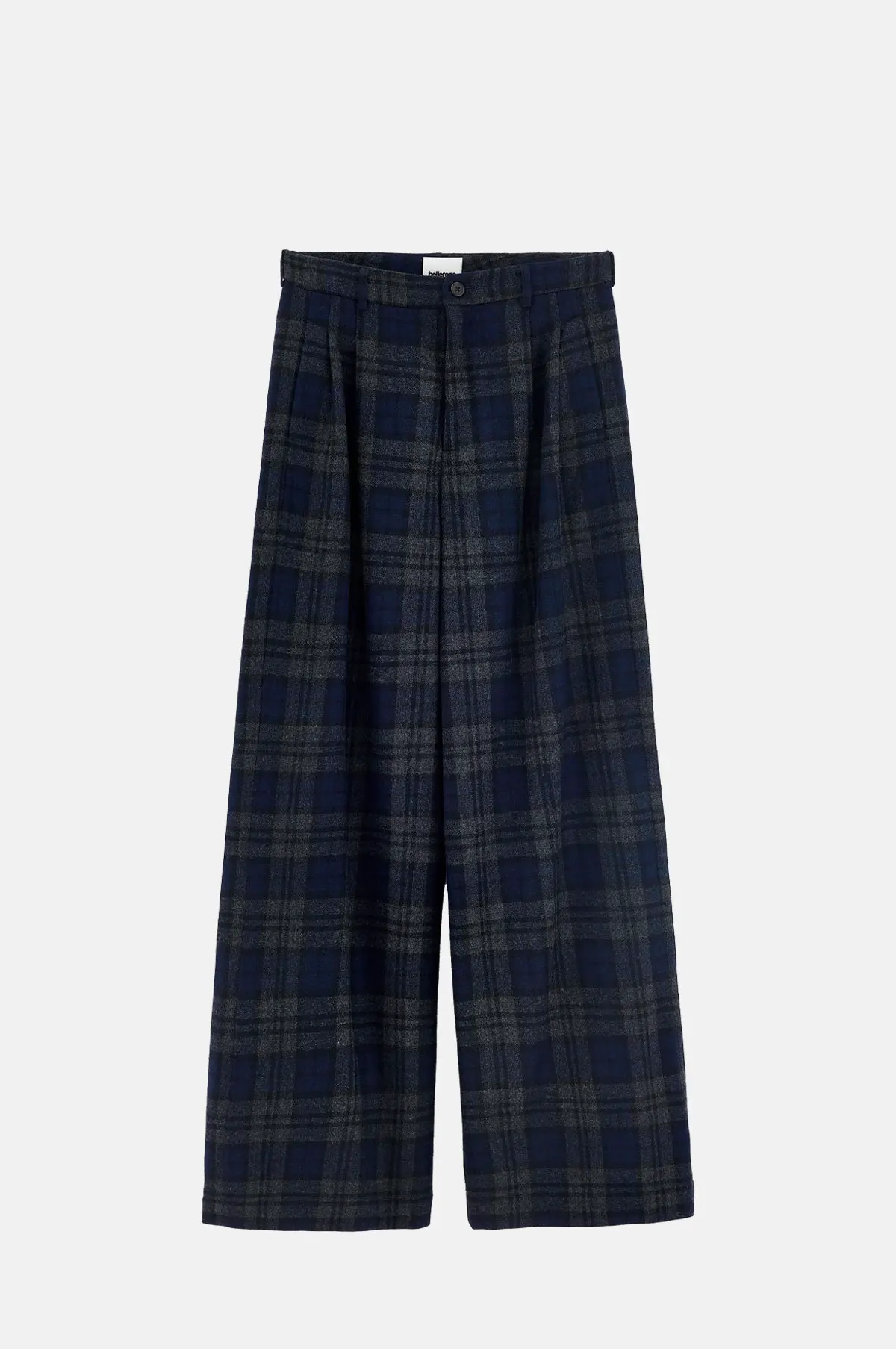

A trouser from Bellerose in a wool blend with a navy and charcoal check, cut low on the waist with extra-long wide legs, deep front pleats, a satin half lining, side and back welt pockets and belt loops, listed at 225 GBP with the largest size sold out. It publishes two length columns rather than the usual one, and that turns out to matter a great deal, because the difference between them is a third measurement that the page never lists. The inseam runs 73 to 77 centimetres and the total length runs 100 to 104, and subtracting one from the other gives 27 centimetres at every single size without exception. That difference is the rise, the distance from the top of the waistband down to the crotch, and it is frozen across the whole size range. Both columns move and the dimension between them does not, so the only way to find out is to subtract, and nothing on the page invites the reader to. That is worth knowing about a trouser, because the rise is the measurement that decides whether it is comfortable to sit down in. The composition is worth a look too, because it is the first in this run to give up partway through and stop naming fibres. The reference is the Jenoa Pant in Check A. Dongguan Bafinasa Garments Co., Ltd. develops comparable trousers on OEM and ODM terms, from cloth sourcing to retail or FBA ready packing. We publish this as a development reference and build your own version of it, and we do not supply the branded original or reproduce anyone else's label.
Key Features
- Inseam and total length both published, and their difference is a constant 27 cm, so the rise does not grade across any of the five sizes. See the note below
- 70% wool, 20% polyester, 6% polyamide and 4% other fibres, the first composition in this run that stops naming fibres partway through. See the note below
- Half-lined with satin as stated, which is a weave and not a fibre, and the lining is absent from the specification panel. See the note below
- Low-rise as stated, on a chart whose column is headed waist, so the two do not refer to the same place on the body. See the note below
- Deep front pleats as stated, with no pleat count and no pleat depth, and on a checked cloth where a pleat breaks the pattern. See the note below
- Extra-long legs that pool at the floor as stated, which makes the inseam unusable for judging fit and depends on a height that is not published. See the note below
- Dry clean only as stated, which does follow from a 70% wool cloth, unlike the cotton skirt published alongside it. See the note below
Customisable Options
- Cloth: wool blend to the reference, with the weight and the wool micron stated, or a 100% wool, a wool polyester or a wool viscose, each quoted separately
- Check: navy and charcoal to the reference, with the repeat published in centimetres, or a smaller check, a windowpane or a plain cloth, each quoted separately
- Rise: low to the reference at a 27 cm side rise, held across sizes, or a graded rise, or a mid rise or a high rise, each quoted separately
- Leg: extra-long wide leg to the reference, with the hem width published, or a standard length, or a tapered leg, or a narrower wide leg
- Pleats: deep front pleats to the reference, with the count and depth specified and the direction chosen, or a single pleat, or no pleats
- Lining: satin half lining to the reference, with the fibre named and the coverage stated, or a viscose half lining, or a full lining, or unlined, each quoted separately
- Cloth weight and wool micron, check repeat, rise and whether it grades, hem width, pleat count and depth, lining fibre and coverage, pocket and welt specification, belt loop specification, size set, colour development, private label and care labelling
Specifications
| Style | Low-rise wide leg trouser in a checked wool blend with front pleats |
| Reference | Bellerose, Jenoa Pant, style BW262118 C1452-CHA, navy grey check, sizes 34 to 42 |
| Composition | 70% wool, 20% polyester, 6% polyamide, 4% other fibres, as stated in the panel. See the note below |
| Cloth | A substantial woollen-blend fabric as stated, with no weight and no wool micron given. See the note below |
| Pattern | Navy and charcoal check as stated, with no repeat given. See the note below |
| Rise | Low-rise as stated, with the rise not published as a figure. See the note below |
| Leg | Wide, extra-long leg that pools slightly at the floor as stated, with no hem width given. See the note below |
| Pleats | Deep front pleats for added volume as stated, with no count and no depth given. See the note below |
| Lining | Half-lined with satin as stated, with no fibre given and no line in the panel. See the note below |
| Pockets | Functional side pockets and back welt pockets as stated, with no dimensions given. See the note below |
| Waist Finish | Traditional belt loops as stated, with no count, width or attachment method given. See the note below |
| Care | Dry clean only as stated. See the note below |
| Sizes Offered | 34 to 42, five sizes, with 42 sold out at the time of writing |
| Size Conversion | Published: 34 is XS, 36 is S, 38 is M, 40 is L and 42 is XL |
| Fit Guidance | None published |
| Model | None published. See the note below |
| Measurements Published | Waist, inseam and total length for all five sizes. See the note below |
| Published Waist | 34, 36, 38, 40 and 42 cm flat, or 13.4 through 16.5 in. See the note below |
| Waist Around | 68, 72, 76, 80 and 84 cm, or 26.8, 28.3, 29.9, 31.5 and 33.1 in. See the note below |
| Ease Against Body Waist | About 2.8, 2.3, 1.9, 1.5 and 1.1 in, but see the note below about where a low-rise band sits |
| Published Inseam | 73, 74, 75, 76 and 77 cm, grading one centimetre per size. See the note below |
| Published Total Length | 100, 101, 102, 103 and 104 cm, grading one centimetre per size. See the note below |
| Rise Derived | Total length minus inseam is 27 cm at every size, so it does not grade. See the note below |
| Hip | None, on a low-rise trouser with pleats. See the note below |
| Hem Width | None, on a garment described as a wide leg. See the note below |
| Check Repeat | None. See the note below |
| Pleat Specification | None. See the note below |
| Cloth Weight | Not stated. See the note below |
| Photographs | Six |
| Production | Made in China as stated |
| Reference Retail | 225 GBP as listed, quoted to show the price band this sits in, not as our price |
| Category | Filed by the reference under trousers |
| Occasion | Autumn and winter, work, smart casual, with a knit or a shirt |
| MOQ | 100 pcs per style per colourway, mixed sizes and colourways accepted |
| Sampling | 7-10 days after tech pack or reference sample confirmation |
| Bulk Lead Time | 20-30 days after sample approval and deposit |
| Service | OEM / ODM / private label, wool blend sourcing by weight, check development and matching, pleat and half lining development, retail or FBA ready packing |
Size Chart as Published by the Reference
| Size | Waist (flat) | Inseam | Total Length |
|---|---|---|---|
| 34 / XS | 34 cm | 73 cm | 100 cm |
| 36 / S | 36 cm | 74 cm | 101 cm |
| 38 / M | 38 cm | 75 cm | 102 cm |
| 40 / L | 40 cm | 76 cm | 103 cm |
| 42 / XL (sold out) | 42 cm | 77 cm | 104 cm |
The waist figures are flat half measures taken with the trouser laid down, doubling to 68, 72, 76, 80 and 84 cm around, or 26.8, 28.3, 29.9, 31.5 and 33.1 in. Against a body waist of 24 to 32 in across XS to XL, the ease runs about 2.8, 2.3, 1.9, 1.5 and 1.1 in, though on a low-rise trouser the band does not sit at the natural waist so that comparison is only indicative. The inseam grades one centimetre per size and the total length grades one centimetre per size, and the difference between them, which is the rise, is a constant 27 cm on every size.
Our Proposed Body Chart
| Size | Body Bust | Body Waist | Body Hips | Length | Source |
|---|---|---|---|---|---|
| 34 / XS | 31 in / 79 cm | 24 in / 61 cm | 34 in / 86 cm | 100 cm / 39.4 in | Our proposal |
| 36 / S | 33 in / 84 cm | 26 in / 66 cm | 36 in / 91 cm | 102 cm / 40.2 in | Our proposal |
| 38 / M | 35 in / 89 cm | 28 in / 71 cm | 38 in / 97 cm | 104 cm / 40.9 in | Our proposal |
| 40 / L | 37 in / 94 cm | 30 in / 76 cm | 40 in / 102 cm | 106 cm / 41.7 in | Our proposal |
| 42 / XL | 39 in / 99 cm | 32 in / 81 cm | 42 in / 107 cm | 108 cm / 42.5 in | Our proposal |
Occasions and Styling
Suits autumn and winter and smart casual dressing. A checked wool trouser with pleats and a long wide leg is a tailored piece, and it wants something plain and fine on top: a knit or a shirt, with the trouser doing the work.
Production and Quality Control
The reference publishes three columns for all five sizes, states a four-part composition with percentages, describes the cloth, the pattern, the rise, the leg, the pleats, the lining, the pockets and the waist finish, gives a care instruction, names the country of production and publishes a size conversion. It publishes no fit guidance and no model information, and gives no hip, no hem width, no check repeat, no pleat specification, no cloth weight, no pocket dimensions and no figure for the rise. Three things follow: the rise that is hiding between two columns, the composition that stops naming fibres, and the measurements that cannot be used as they stand.
Twenty-seven centimetres on every size, and that is the first thing. Most trouser charts in this run publish one length; this one publishes two, an inseam of 73 to 77 cm and a total length of 100 to 104 cm. Subtracting gives 27 at every size: 100 minus 73, 101 minus 74, 102 minus 75, 103 minus 76, 104 minus 77. That difference is not a coincidence or an artifact, it is a measurement, and it is the one the chart does not list. The total length of a trouser is taken down the outside of the leg from the top of the waistband to the hem; the inseam is taken up the inside from the crotch to the hem. So the difference between them is the distance from the top of the waistband down to the crotch, measured along the side seam, which is the side rise. And it is 27 cm on the smallest size and 27 cm on the largest, and on every size between. So the rise does not grade. It is worth saying why this is worth knowing, because the rise is not a minor dimension. It is the measurement that decides where the trouser sits and whether there is room to sit down in it. The body's own waist-to-crotch distance grows as bodies get bigger, by something in the region of half a centimetre to a centimetre per size, so a trouser whose rise is held at 27 across five sizes will sit progressively shorter in the body at the larger sizes, and by the largest the gap is several centimetres. That is not comfortable, and it is not visible from the chart. It is also worth saying how unusual it is to be able to find this at all, and why the method matters. This run has derived dimensions before in order to check a claim: it has doubled flat chest figures to get circumferences, it has subtracted a waist from a length to place a hem on a body, and it has divided one column by another to recover a grade. In each case the published chart contained the answer but did not state it. Here the same trick reveals something the chart actively conceals, because both columns move and the reader has no reason to subtract them. A frozen rise is not a rare decision; plenty of trousers are graded with a constant rise, because it keeps the pattern simple and because a rise that grows can make the seat baggy. The objection is not to the decision but to its invisibility: publishing the rise as a column would take one line and would tell a customer more than either of the two columns it is derived from. And it is worth noting that the two columns do allow one claim to be checked, which is the low rise. A side rise of 27 cm corresponds to a front rise a good deal shorter, because the measurement up the side passes over the hip, and that is consistent with a trouser that sits below the natural waist. So the fit word is supported by arithmetic, which is rarer than it should be.
Four per cent of other fibres, and that is the second thing. The panel reads 70% wool, 20% polyester, 6% polyamide, 4% other fibres. Three fibres are named to the percentage and the fourth is a category. It is worth being fair about this first, because it is not necessarily a failure of disclosure: fibre labelling rules in Europe permit a fibre to be grouped as other fibres when it falls below a threshold, so this is very likely lawful. But lawful and useful are different things, and from a maker's point of view four per cent unidentified is a real gap. The obvious candidate is elastane, and if it is, then this trouser has comfort stretch, which changes how it should be cut, how it recovers at the knee and the seat, and how it behaves under a pressing machine, since elastane is damaged by heat. If it is not elastane, it could be acrylic, or silk, or cashmere, or recycled content, and each of those says something different about the cloth and about what can be claimed for it. A single word would close it. It is worth crediting what the rest of the list does, which is more than most pages manage. Thirty per cent of this cloth is not wool, and the blend has an evident purpose rather than being unexplained: polyester is there for crease recovery and strength, and polyamide for abrasion resistance, which matters on trousers because they wear at the seat, at the inner thigh and at the hem. This is the third blend in two batches in this run with a legible technical reason, and it is worth saying that this is what a blend should look like on a page: the majority fibre named, and the reason for the others inferable from what they do. What is still missing is the weight, which is the number a trouser cloth is bought by, and the wool's own specification, since wool is sold by micron and there is none. Then the lining, which is the part of this garment that is least well served. The description says the trouser is half-lined with satin, and says it is for comfort. Half-lined is good, because it states the coverage, and this run has complained before about linings given with no coverage at all, as on a printed skirt whose panel said lining and said nothing about how far down it went. But satin is a weave, not a fibre, so the page has told the reader how the lining is constructed and not what it is made of. And the specification panel, which gives the shell to four parts, contains no line for the lining whatsoever. So the reader knows the shell precisely and the lining not at all, and the two are not even in the same place on the page. That matters here because a satin lining can be made from polyester, from viscose or from acetate, and they are not equivalent: a polyester satin will not absorb moisture, so on a wool trouser worn over tights the comfort claim depends entirely on which one it is. It is also worth asking whether the stated composition covers the shell only or the garment as a whole, since a half lining is a substantial component and the page does not say. Then the pockets and the waist finish, both of which are named and neither of which is specified: side pockets and back welt pockets with no opening, no depth and no welt width, and belt loops with no count, no width and no statement of whether they are set into the waistband seam or stitched on top of it. A welt pocket in a checked cloth is also a decision rather than a default, because a welt either matches the check or is deliberately cut across it.
A waist that is not at the waist, and legs that are too long on purpose, and that is the third thing. The chart's first column is headed waist and runs 34 to 42 cm flat, or 68 to 84 cm around, and against a body waist of 24 to 32 in that is about 2.8 inches of ease at the smallest falling to about 1.1 at the largest, which is a close, tailored fit and a steady, gentle drift. But the trouser is low-rise, and a low-rise waistband does not sit at the natural waist. It sits below it, on the high hip, where most bodies measure more, not less. So the figure the published waist ought to be compared against is not the body waist at all, it is the body circumference at the point where the band actually lands, and that number is neither published nor the same for every body. The column heading says waist and the fit word says low-rise and they are describing two different places. That is worth stating plainly because it is the sort of thing a customer cannot work out and a maker must: the ease is smaller than the chart suggests, and how much smaller depends on the wearer's shape. Then the length, which the page handles unusually honestly and which still cannot be used. The description says the legs are extra-long and wide and that they pool slightly at the floor. That is a deliberate styling decision and it is refreshing to see it stated rather than hidden, because it means the inseam is not intended to match the wearer's inseam, and a customer who did not read that sentence would conclude the trousers were simply too long. But the sentence describes an effect that depends entirely on how tall the wearer is, and this brand publishes no model height on any garment this run has examined, so there is no way to know at what height the pooling begins or how much there will be. On a woman of average height an inseam of 73 cm roughly reaches the floor, so the pooling will start there and increase as she gets shorter. And if she wants them shortened, a wide leg cannot simply be turned up: the hem circumference is large, and shortening it without adjusting the leg changes the line of the trouser, and no hem width is published to work from. The hip is not published either, which on a low-rise trouser with deep pleats is the measurement that decides whether it goes on. And the pleats themselves, described as deep, have no count and no depth: one or two to a leg, how deep, and pleated towards the fly or towards the side, all of which change how the trouser hangs. On a checked cloth a pleat is also a decision about the pattern rather than only about volume, because a pleat folds the cloth back on itself and so it cannot carry the check through it: the maker has to choose whether to hide the pleat in the check or let it break the pattern, and the repeat that would let her plan it is not given. Finally the care label, which reads dry clean only and which is correct: a 70% wool trouser with pleats and a lining is a dry clean garment, and this run has just spent a page on a cotton skirt from the same brand whose hand wash label the fibre does not explain. So the same brand, in the same batch, gets one care label right for the right reason and one that needs explaining. Every bulk shipment gets a measurement report against your approved chart.
Optional upgrades include publishing the rise as its own column and deciding whether it should grade, naming the fourth fibre or stating that it is elastane, naming the lining fibre and saying whether the stated composition covers the shell only, publishing the check repeat in centimetres and stating whether the check is matched at the seams and across the pleats, publishing the hip and the hem width, specifying the pleats by count, depth and direction, specifying the pockets by opening and depth and the welt by width, specifying the belt loops by count, width and attachment, publishing the cloth weight and the wool micron, publishing a model height so the pooling can be understood, a 100% wool, wool polyester and wool viscose option, smaller check, windowpane and plain options, graded rise, mid rise and high rise options, standard length and tapered leg options, single pleat and no pleat options, viscose half lining, full lining and unlined options, size set, colour development, private label, hangtag and care labelling.
Pre-production sample approval, in-line inspection during cutting and sewing, and a final AQL inspection before packing, with measurement reports and photos shared before shipment.
Send us your tech pack, a photo or a reference garment and we will quote within 24 hours. Contact bafinasa@bafinasa.com or WhatsApp +86 13827222469.