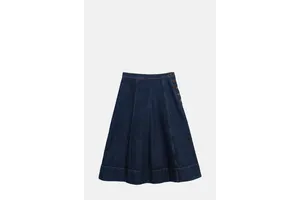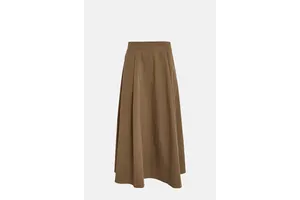
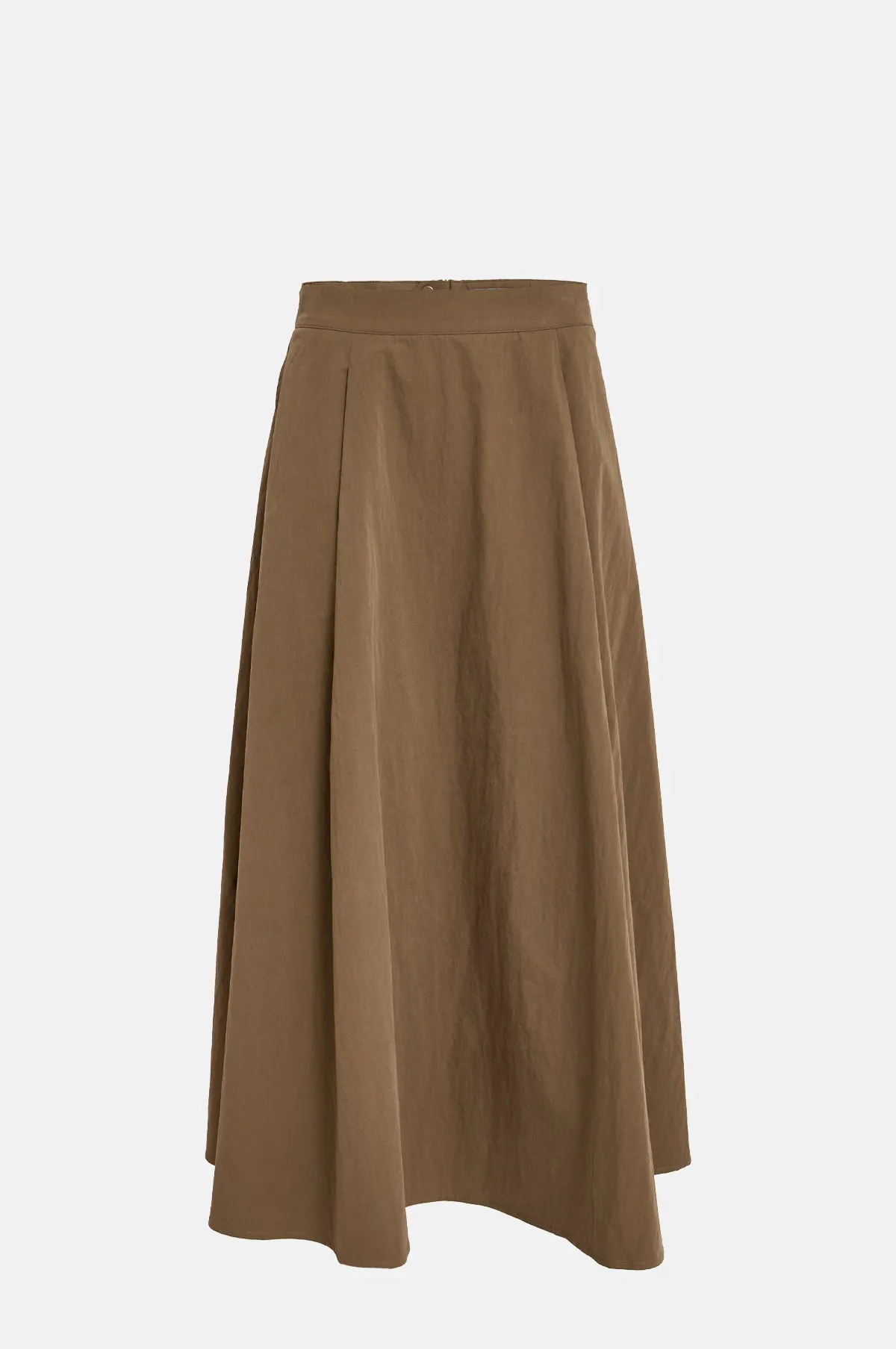

A pleated A-line skirt from Minus in a warm mid brown, in a crisp cotton and polyamide blend with deep pleats at the waistband, side pockets and a fixed waistband, listed at 100 GBP with three of five sizes in stock. It is the second pleated midi skirt this brand has published in this run, and the comparison is the most useful thing about it, because the two are nearly the same garment and their numbers disagree in two interesting places. The first is the length. The other skirt was published at 91 centimetres and this one at 93, and this run worked out last batch that 91 centimetres from the waist puts a hem about fifteen centimetres off the floor on a woman of average height, which is a maxi and not a midi. Two garments from one brand, both called midi, both measuring in the low nineties, which means it is not a slip of the keyboard but the brand's definition of the word. The second is the waist, which grades three, two, two and two centimetres here against a clean two on the other one. And there is a third thing, which is the pleats, and it is the one a customer would want to know: nothing on this page says whether they survive a wash. The reference is the Rosea Midi Skirt in Tiramisu. Dongguan Bafinasa Garments Co., Ltd. develops comparable skirts on OEM and ODM terms, from cloth selection and pleating to retail or FBA ready packing. We publish this as a development reference and build your own version of it, and we do not supply the branded original or reproduce anyone else's label.
Key Features
- Deep pleats at the waistband as stated, with nothing to say whether they are set to survive washing. See the note below
- Midi length as stated, against a published total length of 93 cm, which is longer still than the other skirt from this brand. See the note below
- Waist grading three, two, two and two centimetres, against a clean two on the same brand's other skirt. See the note below
- Crisp, structured handle as stated, achieved here with 26% polyamide where the other skirt used polyester, with no weight given either way. See the note below
- Functional side pockets as stated, on a pleated skirt, where the pocket opening has to miss the pleats. See the note below
- Fixed waistband as stated, with about three and a half inches of ease at the smallest size
- Two photographs, for a garment whose whole description is pleats and volume
Customisable Options
- Cloth: cotton polyamide blend to the reference, with the weight specified, or a cotton polyester, a pure cotton poplin or a wool blend, each quoted separately
- Pleats: deep pleats at the waistband to the reference, with the count, the depth and the direction specified, and either heat set for permanence or pressed only, quoted separately
- Waist: fixed waistband to the reference, with the band depth published and the ease reduced, or an elasticated back, or a gathered waist
- Pockets: side pockets to the reference, placed between the pleats and specified by opening and depth, or no pockets, or patch pockets
- Length: midi to the reference with the length published from a named point and the hem position stated on a woman of a stated height, or offered in two lengths, or shortened to a true midi
- Silhouette: A-line to the reference, with the hem width published, or a straighter, a fuller gathered or an all round pleated version
- Cloth weight, pleat specification and whether set, waistband depth and ease, pocket placement and specification, hem width, length, size set, colour development, private label and care labelling
Specifications
| Style | A-line midi skirt with deep pleats at the waistband and side pockets |
| Reference | Minus, Rosea Midi Skirt, style MI7245 3681, tiramisu, sizes 34 to 42 Danish |
| Composition | 74% cotton and 26% polyamide as stated, with no cloth weight given. See the note below |
| Cloth | A crisp cotton and polyamide blend as stated, with no weight given. See the note below |
| Handle | Crisp and structured as stated, with no finish and no weight given. See the note below |
| Fit | A-line midi silhouette, structured and voluminous, as stated |
| Waist | Fixed waistband as stated, with no band depth given. See the note below |
| Pleats | Deep pleats at the waistband as stated, with no count, no depth and no setting method given. See the note below |
| Pockets | Functional side pockets as stated, with no opening and no depth given. See the note below |
| Care | Machine wash on gentle at 30, do not tumble dry, as stated. See the note below |
| Sizes Offered | 34 to 42 Danish, five sizes, three in stock with the 36 and the 42 sold out |
| Size Conversion | Published: 34 is XS, 36 is S, 38 is M, 40 is L and 42 is XL |
| Model | None stated, no height and no body measurements. See the note below |
| Measurements Published | Waist and total length for all five sizes. See the note below |
| Published Waist | 35, 38, 40, 42 and 44 cm flat, or 13.8 through 17.3 in. See the note below |
| Waist Around | 70, 76, 80, 84 and 88 cm, or 27.6, 29.9, 31.5, 33.1 and 34.6 in. See the note below |
| Ease Against Body Waist | About 3.6, 3.9, 3.5, 3.1 and 2.6 in from smallest to largest. See the note below |
| Published Length | 93 cm on all five sizes, with no grading. See the note below |
| Pleat Specification | None. See the note below |
| Pleat Setting | None, on a garment whose defining feature is its pleats. See the note below |
| Published Hip | None. See the note below |
| Published Hem Width | None, on a garment described as voluminous and A-line. See the note below |
| Cloth Weight | Not stated. See the note below |
| Photographs | Two. See the note below |
| Production | Made in China as stated |
| Reference Retail | 100 GBP as listed, ten pounds above the other pleated skirt from this brand, quoted to show the price band this sits in, not as our price |
| Category | Filed by the reference under skirts |
| Occasion | Autumn, winter and spring, work, weekend, with a tee or a tonal blouse as the reference suggests |
| MOQ | 100 pcs per style per colourway, mixed sizes and colourways accepted |
| Sampling | 7-10 days after tech pack or reference sample confirmation |
| Bulk Lead Time | 20-30 days after sample approval and deposit |
| Service | OEM / ODM / private label, cloth sourcing with weight specified, pleat setting and testing, pocket placement on pleated panels, retail or FBA ready packing |
Size Chart as Published by the Reference
| Size | Waist (flat) | Total Length |
|---|---|---|
| 34 DK / XS | 35 cm | 93 cm |
| 36 DK / S | 38 cm | 93 cm |
| 38 DK / M | 40 cm | 93 cm |
| 40 DK / L | 42 cm | 93 cm |
| 42 DK / XL | 44 cm | 93 cm |
The waist figures are flat half measures taken with the skirt laid down, doubling to 70, 76, 80, 84 and 88 cm around, or 27.6, 29.9, 31.5, 33.1 and 34.6 in. Against a body waist of 24, 26, 28, 30 and 32 in across XS to XL, the ease is about three and three fifths inches at the smallest and about two and three fifths at the largest. The waist grade is uneven, running three, two, two and two centimetres, where the same brand's other pleated skirt grades a clean two throughout. The total length is published as 93 cm on all five sizes with no grading, and no model height is given, so the hem cannot be placed on a body.
Our Proposed Body Chart
| Size | Body Bust | Body Waist | Body Hips | Length | Source |
|---|---|---|---|---|---|
| 34 DK / XS | 31 in / 79 cm | 24 in / 61 cm | 34 in / 86 cm | 93 cm / 36.6 in | Our proposal |
| 36 DK / S | 33 in / 84 cm | 26 in / 66 cm | 36 in / 91 cm | 95 cm / 37.4 in | Our proposal |
| 38 DK / M | 35 in / 89 cm | 28 in / 71 cm | 38 in / 97 cm | 97 cm / 38.2 in | Our proposal |
| 40 DK / L | 37 in / 94 cm | 30 in / 76 cm | 40 in / 102 cm | 99 cm / 39 in | Our proposal |
| 42 DK / XL | 39 in / 99 cm | 32 in / 81 cm | 42 in / 107 cm | 101 cm / 39.8 in | Our proposal |
Occasions and Styling
Suits autumn, winter and spring, work and weekends. A pleated A-line skirt is the piece that goes from a jersey tee to a tonal blouse without changing register, as the reference says, and the pleats are what stop a plain A-line from reading as a basic.
Production and Quality Control
The reference publishes two columns for all five sizes, states a two-fibre composition with percentages, describes the handle, the waist, the pleats, the pockets and the silhouette, gives a care instruction with two parts, names the country of make and publishes a size conversion. It gives no cloth weight, no hem width, no hip, no pleat specification, nothing about whether the pleats are set, and no model height. Three things follow: the second long midi, the uneven waist against the clean one, and the pleats.
Ninety-three, ninety-one, and the word midi, and that is the first thing. This skirt is published at 93 cm and the other pleated midi from this same brand, published in the batch before this one, was published at 91 cm. Both are called midi. This run worked out last batch what 91 cm means on a body: a skirt hangs from the waist, and the waist of a woman of average height sits roughly 105 cm above the floor, so a 91 cm skirt leaves about fourteen or fifteen centimetres between the hem and the ground, and a conventional midi would leave forty to sixty. So 91 is a maxi, and 93 is a longer maxi. Now, on one garment that could be a typo, and this run said last batch that it could be. On two garments from the same brand, it cannot be, and that changes the conclusion in a useful way. It is not an error, it is the brand's use of the word: for this brand a midi is a skirt that nearly touches the floor. That is a perfectly defensible position, and plenty of designers work that way, and it may even be intentional, since a longer skirt is more formal and this is a brand making refined pieces. But it means the word midi on this brand's pages carries a meaning it does not carry anywhere else, and no customer can discover that from either page, because neither publishes a model height. And that is the whole point, and it is worth setting beside the rest of this shop, because the evidence is now clear. Two brands in this shop publish a model height: one gave five feet ten and the size worn, and another, published alongside this one, gives 179 centimetres and the size worn. Minus publishes neither on either of its two skirts. So the information exists in the shop, it is being supplied by other brands, and it is simply absent here. One line, model is such and such and wears a size so and so, and the customer could place 93 cm on a body herself, which is the only way to know whether she is buying a midi or a maxi. It is worth adding the second observation about the length, which is that it does not grade, and here the run should repeat what it said last batch because it is a genuine defence. A skirt hangs from the waist, the waist sits at roughly the same height on the body whatever the size, so a constant skirt length is defensible in a way a constant dress length is not, and this skirt grows in the waist and not in the length and therefore keeps its silhouette. The constant length is fine. It is the value of it that is in question, and that is what the missing model height would settle.
Three, two, two, two, against two, two, two, two, and that is the second thing. The waist column reads 35, 38, 40, 42 and 44, so the steps between sizes are three, two, two and two centimetres. The other pleated skirt from this brand reads 36, 38, 40, 42 and 44, which is a clean two throughout. So the two charts are the same garment, from the same brand, in the same season, with the same number of sizes, and one of them has a first step half again as large as all the others while the other is perfectly even. That is a very tight comparison and it settles the same question this run settled last batch about a different brand's two tables that did and did not reconcile: this is not a method, it is an inconsistency. If the brand's waist grade were three centimetres at the bottom and two above it, you would expect it on both skirts, and it is on one. And it is worth noting what the two charts have in common, which is everything above the smallest size: 38, 40, 42 and 44 appear on both, so the anomaly is entirely in the 34, which is published as 35 here and 36 there. One centimetre at one size, on a garment that is otherwise identical, and it is either a measurement of a different sample or a digit typed wrong. It is worth saying what it costs, because a centimetre at the waist sounds like nothing and is not. Doubling, the smallest size is 70 cm around here and 72 cm there, so two skirts that are otherwise the same at every size differ by two centimetres at the waist in the size most likely to be bought by the smallest customer, who is the customer with the least room for error. Then the ease, which is the other thing the two charts disagree about. This skirt gives about three and three fifths inches of ease at the waist on a fixed band, and the other gives about four and a third, and this run said last batch that four and a third is more than a fixed waistband can comfortably carry, because a band with that much ease slides down until it reaches a part of the body wide enough to hold it. Three and three fifths is better and is close to defensible, so this skirt is the better of the two on that measure. It is worth adding what neither publishes, which is the hip. On an A-line skirt the hip is what decides how the cloth sits over the seat and whether the pleats spring open below it, and neither skirt gives it. And neither publishes the hem width, which on a garment described as a voluminous A-line is the measurement that decides whether it is a gentle A or a full one, and which is the number a customer would most like to see, because it is what she will see in the mirror.
The pleats, and whether they come out in the wash, and that is the third thing. The skirt is described as having deep pleats at the waistband, and they are the reason it looks the way it looks: they are what makes the silhouette voluminous, and they are what the eye reads first. Nothing on the page says whether those pleats are permanent. That is not a pedantic question and it is worth setting out why, because there are three states a pleat can be in and they behave completely differently. The first is a pleat that is simply pressed into the cloth with heat and steam. That pleat lasts until it gets wet, and then it falls out, and the skirt arrives back from its first wash as a plain A-line with a few soft creases where the pleats were. The second is a pleat that is sewn in, which is to say the pleat is stitched down at the waistband or partway down the panel. That pleat lasts as long as the stitching and gives a crisp line from the waist down to wherever the stitching stops, which on a skirt like this might be fifteen or twenty centimetres. The third is a pleat that has been permanently set, which is a chemical and thermal process: the cloth is treated, the pleats are formed in a press or between heated rollers, and the treatment holds them through repeated washing. Which of the three is used is a decision that costs money and changes the product, and it is not stated. And there is a specific reason it is not a straightforward decision on this cloth, which is the blend. Permanent pleating works well on synthetic fibres, because they can be heat set: you heat them above a certain temperature and the fibre takes the new shape and keeps it. It does not work on cotton without a resin, because cotton has no such memory, and a resin treatment adds cost, can weaken the cloth slightly, and needs to be declared. This cloth is 74% cotton and 26% polyamide, so it is mostly the fibre that does not hold a pleat and partly the one that does, which means a permanent pleat here is either a resin finish or a partial set that will soften with washing. A customer is entitled to know which, because it decides whether the skirt she buys is the skirt she has in six months. The care label, which is otherwise perfectly good for the cloth, says machine wash on gentle at thirty and do not tumble dry, and does not mention the pleats at all, and does not say anything about ironing, which is the part that matters: if the pleats are pressed rather than set, then the skirt needs re-pressing after every wash, and that is work the customer is being asked to take on without being told. It is worth adding what the blend is doing, since it is the thing the page does describe, and comparing it with the other skirt. That one used polyester to achieve the same word, structured; this one uses polyamide. Both are legitimate, and polyamide is stronger and more abrasion resistant than polyester while polyester is generally better at holding a crease, so the two cloths will behave differently in wear even though both are called crisp. Neither gives a weight, so a customer cannot compare them, and weight is the number that decides whether a pleat holds its line at all, since a light cloth will not hold a deep pleat as sharply as a heavy one. Finally the pockets, which are described as functional side pockets and which sit on a pleated panel. A side pocket in a pleated skirt has to be placed between two pleats rather than inside one, or the opening will sit in a fold and gape, and the pleat will pull the pocket out of shape. That is a pattern decision worth drawing, no dimensions are given, and on a voluminous cloth a pocket bag full of anything will pull at the pleats. Every bulk shipment gets a measurement report against your approved chart.
Optional upgrades include stating whether the pleats are pressed, stitched or permanently set, and testing them through three washes either way, specifying the pleats by count, depth and direction, stating the cloth weight, which on a deep pleat decides whether the pleat holds its line, deciding and stating the resin or heat set route on a cloth that is mostly cotton, adding an ironing instruction to the care label, publishing the hip and the hem width, correcting the waist grade at the smallest size or stating the wider step as deliberate, publishing a model height and size worn so the midi length can be placed on a body, offering the skirt in two lengths, placing the side pockets between the pleats and specifying them, a cotton polyester and a pure cotton option, an elasticated back and a reduced ease option, a gathered and an all round pleated option, more photographs including a back view and a pleat detail, size set, colour development, private label, hangtag and care labelling.
Pre-production sample approval, in-line inspection during cutting and sewing, and a final AQL inspection before packing, with measurement reports and photos shared before shipment.
Send us your tech pack, a photo or a reference garment and we will quote within 24 hours. Contact bafinasa@bafinasa.com or WhatsApp +86 13827222469.