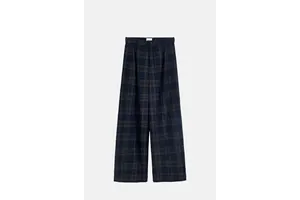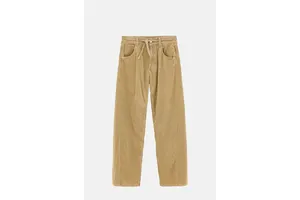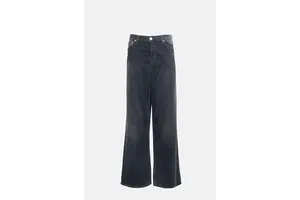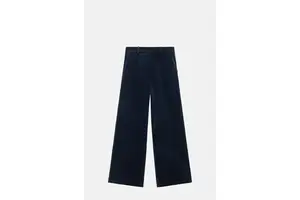
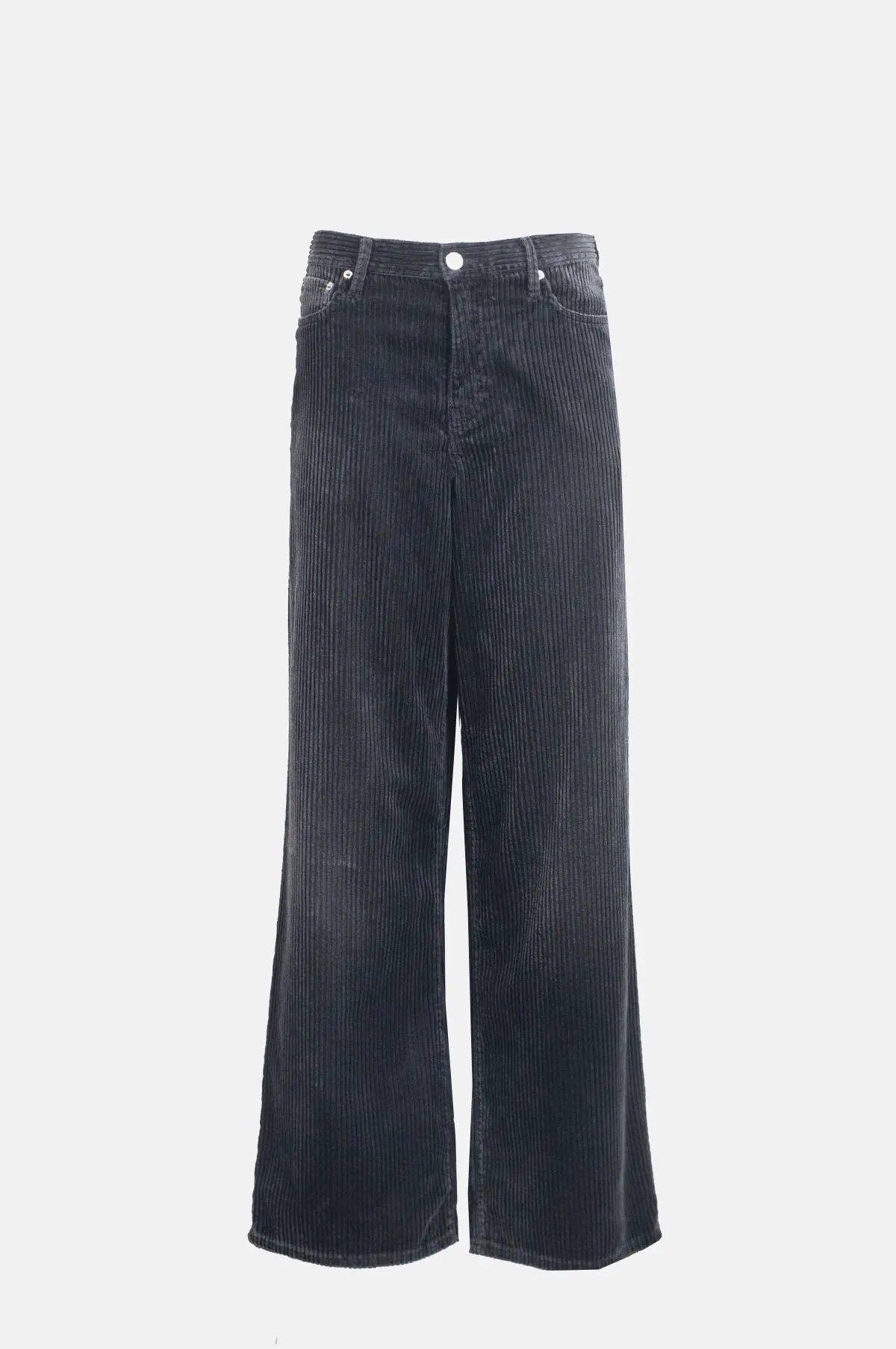

A wide leg trouser from Bellerose in a grey corduroy of cotton, modal and polyester, cut with a high-rise waist and five-pocket styling, listed at 175 GBP with all seven sizes in stock. The cloth is the interesting part, because corduroy is a cut pile cloth with ribs running in one direction, and that one property has two consequences this run has met before on a different cloth. The first is that the ribs have a nap, so every piece has to be cut the same way up and the marker cannot be nested to save cloth, which costs ten to fifteen per cent more material than the pattern seems to need. The second is that corduroy is specified by the number of ribs to the inch, in the same way denim is specified by weight in ounces, and this page gives that number as a word, textured, rather than as a figure. The other thing worth a close look is the size table, whose two columns disagree with each other by a centimetre or so on four of its six rows, which is a small discrepancy and an interesting one, because the jean published in the batch before this one had three figures that reconciled to within two millimetres. The reference is the Parthe Jean in Meteorite. Dongguan Bafinasa Garments Co., Ltd. develops comparable trousers on OEM and ODM terms, from cloth selection and wash to retail or FBA ready packing. We publish this as a development reference and build your own version of it, and we do not supply the branded original or reproduce anyone else's label.
Key Features
- Corduroy as stated, with no wale count, which is the specification corduroy is bought and sold by. See the note below
- Textured tonal corduroy finish as stated, meaning the ribs and the ground are the same colour, so the texture reads through shade
- High-rise waist as stated, with no rise published, though the two length columns imply about 32 cm. See the note below
- Wide leg silhouette as stated, with no leg opening, no thigh and no hip published
- Classic five-pocket denim styling as stated, with the pocket lining given its own fibre, 100% cotton. See the note below
- Branded leather patch at the back waist as stated, on a garment to be machine washed. See the note below
- Waist grading 2, 2, 2, 1 and 1 cm, and a size 31 sold with no measurements published for it. See the note below
Customisable Options
- Cloth: cotton modal blend corduroy to the reference, with the wale count and the weight specified, or a cotton corduroy, a wide wale cord, a needlecord or a plain cotton twill, each quoted separately
- Finish: tonal to the reference, so the ribs and the ground are the same shade, or a contrast cord, or a piece dyed and garment washed version
- Rise: high to the reference at about 32 cm, or a mid rise at about 27, or a low rise, each stated in centimetres and measured from a named point
- Leg: wide to the reference, with the leg opening and the thigh specified, or a straight leg, a tapered leg or a barrel leg
- Pockets: five pocket styling to the reference, with the pocket lining specified, or a four pocket, or slash pockets
- Closure: button and zip fly to the reference, or a zip fly alone, or an elasticated back
- Wale count and cloth weight, nap direction and one-way layout, rise measured from a named point, leg opening and thigh, pocket specification, leather patch specification or a woven alternative, size set, colour development, private label and care labelling
Specifications
| Style | High-rise wide leg trouser in corduroy with five-pocket styling |
| Reference | Bellerose, Parthe Jean, style BW262178 P1754-898, meteorite grey, sizes 25 to 31 |
| Composition | 61% cotton, 23% modal and 16% polyester as stated, with no cloth weight given. See the note below |
| Cloth | Corduroy as stated, with no wale count and no weight given. See the note below |
| Finish | Textured tonal corduroy finish as stated, so the ribs read in shade rather than in contrast colour |
| Fit | Wide-leg silhouette with a high-rise waist as stated. See the note below |
| Pockets | Classic five-pocket denim styling as stated, with no pocket dimensions given |
| Pocket Lining | 100% cotton as stated, given its own line. See the note below |
| Closure | Button and zip fly fastening as stated |
| Trim | Branded leather patch at the back waist as stated, with no leather specification. See the note below |
| Care | Machine wash at 30 degrees as stated, with no drying instruction and nothing about the leather patch. See the note below |
| Sizes Offered | 25 to 31, seven sizes, all seven in stock, with measurements published for six. See the note below |
| Size Conversion | None published, on a numeric size range. See the note below |
| Model | None stated, no height and no body measurements |
| Measurements Published | Waist, inseam and total length for six of the seven sizes offered. See the note below |
| Published Waist | 35, 37, 39, 41, 42 and 43 cm flat, or 13.8 through 16.9 in. See the note below |
| Waist Around | 70, 74, 78, 82, 84 and 86 cm, or 27.6, 29.1, 30.7, 32.3, 33.1 and 33.9 in. See the note below |
| Gap Against the Label | About 2.6, 3.1, 3.7, 4.3, 4.1 and 3.9 in above the size number. See the note below |
| Published Inseam | 81, 83, 84, 85, 85 and 85 cm, grading two, one, one and then nothing. See the note below |
| Published Length | 112, 116, 116, 117, 117 and 117 cm, grading four, zero, one and then nothing. See the note below |
| Implied Rise | 31, 33, 32, 32, 32 and 32 cm, from the two length columns, so they disagree. See the note below |
| Wale Count | None. See the note below |
| Leg Opening | None, on a garment whose whole shape is a wide leg. See the note below |
| Published Hip | None. See the note below |
| Published Thigh | None |
| Cloth Weight | Not stated |
| Photographs | Six |
| Production | Made in Tunisia as stated |
| Reference Retail | 175 GBP as listed, quoted to show the price band this sits in, not as our price |
| Category | Filed by the reference under trousers |
| Occasion | Autumn and winter, everyday, weekend, work, with a knit or a shirt |
| MOQ | 100 pcs per style per colourway, mixed sizes and colourways accepted |
| Sampling | 7-10 days after tech pack or reference sample confirmation |
| Bulk Lead Time | 20-30 days after sample approval and deposit |
| Service | OEM / ODM / private label, corduroy sourcing by wale count and weight, one-way nap layout and cloth planning, five pocket construction, retail or FBA ready packing |
Size Chart as Published by the Reference
| Size | Waist (flat) | Inseam | Total Length |
|---|---|---|---|
| 25 | 35 cm | 81 cm | 112 cm |
| 26 | 37 cm | 83 cm | 116 cm |
| 27 | 39 cm | 84 cm | 116 cm |
| 28 | 41 cm | 85 cm | 117 cm |
| 29 | 42 cm | 85 cm | 117 cm |
| 30 | 43 cm | 85 cm | 117 cm |
| 31 | not published | not published | not published |
The waist figures are flat half measures taken with the trouser laid down, doubling to 70, 74, 78, 82, 84 and 86 cm around, or 27.6, 29.1, 30.7, 32.3, 33.1 and 33.9 in, which run about two and a half to four and a third inches above the number on the label. The waist grade is uneven, running two, two, two, one and one centimetres. A size 31 is offered and in stock but no measurements are published for it. Subtracting the inseam from the total length gives an implied rise of 31, 33, 32, 32, 32 and 32 cm, which should be a constant and is not.
Our Proposed Body Chart
| Size | Body Bust | Body Waist | Body Hips | Length | Source |
|---|---|---|---|---|---|
| 25 | 31 in / 79 cm | 24 in / 61 cm | 34 in / 86 cm | 81 cm / 31.9 in | Our proposal |
| 26 | 33 in / 84 cm | 26 in / 66 cm | 36 in / 91 cm | 83 cm / 32.7 in | Our proposal |
| 27 | 33 in / 84 cm | 26 in / 66 cm | 36 in / 91 cm | 85 cm / 33.5 in | Our proposal |
| 28 | 35 in / 89 cm | 28 in / 71 cm | 38 in / 97 cm | 87 cm / 34.3 in | Our proposal |
| 29 | 35 in / 89 cm | 28 in / 71 cm | 38 in / 97 cm | 89 cm / 35 in | Our proposal |
| 30 | 37 in / 94 cm | 30 in / 76 cm | 40 in / 102 cm | 91 cm / 35.8 in | Our proposal |
Occasions and Styling
Suits autumn and winter, everyday, weekends and work. A wide leg corduroy trouser is a soft alternative to denim, warmer than a cotton trouser and less formal than a wool one, and the grey reads as a neutral that goes with everything.
Production and Quality Control
The reference publishes three columns, states a three-fibre composition with percentages, describes the cloth, the finish, the fit, the pockets, the closure and the trim, gives a care instruction, names the country of make and has every size in stock. It gives no wale count, no weight, no rise, no leg opening, no hip, no size conversion and no model, and two of its three columns disagree with each other. Three things follow: what corduroy costs to cut and how it is specified, the internal disagreement between the columns, and the leather patch in a washing machine.
Corduroy, its nap, and the number it is bought by, and that is the first thing. Corduroy is woven with extra yarns floating along the surface which are then cut, and the cut ends stand up in rows called wales, which is where the ribs come from. Two consequences follow, and the first is about cutting. Those cut ends lean in one direction, exactly as the pile of a velvet does, which means the cloth reflects light differently depending on which way up it is, and two panels cut from the same roll and sewn together with one of them turned will read as two different shades of grey on the finished garment. So every piece has to be cut with the nap running the same way, which in cutting terms is a one-way or nap layout, and the marker can no longer flip a piece to make it fit, so it uses more cloth. This run made exactly this point two batches ago about the velvet lining on a jacket, and the figure is the same here: somewhere between ten and fifteen per cent more cloth on a trouser of this shape. That is a real cost, it has to be in the quotation before the cloth is bought rather than discovered when the marker is made, and it is one of the clearest cases in this run of a property of the cloth turning directly into money. The second consequence is how corduroy is specified, and it is worth setting out because the absence is the point. Corduroy is bought and sold by its wale count, which is the number of ribs to the inch. A fine needlecord runs sixteen to twenty wales to the inch and looks like a subtle texture; a standard cord runs about ten to twelve; a wide wale runs four to eight and reads as bold ribs you can see across a room. The wale count decides the look, the weight, the drape and the price, and it is to corduroy what the weight in ounces is to denim, which this run complained about in the batch before this one. This page says textured, which is a word describing the result rather than the specification that produces it, so a customer cannot tell whether she is buying a fine needlecord or a wide wale, and a factory developing a version of this has to guess from a photograph. It is worth adding two things about corduroy that belong in a specification and are not here. The first is the direction the nap is cut in, which is a real decision: cut with the pile running up and the cloth looks richer and darker but the pile crushes and wears faster at the seat and the knee, and cut with the pile running down and it wears better and looks slightly paler. The second is that corduroy wears at the points of friction, so the seat and the knee go shiny, and a cloth with a polyester content, as this one has at sixteen per cent, recovers better than a pure cotton one, which is a good reason for the blend and a reason to say so. Then the weight, which is missing as usual, and which on a wide leg trouser is the number that decides whether the leg hangs or stands away from the body. It is worth being fair about what the page does give, because it is better than most: the composition is stated as three fibres with three percentages that add to a hundred, and the pocket lining is given its own line at one hundred per cent cotton, which is the second time in this run that a component has been specified separately, after the nylon trim on the lace dress, and which is exactly right, because a pocket bag behaves differently from the cloth it sits behind.
Two columns that disagree, and a size with no numbers, and that is the second thing. The table publishes a waist, an inseam and a total length for six sizes. The inseam runs 81, 83, 84, 85, 85 and 85, and the total length runs 112, 116, 116, 117, 117 and 117. Now, total length minus inseam is the rise, measured from the top of the waistband down to the crotch, and on a graded pattern the rise should be constant or very nearly so, because the waistband sits at the same place on the body whatever the size. Subtracting one column from the other gives 31, 33, 32, 32, 32 and 32 centimetres. Four of the six agree on 32, and the two smallest sizes give 31 and 33. So the table contains a rise that jumps by a centimetre in either direction at the bottom of the range and then holds steady. That is a discrepancy of about a centimetre, and it is worth being precise about why it matters rather than waving it away as rounding. The customer reading this chart sees the inseam grow by two centimetres from the 25 to the 26 and the total length grow by four. She will therefore conclude that the 26 is a taller trouser with a longer rise, and she will be wrong: the rise is a constant 32 and the four centimetre jump in one column against the two in the other is an error in one of them. Which one is wrong cannot be determined from the page, and that is the real cost of a table whose columns do not cross check: the chart stops being a set of facts and becomes a set of claims that cannot be tested. It is worth setting this directly beside the jean published in the batch before this one, which is the closest comparison in this run and which comes out the other way. That page published an inseam of 69 cm, a total length of 98 cm and a separate rise of eleven and a half inches, which is 29.2 cm, and 69 plus 29.2 is 98.2 against a published 98. Three figures from two places on the page reconciling to within two millimetres. And it is worth adding the second comparison, which settles it: the other trouser from this same brand, published alongside this one, has an inseam of 77 and a total length of 107, so the implied rise is 30 cm, and it is 30 on all six of its sizes without exception. So the same brand, in the same season, publishes one table whose columns agree perfectly and one whose do not. That proves the agreement is achievable and that the wobble here is a mistake rather than a method. There is a second absence in the same table that is more straightforward. The product is offered in seven sizes, 25 to 31, and all seven are in stock, and the table has six columns of measurements. So the largest size is being sold with no waist, no inseam and no length published for it. This run has seen charts narrower than the size range before, but not on a size that is actually available to buy, and the effect is that a customer in the largest size has to choose between buying blind and not buying at all. Then the waist column itself, which grades two, two, two, one and one centimetres, so the increase halves at the top two sizes: a customer moving from the 27 to the 28 gains two centimetres of waist, and a customer moving from the 28 to the 29 gains one. That may be deliberate, and some brands do compress the grade at the top of a range, but as with every uneven grade in this run it is invisible until someone compares two rows, and one line would make it either a decision or a fault.
A leather patch, in a washing machine, at thirty degrees, and that is the third thing. The trousers carry a branded leather patch at the back waist, and the care instruction is machine wash at 30 degrees. Leather and water are not a good combination, and it is worth saying precisely what happens, because this is a problem the customer discovers rather than one she is warned about. Untreated leather soaked in water stiffens as it dries, because the water dissolves some of the fats and oils that keep the fibre supple and they do not go back, so a patch that has been through a wash comes out board-like and then cracks along the fold lines. Most leather, and nearly all dyed leather, also bleeds, and a dark patch on a pale grey corduroy, in thirty degree water, with agitation, is a recipe for a grey stain spreading out from the patch into the surrounding cloth and setting there. This run has spent fifteen batches on care labels that omit the step that damages the garment, and the list is now long enough to be worth stating as a pattern. The wool trouser said dry clean and not how to dry it, and a wet wool hung up stretches. The geese and mushroom sweaters said hand wash and not dry flat, and a wet chunky knit stretches under its own weight. The faux fur jacket said dry clean on a gentle cycle and not a word about heat, and heat melts and crushes a synthetic pile. And now a leather patch that goes through a machine wash, with no mention of it at all. In each case the instruction covers the cloth and not the component, and in each case the component is the part that fails first. There are four ways to deal with it and all of them are cheap. Use a washable synthetic or a coated paper patch instead of leather, which is what most volume denim does and which nobody notices. Or specify a leather that has been finished to resist water and test it. Or attach the patch after washing, which is not possible in this construction. Or say so, in two words on the label, wash inside out, which at least slows the bleeding. What the page does instead is name the leather patch as a feature and then give a care instruction that does not mention it. It is worth adding what else the label leaves out, which is the ordinary things: no drying instruction at all, and nothing about the nap, and a corduroy tumble dried will flatten its ribs. Then the remaining absences, which are the usual ones and worth listing because they are the ones a customer would use. No rise is published, although the two length columns imply about 32 cm, or 12.6 in, which by the convention this run set out in the batch before this one is a high rise and which therefore supports the high-rise claim on the page. No leg opening, on a garment whose entire description is a wide leg, so the customer cannot tell how wide. No hip and no thigh, on a trouser that has to pass over both. No size conversion, on a numeric range from 25 to 31, so there is nothing to tell a customer which of the seven is hers, and the gap between the label and the actual waist is not constant, running about two and a half inches at the 25 and about four and a third at the 28 before falling back. And no model height, so nobody can work out where the 81 cm inseam will fall. Every bulk shipment gets a measurement report against your approved chart.
Optional upgrades include stating the wale count and the cloth weight, deciding and stating the nap direction and planning the one-way layout and the extra cloth it consumes, publishing the rise in centimetres from a named point, correcting the two length columns so they reconcile and reissuing the chart, publishing measurements for the seventh size, smoothing the waist grade or stating the compressed top end as deliberate, publishing the leg opening, the thigh and the hip, adding a size conversion to the numeric range, specifying the leather patch or offering a washable synthetic alternative and testing it for bleeding, adding a drying instruction and a note about the nap, washable corduroy finishes, mid and low rise options, straight, tapered and barrel leg options, size set, colour development, private label, hangtag and care labelling.
Pre-production sample approval, in-line inspection during cutting and sewing, and a final AQL inspection before packing, with measurement reports and photos shared before shipment.
Send us your tech pack, a photo or a reference garment and we will quote within 24 hours. Contact bafinasa@bafinasa.com or WhatsApp +86 13827222469.