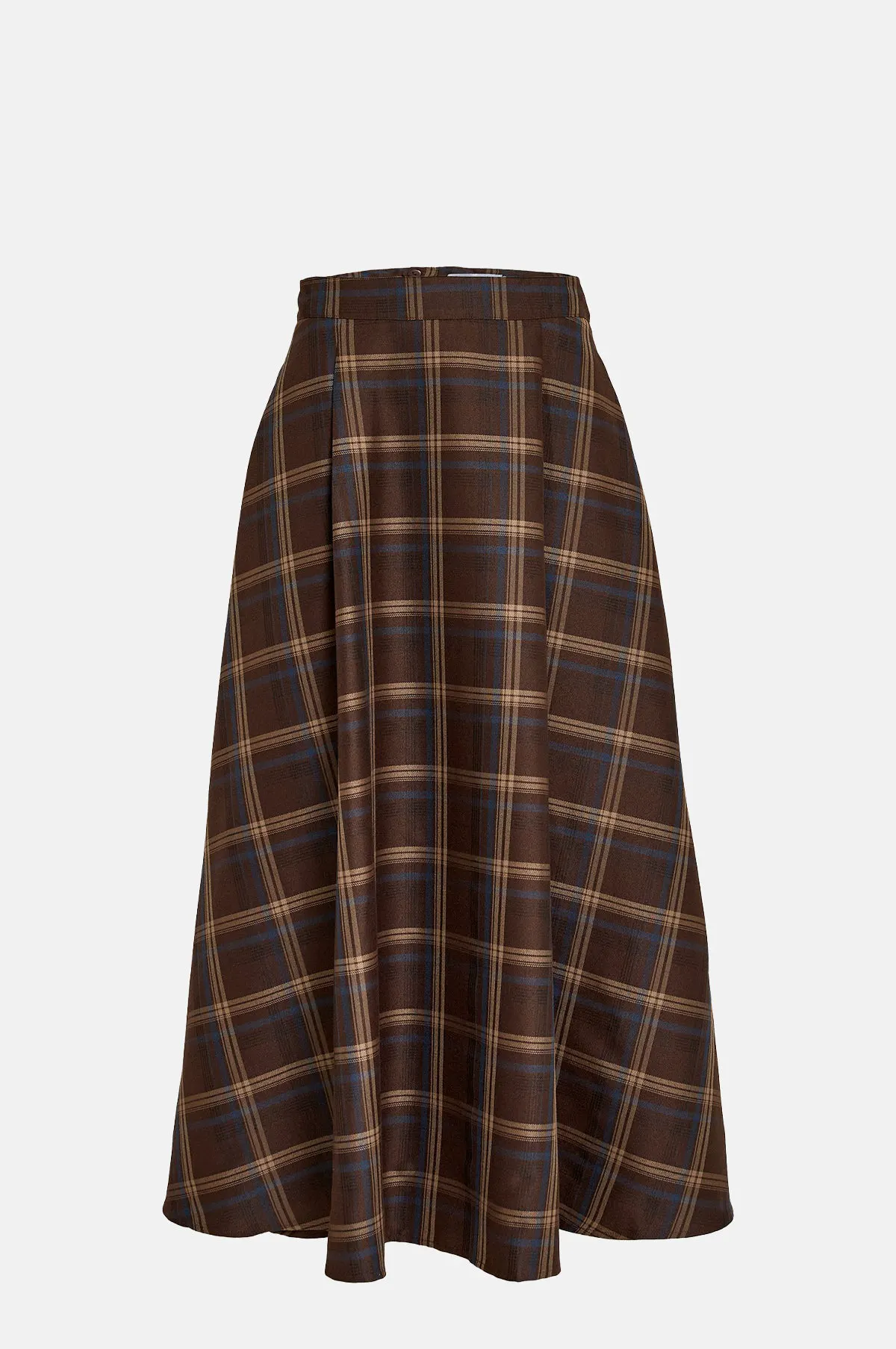

A checked A-line skirt from Minus in a chocolate and tan plaid with blue accents, cut with a high waist, a fixed waistband and front pleats, in a structured cloth with a slight stretch, listed at 90 GBP with one of five sizes in stock. Its length is published as 91 centimetres on all five sizes, and that figure is worth stopping over, because the garment is called a midi. A skirt hangs from the waist, and the waist of an average height woman sits around 105 centimetres from the floor, so a skirt measuring 91 centimetres from the waistband puts its hem somewhere around fifteen centimetres off the ground, which is a maxi and not a midi. One of the two is wrong: either the figure is not measuring what it appears to measure, or the skirt is longer than its name. And the page gives no model height, so there is no way to check, which is worth setting beside the dress published in the batch before this one, where the model height was given and the same calculation could be done and was worth doing. The reference is the Christel Midi Skirt in Tiramisu Checked. Dongguan Bafinasa Garments Co., Ltd. develops comparable skirts on OEM and ODM terms, from cloth selection and pleating to retail or FBA ready packing. We publish this as a development reference and build your own version of it, and we do not supply the branded original or reproduce anyone else's label.
Key Features
- Midi length as stated, against a published total length of 91 cm, which on an average height would put the hem near the floor. See the note below
- Total length of 91 cm on all five sizes, which on a skirt is more defensible than on a dress. See the note below
- Large scale plaid as stated, with no repeat given, on a skirt with pleats at the front. See the note below
- Fixed waistband with front pleat detailing as stated, with no pleat count, no pleat depth and nothing about the pleats against the plaid. See the note below
- Structured fabric with a slight stretch as stated, and 2% elastane published, so the claim is supported by the data
- High waist as stated, and a size conversion published from 34 to 42 Danish
- One of five sizes in stock, the most depleted garment in this run
Customisable Options
- Cloth: structured checked polyester with 2% elastane to the reference, with the weight specified, or a wool blend, a cotton twill or a viscose, each quoted separately
- Plaid: large scale to the reference, with the repeat published in centimetres, or a small check, a windowpane or a plain cloth
- Pleats: front pleat detailing to the reference, with the count, the depth and the direction specified, and set on the plaid or set on the pattern, either quoted separately
- Waist: fixed waistband to the reference, high, with the band depth published, or a mid rise, or an elasticated back
- Length: midi to the reference with the length published from the top of the waistband and the hem position stated, or offered in two lengths, or a shorter knee length version
- Silhouette: A-line to the reference, with the hem width published, or a straighter pencil, a gathered or a pleated all round version
- Cloth weight, plaid repeat, pleat specification and setting, waistband depth, hem width, length, size set, colour development, private label and care labelling
Specifications
| Style | High waist A-line midi skirt with front pleats in a large scale plaid |
| Reference | Minus, Christel Midi Skirt, style MI7248 3681C, tiramisu checked, sizes 34 to 42 Danish |
| Composition | 98% polyester and 2% elastane as stated, with no cloth weight given. See the note below |
| Cloth | Structured fabric with a slight stretch as stated, which the 2% elastane supports. See the note below |
| Plaid | Large scale plaid in chocolate and tan with subtle blue accents, as stated, with no repeat given. See the note below |
| Fit | High waist and a generous A-line silhouette as stated. See the note below |
| Waist | Fixed waistband with front pleat detailing as stated, with no band depth and no pleat count given. See the note below |
| Care | Machine wash on gentle at 30, do not tumble dry, as stated |
| Sizes Offered | 34 to 42 Danish, five sizes, one in stock with four sold out. See the note below |
| Size Conversion | Published: 34 is XS, 36 is S, 38 is M, 40 is L and 42 is XL |
| Model | None stated, no height and no body measurements. See the note below |
| Measurements Published | Waist and total length for all five sizes. See the note below |
| Published Waist | 36, 38, 40, 42 and 44 cm flat, or 14.2 through 17.3 in. See the note below |
| Waist Around | 72, 76, 80, 84 and 88 cm, or 28.3, 29.9, 31.5, 33.1 and 34.6 in. See the note below |
| Ease Against Body Waist | About 4.3, 3.9, 3.5, 3.1 and 2.7 in from smallest to largest, on a fixed waistband. See the note below |
| Published Length | 91 cm on all five sizes, with no grading. See the note below |
| Hem Position | Not stated, and no model height to work it out from. See the note below |
| Plaid Repeat | None. See the note below |
| Pleat Specification | None. See the note below |
| Waistband Depth | None |
| Published Hip | None, on an A-line skirt where the hip determines how it sits |
| Published Hem Width | None, on a garment described as a generous A-line |
| Cloth Weight | Not stated |
| Photographs | Three |
| Production | Made in China as stated |
| Reference Retail | 90 GBP as listed, the lowest priced garment in this run for some batches, quoted to show the price band this sits in, not as our price |
| Category | Filed by the reference under skirts |
| Occasion | Autumn, winter and spring, work, weekend, with boots and knitwear as the reference suggests |
| MOQ | 100 pcs per style per colourway, mixed sizes and colourways accepted |
| Sampling | 7-10 days after tech pack or reference sample confirmation |
| Bulk Lead Time | 20-30 days after sample approval and deposit |
| Service | OEM / ODM / private label, checked cloth sourcing with the repeat specified, pleat setting and matching, waistband construction, retail or FBA ready packing |
Size Chart as Published by the Reference
| Size | Waist (flat) | Total Length |
|---|---|---|
| 34 DK / XS | 36 cm | 91 cm |
| 36 DK / S | 38 cm | 91 cm |
| 38 DK / M | 40 cm | 91 cm |
| 40 DK / L | 42 cm | 91 cm |
| 42 DK / XL | 44 cm | 91 cm |
The waist figures are flat half measures taken with the skirt laid down, doubling to 72, 76, 80, 84 and 88 cm around, or 28.3, 29.9, 31.5, 33.1 and 34.6 in. Against a body waist of 24, 26, 28, 30 and 32 in across XS to XL, the ease is about four and a third inches at the smallest and about two and seven tenths at the largest, which is more than a fixed waistband usually carries. The total length is published as 91 cm on all five sizes with no grading, and no model height is given, so the hem cannot be placed on a body.
Our Proposed Body Chart
| Size | Body Bust | Body Waist | Body Hips | Length | Source |
|---|---|---|---|---|---|
| 34 DK / XS | 31 in / 79 cm | 24 in / 61 cm | 34 in / 86 cm | 91 cm / 35.8 in | Our proposal |
| 36 DK / S | 33 in / 84 cm | 26 in / 66 cm | 36 in / 91 cm | 93 cm / 36.6 in | Our proposal |
| 38 DK / M | 35 in / 89 cm | 28 in / 71 cm | 38 in / 97 cm | 95 cm / 37.4 in | Our proposal |
| 40 DK / L | 37 in / 94 cm | 30 in / 76 cm | 40 in / 102 cm | 97 cm / 38.2 in | Our proposal |
| 42 DK / XL | 39 in / 99 cm | 32 in / 81 cm | 42 in / 107 cm | 99 cm / 39 in | Our proposal |
Occasions and Styling
Suits autumn, winter and spring, work and weekends. A checked A-line skirt is the piece that goes with boots and a fine knit, as the reference suggests, and the pleats make it read smarter than a plain A-line, so it works for work as well as for weekends.
Production and Quality Control
The reference publishes two columns for all five sizes, states a two-fibre composition with percentages, names the colours in the check, describes the waist, the pleats, the silhouette and the hand of the cloth, gives a care instruction with two parts, names the country of make and publishes a size conversion. It gives no cloth weight, no plaid repeat, no pleat specification, no hem width and no model height, and its published length sits oddly against the word midi. Three things follow: the length against the name, pleats against a large plaid, and the ease at a fixed waistband.
Ninety-one centimetres, called a midi, and that is the first thing. The skirt is named and described as a midi, and the published total length is 91 cm on every size. A skirt hangs from the waist, and the natural waist of a woman of average height, say 165 cm, sits roughly 105 cm above the floor, so a skirt measuring 91 cm from the top of its waistband puts the hem somewhere around fourteen or fifteen centimetres off the ground. That is a hem that grazes the floor, which is a maxi, and a midi is conventionally a hem that falls somewhere between the knee and mid calf, which on the same woman is a skirt of about 60 to 75 cm. So the two figures cannot both be right, and it is worth setting out the three possibilities because the page does not distinguish between them. The first is that the figure is not measuring what it appears to: perhaps it is taken from the shoulder on a form, or includes a hem allowance, or is a cloth measurement rather than a garment one, and the page does not say where the tape started or stopped, which is the same missing clause this run has met on sleeves and rises. The second is that the skirt is genuinely 91 cm and the name is wrong, in which case every customer who buys a midi receives a maxi. The third is that the brand's idea of a midi is longer than the convention, which is possible and which Scandinavian sizing and proportion sometimes is, but which is exactly why a length figure needs a body to go with it. And there is the crux, which this run has now met twice in two batches and in opposite forms. A length figure is only meaningful next to a body. The dress published in the batch before this one gave the model's height, five feet ten, and the size she wore, and that was enough to work out that its 122 cm fell just above the ankle on her and would sweep the floor on a woman six inches shorter, which is a calculation worth being able to do. This page gives no model height, so its length figure cannot be checked against anything, and a customer is left with a number she cannot place and a word that the number appears to contradict. One line would fix it, and this run has said it on every garment for fifteen batches: model height and size worn, or a statement of where the hem falls on a woman of a stated height. It is worth adding the second observation about the length, which is that it does not grade: 91 on all five sizes. Here the run should be fair, because there is a real argument for it and it is different from the argument on a dress. A skirt hangs from the waist, and the waist sits at roughly the same place on the body whatever the size, so the distance from waist to floor is a function of height and not of size, and a skirt length that does not grade is defensible in a way that a dress length that does not grade is not. The dress published two batches ago grew in the chest and not in the length, so its silhouette changed with size; this skirt grows in the waist and not in the length, and its silhouette stays the same. So the constant length is the right decision and the run should say so. The problem is not that it is constant, it is that 91 cm is a long way down and the customer has no way to discover that.
Pleats, against a large plaid, with no repeat published, and that is the second thing. The skirt has a fixed waistband with front pleat detailing, and the cloth is a large scale plaid. Those two facts interact, and the interaction is the sort of thing that decides whether a garment looks considered or accidental. A pleat is a fold, and a pleat in a checked cloth does one of two things: either it is set on the plaid, so the fold runs along a line in the check and the pattern reads continuously into the pleat and out of it, or it is set on the pattern, so the fold goes wherever the pattern says and the check breaks across it. Both are legitimate. Setting the pleats on the plaid is the more expensive and the more formal choice, because it means the pleat positions are determined by the cloth rather than by the pattern, so the pleats are not evenly spaced unless the plaid happens to divide evenly into the panel width, and it uses more cloth because the cutter cannot shift the pieces to save room. Setting them on the pattern is cheaper and gives even pleats, and the check breaks at each fold, which on a large scale plaid is very visible because one repeat may be wider than the pleat itself. This run has met this problem twice before in different forms, on a welt pocket that had to be matched to a check and on a ruffle that broke one, and it has said the same thing each time: two patterns on one garment, and only one of them can be matched. Here the second pattern is the pleat rather than a seam, and it is harder rather than easier, because a seam can be moved a few millimetres and the pleat spacing is what makes the skirt. The specification that settles it is the repeat of the plaid in centimetres, and it is not published. Without it nobody can decide where the pleats go, nobody can cost the cloth, and nobody can tell the customer what the skirt will look like at the front. And there is a second thing about a large scale plaid that belongs on the page for the customer's sake rather than the factory's: with a repeat that big, the position of the check on the body varies from garment to garment, because two skirts cut from different parts of the same roll will have the plaid falling differently across the front. On a small check nobody notices. On a large scale plaid it is the first thing you see, and the trade either accepts it or controls it by cutting every panel from the same point in the repeat, which uses more cloth and costs more. Neither is stated. Then the pleats themselves, which are described but not specified: no count, no depth, and no direction, so nobody knows whether these are knife pleats all facing one way or box pleats facing outwards, which are two different skirts. And no waistband depth, on a waist described as high and fixed, where the depth of the band is what makes it read as high.
Four inches of ease on a fixed band, and one size left, and that is the third thing. The waist measures 36 cm flat at the smallest size, which doubles to 72 cm around, or 28.3 in, against a body waist of 24 in at an XS, so there is about four and a third inches of ease, falling to about two and seven tenths at the 42. Now, some ease at the waist is necessary, because a skirt has to pass over the hip to get on, and because it needs room to sit and to breathe. But four and a third inches on a fixed, non-elastic waistband is more than a fixed band usually carries, and a band with that much ease does not stay where it is put: it slides down until it reaches a part of the body that is wide enough to hold it, which on most bodies means it settles lower than the natural waist. So either this skirt is cut to be worn low despite being described as high waisted, or the waist figure is not what it appears to be, or the skirt simply runs large. The page does not allow a customer to tell these apart, and the reason is the one that has run through this whole batch: the column is headed waist, with nothing to say whether it is a flat half measure or the distance all the way round. It must be flat, since 36 cm around would be a child's skirt, but that is a deduction and not a statement, and it is worth setting this page beside the trouser from another brand published alongside it, which heads its column waist 1/2 and removes the question in one word. Three pages in this batch publish a waist and one of them says which kind it is. It is worth being fair about what this page does better than most, because there is plenty, and this run should credit it. The composition is given as two fibres with percentages, and the 2% elastane is exactly what the phrase a slight stretch describes, so the claim in the prose is supported by the data in the panel, which is rare: this run has spent many batches on prose claims that the panel contradicts, on organic cotton that the panel called cotton, on a wool mix that the panel called polyester, on ink blue that the description called green, and here the two halves agree. The colours are named in the bullets as brown, tan and blue, which is more than most pages give. The care instruction has two parts and both are right for the cloth, gentle at thirty and do not tumble dry, since heat sets creases into polyester. And a size conversion is published from 34 to 42 Danish into XS to XL, which several brands in this run do not do. Then two absences to finish. No hip measurement, which on an A-line skirt decides how it sits over the seat, and no hem width, on a garment described as a generous A-line where the hem is most of the shape and is the figure that distinguishes a gentle A from a full one. And one of five sizes left in stock, which is the most depleted garment in this run: four sizes have gone and only the 38 remains, and the page still shows all five as though they could be chosen. Every bulk shipment gets a measurement report against your approved chart.
Optional upgrades include publishing the length from a named point and stating where the hem falls on a woman of a stated height, publishing a model height and size worn, offering the skirt in two lengths or shortening it to a true midi, publishing the plaid repeat in centimetres and deciding whether the pleats are set on the plaid or on the pattern, specifying the pleats by count, depth and direction, publishing the waistband depth, reducing the waist ease or adding an elasticated back so a fixed band can be held at the waist, publishing the hip and the hem width, stating the cloth weight, controlling the plaid placement across panels or stating that it is not controlled, knife, box and gathered pleat options, mid rise and elasticated back options, small check, windowpane and plain cloth options, size set, colour development, private label, hangtag and care labelling.
Pre-production sample approval, in-line inspection during cutting and sewing, and a final AQL inspection before packing, with measurement reports and photos shared before shipment.
Send us your tech pack, a photo or a reference garment and we will quote within 24 hours. Contact bafinasa@bafinasa.com or WhatsApp +86 13827222469.