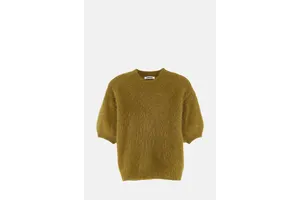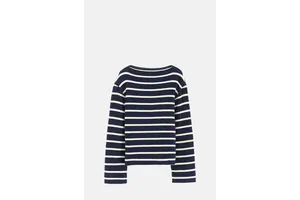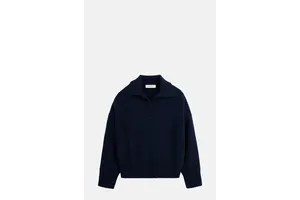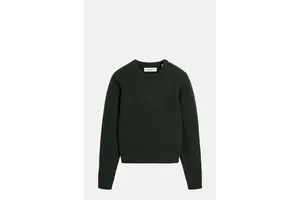
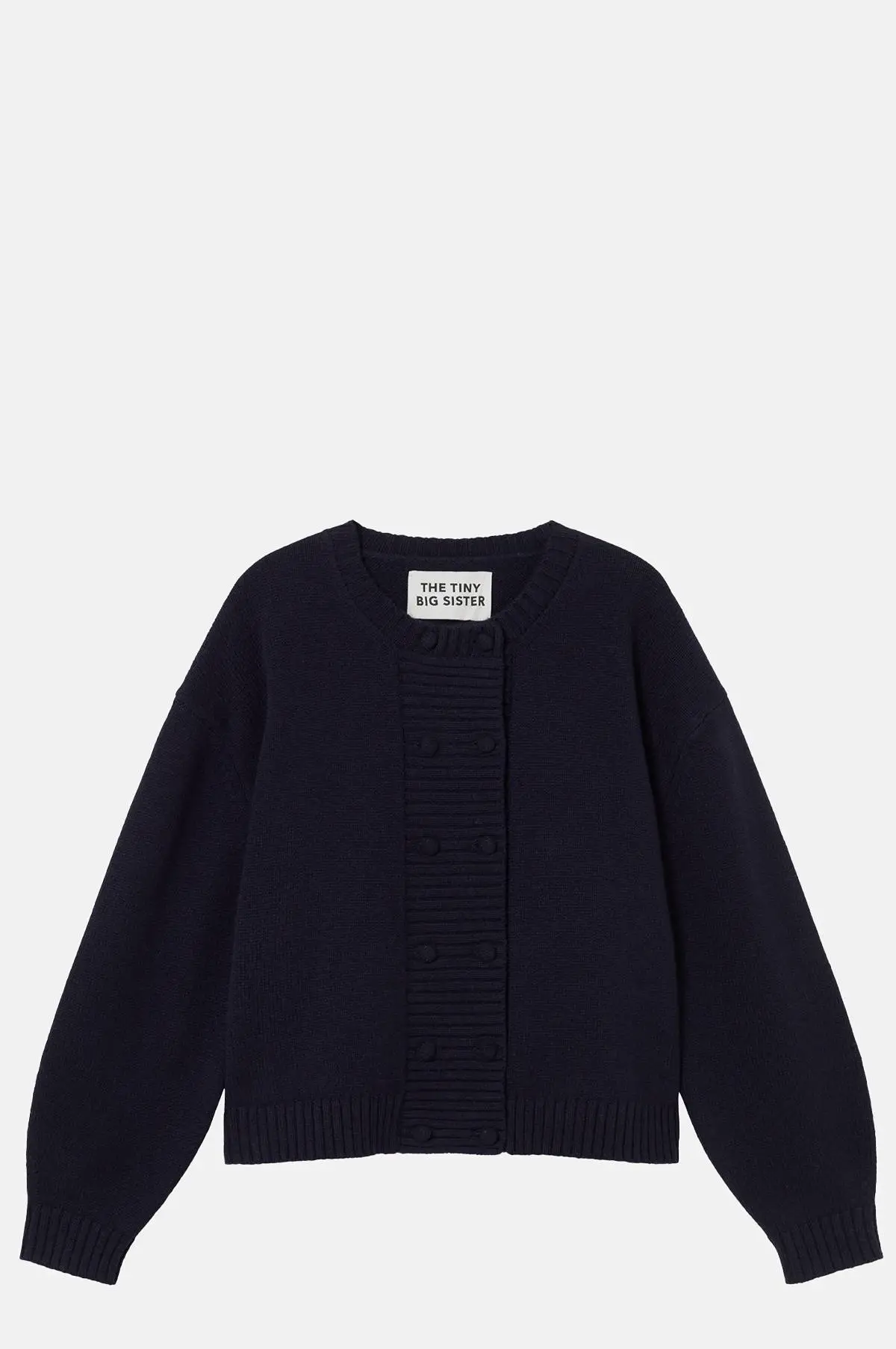

A navy merino cardigan from The Tiny Big Sister with a double button placket, puff sleeves, dropped shoulders, ribbed trims and a high neck, listed at 136 GBP with all five sizes in stock. The description contains the single most useful construction term this run has found on any knitwear page, and it is two words long: fully fashioned. It means the panels were knitted to shape on the machine rather than cut out of a knitted length, and that one fact settles something this run argued about a few batches ago, because it means each size is knitted to its own shape and each one could therefore have been given its own sleeve length at no extra cost. Which makes the sleeve column harder to explain rather than easier, because it reads 50 centimetres on all five sizes. Then there is the ease. The chest works out at 110 centimetres around at the smallest size, which against a body bust of 31 inches is about twelve and a third inches, and that is the largest ease figure this run has measured on anything. It is worth putting that beside the two other garments in this same house that are also described as relaxed, which measure four and two fifths and eight and two fifths. The reference is the Buttoned Cardigan in Navy. Dongguan Bafinasa Garments Co., Ltd. develops comparable knitwear on OEM and ODM terms, from yarn and gauge selection to retail or FBA ready packing. We publish this as a development reference and build your own version of it, and we do not supply the branded original or reproduce anyone else's label.
Key Features
- Fully fashioned as stated, which means each size is knitted to its own shape and each could have had its own sleeve length. See the note below
- Sleeve length of 50 cm on all five sizes, despite the shaping being done on the machine. See the note below
- Relaxed fit as stated, with about twelve and a third inches of ease at the smallest size, the largest this run has measured. See the note below
- Double button placket as stated, with no button count, no size, no spacing and no buttonhole type given. See the note below
- Dropped shoulders as stated, which moves the point a sleeve would be measured from. See the note below
- Puff sleeves as stated, with no cap height, no cuff width and no gather ratio given
- Hand wash only as stated, with no drying instruction, as on every wool in this house. See the note below
Customisable Options
- Construction: fully fashioned to the reference, with the shaping knitted in, or cut and sewn from knitted panels at a lower cost
- Yarn: soft merino to the reference, with the micron count, the ply, the yarn count and the gauge specified, or a lambswool or a merino blend, each quoted separately
- Fit: relaxed to the reference at about twelve inches of ease, or a closer eight inch version, or a four inch one
- Sleeves: puff sleeves to the reference, with the cap height, the cuff and the gather ratio specified, graded across the size range, or a plain sleeve
- Closure: double button placket to the reference, with the count, the size and the spacing specified and a backing button, or a single button, or a concealed placket
- Trims: ribbed to the reference, with the rib width and construction specified, or a plain hem and cuff
- Micron count, ply, yarn count and gauge, cloth weight, shaping method, ease, sleeve grading and measurement point, button specification, rib specification, size set, colour development, private label and care labelling
Specifications
| Style | Relaxed merino cardigan with a double button placket and puff sleeves |
| Reference | The Tiny Big Sister, Buttoned Cardigan, style AW26-734, navy, sizes 34 to 42 |
| Composition | 100% merino wool as stated, with no micron count, no ply and no yarn count given. See the note below |
| Construction | Fully fashioned as stated, with no gauge and no cloth weight given. See the note below |
| Fit | Relaxed fit as stated. See the note below |
| Neck | High neck as stated, with no neck opening given. See the note below |
| Shoulders | Dropped shoulders as stated. See the note below |
| Sleeves | Puff sleeves as stated, measured at 50 cm on all five sizes. See the note below |
| Closure | Double button placket as stated, with no button count, size or spacing given. See the note below |
| Trims | Ribbed trims as stated, with no rib width and no rib construction given |
| Care | Hand wash only as stated, with no drying instruction. See the note below |
| Sizes Offered | 34 to 42, five sizes, all five in stock |
| Size Conversion | Published: 34 is XS, 36 is S, 38 is M, 40 is L and 42 is XL |
| Measurements Published | Pit to pit, sleeve length and total length for all five sizes. See the note below |
| Published Chest | Pit to pit 55, 57, 59, 61 and 63 cm flat, or 21.7 through 24.8 in. See the note below |
| Chest Around | 110, 114, 118, 122 and 126 cm, or 43.3, 44.9, 46.5, 48.0 and 49.6 in. See the note below |
| Ease Against Body Bust | About 12.3, 11.9, 11.5, 11.1 and 10.7 in from smallest to largest, the largest this run has measured. See the note below |
| Published Sleeve | 50 cm on all five sizes, with no grading. See the note below |
| Published Length | 53, 54, 55, 56 and 57 cm, grading one centimetre per size |
| Published Hem | None. See the note below |
| Cloth Weight | Not stated |
| Gauge | Not stated |
| Button Specification | None. See the note below |
| Model | None stated, no height and no body measurements |
| Photographs | Six |
| Production | Made in China as stated |
| Reference Retail | 136 GBP as listed, the same as the velvet trousers, the checked skirt and the bow blouse from this house, quoted to show the price band this sits in, not as our price |
| Category | Filed by the reference under knitwear |
| Occasion | Autumn and winter, work, weekend, over a shirt or a dress, dressed up as the reference claims |
| MOQ | 100 pcs per style per colourway, mixed sizes and colourways accepted |
| Sampling | 7-10 days after tech pack or reference sample confirmation |
| Bulk Lead Time | 20-30 days after sample approval and deposit |
| Service | OEM / ODM / private label, merino yarn sourcing with micron specified, fully fashioned gauge and shaping development, button and trim specification, retail or FBA ready packing |
Size Chart as Published by the Reference
| Size | Pit to Pit (flat) | Sleeve Length | Total Length |
|---|---|---|---|
| 34 / XS | 55 cm | 50 cm | 53 cm |
| 36 / S | 57 cm | 50 cm | 54 cm |
| 38 / M | 59 cm | 50 cm | 55 cm |
| 40 / L | 61 cm | 50 cm | 56 cm |
| 42 / XL | 63 cm | 50 cm | 57 cm |
The chest figures are flat half measures taken with the cardigan laid down, doubling to 110, 114, 118, 122 and 126 cm around, or 43.3, 44.9, 46.5, 48.0 and 49.6 in. Against a body bust of 31, 33, 35, 37 and 39 in across XS to XL, the ease is about twelve and a third inches at the smallest and about ten and seven tenths at the largest, which is more ease than this run has measured on any garment. The sleeve is published as 50 cm on all five sizes with no grading at all, and the length grades one centimetre per size.
Our Proposed Body Chart
| Size | Body Bust | Sleeve | Body Waist | Body Hips | Length | Source |
|---|---|---|---|---|---|---|
| 34 / XS | 31 in / 79 cm | 50 cm | 24 in / 61 cm | 34 in / 86 cm | 53 cm / 20.9 in | Our proposal |
| 36 / S | 33 in / 84 cm | 51 cm | 26 in / 66 cm | 36 in / 91 cm | 55 cm / 21.7 in | Our proposal |
| 38 / M | 35 in / 89 cm | 52 cm | 28 in / 71 cm | 38 in / 97 cm | 57 cm / 22.4 in | Our proposal |
| 40 / L | 37 in / 94 cm | 53 cm | 30 in / 76 cm | 40 in / 102 cm | 59 cm / 23.2 in | Our proposal |
| 42 / XL | 39 in / 99 cm | 54 cm | 32 in / 81 cm | 42 in / 107 cm | 61 cm / 24 in | Our proposal |
Occasions and Styling
Suits autumn and winter, work and weekends. A merino cardigan with a high neck and a short placket is the piece that replaces a jacket indoors, and the reference is right that it reads smart, because a knit with a placket and buttons reads as a garment rather than as a layer.
Production and Quality Control
The reference publishes three columns for all five sizes, states its fibre, describes the fit, the neck, the shoulders, the sleeves, the closure and the trims, gives a care instruction, names the country of make, publishes a size conversion, has every size in stock and shows six photographs. It publishes no sleeve grading, no button specification, no micron count, no gauge, no cloth weight and no drying instruction. Three things follow: what fully fashioned means for the frozen sleeve, what twelve inches of ease does to a two button placket, and the distance between the word relaxed and anything checkable.
Fully fashioned, and what it makes inexcusable, and that is the first thing. Fully fashioned knitwear is knitted to shape: the machine increases and decreases the number of working needles as it goes, so the panel comes off the machine already shaped at the armhole, the neck and the sleeve head, with a visible line of decreased stitches, called the fashioning mark, running along each shaped edge. The alternative is cut and sewn, where a rectangle or a shaped length is knitted and then cut with a pattern, which wastes yarn, needs the edges overlocked or linked, and produces a seam that is bulkier at the armhole. So fully fashioned is the better method, it is the mark of a well made knit, and it is the single most informative thing on this page, which is why it is worth putting a number of consequences against it. The first is waste and cost: shaped panels waste almost nothing, so a fully fashioned garment uses less yarn than a cut and sewn one of the same dimensions, which partly offsets the slower knitting. The second is that the shaping is limited by what the machine can do: the number of needles you can move at once is fixed, so the slope of an armhole is set by the gauge and the machine and not by a pattern cutter's free hand, and a good designer works to that rather than against it. The third, and this is the one that matters here, is that a fully fashioned garment has a separate knitting programme for every size. The machine is told how many needles to cast on, where to shape and how many rows to knit, and all of those are numbers in a programme. So the length of the sleeve in a size 42 is a number somebody typed, and the length of the sleeve in a size 34 is another number somebody typed. Which means the sleeve column reading 50, 50, 50, 50 and 50 is not a constraint of the method. It is five separate decisions to type the same figure, or one programme copied and only the width changed. That is worth setting beside the seamless tee from Sunray a few batches back, where this run argued the opposite and meant it: a tubular body is knitted to the diameter of a cylinder, so its width really is constrained by the machinery, and the neat two centimetre steps in that size chart were the cylinders that existed rather than widths derived from a body. Here the construction imposes no such limit, so there is nothing to explain the column away. It is also worth saying what the frozen sleeve costs in wear, and it is worse on this garment than on most because of the dropped shoulders. A dropped shoulder means the shoulder seam sits down the upper arm rather than on the shoulder, so the sleeve is already measured from a point that is not on the body, and the effective sleeve length is the published sleeve plus however far the shoulder has dropped. With a frozen 50 and a shoulder that drops, the largest size has less sleeve relative to the arm than the smallest, and no way for a customer to work that out.
Twelve inches of ease against two buttons, and that is the second thing. The chest measures 110 cm around at the 34 against a body bust of 79 cm, so there is about twelve and a third inches of ease in this cardigan, and it is still about ten and seven tenths at the 42. That is the largest ease figure in this run by a distance, and it is worth asking whether so much ease does anything useful. It does some: a garment with that much room layers over anything, it fits across a range of bodies with fewer sizes, and it drapes rather than clings, which is what a soft merino does best. But it does two things that are worth naming. The first is that it removes the body from the fit entirely. With twelve inches of ease there is no defined bust point, no defined waist and no shoulder line, so the garment fits by falling from wherever it does fall from, and it will look like a different garment on two women of the same bust but different shoulder widths. The second is that it makes the closure decorative. A double button placket closes two points, and on a garment with a foot of ease in it the front edges are nowhere near meeting in the ordinary sense, so the buttons are not holding anything shut; they are marking a line and holding two overlapping panels in place. That is a legitimate design, and plenty of good cardigans work that way, but it changes what the buttons have to be. A button on a knit that is under no load can be sewn straight through with a shank. A button that is genuinely fastening a garment under tension needs a backing button on the inside, which is a small disc sewn against the cloth behind the button so the thread does not pull through, and it needs the cloth behind it reinforced, because merino is soft and a button under tension will slowly tear a hole in it. This page says double button placket and gives no count, no diameter, no spacing, no material and no buttonhole type, so a factory developing a version has to guess all five, and the guess decides whether the placket looks crisp or sags. It is worth noting this is the second garment in this house in two batches whose closure is described and never specified: the bow blouse published alongside this one has a tie up bow fastening with no tie length, and this has two buttons with no size. The house is good at saying what kind of fastening and silent about everything about it. Then the puff sleeves, which are the third feature and which have the same three missing numbers as the puff sleeves on the embroidered blouse: no cap height, so nobody knows whether the puff stands up or lies flat; no cuff width, so nobody knows whether the cuff grips; and no gather ratio, so the fullness is decided at the machine rather than in the specification. On a fully fashioned garment the fullness is knitted in rather than gathered out, which is a different operation and which needs its own number.
Relaxed, across eight inches, in one house, and that is the third thing. This cardigan is described as relaxed and measures about twelve and a third inches of ease at the 34. The bow blouse from the same house, published alongside it, is described as relaxed and measures about eight and two fifths. The embroidered blouse from the same house is described as relaxed and measures about four and two fifths. Three garments, one word, an eight inch spread, and all three in the same season from the same designer. This run has been measuring fit words against measurements for fifteen batches and has found them unreliable every time, on the Thompson jumper whose oversized was an inch and a half, and on the cotton dress whose relaxed was half an inch at the waist, and it has usually had to say the word cannot be checked because no equivalence was published. Here the house publishes a size conversion on everything, so every figure can be checked, and the result is unambiguous: relaxed, as used on this page, means anything from a blouse that skims to a cardigan that tents. It is worth being fair about why, because there is a real reason and it is not carelessness. Ease is a matter of intent: a designer choosing twelve inches wants a garment that envelops, and one choosing four wants one that skims, and both are relaxed compared with a garment cut to the body. The problem is only that the customer has one word and no number, and the two garments she might choose between are four and twelve. The remedy is now the standard one in this run and it is worth stating once more because it is cheap: print the ease, or print the body measurements each size was drafted for. Three rows of numbers. Then the remaining absences, which are short and familiar. No micron count, so nobody knows whether the merino prickles, and no gauge, so nobody knows how open or how dense the knit is, and no cloth weight, so nobody knows how warm it is. No hem width on a garment this full, where the hem is what decides whether it hangs or swings. No drying instruction after hand wash only, which is the third time in this house and which on a soft merino with twelve inches of ease is the difference between a cardigan that keeps its shape and one that grows, since a wet knit hung up stretches under its own weight and a garment this big is heavy when wet. And no model height, so 53 centimetres cannot be placed on anybody. Every bulk shipment gets a measurement report against your approved chart.
Optional upgrades include grading the sleeve through the five sizes, which the fully fashioned construction allows at no extra cost, stating the point the sleeve is measured from given the dropped shoulder, publishing the ease or the body measurements each size is drafted for, specifying the buttons by count, diameter, material and spacing and adding a backing button with reinforcement, specifying the puff sleeve by cap height, cuff width and fullness, specifying the merino by micron count, ply, yarn count and gauge and stating the cloth weight, adding dry flat, reshaped, away from direct heat to the care label, publishing the hem width and a model height, closer eight inch and four inch ease versions, a plain sleeve, a single button and a concealed placket option, a cut and sewn version quoted as a lower cost alternative, size set, colour development, private label, hangtag and care labelling.
Pre-production sample approval, in-line inspection during cutting and sewing, and a final AQL inspection before packing, with measurement reports and photos shared before shipment.
Send us your tech pack, a photo or a reference garment and we will quote within 24 hours. Contact bafinasa@bafinasa.com or WhatsApp +86 13827222469.