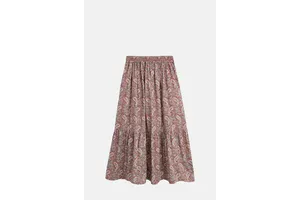
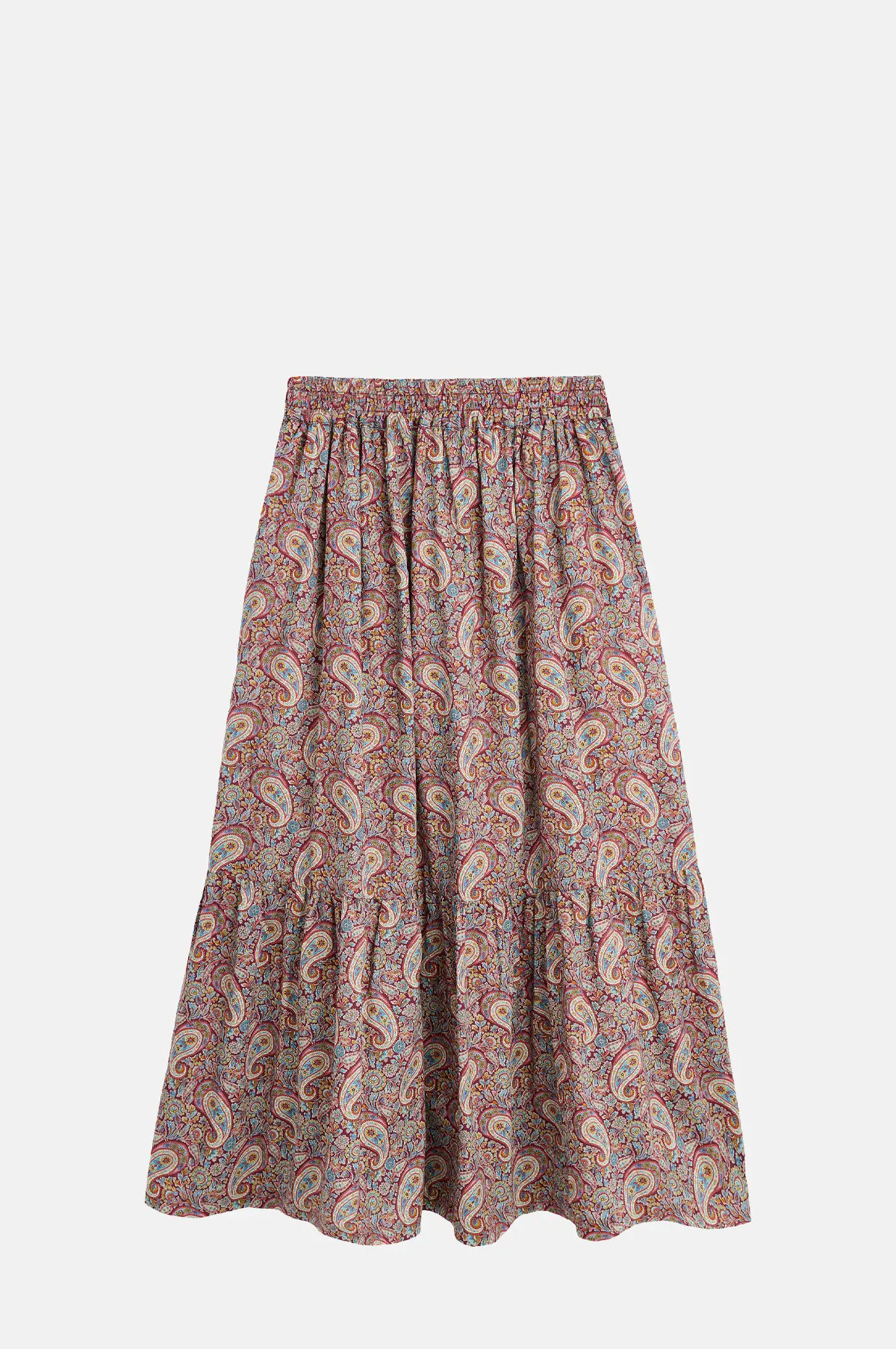

A printed midi skirt from Skall Studio in organic cotton, with an all over Liberty paisley, an elasticated waist, a gathered hem tier and side seam pockets, listed at 280 GBP with all four sizes in stock. Its waist column is worth stopping over, because the numbers look like a mistake and are not. The waist is published as 28, 30, 32 and 34 centimetres flat, which is 56 to 68 centimetres around, and a body waist at these sizes is 61 to 76 centimetres, so the skirt measures about two to three inches smaller than the body it is meant to fit. That is not an error, it is what an elasticated waist looks like: the elastic at rest is narrower than the body and it stretches to go on and then grips. The proof that this is a real problem rather than a theoretical one is in the batch before this one, which contained an elasticated paperbag trouser from another brand whose waist was published at 80 to 90 centimetres around, or about five and a half inches larger than its label. Two elasticated waists, two batches apart, one published two inches under the body and one five inches over it, and neither page says whether its figure is the elastic relaxed or stretched. The other thing worth a look is the length, because this page publishes a model height and the batch before this one could not check a length at all for want of one. The reference is the Iseline Skirt in Floral Paisley. Dongguan Bafinasa Garments Co., Ltd. develops comparable skirts on OEM and ODM terms, from cloth and print development to retail or FBA ready packing. We publish this as a development reference and build your own version of it, and we do not supply the branded original or reproduce anyone else's label.
Key Features
- Elasticated waistband as stated, with the waist published at about two to three inches under the body waist, which is the relaxed elastic and not an error. See the note below
- Waist 28 to 34 cm flat against another brand's elasticated waist at 40 to 45 cm flat one batch apart, with neither saying relaxed or stretched. See the note below
- Organic cotton lining given its own fibre line and declared organic as well, on a page that also states the shell. See the note below
- Total length 85 to 88 cm, grading one centimetre per size, and a model height of 179 cm published, so the length can be checked on a body. See the note below
- Gathered hem tier as stated, with no tier depth and no gather ratio given. See the note below
- All-over Liberty paisley as stated, with no repeat given, on a page that sells the print. See the note below
- Side seam pockets as stated, in a lined skirt, which is a construction decision, with no pocket dimensions given. See the note below
Customisable Options
- Cloth: organic cotton to the reference, with the weight and the certification named, or a conventional cotton poplin, a cotton lawn or a viscose, each quoted separately
- Print: all over Liberty paisley to the reference, with the repeat published in centimetres, or a smaller scale, a placement print or a plain cloth, each quoted separately
- Waist: elasticated to the reference, with both the relaxed and the stretched width published, or a flat waistband, or a half elastic back, or a drawstring channel
- Hem tier: gathered tier to the reference, with the tier depth and the gather ratio specified, or a plain hem, or two tiers, or a deeper single tier
- Lining: organic cotton to the reference, with the weight and the coverage specified and the shrinkage matched to the shell, or a viscose lining, or unlined
- Pockets: side seam to the reference, hung between shell and lining and specified by opening and depth, or patch pockets, or no pockets
- Cloth weight and certification, print repeat, relaxed and stretched waist, tier depth and gather ratio, lining specification and shrinkage matching, pocket specification, size set, colour development, private label and care labelling
Specifications
| Style | Relaxed A-line midi skirt with an elasticated waist and a gathered hem tier |
| Reference | Skall Studio, Iseline Skirt, style 10561-26541, floral paisley, sizes 34 to 40 Danish |
| Composition | 100% organic cotton as stated in both the bullets and the panel, with no certification named. See the note below |
| Lining | 100% organic cotton as stated, given its own line. See the note below |
| All-over Liberty paisley pattern as stated, with no repeat given. See the note below | |
| Fit | A relaxed A-line silhouette with a loose fit as stated, with the fit guidance published |
| Waist | Elasticated waistband as stated, with the relaxed and stretched widths not distinguished. See the note below |
| Hem | Gathered hem tier as stated, with no tier depth and no gather ratio given. See the note below |
| Pockets | Side seam pockets as stated, with no opening and no depth given. See the note below |
| Care | Machine wash 30 degrees as stated, with no drying instruction. See the note below |
| Sizes Offered | 34 to 40 Danish, four sizes, all four in stock |
| Size Conversion | Published: 34 is XS, 36 is S, 38 is M and 40 is L |
| Fit Guidance | Published: go for your normal size for an oversized look, or size down for slightly less volume |
| Model | Published: 179 cm tall, wearing a size 36 |
| Measurements Published | Waist and total length for all four sizes. See the note below |
| Published Waist | 28, 30, 32 and 34 cm flat, or 11.0 through 13.4 in. See the note below |
| Waist Around | 56, 60, 64 and 68 cm, or 22.0, 23.6, 25.2 and 26.8 in. See the note below |
| Gap Against Body Waist | About 2.0, 2.4, 2.8 and 3.2 in below the body waist, because this is the relaxed elastic. See the note below |
| Waist Relaxed or Stretched | Not stated. See the note below |
| Published Length | 85, 86, 87 and 88 cm, grading one centimetre per size. See the note below |
| Print Repeat | None. See the note below |
| Tier Specification | None. See the note below |
| Pocket Specification | None. See the note below |
| Published Hip | None |
| Published Hem Width | None, on a garment described as A-line with a gathered tier |
| Cloth Weight | Not stated |
| Certification | None named, on a page that claims organic twice. See the note below |
| Photographs | Five |
| Production | Produced in Romania as stated. See the note below |
| Reference Retail | 280 GBP as listed, quoted to show the price band this sits in, not as our price |
| Category | Filed by the reference under skirts |
| Occasion | Spring, summer and autumn, everyday, weekend, with a tee or a knit |
| MOQ | 100 pcs per style per colourway, mixed sizes and colourways accepted |
| Sampling | 7-10 days after tech pack or reference sample confirmation |
| Bulk Lead Time | 20-30 days after sample approval and deposit |
| Service | OEM / ODM / private label, organic cotton sourcing with certification, print development and repeat setting, elasticated waist and tier development, lining sourcing and shrinkage matching, retail or FBA ready packing |
Size Chart as Published by the Reference
| Size | Waist (flat, relaxed) | Total Length |
|---|---|---|
| 34 DK / XS | 28 cm | 85 cm |
| 36 DK / S | 30 cm | 86 cm |
| 38 DK / M | 32 cm | 87 cm |
| 40 DK / L | 34 cm | 88 cm |
The waist figures are flat half measures taken with the skirt laid down, doubling to 56, 60, 64 and 68 cm around, or 22.0, 23.6, 25.2 and 26.8 in. Against a body waist of 24, 26, 28 and 30 in across XS to L, those are about 2.0, 2.4, 2.8 and 3.2 inches smaller, which is not an error but the elastic at rest: an elasticated waist is narrower than the body and stretches to go on and then grips. The alternative reading, that these are already the stretched widths, would mean the relaxed waist is much narrower still, and the page does not distinguish them. The total length grades one centimetre per size from 85 to 88 cm, and because the model height is published the hem can be placed on a body.
Our Proposed Body Chart
| Size | Body Bust | Body Waist | Body Hips | Length | Source |
|---|---|---|---|---|---|
| 34 DK / XS | 31 in / 79 cm | 24 in / 61 cm | 34 in / 86 cm | 85 cm / 33.5 in | Our proposal |
| 36 DK / S | 33 in / 84 cm | 26 in / 66 cm | 36 in / 91 cm | 87 cm / 34.3 in | Our proposal |
| 38 DK / M | 35 in / 89 cm | 28 in / 71 cm | 38 in / 97 cm | 89 cm / 35 in | Our proposal |
| 40 DK / L | 37 in / 94 cm | 30 in / 76 cm | 40 in / 102 cm | 91 cm / 35.8 in | Our proposal |
Occasions and Styling
Suits spring, summer and autumn, everyday and weekends. A printed A-line skirt with a gathered tier is an easy piece that moves, and the print is what carries it, so it wants a plain top and works equally well with a tee in summer and a fine knit in autumn.
Production and Quality Control
The reference publishes two columns for all four sizes, states its fibre as organic in both the bullets and the panel, gives the lining its own fibre line, describes the print, the fit, the waist, the hem tier and the pockets, gives a care instruction, names the country of production, publishes a size conversion, publishes fit guidance and gives the height of the model and the size she wears. It does not say whether the elasticated waist is measured relaxed or stretched, gives no print repeat, no tier specification, no pocket specification, no hip, no hem width and no certification. Three things follow: the waist that looks too small, the length that can finally be checked, and the lining.
Two inches under the body, and five inches over it, and that is the first thing. The waist is published as 28, 30, 32 and 34 cm flat, which is 56, 60, 64 and 68 cm around, or 22.0, 23.6, 25.2 and 26.8 in. A body waist at XS to L is 24, 26, 28 and 30 in. So the skirt is published at about two to three inches smaller than the body it is meant to fit, and by more at the larger sizes than at the smaller. Read naively, that is a skirt that will not go on. It is not, and the reason is the construction: the waistband is elasticated, and an elasticated waistband at rest is narrower than the body by design, because that is what makes it grip. The elastic stretches to pass over the hips and then contracts onto the waist, so the figure the brand has published is the elastic at rest, and it is supposed to be smaller than the body. That is a coherent and correct way to measure an elasticated waist, and a customer who knows that will read the chart correctly. The problem is that nothing on the page tells her, and it is worth setting out how badly that can go, because the batch before this one supplied the proof. That batch contained an elasticated paperbag trouser from another brand whose waist was published at 40 to 45 cm flat, which is 80 to 90 cm around, or about five and a half to six and a half inches larger than its label. So this run now has two elasticated waists, published one batch apart, one at 56 cm around and one at 80 cm around at the bottom of its range. Twenty-four centimetres of difference on the same class of garment. And both are correct for what they are, which is the interesting part: the trouser's elastic is loose because it has a self-tie cord that does the gripping, while this skirt has no cord, so its elastic alone has to do the work and has to be tight. Two right answers, two completely different numbers, and neither page says which state its figure is in. This run identified relaxed-versus-stretched as a second ambiguity layered on top of flat-versus-around when it looked at the trouser, and said it was the more consequential of the two because it decides the range of bodies a garment will fit. Here is the demonstration: a customer comparing these two charts would conclude that the brands size their waists a foot apart, when what differs is the ruler. The remedy is two columns, relaxed and stretched, which is what the trade does internally and which costs nothing to publish. It is worth adding what the stretched figure would tell her here, which is the practical part: an elasticated waist that is 56 cm at rest has to pass over a hip of about 86 cm on an XS body, which is a stretch of about fifty per cent, and whether the elastic will still grip after it has done that a hundred times is a question about the elastic rather than the skirt, and no elastic specification is given. It is also worth noting what is missing alongside it, which is the hip. On a skirt that is pulled on over the hips, the hip is the measurement that decides whether it goes on at all, and it is not published.
Eighty-five centimetres, on a model of one hundred and seventy-nine, and that is the second thing. The length runs 85 to 88 cm, grading one centimetre per size, and the page publishes the model's height, 179 cm, and the size she wears, a 36. That is enough to place the hem on a body, which is the calculation this run has been unable to do on most of the garments it has looked at, and it is worth doing it here because it gives the run its first calibrated reference point. A woman's natural waist sits at roughly sixty-three per cent of her height, so on a model of 179 cm the waist is about 113 cm above the ground, and a skirt of 86 cm, which is the size she wears, leaves about 27 cm between the hem and the floor. That is just above the ankle, which is a midi, and it is what the photographs show. Now the same skirt on a woman of 165 cm, whose waist is about 104 cm above the ground: the hem sits about 18 cm off the floor, at the top of the foot. Still a skirt, noticeably longer, and on a boot it would sit differently. So the garment is a genuine midi and its length is honestly published, and the customer who is the same height as the model can expect exactly what she sees. It is worth setting that beside the two skirts from another brand published in the batch before this one, which were published at 91 and 93 cm and which gave no model height at all. With the relationship this page has just supplied, those two can now be placed: on the same 179 cm model, 91 cm would leave about 22 cm to the floor, and on a woman of 165 cm about 13 cm, which is grazing it. So the conclusion the run reached last batch, that those are long skirts rather than midis on an average height, is confirmed by this page's arithmetic rather than merely asserted. That is the value of publishing a model height, and it is worth saying plainly because this run has now found it on three garments from this brand and on none from the brand whose skirts needed it: it is the one line that turns a length from a number into a fact. The length grade is also worth a word, because it is good: one centimetre per size, evenly, across all four sizes. This run has found a great many skirts whose length does not move at all, and has argued that on a skirt a constant length is more defensible than on a dress, since a skirt hangs from the waist and the waist sits at the same place on the body whatever the size. This skirt goes further and grades it, which is better still, because a taller size wants a slightly longer skirt and a grade of one centimetre a size is a reasonable answer.
A lining with its own fibre, organic twice, and a repeat that is not given, and that is the third thing. The specification panel reads 100% organic cotton and then, on the next line in brackets, lining: 100% organic cotton. That second line is the good news and it is worth crediting, because it is now the third time in this run that a component has been given its own fibre: a nylon trim on a lace dress, a cotton pocket lining on a pair of trousers, and here a lining. It is the right way to do it, because a lining is a cloth with its own behaviour and a factory needs to buy it separately. It is worth saying what a lining is doing on a lightweight cotton skirt, because it is not self-evident and the page does not say. A light organic cotton printed with a pale-ground paisley will show the light through it, so a lining is there for opacity, and it is also there so the skirt does not cling to the legs or to tights, which is what gives the A-line its movement. What is not stated is the coverage and the weight: a full lining, a lining to the tier only, or a half lining, and how heavy it is. And there is a technical consequence of lining a cotton skirt that belongs in the specification and is not there. Cotton shrinks. If the shell and the lining shrink by different amounts the skirt will pucker at the waist and the hem will pull, so the two cloths want their shrinkages matched, or the lining wants to be pre-shrunk, and with a care instruction of machine wash at thirty degrees and nothing else, the customer is being told to do the thing that will reveal any mismatch. No drying instruction, either. Then the organic claim, which is stated twice and agrees with itself: the bullets say one hundred per cent organic cotton and the panel says one hundred per cent organic cotton, and this run has noted before that this self-consistency is rarer than it should be, since on other garments the prose claimed organic and the panel said cotton. But the certification is not named, and this is now the second brand in this run to make an organic claim that agrees with itself and still does not say who certified it. The claim is a claim about farming, and farming claims run on standards with audits and certificate numbers, and a mill cannot buy against a word. It is worth adding what the run has not yet said about this particular case, which is that here the organic claim is made twice over, for the shell and for the lining, so there are two supply chains to certify and no certificate for either. Then the print. It is an all over Liberty paisley, and naming Liberty is more specific than most pages bother to be, since a print is usually described only by its colours. But it is ambiguous, and worth flagging: it is not stated whether this means Liberty cloth, from the printer and merchant, or a Liberty-designed print licensed onto this organic cotton. Those are different products and the difference is part of what the customer is paying for. And the repeat is not given, which is the specification a print is developed against: it decides how many motifs appear across the skirt, whether the pattern can be matched at the seams, and how much cloth is wasted, since a large repeat cannot be shifted along the marker to save room, exactly as a one-way nap cannot. This run has now asked for a repeat on a checked skirt, on a plaid pleated skirt and on a printed shirt, and it has not been given on any of them. Finally two small things. The hem is a gathered tier, and a tier is specified by its depth and by how much cloth is gathered into it, and neither is given, so a factory has to work it out from a photograph, and this run has made the same point about gathered sleeves, where the missing number is the gather ratio. And the pockets are in the side seam of a lined skirt, which means the pocket bag either hangs between the shell and the lining or the lining is slashed to let the hand through, and both are standard but they are different constructions and the choice is not stated, and no pocket dimensions are given at all. Every bulk shipment gets a measurement report against your approved chart.
Optional upgrades include publishing the waist both relaxed and stretched, which is the single most useful addition on any elasticated garment, specifying the elastic so a customer knows how it will hold up, publishing the hip, naming the organic certification for both the shell and the lining, stating the lining by weight and coverage and matching its shrinkage to the shell, publishing the print repeat in centimetres and saying whether the print is Liberty cloth or a Liberty design, specifying the hem tier by depth and gather ratio, specifying the side seam pockets by opening and depth and saying how the lining is dealt with, adding a drying instruction, publishing the hem width, a flat waistband, a half elastic back and a drawstring channel option, plain hem and two tier options, a viscose lining and an unlined option, patch and no pocket options, a smaller scale print and a placement print option, size set, colour development, private label, hangtag and care labelling.
Pre-production sample approval, in-line inspection during cutting and sewing, and a final AQL inspection before packing, with measurement reports and photos shared before shipment.
Send us your tech pack, a photo or a reference garment and we will quote within 24 hours. Contact bafinasa@bafinasa.com or WhatsApp +86 13827222469.