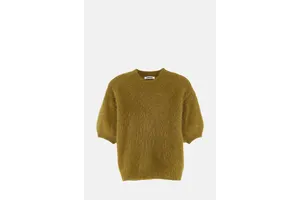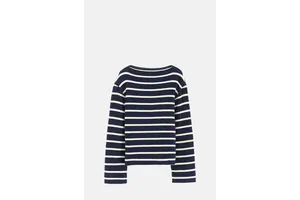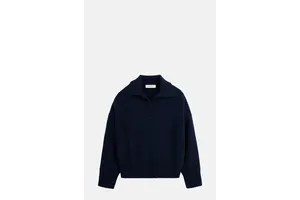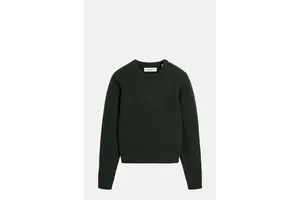
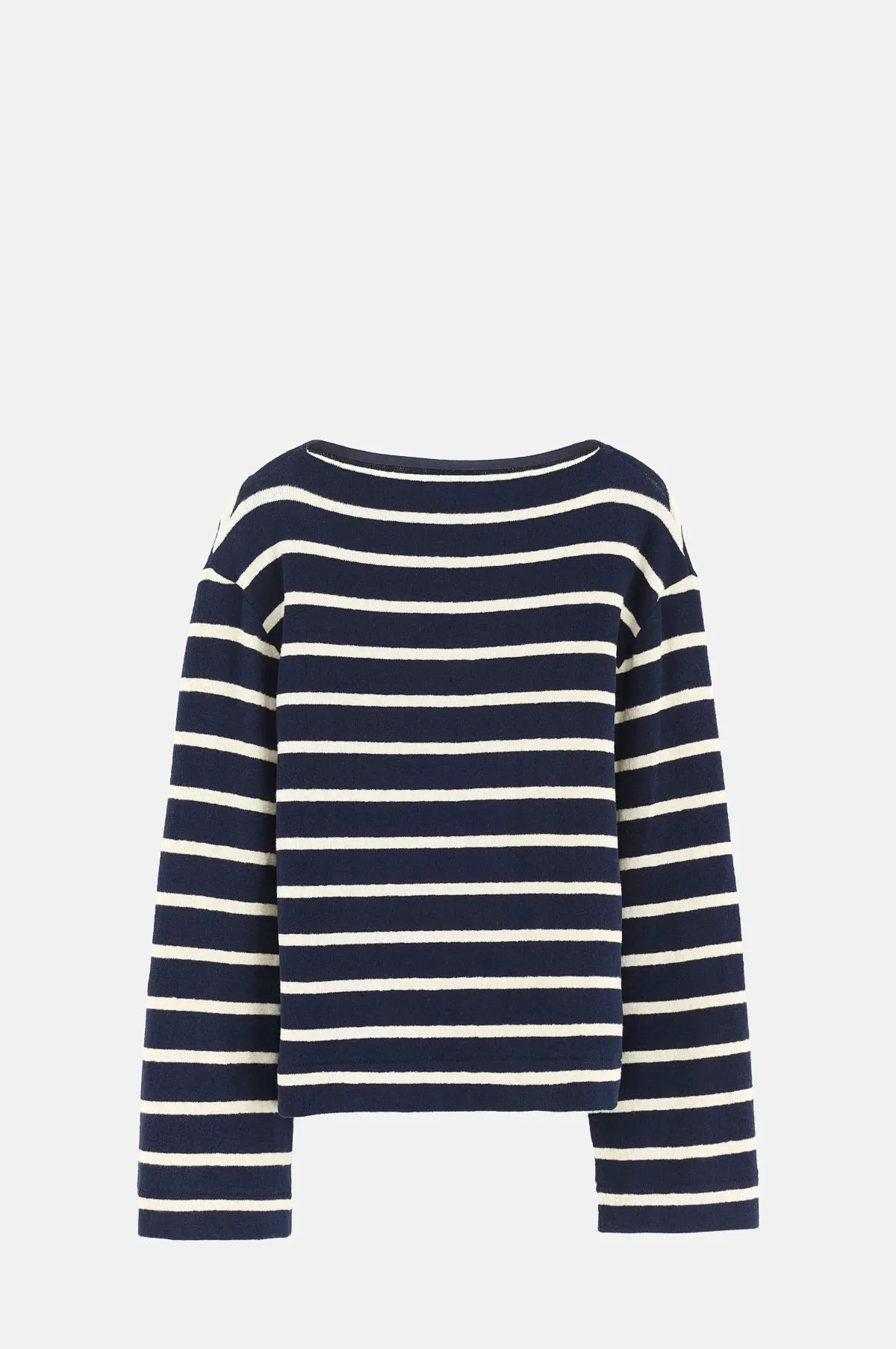

A Breton top from Bellerose in a soft brushed cotton jersey, in navy and ecru nautical stripes with a wide boat neckline and long sleeves, listed at 105 GBP with all five sizes in stock. It is the first striped garment this run has examined, and a stripe is the case where a missing number hurts most, because a stripe is specified by numbers or not at all. The page gives the colours, navy and ecru, and says the pattern is classic nautical stripes, and gives no stripe width, no repeat and no statement about whether the stripes are matched at the seams. On a Breton that last one is the difference between a well-made garment and a cheap one. The table is also worth a close look, because it contains two columns whose grades slow down at exactly the same size, and this run can now prove, using the arithmetic it learned from the one page in this run that publishes decimals, that they are not rounding artifacts but a real change in the grading rule. And the care label is the most complete of the whole run, which is worth remarking on because it appears on the cheapest garment examined so far. The reference is the Fonsy Knit in Stripe G. Dongguan Bafinasa Garments Co., Ltd. develops comparable jersey tops on OEM and ODM terms, from yarn and stripe development to retail or FBA ready packing. We publish this as a development reference and build your own version of it, and we do not supply the branded original or reproduce anyone else's label.
Key Features
- Navy and ecru nautical stripes as stated, with no stripe width and no repeat given, on the first striped garment this run has examined. See the note below
- A Breton with no statement that the stripes are matched at the side seams or across the sleeve head. See the note below
- 18% polyester that appears only in the specification panel and not anywhere in the description, on nearly a fifth of the cloth. See the note below
- Chest grades 3, 3, 2 and 2 cm and the sleeve grades 2, 2, 1 and 1 cm, both slowing at the same size, provably not a rounding artifact. See the note below
- Ease peaks in the middle of the range at about 7.5 in at M and falls to about 6.7 in at XL, which is a non-monotonic curve. See the note below
- The most complete care label this run has met, four clauses, on the least expensive garment this run has examined. See the note below
- Iron at low temperature, which is the clause that shows someone read the elastane in the composition. See the note below
Customisable Options
- Cloth: brushed cotton jersey with stretch to the reference, with the weight and the stretch percentage specified, or a cotton modal, a cotton elastane single jersey or a heavier loopback, each quoted separately
- Stripe: navy and ecru nautical stripes to the reference, with the width of each colour and the repeat published in centimetres, or a wider stripe, a finer stripe or a placed stripe, each quoted separately
- Stripe matching: matched at the side seams and across the sleeve head as an option, or unmatched for a lower price, quoted separately so the difference is visible
- Neck: wide boat neck to the reference, with the neck width specified, or a narrower boat neck, a crew neck or a slash neck
- Fit: relaxed to the reference at about 7 in of ease, held steady by grading at about 2.5 cm a size, or a closer fit at about 4
- Sizes: XS to XL to the reference, or extended to XXL, with one grading rule across the whole range
- Cloth weight and stretch percentage, stripe width and repeat, stripe matching, neck width, ease and grading step, elastane specification and recovery, care labelling with a like-colours clause, size set, colour development, private label
Specifications
| Style | Relaxed long sleeve Breton top in brushed cotton jersey with a boat neck |
| Reference | Bellerose, Fonsy Knit, style BW262338 T1664-STG, navy and ecru stripe, sizes XS to XL |
| Composition | 78% cotton, 18% polyester, 4% elastane as stated in the panel. See the note below |
| Composition in Description | Soft brushed cotton jersey with a hint of stretch, with the polyester not mentioned. See the note below |
| Cloth | Brushed cotton jersey as stated, with no weight and no stretch percentage given. See the note below |
| Pattern | Classic nautical stripes, navy and ecru, as stated, with no stripe width and no repeat given. See the note below |
| Stripe Matching | Not stated, on a Breton. See the note below |
| Neck | Wide boat neckline as stated, with no neck width given. See the note below |
| Sleeve | Long sleeves as stated, with no sleeve measurement origin given |
| Fit | A relaxed silhouette as stated, with no fit guidance and no model information published. See the note below |
| Care | Machine wash at 30 degrees, very delicate wash, do not bleach, do not tumble dry, iron at low temperature. See the note below |
| Sizes Offered | XS to XL, five sizes, all five in stock |
| Fit Guidance | None published |
| Model | None published. See the note below |
| Measurements Published | Pit to pit, sleeve length and total length for all five sizes. See the note below |
| Published Chest | 48, 51, 54, 56 and 58 cm flat, or 18.9 through 22.8 in. See the note below |
| Chest Around | 96, 102, 108, 112 and 116 cm, or 37.8, 40.2, 42.5, 44.1 and 45.7 in. See the note below |
| Ease Against Body Bust | About 6.8, 7.2, 7.5, 7.1 and 6.7 in, peaking at M. See the note below |
| Published Sleeve | 57, 59, 61, 62 and 63 cm, grading 2, 2, 1 and 1 cm. See the note below |
| Published Length | 56, 57, 58, 59 and 60 cm, grading one centimetre per size uniformly. See the note below |
| Stripe Width and Repeat | None. See the note below |
| Cloth Weight | Not stated. See the note below |
| Stretch Percentage | A hint of stretch as stated, with no number. See the note below |
| Neck Width | None. See the note below |
| Pocket Specification | No pockets |
| Photographs | Six |
| Production | Made in Portugal as stated |
| Reference Retail | 105 GBP as listed, the least expensive garment this run has examined, quoted to show the price band this sits in, not as our price |
| Category | Filed by the reference under knitwear and tops |
| Occasion | Spring, summer and autumn, everyday, weekend, with denim or tailored trousers |
| MOQ | 100 pcs per style per colourway, mixed sizes and colourways accepted |
| Sampling | 7-10 days after tech pack or reference sample confirmation |
| Bulk Lead Time | 20-30 days after sample approval and deposit |
| Service | OEM / ODM / private label, yarn-dyed and engineered stripe development, stripe matching, brushed jersey finishing, retail or FBA ready packing |
Size Chart as Published by the Reference
| Size | Pit to Pit (flat) | Sleeve Length | Total Length |
|---|---|---|---|
| XS | 48 cm | 57 cm | 56 cm |
| S | 51 cm | 59 cm | 57 cm |
| M | 54 cm | 61 cm | 58 cm |
| L | 56 cm | 62 cm | 59 cm |
| XL | 58 cm | 63 cm | 60 cm |
The chest figures are flat half measures taken with the top laid down, doubling to 96, 102, 108, 112 and 116 cm around, or 37.8, 40.2, 42.5, 44.1 and 45.7 in. Against a body bust of 31, 33, 35, 37 and 39 in across XS to XL, the ease runs about 6.8, 7.2, 7.5, 7.1 and 6.7 in, so it rises to a peak at M and then falls at both ends. That shape comes from the grade, which is three centimetres for the first two steps and two for the last two. The sleeve grades 2, 2, 1 and 1 cm and slows at the same size as the chest. The length grades one centimetre per size uniformly.
Our Proposed Body Chart
| Size | Body Bust | Sleeve | Body Waist | Body Hips | Length | Source |
|---|---|---|---|---|---|---|
| XS | 31 in / 79 cm | 57 cm | 24 in / 61 cm | 34 in / 86 cm | 56 cm / 22 in | Our proposal |
| S | 33 in / 84 cm | 58 cm | 26 in / 66 cm | 36 in / 91 cm | 58 cm / 22.8 in | Our proposal |
| M | 35 in / 89 cm | 59 cm | 28 in / 71 cm | 38 in / 97 cm | 60 cm / 23.6 in | Our proposal |
| L | 37 in / 94 cm | 60 cm | 30 in / 76 cm | 40 in / 102 cm | 62 cm / 24.4 in | Our proposal |
| XL | 39 in / 99 cm | 61 cm | 32 in / 81 cm | 42 in / 107 cm | 64 cm / 25.2 in | Our proposal |
Occasions and Styling
Suits spring, summer and autumn, everyday and weekends. A Breton is a flat layer that works because it is quiet, and it wants something plain below it: the reference suggests indigo denim or crisp white trousers, which is exactly right.
Production and Quality Control
The reference publishes three columns for all five sizes, states a full composition with percentages in the panel, describes the cloth, the pattern, the neck, the sleeve and the fit, gives a four-clause care instruction and names the country of production. It publishes no fit guidance and no model information, gives no stripe width, no repeat, no stripe matching statement, no cloth weight, no stretch percentage and no neck width. Three things follow: the stripe with no numbers, the two grades that slow down together, and the care label.
A stripe with no numbers, and that is the first thing. This is the first striped garment in this run, and it is worth saying why a stripe is the hardest pattern to specify by words. A check, a plaid and a print all have a repeat, which is the distance before the pattern starts again, and this run has asked for that number on a checked skirt, a plaid pleated skirt and a printed cotton skirt and has not been given it on any of them. A stripe is the same problem made more acute, because a stripe has two numbers rather than one: the width of each colour, and the repeat, which here would be the navy plus the ecru. Those two numbers decide everything a maker and a buyer need to know. They decide how many stripes appear across the chest, which is the entire look of the garment and the difference between a fine Breton and a bold one. They decide whether the pattern can be matched at the seams or has to be cut as it falls, because a stripe with a large repeat cannot be shifted along the marker to save cloth, exactly as a one-way nap cannot. And they decide how much cloth is wasted, which is a cost. None of them is given. There is a second specification a stripe carries that no plain cloth does, and it is also absent: how the stripe is made. On a jersey, which is a knitted cloth, a stripe is usually engineered, which is to say the machine is fed different coloured yarns in a set sequence so the stripe is knitted in, and the stripe width is set in courses on the machine. The alternative is to knit a plain cloth and print the stripes onto it. Those are different products with different costs and different fastness, and the page does not say which this is. Then the third thing, which is the one that separates a well-made Breton from a cheap one, and which is the whole point of the garment. Are the stripes matched at the seams? On a striped top there are three places where the pattern either continues or breaks: the two side seams, where the stripes have to meet themselves round the body, and the sleeve head, where a horizontal stripe on the body has to meet a horizontal stripe on the sleeve at the armhole. Matching all three costs money, in cutting time and in cloth, and it is the single most visible difference between a Breton that looks considered and one that looks assembled. Not one word about it. It is worth adding what this means for a maker: without a repeat and a matching instruction, a factory has to guess from the photographs, and if it guesses wrong the garment will look wrong in a way that is immediately obvious to the customer and which nobody will have specified.
Two grades that slow down at the same size, and it is not rounding, and that is the second thing. The chest reads 48, 51, 54, 56 and 58 cm, so the grades are three, three, two and two, and the sleeve reads 57, 59, 61, 62 and 63 cm, so its grades are two, two, one and one. Both slow down between M and L. This run learned something last batch that lets it settle what this is, and it is worth setting out, because it turns a guess into a proof. One page in this run publishes its figures to two decimal places, and its sleeve reads 80.25, 82, 83.75 and 85.5, which grades exactly 1.75 cm per size. That single column proved the thing this run had only been able to guess at before: real grades are not round numbers, and a chart rounded to whole centimetres cannot be trusted to show them. So the natural suspicion here is that three, three, two, two is a rounded picture of something uniform. It is not, and it can be shown. For a uniform grade to round to 48, 51, 54, 56 and 58, the grade would have to satisfy four conditions at once: it must be between 2.5 and 3.5 to turn 48 into 51, between 2.75 and 3.25 to turn it into 54, between 2.5 and 2.83 to turn it into 56, and between 2.375 and 2.625 to turn it into 58. No number satisfies all four, because the third and fourth conditions do not overlap. So no uniform grade rounds to this column, and the grade really does change. The same test on the sleeve gives the same answer: to turn 57 into 59, 61, 62 and 63 a uniform grade would need to be between 1.75 and 1.83 and also between 1.375 and 1.625, which is impossible. So both columns are genuinely non-uniform. And the important detail is that they change at the same place. If a single column had slowed down, it might be a typo or a mis-measured sample. Two independent columns slowing between the same two sizes points to a rule, and the obvious candidate is one this run has not yet had cause to mention: extended sizes are often graded from a different block or a different rule than the core sizes, because a range that runs XS to XL is sometimes two size sets joined rather than one. That would explain a change at M to L exactly, and it would be a deliberate decision rather than an accident. It is worth saying what this does to the fit, which is less than the shape of the numbers suggests. Because the grade of three centimetres is 2.36 in of circumference against a body grade of two inches, the ease grows through S and M; because two centimetres is 1.57 in, it shrinks through L and XL. So the ease reads about 6.8, 7.2, 7.5, 7.1 and 6.7 in: it peaks in the middle and both ends are slightly closer than the middle is. The whole spread is under an inch, so it will not be felt, but it is a real shape and it is unusual: this run has otherwise met grades that hold the ease steady, that let it collapse steadily, and that let it grow steadily, and this is the first that goes up and comes back down. It is also worth crediting what the word on the page does: relaxed, at about seven inches of ease, is correct, and the ease stays within about four fifths of an inch across five sizes, which is a great deal better than the eight inch spread this run found under the same word at another house.
The most complete care label in this run, on the cheapest garment in this run, and that is the third thing. The panel reads: machine wash at thirty degrees, very delicate wash; do not bleach; do not tumble dry; iron at low temperature. Four clauses. This run has now read a good many care labels and almost all of them are one clause: handwash only, or machine wash thirty, or dry clean only, with nothing after. It has spent a great deal of this run saying that the missing clause is always the one that does the damage, because washing is the instruction everybody remembers to write and drying is the one nobody does, and it has recommended dry flat about a wool trouser, two sweaters, a handwash knit and an expensive cardigan. Here, on a hundred and five pound cotton jersey top, is a label with a drying instruction in it, and a bleaching instruction, and an ironing instruction. It is worth noticing that the completeness runs the opposite way to the price, which is a useful thing for a buyer to know: the amount of care information a brand publishes has no relationship to what the garment costs. And there is one clause here that is better than merely complete, which is iron at low temperature. That clause is only there because somebody read the composition, because it is the elastane that cannot take heat, and elastane is four per cent of this cloth. A care label that matches the fibre list is a care label somebody thought about; most are generic blocks that would be identical whatever the garment was made of. Do not tumble dry is likewise right for a brushed cotton with elastane, and very delicate wash is right for a brushed surface, which mats if it is agitated hard. So the label is coherent with the cloth, and it should be credited. Two things are still missing, and one of them is specific to this garment. The first is washing with like colours, which matters more here than on almost anything else in this run, because this is navy and ecru in the same garment: any loose navy dye in the wash water will go straight onto the ecru and grey it, and the first wash is when that happens. The second is a word about the brushed surface, which is what makes a jersey soft and is also what makes it pill and mat, and which wants turning inside out for washing. Then the other half of the page, which is less good. The composition in the panel is 78% cotton, 18% polyester and 4% elastane, and the description says soft brushed cotton jersey with a hint of stretch, which names the cotton and gestures at the elastane and does not mention the eighteen per cent polyester at all. This run has met this before in both directions: at one house the prose claimed a fibre the panel did not confirm, and at another the panel listed a trim the prose never mentioned. Here the panel holds nearly a fifth of the cloth that the prose does not, and it is worth saying why eighteen per cent is not a detail. A brushed surface is made by raising the surface fibres of the cloth, and raised fibres are what form pills. Cotton pills are weak and break away, but polyester is strong and holds on, so pills that form on a polyester blend tend to stay attached rather than shedding. Brushing makes more pills and polyester makes them last, so the two specifications interact, and a reader of the description would never know the second one was there. No cloth weight is given either, and jersey is bought by weight. Every bulk shipment gets a measurement report against your approved chart.
Optional upgrades include publishing the stripe width and the repeat in centimetres, saying whether the stripe is yarn-dyed and engineered on the machine or printed onto the cloth, stating whether the stripes are matched at the side seams and across the sleeve head and quoting matched and unmatched separately, stating the cloth weight and the stretch percentage, stating the neck width, grading with one rule across the whole size range or holding the ease steady at about two and a half centimetres a size, adding a wash with like colours clause, which matters most on a navy and ecru stripe, adding a word about the brushed surface and turning inside out, naming the elastane and its recovery, publishing fit guidance and a model height, a cotton modal, cotton elastane single jersey and loopback option, wider and finer stripe options, narrower boat neck, crew neck and slash neck options, a closer fit option, extension to XXL, size set, colour development, private label, hangtag and care labelling.
Pre-production sample approval, in-line inspection during cutting and sewing, and a final AQL inspection before packing, with measurement reports and photos shared before shipment.
Send us your tech pack, a photo or a reference garment and we will quote within 24 hours. Contact bafinasa@bafinasa.com or WhatsApp +86 13827222469.