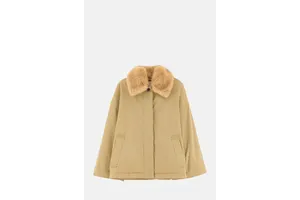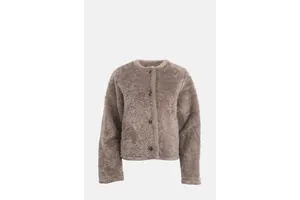
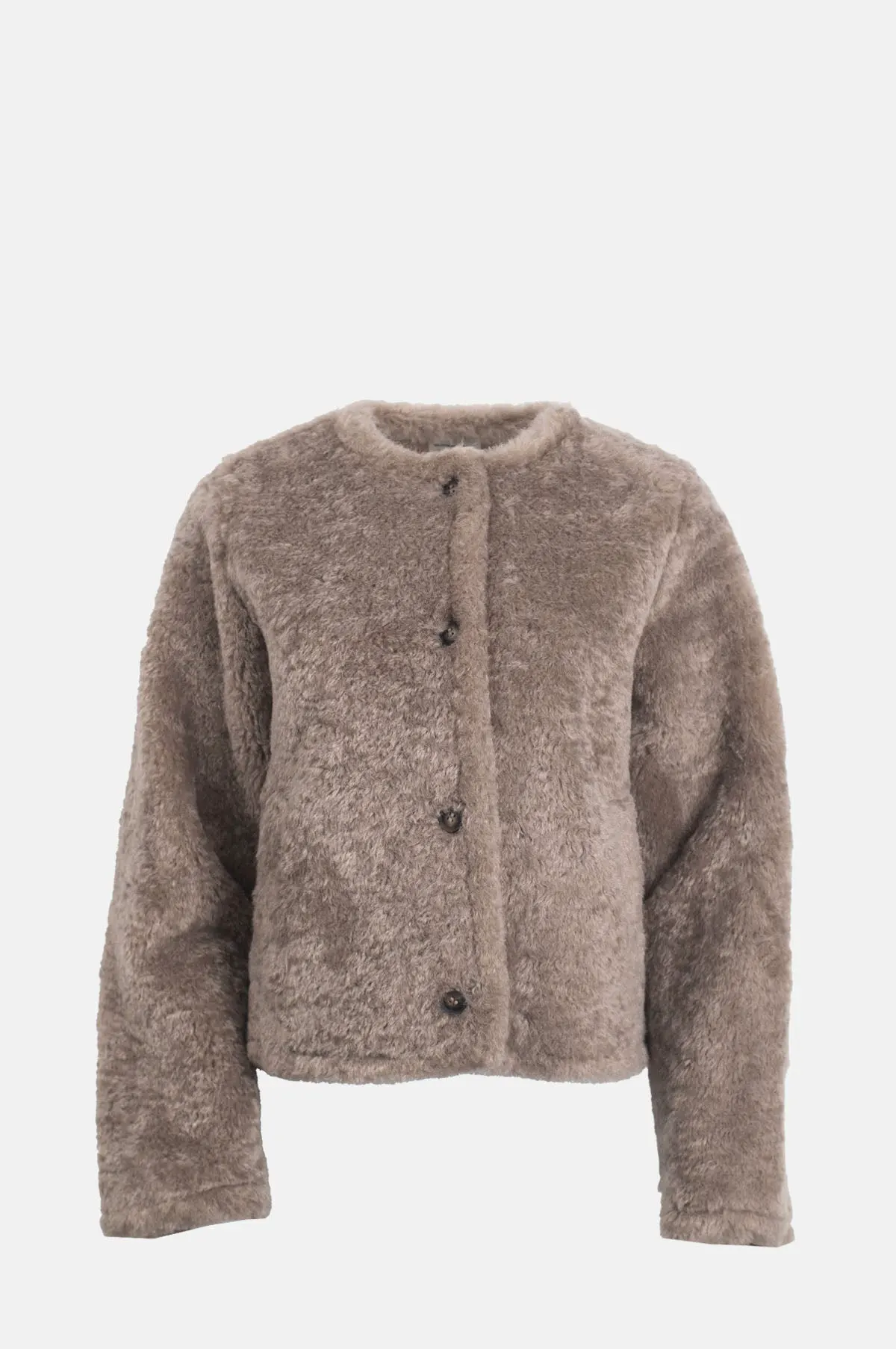

A taupe jacket from Hartford in polyester faux fur with a velvet lining, a crew neck, side pockets and a button closure, boxy in fit, listed at 189 GBP with all four sizes in stock. Two of the things on this page are worth more attention than the rest, and both are about materials rather than measurements, which is unusual for this run. The first is the velvet lining, because velvet is a cloth with a direction to it, and a direction has a consequence that costs money: every piece has to be cut the same way up, so the pattern cannot be flipped or nested to save cloth, and a jacket like this uses noticeably more cloth than its size suggests. The second is the faux fur, and specifically what the care label leaves out. Faux fur is a pile made of synthetic fibre, and heat is what destroys it: it melts, it mats and it flattens, permanently. The label here says professional dry cleaning on a gentle cycle and stops, which tells the customer how to clean the jacket and not the one thing that will ruin it. That is the same omission, in the same shape, as the wool pages in this run that say how to wash a jumper and not how to dry it. The reference is the Vigo Jacket in Taupe. Dongguan Bafinasa Garments Co., Ltd. develops comparable jackets on OEM and ODM terms, from pile and lining selection to retail or FBA ready packing. We publish this as a development reference and build your own version of it, and we do not supply the branded original or reproduce anyone else's label.
Key Features
- Velvet lining as stated, which has a nap and therefore has to be cut one way, using more cloth than the pattern suggests. See the note below
- Faux fur as stated, with no pile height, no pile density and no weight given. See the note below
- Professional dry cleaning on a gentle cycle as stated, with no heat warning, which is the instruction faux fur most needs. See the note below
- Boxy fit as stated, with about nine and a fifth inches of ease at the smallest size
- Sleeve length grading one centimetre per size from 63 to 66 cm, which is correct
- Total length of 50, 52, 55 and 57 cm, grading two, three and two. See the note below
- Button closure as stated, with no count, no size and no spacing, as on every closure in this run. See the note below
Customisable Options
- Shell: polyester faux fur to the reference, with the pile height, the pile density and the weight specified, or a boucle, a teddy pile or a wool, each quoted separately
- Lining: velvet to the reference, with the pile specified and cut one way, or a satin, a cupro or a printed lining, each quoted separately
- Fit: boxy to the reference at about nine inches of ease, or a straighter six inch version, or a closer one
- Closure: button to the reference, with the count, size and spacing specified, or a concealed placket, a snap or a zip
- Pockets: side pockets to the reference, with the position and the opening specified, or patch pockets, or welt pockets
- Neck: crew neck to the reference with the opening given, or a collar, a shawl collar or a v
- Pile height, pile density and shell weight, lining specification and nap layout, button specification, pocket specification, ease, body length, sleeve length, size set, colour development, private label and care labelling
Specifications
| Style | Boxy faux fur jacket with a velvet lining, crew neck and button closure |
| Reference | Hartford, Vigo Jacket, style BGXE556-03, taupe, sizes 1 to 4 |
| Composition | 100% polyester as stated, with no weight given. See the note below |
| Shell | Faux fur as stated, with no pile height, no pile density and no weight given. See the note below |
| Lining | Velvet lining as stated, with no pile specification given. See the note below |
| Texture | A fine textured drape and a notable texture to the faux fur as stated, with nothing quantified. See the note below |
| Fit | Boxy as stated. See the note below |
| Neck | Crew neck as stated, with no neck opening given |
| Shoulder | Neat shoulder stitching as stated, with no stitch specification given |
| Pockets | Side pockets as stated, with no position and no opening given. See the note below |
| Closure | Button closure as stated, with no count, size or spacing given. See the note below |
| Care | Professional dry cleaning on a gentle cycle as stated, with no heat warning and no drying instruction. See the note below |
| Sizes Offered | 1 to 4, four sizes, all four in stock |
| Size Conversion | Published: 1 is XS, 2 is S, 3 is M and 4 is L |
| Model | Published: 1.75 m tall, wearing a size 2 |
| Measurements Published | Pit to pit, sleeve length and total length for all four sizes. See the note below |
| Published Chest | Pit to pit 51, 53, 55 and 57 cm flat, or 20.1 through 22.4 in. See the note below |
| Chest Around | 102, 106, 110 and 114 cm, or 40.2, 41.7, 43.3 and 44.9 in. See the note below |
| Ease Against Body Bust | About 9.2, 8.7, 8.3 and 7.9 in from smallest to largest. See the note below |
| Published Sleeve | 63, 64, 65 and 66 cm, grading one centimetre per size |
| Published Length | 50, 52, 55 and 57 cm, grading two, three and two. See the note below |
| Published Hem | None |
| Cloth Weight | Not stated. See the note below |
| Pile Specification | None. See the note below |
| Photographs | Six |
| Production | Made in China as stated |
| Reference Retail | 189 GBP as listed, quoted to show the price band this sits in, not as our price |
| Category | Filed by the reference under coats and jackets |
| Occasion | Autumn, winter and spring, daily wear, over a knit or a shirt |
| MOQ | 100 pcs per style per colourway, mixed sizes and colourways accepted |
| Sampling | 7-10 days after tech pack or reference sample confirmation |
| Bulk Lead Time | 20-30 days after sample approval and deposit |
| Service | OEM / ODM / private label, faux fur sourcing with pile specified, one-way nap layout and cloth consumption planning, velvet lining sourcing, retail or FBA ready packing |
Size Chart as Published by the Reference
| Size | Pit to Pit (flat) | Sleeve Length | Total Length |
|---|---|---|---|
| 1 / XS | 51 cm | 63 cm | 50 cm |
| 2 / S | 53 cm | 64 cm | 52 cm |
| 3 / M | 55 cm | 65 cm | 55 cm |
| 4 / L | 57 cm | 66 cm | 57 cm |
The chest figures are flat half measures taken with the jacket laid down, doubling to 102, 106, 110 and 114 cm around, or 40.2, 41.7, 43.3 and 44.9 in. Against a body bust of 31, 33, 35 and 37 in across XS to L, the ease is about nine and one fifth inches at the smallest and about seven and nine tenths at the largest, which is a full jacket and consistent with the boxy fit it claims. The sleeve grades a clean one centimetre per size from 63 to 66 cm. The total length grades unevenly, by two, three and two centimetres, which is what a real grade of about two and a third rounded to whole centimetres looks like.
Our Proposed Body Chart
| Size | Body Bust | Sleeve | Body Waist | Body Hips | Length | Source |
|---|---|---|---|---|---|---|
| 1 / XS | 31 in / 79 cm | 63 cm | 24 in / 61 cm | 34 in / 86 cm | 50 cm / 19.7 in | Our proposal |
| 2 / S | 33 in / 84 cm | 64 cm | 26 in / 66 cm | 36 in / 91 cm | 52 cm / 20.5 in | Our proposal |
| 3 / M | 35 in / 89 cm | 65 cm | 28 in / 71 cm | 38 in / 97 cm | 54 cm / 21.3 in | Our proposal |
| 4 / L | 37 in / 94 cm | 66 cm | 30 in / 76 cm | 40 in / 102 cm | 56 cm / 22 in | Our proposal |
Occasions and Styling
Suits autumn, winter and spring and daily wear. A boxy jacket that is short in the body is the piece that goes over everything from a shirt to a chunky knit, and the velvet lining is what makes it warm enough for winter without being a coat.
Production and Quality Control
The reference publishes three columns for all four sizes, states its fibre, the shell, the lining, the fit, the neck, the pockets and the closure, gives a care instruction, names the country of make, publishes a size conversion and gives the height of the model and the size she wears. It gives no weight, no pile specification, no button specification and no heat warning, and its length grade is uneven. Three things follow: what a velvet lining costs to cut, what a faux fur label has to say about heat, and the two honest sentences on the page.
A velvet lining, and the cloth it wastes, and that is the first thing. Velvet is a pile cloth: the surface is made of upright threads, and those threads lean one way. The consequence is that velvet looks like a different colour depending on which way the light catches it and which way the pile is lying, so two panels cut from the same roll and sewn together with one of them turned the other way up will read as two different shades on the finished garment. That is why every piece of a velvet garment has to be cut with its pile running the same direction, and the technical term for it is a one-way or nap layout. In cutting, that is expensive, and it is worth saying exactly how. Normally a marker nests pattern pieces to use the cloth like a jigsaw, flipping a piece over where it saves room, because most cloths look the same either way up. With a one-way layout you cannot flip anything, so the pieces can only slide around, and the marker uses more cloth, typically somewhere between ten and fifteen per cent more on a jacket of this shape. That is real money, it is the main reason a velvet garment costs more than its weight suggests, and it is a number a factory has to plan for before quoting rather than discovering afterwards. This run met the same cloth a few batches ago on the velvet trousers from another house, and said the same thing there, and it is worth repeating because it is the clearest case in the run of a cloth property turning directly into a cost. There are two more things a velvet lining brings that belong in a specification and are not on this page. The first is that velvet crushes: a pile laid flat under pressure does not always come back, which is why velvet garments are stored hanging and pressed on a needle board rather than flat, and a jacket with a velvet lining crushed against the back of a chair is a jacket with a permanently flat patch inside it. The second is that velvet is heavier than a normal lining of the same thickness, so it adds warmth and it adds weight, and a boxy jacket with a heavy lining pulls at the shoulders, which is one more reason to want the shell weight stated. Then the shell itself. Faux fur is specified by three numbers and none of them is here. The first is pile height, which is how long the fibres stand, and it is the difference between a teddy texture and a long shag. The second is pile density, which is how many fibres per square centimetre, and it is what decides whether the cloth looks rich or sparse and whether you can see the backing through it. The third is weight per square metre, which ties the two together and which is also the number that decides how warm and how heavy the jacket is. Without them, faux fur is a word, and the reference is honest enough to concede as much in its own copy, which is the second thing worth looking at.
The two honest sentences, and the warning they forgot, and that is the second thing. The description says, in person, it exhibits a notable texture to the faux fur, super soft. That is a strange sentence to put on a product page and it is worth taking seriously, because it is an admission: it says the photographs do not convey the texture, and it says so in the first person, as though the writer has just handled the sample. This run has read a great deal of copy in fifteen batches and most of it asserts; this one concedes, and that is to its credit. But it does not solve the problem it identifies. If the texture cannot be seen in the picture, then the texture has to be in the specification, and it is not: no pile height, no density, no weight, and the word notable doing the work that a millimetre would do. It is worth saying what the fix is, because it is cheap and this run has recommended it before on other cloths: publish a close-up photograph of the cloth at a stated scale, or name the pile in millimetres. Either one takes the claim out of the realm of trust. Now the care label, which is where this page does real damage. It reads professional dry cleaning, gentle cycle, and stops there. The gentle cycle part is good and unusually careful, because it tells the cleaner not to use a harsh solvent or a long cycle, and it is the sort of detail that shows someone thought about it. What is missing is the part that matters most on this particular cloth. Faux fur is made of synthetic fibre standing up in a pile, and synthetics are thermoplastic, which means heat softens and then permanently deforms them. Three ordinary household things will ruin this jacket and the label warns against none of them. A tumble dryer will mat and flatten the pile. An iron will melt it into a shiny patch in one touch. And even a hot radiator or a steamer held too close will crush it. So the three warnings this label needs are do not tumble dry, do not iron, and keep away from heat, and it has none of them. It is worth setting this beside the pattern this run has found repeatedly on wool, because the shape is identical and the diagnosis is the same. The wool trouser said dry clean only and not how to dry it. The geese sweater said hand wash only and not dry flat. The mushrooms sweater said hand wash only and not dry flat. In every case the label gives the cleaning and omits the step that actually damages the garment, because washing is the part everybody remembers to write down and drying and heat are the parts nobody does. On wool the damaging step is hanging it wet; on faux fur it is heat; in both cases the instruction that would save the garment is three words and it is absent. It is worth adding what the label does not say about the velvet either, since a lining that gets wet and is then dried badly will crush, and the gentle cycle instruction is the right instinct for both materials and simply stops too early.
Boxy, uneven, and a closure with no buttons on it, and that is the third thing. The chest measures 102 cm around at the size 1 against a body bust of 79 cm at an XS, so there is about nine and a fifth inches of ease, and it is still about seven and nine tenths at the size 4. Boxy is the right word for that, and it is worth noting what boxy implies and does not deliver. Boxy usually means two things together: wide, and with little or no shaping at the waist. This jacket is certainly wide, and it has waist shaping only if the side seams curve, which cannot be seen from the numbers because no waist measurement is published at all. So the claim rests on the chest ease alone, and a garment can be very wide and still be shaped. A waist measurement would settle it, and for a jacket it is the one figure this run would add first. Then the length column, which is worth a paragraph because it is the only arithmetical oddity on the page. It reads 50, 52, 55 and 57, so the steps are two, three and two centimetres. An uneven grade like that is almost always a rounding artifact rather than a mistake: the total across three steps is seven centimetres, which is about two and a third per size, and if the underlying pattern grades at two and a third and somebody rounds each size to a whole centimetre for the chart, you get exactly this, two, three, two. So the published chart is very probably a rounded picture of a correct pattern rather than a wrong one. But that is precisely the problem, and this run has met it before: the chart is what the customer and the factory see, and a chart that is a rounding of the real thing is a chart that cannot be used to check the pattern. Either publish the actual grade to one decimal, or hold the lengths at clean two centimetre steps and accept the difference. It is worth setting this beside the dress published alongside this one, whose chest grade is one, two and two, so the first step is half the others, and which is not a rounding artifact at all because no uniform grade rounds to that. Two garments in one batch, two uneven grades, two different causes. Then the closure. The specification list says button closure, and that is all: no count, no diameter, no material, no spacing, no buttonhole type. This is now the fifth garment in two batches whose fastening is named and never specified, after the double button placket on the cardigan, the tie bow on the blouse, the button through front on the vest and the invisible side zip on the dress, which at least gave its type and position. It is worth saying why a button specification matters more on this jacket than on most. The shell is a thick pile, and a button sewn through a thick pile sinks into it and disappears, so the button has to be large enough to be seen and it needs a shank long enough to clear the pile, and behind it the cloth needs reinforcing or the button will pull through under the weight of the garment. None of that can be guessed from the word button. And the pockets, in the same family: side pockets, with no position and no opening given, so nobody knows how high they sit or whether a hand goes in. Every bulk shipment gets a measurement report against your approved chart.
Optional upgrades include specifying the faux fur by pile height, pile density and weight, stating the shell weight and the lining weight, planning the one-way nap layout and quoting the extra cloth it consumes, adding do not tumble dry, do not iron and keep away from heat to the care label, publishing the body length to one decimal or holding it at clean two centimetre steps, publishing a waist measurement so the word boxy can be checked, specifying the buttons by count, diameter, material and spacing with a shank long enough to clear the pile and reinforcement behind, specifying the pocket position and opening, adding a close-up photograph of the cloth at a stated scale, a satin, cupro and printed lining option, a concealed placket, a snap and a zip option, patch and welt pocket options, collar and shawl collar options, size set, colour development, private label, hangtag and care labelling.
Pre-production sample approval, in-line inspection during cutting and sewing, and a final AQL inspection before packing, with measurement reports and photos shared before shipment.
Send us your tech pack, a photo or a reference garment and we will quote within 24 hours. Contact bafinasa@bafinasa.com or WhatsApp +86 13827222469.