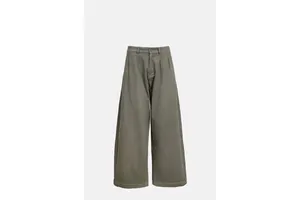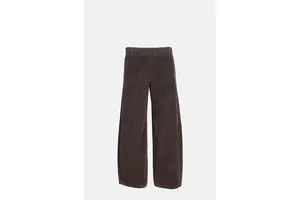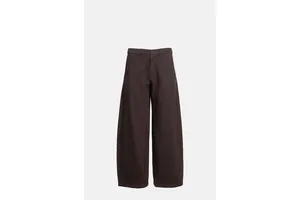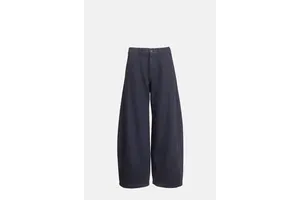
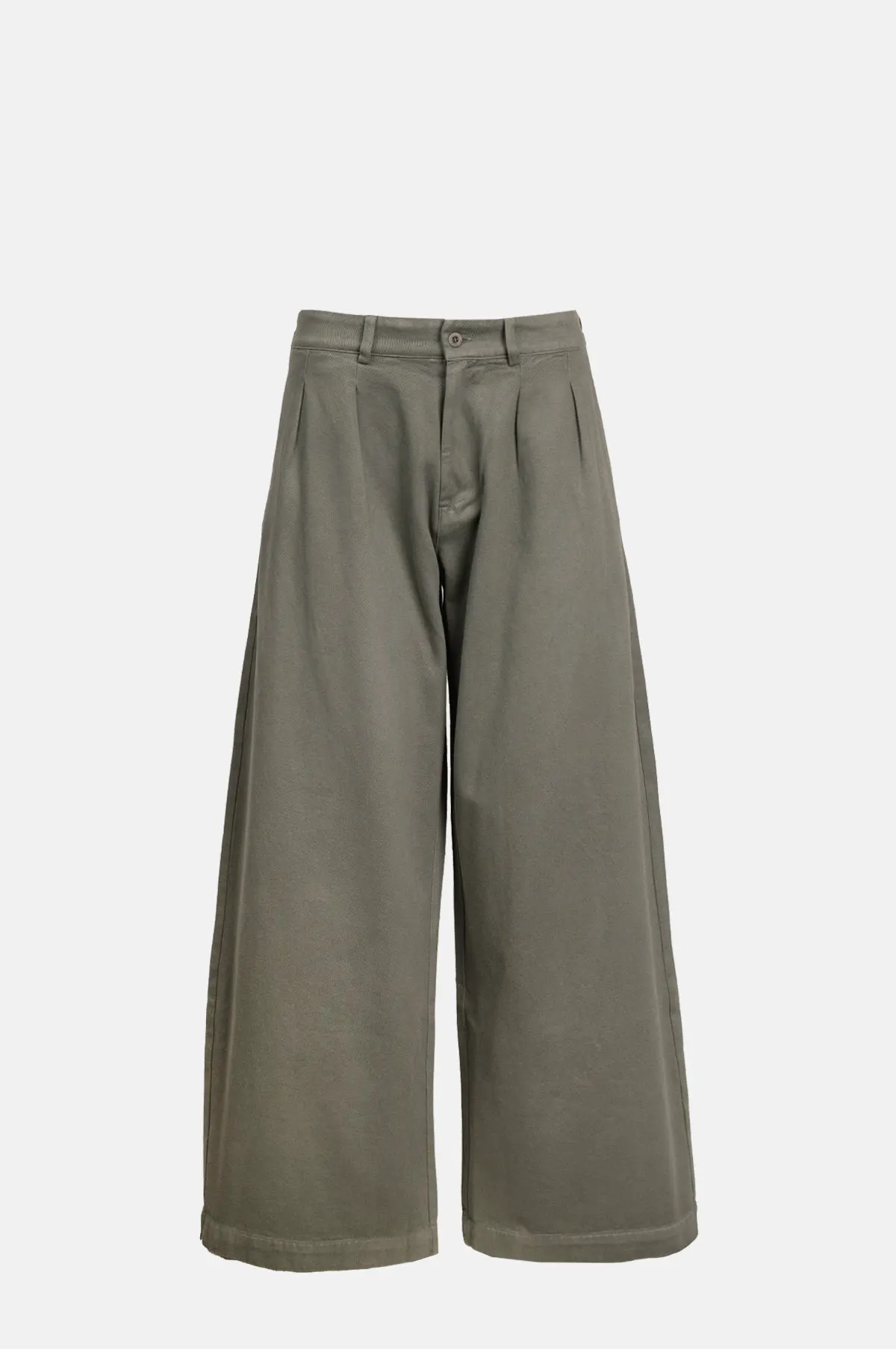

A voluminous wide leg trouser from LABO.ART in a soft brushed cotton drill, lichen green, with pleats set from the waistband, side pockets and rear pockets and a button and zip fastening, listed at 251 GBP with all five sizes in stock. It publishes waist, total length and inseam for all five sizes, and having a published inseam means the rise can be derived, which makes this the third trouser in this run whose rise can be read and the third to behave differently: this one runs 26, 26, 27, 27 and 27 cm, rising slightly, where one held constant at 26 and another closed from 26 to 24. The step in this one comes from a single uneven figure in the length column, which is worth noticing because it shows how a small irregularity in a published number becomes a visible one in a derived one. The reference is the Marlon Mel Pant in Lichene. Dongguan Bafinasa Garments Co., Ltd. develops comparable trousers on OEM and ODM terms, from cloth selection and pleat construction to retail or FBA ready packing. We publish this as a development reference and build your own version of it, and we do not supply the branded original or reproduce anyone else's label.
Key Features
- Three columns for all five sizes, with a published inseam that allows the rise to be derived
- A derived rise of 26 rising to 27 cm, the third trouser in this run and the third different behaviour. See the note below
- 100% brushed cotton drill as stated, made in Italy
- Voluminous wide leg with pleats set from the waistband as stated
- Side pockets and rear pockets as stated, which is more pocketing than most trousers in this run
- Button and zip fastening as stated, so a fixed waistband with no elastic. See the note below
- Machine wash at 30 degrees, do not tumble dry, as stated
- All five sizes in stock
Customisable Options
- Cloth: brushed cotton drill to the reference, with the weight in grams per square metre set to your market since none is given
- Finish: brushed to the reference, or an unbrushed drill for a firmer hand and better abrasion, quoted separately
- Leg: voluminous wide to the reference, with the leg opening width specified, or a moderate wide leg off the same block
- Pleats: pleats from the waistband to the reference, with single or double pleats and the depth specified, or a flat front
- Waistband: fixed with a button and zip to the reference, or a half elasticated back, or a fully elasticated option
- Rise: 26 to 27 cm to the reference as derived, with a higher rise option quoted
- Cloth weight, finish, leg opening, pleat depth, rise, inseam, pocket style, size set, colour development, private label and care labelling
Specifications
| Style | Voluminous pleated wide leg trouser in brushed cotton drill |
| Reference | LABO.ART, Marlon Mel Pant, style L972FP010 022 - 26W LICHENE 011, lichen green, size 0 to 4, given as 0/XS through 4/XL |
| Composition | 100% cotton as stated |
| Cloth | Soft brushed cotton drill as stated, with no weight given. See the note below |
| Leg | Voluminous wide leg silhouette as stated, with no leg opening width published. See the note below |
| Pleats | Pleats accented from the waistband as stated, with no pleat count and no depth given. See the note below |
| Waistband | Fixed waistband with a button and zip fastening as stated, no elastic. See the note below |
| Pockets | Side pockets and rear pockets as stated |
| Care | Machine wash at 30 degrees, do not tumble dry, as stated |
| Sizes Offered | 0 to 4, five sizes, all in stock |
| Measurements Published | Waist, total length and inseam for all five sizes. See the note below |
| Published Waist | 36, 38, 40, 42 and 44 cm flat, or 14.2 through 17.3 in. See the note below |
| Published Total Length | 101, 102, 104, 105 and 106 cm, grading one, two, one and one centimetres. See the note below |
| Published Inseam | 75, 76, 77, 78 and 79 cm, grading one centimetre per size throughout |
| Derived Rise | About 26, 26, 27, 27 and 27 cm, arrived at by subtraction. See the note below |
| Published Hip | None. See the note below |
| Published Leg Opening | None. See the note below |
| Model | None stated, no height and no body measurements |
| Photographs | Five |
| Cloth Weight | Not stated, only the words soft and brushed |
| Production | Made in Italy as stated |
| Reference Retail | 251 GBP as listed, quoted to show the price band this sits in, not as our price |
| Category | Filed by the reference under trousers |
| Occasion | Autumn and winter, everyday, weekend, work in a relaxed setting, travel |
| MOQ | 100 pcs per style per colourway, mixed sizes and colourways accepted |
| Sampling | 7-10 days after tech pack or reference sample confirmation |
| Bulk Lead Time | 20-30 days after sample approval and deposit |
| Service | OEM / ODM / private label, drill sourcing and brushing, pleat construction, retail or FBA ready packing |
Size Chart as Published by the Reference
| Size | Waist (flat) | Total Length | Inseam |
|---|---|---|---|
| 0 / XS | 36 cm | 101 cm | 75 cm |
| 1 / S | 38 cm | 102 cm | 76 cm |
| 2 / M | 40 cm | 104 cm | 77 cm |
| 3 / L | 42 cm | 105 cm | 78 cm |
| 4 / XL | 44 cm | 106 cm | 79 cm |
The waist figures are flat half measures taken with the trouser laid down, doubling to 72, 76, 80, 84 and 88 cm around, or 28.3 through 34.6 in. Against the body chart that is about four inches of ease at size 0 falling to about two and a half at size 4, since the waist grades two centimetres flat per size, or four centimetres of circumference, while the body chart moves two inches, or about five centimetres. On a fixed waistband with no elastic that fall matters more than it would on an elasticated one. Subtracting the inseam from the total length leaves a rise of about 26 cm on the first two sizes and 27 on the last three, and the step comes from the one irregular figure in the length column rather than from the inseam.
Our Proposed Body Chart
| Size | Body Bust | Body Waist | Body Hips | Length | Source |
|---|---|---|---|---|---|
| 0 / XS | 31 in / 79 cm | 24 in / 61 cm | 34 in / 86 cm | 101 cm / 39.8 in | Our proposal |
| 1 / S | 33 in / 84 cm | 26 in / 66 cm | 36 in / 91 cm | 103 cm / 40.6 in | Our proposal |
| 2 / M | 35 in / 89 cm | 28 in / 71 cm | 38 in / 97 cm | 105 cm / 41.3 in | Our proposal |
| 3 / L | 37 in / 94 cm | 30 in / 76 cm | 40 in / 102 cm | 107 cm / 42.1 in | Our proposal |
Occasions and Styling
Suits autumn and winter, everyday wear, weekends, relaxed workplaces and travel. A brushed drill is warmer than an unbrushed cloth of the same weight, and the pleats and the volume make this a trouser that reads well with a flat shoe and a knit, which is the practical case for the length it carries.
Production and Quality Control
The reference states its fibre, names the cloth as a brushed drill, publishes three columns for all five sizes, describes the pleats, the pockets and the fastening, gives a care instruction and states the country of make. Three things follow: how a one centimetre irregularity in a published column becomes a visible step in a derived one, what four inches of ease falling to two and a half means on a waistband with no elastic, and what brushed drill is and what it costs you.
One irregular figure, one derived step, and that is the first thing. The total length runs 101, 102, 104, 105 and 106, so the differences between them are one, two, one and one. The inseam runs 75 through 79 in clean ones. Subtract one from the other and the rise comes out at 26, 26, 27, 27 and 27, because the single two centimetre step in the length column happens at the second size and the inseam beside it moves only one, so one centimetre of rise appears where none was planned. This run has now read the rise on three trousers from the same house and got three answers: one held 26 cm across the whole range, one closed from 26 to 24, and this one rises from 26 to 27. All three are within a couple of centimetres, which is inside the rounding you would expect from published figures, and all three are arrived at by arithmetic rather than read off a spec, which is the real problem and the reason this run keeps making the same recommendation. A derived measurement inherits the errors of both its parents and publishes them as if they were measured, and here it is visible: a one centimetre wobble in a length column looks like nothing on its own and looks like a change in the cut once it has been subtracted. Two practical conclusions follow. The first is for anyone reading retail tables, which is to treat a derived rise as a rough indication and not as a specification, and to expect it to wobble by one or two centimetres for reasons that have nothing to do with the pattern. The second is for anyone publishing one, which is to measure the rise directly, from the waistband seam to the crotch seam, and publish that, because it is one measurement, it is easy to take, and it removes the arithmetic entirely. We take it on every sample and put it on every spec, alongside the waist, the hip and the inseam, and it is usually the first number a fit model comments on.
Four inches of ease falling to two and a half, on a waistband that does not stretch, and that is the second thing. The waist is published at 36 cm flat on the smallest size, doubling to 72 cm around, or 28.3 in, against a 24 in body, which is about four inches of ease. It is worth comparing that with the two other trousers in this run that published a waist: both started at 34 cm flat, or about two and three quarter inches of ease, and both had elasticated waistbands. This one starts two centimetres flatter and has no elastic at all, just a button and a zip, so it has to carry more ease at the waist to do the same job, and it does. Then watch the ease across the range. The waist grades two centimetres flat per size, which is four centimetres of circumference, or about one and a half inches, while the body chart moves two inches, so each step up in size gives back half an inch of ease, and by size 4 there is only about two and a half inches left. Two and a half inches of waist ease on a fixed waistband is snug. It is wearable, and the pleats below it mean the trouser will not pull, but it is a different garment from the one at size 0, where four inches gives real room, and a customer who buys these for the comfort and takes the largest size is buying the least comfortable pair in the range. The same effect appeared on the corduroy jacket earlier in this run, where the ease fell from seventeen inches to thirteen, and on the poplin shirt before it, and it is what a grade built on the cloth rather than on the body always produces. It is a decision, it should be made deliberately, and the way to see it is to write the ease column out against your own body chart before the grade is fixed. There is a second gap that makes this harder to judge than it should be, which is that no hip measurement appears anywhere on the page, and on a pleated trouser the hip is what the pleats exist to cover.
Brushed drill, and what the brushing costs, and that is the third thing. A drill is a stout warp faced twill, the same family as a jean cloth or a heavy chino, typically running somewhere between 250 and 350 grams per square metre, and it is a durable cloth that holds a crease and takes a hard wear. Brushing it means passing the finished cloth over revolving wire covered rollers so the surface fibres are raised into a nap, which gives the soft, slightly fuzzy hand the reference describes and which makes the cloth warmer, since the raised surface traps air. Three consequences follow and they all belong in a costing and a specification. The hand improves and the warmth improves, which is why a brushed drill is the right cloth for a winter trouser with volume in it. The cloth becomes slightly less durable at the surface, since a raised nap abrades and will pill or go shiny at the points that rub, which on a trouser means the seat and the inner thigh, and this run has already discussed how a garment described as durable should publish an abrasion figure and does not. And the cloth now has a nap, which means it has to be cut one way with every panel running the same direction, raising cloth consumption by roughly five to ten per cent over a cloth that can be cut either way, and making shade variation between panels an inspection point, since two panels cut in opposite directions read as two different greens under the same light. No weight is given, and for a garment described as voluminous the weight is what decides whether the volume drapes or stands, because a light drill at this width will collapse and a heavy one will hold the shape the reference is describing. No leg opening width is published either, so voluminous has no number behind it, which is the same gap this run has met on every wide leg garment it has examined. The pleats are described as accented from the waistband with no count and no depth, so single and double pleats are both possible readings. And there are rear pockets, which is more pocketing than most trousers in this run carry and which is worth a line: rear pockets on a voluminous pleated trouser have to be placed with care, because a pocket set too high or too small on a full seat will gape open when the wearer sits, and that is a fitting fault rather than a making fault. Every bulk shipment gets a measurement report against your approved chart.
Optional upgrades include publishing the rise as a measured figure rather than leaving it to be derived, since a one centimetre wobble in the length column becomes a visible step in the rise, publishing the hip measurement, publishing the leg opening width so voluminous has a number behind it, stating the cloth weight in grams per square metre, which decides whether a wide leg drapes or stands, holding the waist ease constant across the range rather than letting it fall from four inches to two and a half, specifying the pleat count and depth, offering an unbrushed drill alongside the brushed one for anyone who wants the firmness and the abrasion resistance, quoting abrasion resistance for a cloth described as durable, a half elasticated back for comfort at the top of the range, regular and long inseams, a moderate wide leg off the same block, size set, colour development, private label, hangtag and care labelling.
Pre-production sample approval, in-line inspection during cutting and sewing, and a final AQL inspection before packing, with measurement reports and photos shared before shipment.
Send us your tech pack, a photo or a reference garment and we will quote within 24 hours. Contact bafinasa@bafinasa.com or WhatsApp +86 13827222469.