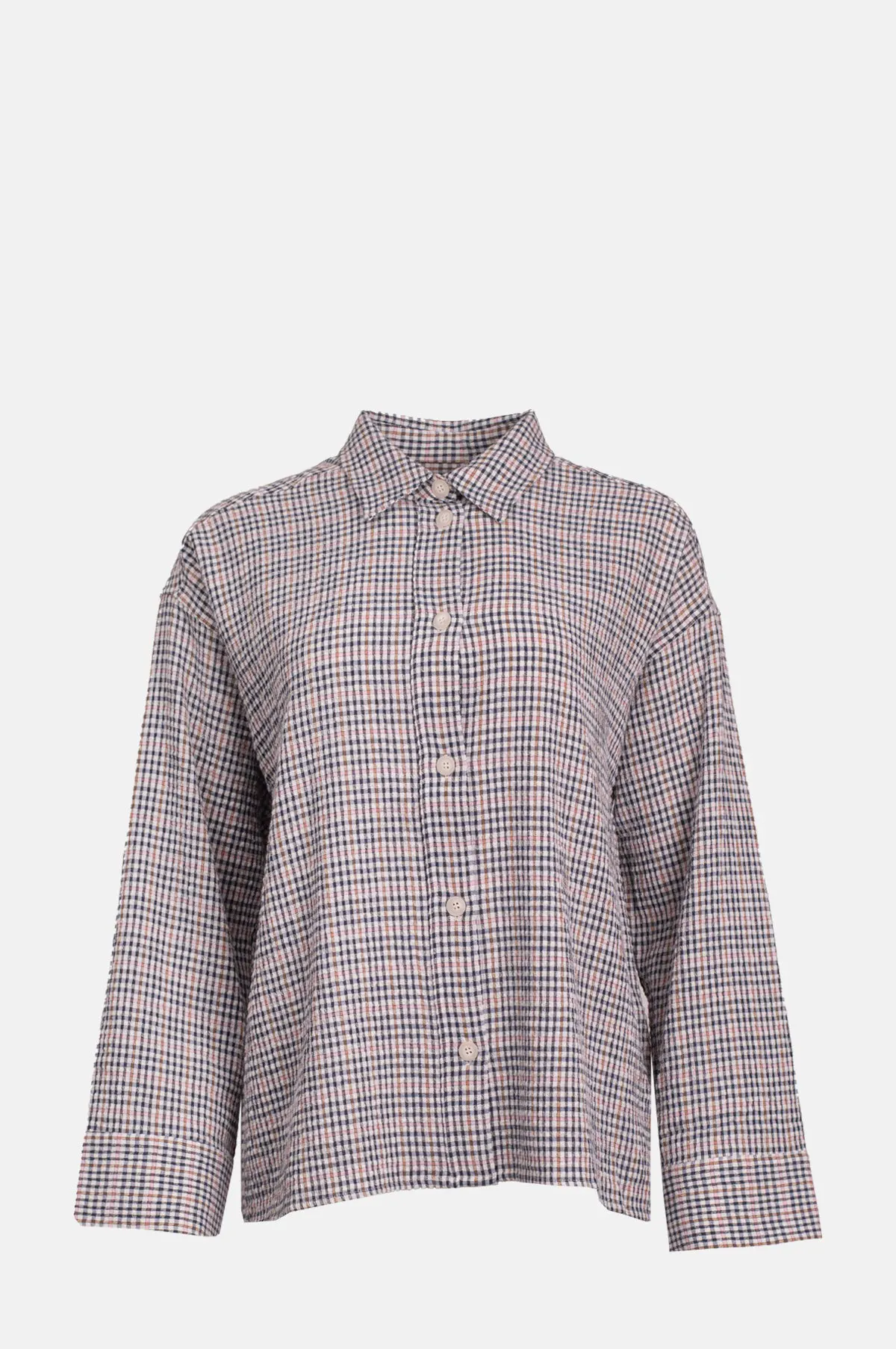

A pastel check overshirt from Sacrecoeur in a cotton rich blend with a seersucker texture, a relaxed fit, a button-down front, a classic collar, a back yoke and buttoned cuffs, listed at 149 GBP with only the XS in stock and S, M and L sold out. It publishes pit to pit, sleeve and length for all four sizes, and two things on the page are worth more attention than the check. The first is the sleeve, at 51 cm on the smallest size, which is the shortest published figure in this whole run and appears on the garment described as relaxed, where you would expect the longest. The second is the composition, which names ninety five per cent of the cloth and then stops, and on a seersucker that last five per cent may be doing more work than any of the rest. The reference is the Linetta Overshirt in Multico. Dongguan Bafinasa Garments Co., Ltd. develops comparable shirting on OEM and ODM terms, from cloth selection and seersucker development to retail or FBA ready packing. We publish this as a development reference and build your own version of it, and we do not supply the branded original or reproduce anyone else's label.
Key Features
- A three column table for all four sizes
- 51 cm sleeve on the smallest size, the shortest in this run, on the garment described as relaxed. See the note below
- Seersucker texture in a pastel check as stated, which is a puckered woven cloth rather than a printed one. See the note below
- Composition given to a hundred per cent, with the last five per cent listed only as other fibres. See the note below
- Relaxed fit, button-down front, classic collar, back yoke and buttoned cuffs as stated
- Machine wash at 30 degrees as stated
- Made in Tunisia as stated
- One of four sizes in stock, the XS, with S, M and L sold out
Customisable Options
- Cloth: cotton rich seersucker to the reference, with the blend ratio and weight open since neither is fully specified
- Texture: seersucker pucker to the reference, or a flat plain weave or a yarn dyed check without the puckering
- Fit: relaxed to the reference, with the ease reducible by four to six inches for a closer shirt
- Collar: classic to the reference, with point size and interlining weight adjustable
- Cuffs: buttoned to the reference, or a single button, or a plain hem
- Length: 65 to 68 cm to the reference, with an overshirt length and a shirt length quoted separately
- Cloth weight, blend ratio, ease, sleeve length, pocket options, size set, colour development, private label and care labelling
Specifications
| Style | Relaxed fit seersucker overshirt in a pastel check |
| Reference | Sacrecoeur, Linetta Overshirt, style LINETTA/CLIC, pastel check, size XS to L |
| Composition | 48% cotton, 34% viscose, 13% polyester and 5% other fibres as stated, totalling one hundred |
| Cloth | Seersucker in a pastel check as stated, with no weight given. See the note below |
| Fit | Relaxed fit as stated |
| Front | Button-down front as stated |
| Collar | Classic collar as stated |
| Back | Back yoke as stated |
| Cuffs | Buttoned cuffs as stated |
| Care | Machine wash at 30 degrees as stated |
| Sizes Offered | XS, S, M and L, four sizes, one in stock with S, M and L sold out |
| Measurements Published | Pit to pit, sleeve length and total length for all four sizes. See the note below |
| Published Chest | Pit to pit 55, 56, 58 and 60 cm flat, or 21.7, 22.0, 22.8 and 23.6 in. See the note below |
| Published Sleeve | 51, 52, 53 and 54 cm. See the note below |
| Published Length | 65, 66, 67 and 68 cm, grading one centimetre per size |
| Model | None stated, no height and no body measurements |
| Photographs | Four |
| Cloth Weight | Not stated, only the word seersucker |
| Production | Made in Tunisia as stated |
| Reference Retail | 149 GBP as listed, quoted to show the price band this sits in, not as our price |
| Category | Filed by the reference under blouses and shirts |
| Occasion | Everyday, weekend, travel, worn open as an overshirt or buttoned as a shirt |
| MOQ | 100 pcs per style per colourway, mixed sizes and colourways accepted |
| Sampling | 7-10 days after tech pack or reference sample confirmation |
| Bulk Lead Time | 20-30 days after sample approval and deposit |
| Service | OEM / ODM / private label, seersucker cloth sourcing, yarn dyed check development, retail or FBA ready packing |
Size Chart as Published by the Reference
| Size | Pit to Pit (flat) | Sleeve Length | Total Length |
|---|---|---|---|
| XS | 55 cm | 51 cm | 65 cm |
| S | 56 cm | 52 cm | 66 cm |
| M | 58 cm | 53 cm | 67 cm |
| L | 60 cm | 54 cm | 68 cm |
The chest figures are flat half measures taken with the garment laid down, doubling to 110, 112, 116 and 120 cm around, or 43.3 through 47.2 in. Against the body chart that is about twelve inches of ease at XS falling to about ten at L, so the garment is slightly less relaxed at the top of its range than at the bottom. The grade is uneven, one centimetre between XS and S and then two between each of the rest, which is worth knowing if you are copying the block. The sleeve figure is the one to be careful with. At 51 cm it is seven centimetres shorter than the sleeve on the straight cut poplin shirt earlier in this run and twenty eight shorter than the dropped shoulder shirts, which is the opposite of what the word relaxed would lead you to expect, and the only sensible reading is that it is measured from a different point. No origin is stated.
Our Proposed Body Chart
| Size | Body Bust | Sleeve | Body Waist | Body Hips | Length | Source |
|---|---|---|---|---|---|---|
| XS | 31 in / 79 cm | 51 cm | 24 in / 61 cm | 34 in / 86 cm | 65 cm / 25.6 in | Our proposal |
| S | 33 in / 84 cm | 52 cm | 26 in / 66 cm | 36 in / 91 cm | 67 cm / 26.4 in | Our proposal |
| M | 35 in / 89 cm | 53 cm | 28 in / 71 cm | 38 in / 97 cm | 69 cm / 27.2 in | Our proposal |
| L | 37 in / 94 cm | 54 cm | 30 in / 76 cm | 40 in / 102 cm | 71 cm / 28 in | Our proposal |
Occasions and Styling
Suits everyday wear, weekends, travel and layering. A seersucker in a pastel check is a warm weather cloth worn for the texture rather than the warmth, and the relaxed cut with a 65 to 68 cm length means it works both buttoned as a shirt and open over a tee or a vest as the light layer the reference describes.
Production and Quality Control
The reference names its cloth as seersucker, publishes three columns for all four sizes, describes the collar, the yoke, the cuffs and the front, gives a care instruction and states the country of make. That is more than most pages in this run offer. Three things follow: what the unnamed five per cent of the composition might be doing, why the shortest sleeve in the run sits on the most relaxed garment, and what a puckered cloth does to a measurement.
Five per cent of other fibres, on a cloth whose whole character is a pucker, and that is the first thing. The composition is given as 48% cotton, 34% viscose, 13% polyester and 5% other fibres, which totals a hundred and is therefore complete as arithmetic and incomplete as information. Five per cent is a small number and it is also roughly the amount of elastane that turns a rigid cloth into a comfort stretch one, so the difference between this being a stable woven shirt and a shirt with give in it sits entirely inside the unnamed fraction. On most garments that would be a minor gap. On a seersucker it may be the central one, because the classic way of making a seersucker is not to weave the pucker in but to weave it flat and let differential shrinkage raise it afterwards, by using a high shrink yarn in some of the warp or by printing caustic soda in stripes onto a cotton cloth, and either route means the pucker depends on a fibre difference between two sets of yarns. So the five per cent could be the ingredient that makes this cloth what it is, and the page tells you only that something is in there. There is a second consequence that follows from the same gap and it affects anyone costing a copy. If there is elastane in it, the ease requirement drops, the shrinkage behaviour changes, the pressing temperature has a ceiling and the care instruction may be set by that fibre rather than by the cotton, and none of that can be read off the page. The remedy is a sentence long: name the fibre. Where a mill will not release the full breakdown, a mill statement of the elastane percentage alone is usually obtainable, and it changes what the garment is.
Fifty one centimetres, and the third sleeve convention this run has met, and that is the second thing. Earlier in this run a dropped shoulder shirt published a sleeve of 79.5 cm, a set in shoulder poplin shirt published 58, and a parka published 69 and was the only one to say where it started, from the neck. This page publishes 51, says sleeve length, and says nothing else. Now, this is the relaxed garment of the three shirts, so if the sleeves were measured the same way it should be the longest, and instead it is the shortest by seven centimetres. The explanation is almost certainly the origin: measured from an underarm seam, or from a shoulder seam on a dropped shoulder block, or to a bracelet length cuff rather than to the wrist. Whichever it is, the figure is not comparable with the other two, and this run has now produced three sleeve conventions across four pages, which is about the rate you would expect across the industry and is exactly why the column is close to useless without an origin. It is worth stating the practical consequence for a developer rather than only for a customer. If you take 51 cm off this page and hand it to a pattern cutter as a sleeve length without saying where it was measured, you will get a sample with a sleeve roughly five centimetres short of what the customer expects, and the fault will not be the cutter's. Ask for the origin, or measure a reference sample yourself, and write the point on your own spec from the first sample onward.
A puckered cloth, measured flat, and the rest of what is missing, and that is the third thing. Measuring pit to pit on a seersucker is not the simple act it is on a poplin, because the pucker means the cloth has no single settled width: laid relaxed the cloth is narrower, smoothed flat it is wider, and the difference across a 55 cm half chest is easily a centimetre or more. Nobody says which was done here, and on a cloth sold for its texture it is a fair question. Seersucker also moves in wear and in washing in a way a flat woven does not, since the pucker relaxes with use and the cloth grows in width while it shrinks a little in length, so a measurement taken on a fresh garment and one taken after three washes will not agree, and a tolerance that does not account for that will fail good garments. No cloth weight is given, and for a shirt in a blend of four fibres the weight in grams per square metre is the number that decides whether this drapes or stands. No model information appears, no height and no body measurements, so the 65 cm length cannot be read against a body. And the stock is worth one line: four sizes published and one buyable, which is a commercial fact rather than a specification one, and which means the size set you can actually study from this page is a quarter of the one it claims. Every bulk shipment gets a measurement report against your approved chart.
Optional upgrades include naming the fifth fibre, which on a seersucker may be the ingredient that produces the pucker and which certainly affects shrinkage, care and ease, stating the cloth weight in grams per square metre, publishing where the sleeve is measured from so the 51 cm figure becomes usable, quoting a flat plain weave version alongside the seersucker for anyone who wants the check without the texture, a closer fit option with four to six inches less ease, setting a wash test tolerance that accounts for seersucker relaxing in width, adding a model height and body measurements, interlining weight and point size options on the collar, a shirt length option alongside the overshirt length, pocket options, size set, colour development, private label, hangtag and care labelling.
Pre-production sample approval, in-line inspection during cutting and sewing, and a final AQL inspection before packing, with measurement reports and photos shared before shipment.
Send us your tech pack, a photo or a reference garment and we will quote within 24 hours. Contact bafinasa@bafinasa.com or WhatsApp +86 13827222469.