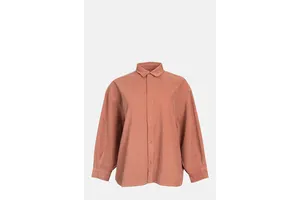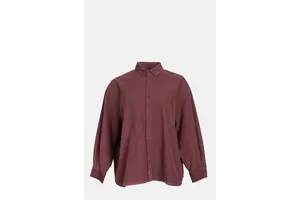
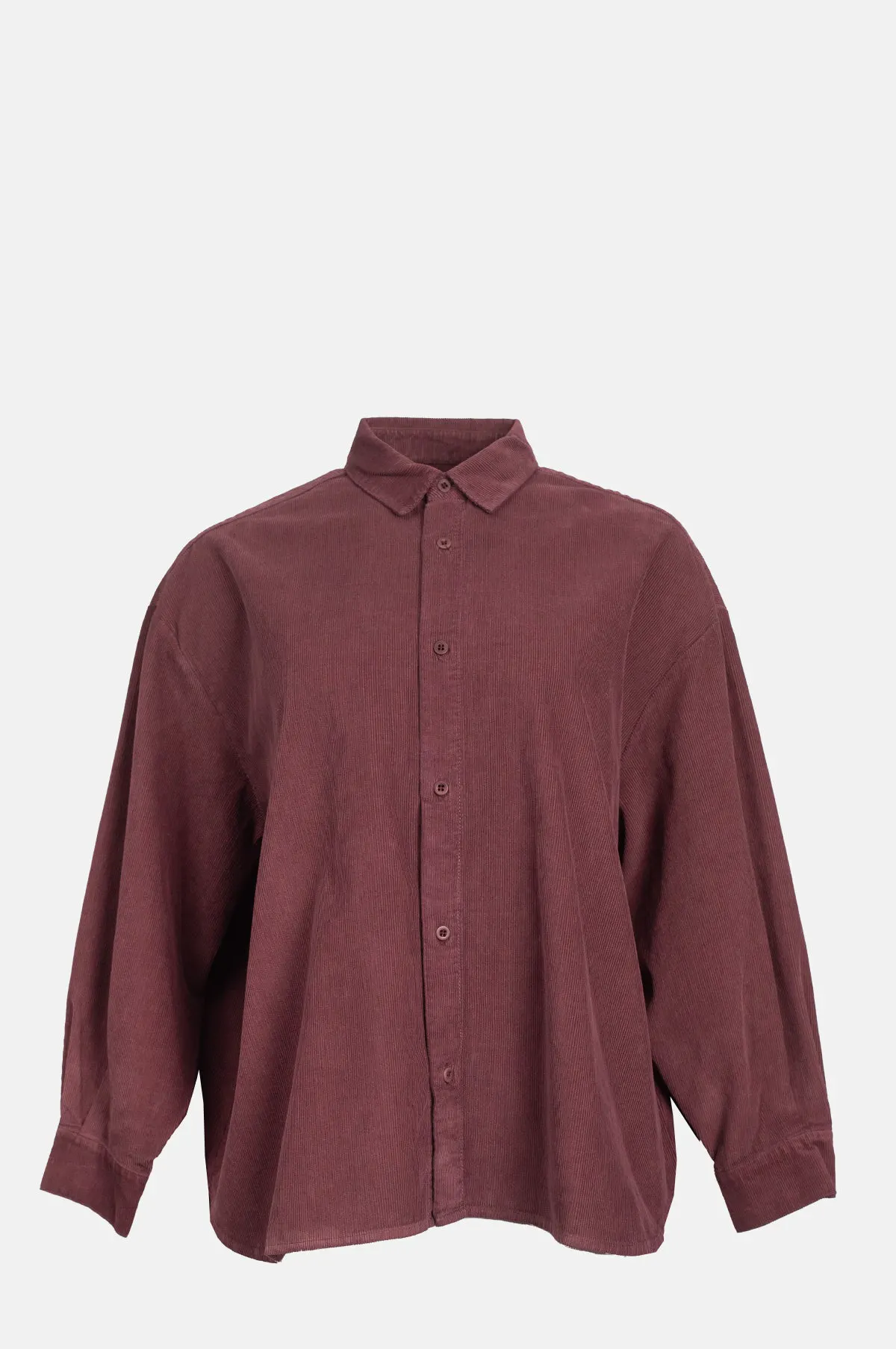

A grape coloured corduroy shirt from LABO.ART with a relaxed fit, dropped shoulders, a back yoke, a classic collar and a run of tonal buttons, listed at 227 GBP with all five sizes in stock. It publishes pit to pit, sleeve and length for all five sizes, and the chest column is the largest this run has met by a distance: 74 cm flat on the smallest size, which doubles to a fraction under fifty eight and a half inches around on a garment sized for a thirty one inch body. That is about twenty seven inches of ease, roughly double the most generous garment examined so far, and it is the number that decides what this shirt is. It is also described as cropped, and the length column runs 64 to 72 cm, which is cropped at one end of the range and not at the other. The reference is the Quadra Sarca Shirt in Sasso. Dongguan Bafinasa Garments Co., Ltd. develops comparable corduroy shirting on OEM and ODM terms, from cloth and wale selection to retail or FBA ready packing. We publish this as a development reference and build your own version of it, and we do not supply the branded original or reproduce anyone else's label.
Key Features
- About twenty seven inches of ease at the smallest size, by a distance the widest in this run. See the note below
- 100% cotton corduroy in a grape shade as stated, made in Italy
- Dropped shoulders stated explicitly, with a sleeve published at 54 cm. See the note below
- Cropped silhouette as stated, with the length running 64 to 72 cm across five sizes. See the note below
- Back yoke, classic collar and a run of tonal buttons as stated
- Machine wash at 30 degrees, do not tumble dry, as stated
- All five sizes in stock
Customisable Options
- Cloth: cotton corduroy to the reference, with the wale count and weight set to your market since neither is given
- Wale: fine or medium wale options quoted separately, since no count is published
- Fit: relaxed and oversized to the reference, or brought in by ten to fourteen inches for a shirt that sits closer
- Shoulder: dropped to the reference, or set in, which changes the sleeve figure substantially and is the fix for the measurement problem below
- Length: cropped at 64 to 72 cm to the reference, or a standard shirt length, or a longer overshirt length
- Collar: classic to the reference, with point size and interlining weight adjustable
- Cloth weight, wale count, ease, body length, sleeve length, shoulder construction, pocket options, size set, colour development, private label and care labelling
Specifications
| Style | Relaxed cropped corduroy shirt with dropped shoulders |
| Reference | LABO.ART, Quadra Sarca Shirt, style L972FZ004 029 - 26W SASSO 009, grape, size 0 to 4, given as 0/XS through 4/XL |
| Composition | 100% cotton as stated |
| Cloth | Soft corduroy in a grape shade as stated, with no wale count and no weight given. See the note below |
| Fit | Relaxed fit, cropped silhouette, as stated. See the note below |
| Shoulder | Dropped shoulders as stated. See the note below |
| Collar | Classic collar as stated |
| Front | Button-down front with a run of tonal buttons as stated |
| Back | Back yoke as stated |
| Care | Machine wash at 30 degrees, do not tumble dry, as stated |
| Sizes Offered | 0 to 4, five sizes, all in stock |
| Measurements Published | Pit to pit, sleeve length and total length for all five sizes. See the note below |
| Published Chest | Pit to pit 74, 76, 78, 79 and 80 cm flat, or 29.1 through 31.5 in. See the note below |
| Published Sleeve | 54, 56, 58, 60 and 62 cm, grading two centimetres per size. Origin not stated. See the note below |
| Published Length | 64, 66, 68, 70 and 72 cm, grading two centimetres per size. See the note below |
| Model | None stated, no height and no body measurements |
| Photographs | One. See the note below |
| Cloth Weight | Not stated |
| Production | Made in Italy as stated |
| Reference Retail | 227 GBP as listed, quoted to show the price band this sits in, not as our price |
| Category | Filed by the reference under blouses and shirts |
| Occasion | Autumn and winter, everyday, weekend, worn as an overshirt or as a mid-layer |
| MOQ | 100 pcs per style per colourway, mixed sizes and colourways accepted |
| Sampling | 7-10 days after tech pack or reference sample confirmation |
| Bulk Lead Time | 20-30 days after sample approval and deposit |
| Service | OEM / ODM / private label, corduroy sourcing and wale selection, nap one way cutting, retail or FBA ready packing |
Size Chart as Published by the Reference
| Size | Pit to Pit (flat) | Sleeve Length | Total Length |
|---|---|---|---|
| 0 / XS | 74 cm | 54 cm | 64 cm |
| 1 / S | 76 cm | 56 cm | 66 cm |
| 2 / M | 78 cm | 58 cm | 68 cm |
| 3 / L | 79 cm | 60 cm | 70 cm |
| 4 / XL | 80 cm | 62 cm | 72 cm |
The chest figures are flat half measures taken with the shirt laid down, doubling to 148, 152, 156, 158 and 160 cm around, or 58.3 through 63.0 in. Against the body chart that is about twenty seven inches of ease at size 0 falling to about twenty four at size 4, because the shirt grades two centimetres of flat width per size, or four centimetres of circumference, against a body chart that moves two inches, or about five centimetres, and then halves its grade at the top of the range. Twenty seven inches is roughly double the ease on the most generous garment examined earlier in this run. The sleeve grades two centimetres per size and no origin is stated, and the length runs 64 to 72 cm, so the cropped description holds at the small end of the range and stops holding at the large end.
Our Proposed Body Chart
| Size | Body Bust | Sleeve | Body Waist | Body Hips | Length | Source |
|---|---|---|---|---|---|---|
| 0 / XS | 31 in / 79 cm | 54 cm | 24 in / 61 cm | 34 in / 86 cm | 64 cm / 25.2 in | Our proposal |
| 1 / S | 33 in / 84 cm | 55 cm | 26 in / 66 cm | 36 in / 91 cm | 66 cm / 26 in | Our proposal |
| 2 / M | 35 in / 89 cm | 56 cm | 28 in / 71 cm | 38 in / 97 cm | 68 cm / 26.8 in | Our proposal |
| 3 / L | 37 in / 94 cm | 57 cm | 30 in / 76 cm | 40 in / 102 cm | 70 cm / 27.6 in | Our proposal |
Occasions and Styling
Suits autumn and winter, everyday wear, weekends and layering. The reference is right that this works as an overshirt and as a mid-layer, and the amount of ease in the body is what makes both possible: there is room over a knit and the dropped shoulder means the armhole does not bind, so it layers where a closer cut shirt could not.
Production and Quality Control
The reference states its fibre, names the cloth, publishes three columns for all five sizes, describes the shoulder, the collar, the yoke, the buttons and the fit, gives a care instruction and states the country of make. Three things follow: what twenty seven inches of ease makes this garment, why cropped and 72 centimetres cannot both be true, and what the sleeve figure proves about sleeve origins in this run.
Twenty seven inches of ease, and the garment that number produces, and that is the first thing. A 74 cm flat chest doubles to 58.3 in around on a shirt sized XS, against a 31 in body. Set that beside the rest of this run and the scale becomes clear: the cotton poplin shirt carried about eleven and a half inches, the seersucker overshirt about twelve, the felted wool jacket about twelve, and the widest thing examined before this, the brown corduroy jacket, carried about seventeen. Twenty seven inches is nearly double that, and it means this garment is not a shaped shirt with ease in it, it is closer to a rectangle with a collar and sleeves, where the cloth falls from the shoulder and the body inside it is barely described by the cut. That is a perfectly coherent design and there is a market for it, and the drop shoulder and the back yoke are the right construction for it, since both keep the volume away from the armhole. But two consequences follow that any developer should be told. The first is cloth consumption: at this width a shirt takes substantially more cloth than a standard one, roughly a third more on the body panels alone, so the cost per piece is materially higher than a shirt of the same price band would suggest, and that has to be in the costing from the start. The second is that the ease is doing all the fitting work, and it does it less well as the sizes grow, since the ease falls from twenty seven to twenty four inches across the range, and the grade halves at the top, going two, two, one, one centimetres of flat width per size. So the largest size is proportionally the least oversized, and a customer who buys this for the shape and takes the biggest size will not get quite the shape in the photograph. That may be deliberate, since a very large garment on a very large body reads differently, and it may be a grade that was set by eye, and the page does not say which.
Cropped, at seventy two centimetres, and that is the second thing. The description says cropped silhouette, and the length column runs 64, 66, 68, 70 and 72 cm. Now, 64 cm is a cropped shirt by any standard: on most heights it finishes at or above the hip bone. But 72 cm is not cropped at all, it is an ordinary shirt length, and this run has published a straight poplin shirt at 71 to 74 cm that nobody called cropped. So the same style, under the same name, is cropped at one end of its size range and not at the other, and the difference is not subtle, it is eight centimetres, which is the distance from above the hip to below it. There is a second factor that makes the label even harder to read, which is that no model height and no body measurements appear anywhere on the page, so 64 cm cannot be placed on a body at all. Cropped is a word about proportion, and proportion is a relationship between a garment and a person, and without the person it is not a measurement. For anyone developing this the practical advice is the one this run keeps arriving at and it costs almost nothing: state the length in centimetres, state the height of the wearer the photograph shows, and say where the garment falls, because then a customer can work out whether it will be cropped on them rather than on nobody. And it is worth quoting the length as a variable rather than inheriting it, since a cropped overshirt sold into a market where customers are on average shorter or taller needs the number moved, not the name.
Fifty four centimetres on a dropped shoulder, and what that settles, and that is the third thing. This run has now collected sleeve figures on garments that state their shoulder construction, and they do not agree: a dropped shoulder shirt published 79.5 cm, the dropped shoulder wool top published 59 to 65, the dropped shoulder padded jacket 59 to 62, the dropped shoulder felted wool jacket 55 rising to 67, and this dropped shoulder shirt publishes 54 to 62. The spread at the smallest size runs from 54 to 79.5 centimetres on garments that all say dropped shoulders, and no human arm differs by twenty five centimetres between two size XS garments. So the construction word, which this page deserves credit for stating, does not by itself make the figure comparable, because the origin is still missing and the origins are clearly not the same. The 54 cm here is the shortest sleeve in the run and it sits on one of the widest garments in the run, which is the clearest single proof this series has produced that a sleeve column without an origin is not a measurement of the sleeve at all. There is a specific reason a dropped shoulder garment can publish a short sleeve, and it is worth stating because it is the most likely explanation here: measure from the underarm seam to the cuff, and you get the true sleeve, which on a garment this wide is short because the shoulder and the body are doing the rest. Measure from the centre back neck, and you get something much longer. Both are legitimate and they differ by fifteen centimetres or more. The fix is four words on a page, and the recommendation is to adopt one convention and print it on every chart: centre back neck to cuff, or underarm to cuff, chosen once and never mixed. We do that on our own specs, and we measure a reference sample ourselves rather than trusting a published column, because as this run has shown repeatedly, the published column is usually right and is unusable anyway. Every bulk shipment gets a measurement report against your approved chart.
Optional upgrades include stating the sleeve origin, which on this garment matters more than on any other page in the run since the figure is the shortest and the shoulder the widest, stating the cloth weight in grams per square metre and the wale count in ribs per inch, adding a model height and body measurements so cropped becomes a proportion rather than a claim, offering a set in shoulder version off the same block, which fixes the sleeve problem and produces a completely different garment, a closer fit with ten to fourteen inches less ease as a second option, standard and long lengths alongside the cropped one, holding the grade even at the top of the range or saying that the change is deliberate, pocket options, interlining weight and point size on the collar, back and side views rather than a single front image, size set, colour development, private label, hangtag and care labelling.
Pre-production sample approval, in-line inspection during cutting and sewing, and a final AQL inspection before packing, with measurement reports and photos shared before shipment.
Send us your tech pack, a photo or a reference garment and we will quote within 24 hours. Contact bafinasa@bafinasa.com or WhatsApp +86 13827222469.