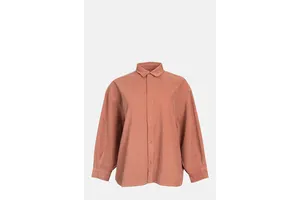
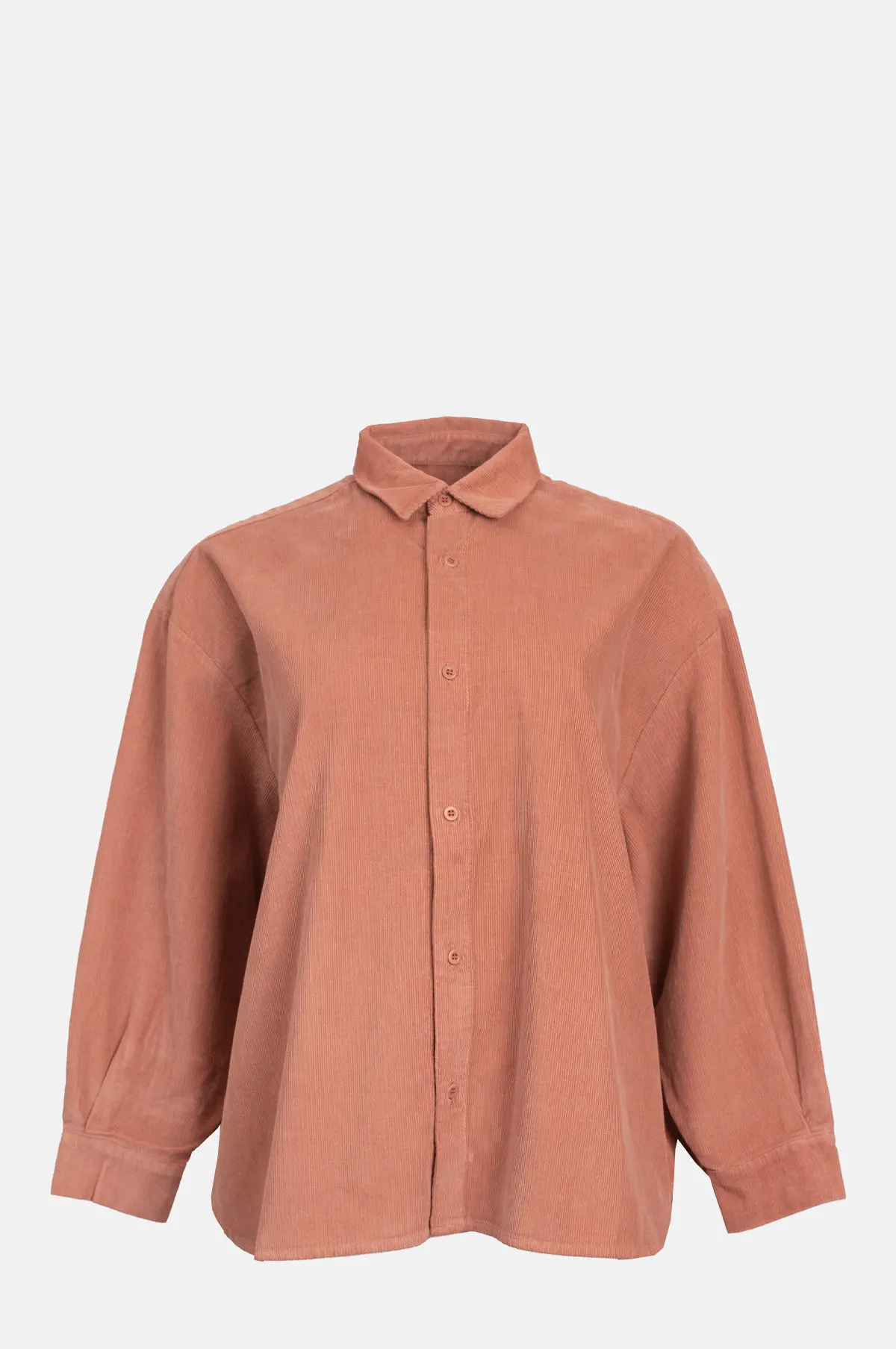

The same Quadra Sarca shirt from LABO.ART in a dusky pink corduroy rather than the grape published beside it in this batch, with the same relaxed cropped silhouette, dropped shoulders, back yoke, classic collar and tonal buttons, listed at 227 GBP with four of five sizes in stock and size 4 sold out. It publishes pit to pit, sleeve and length for all five sizes, and every figure is identical to the grape version, digit for digit, which is the second time this run has met one table serving two colourways of the same cloth. That is defensible and the reason it is defensible is worth stating, because it is the same reason it would not be defensible across two cloths, which the two Ficus jackets in the previous batch demonstrated. What is specific to this version is the shade, and a pile cloth in a pale pink asks a mill for things that a deep shade does not. The reference is the Quadra Sarca Shirt in Canyon. Dongguan Bafinasa Garments Co., Ltd. develops comparable corduroy shirting on OEM and ODM terms, from cloth and shade development to retail or FBA ready packing. We publish this as a development reference and build your own version of it, and we do not supply the branded original or reproduce anyone else's label.
Key Features
- Identical measurements to the grape colourway of this shirt, figure for figure. See the note below
- 100% cotton corduroy in a dusky pink shade as stated, made in Italy
- Relaxed cropped silhouette with dropped shoulders, a back yoke and a classic collar as stated
- Run of tonal buttons as stated, which on a pale shade is a harder match than it sounds. See the note below
- About twenty seven inches of ease at the smallest size, as on the grape version
- Machine wash at 30 degrees, do not tumble dry, as stated
- Four of five sizes in stock, with size 4 sold out
Customisable Options
- Cloth: cotton corduroy to the reference, with the wale count and weight set to your market since neither is given
- Shade: dusky pink to the reference, with lab dips and a shade band agreed before bulk, and grape, navy, stone and chocolate as further options
- Fit: relaxed and oversized to the reference, or brought in by ten to fourteen inches
- Shoulder: dropped to the reference, or set in, which changes the sleeve figure substantially
- Length: cropped to the reference, or a standard shirt length, or a longer overshirt length
- Buttons: tonal to the reference, or contrast, or a dyed to match button submitted against the bulk shade
- Cloth weight, wale count, shade development, light fastness, ease, body length, sleeve length, size set, private label and care labelling
Specifications
| Style | Relaxed cropped corduroy shirt with dropped shoulders |
| Reference | LABO.ART, Quadra Sarca Shirt, style L972FZ004 029 - 26W CANYON 008, dusky pink, size 0 to 4, given as 0/XS through 4/XL |
| Composition | 100% cotton as stated |
| Cloth | Soft corduroy in a dusky pink shade as stated, with no wale count and no weight given. See the note below |
| Fit | Relaxed fit, cropped silhouette, as stated |
| Shoulder | Dropped shoulders as stated. See the note below |
| Collar | Classic collar as stated |
| Front | Button-down front with a run of tonal buttons as stated. See the note below |
| Back | Back yoke as stated |
| Care | Machine wash at 30 degrees, do not tumble dry, as stated |
| Sizes Offered | 0 to 4, five sizes, four in stock with size 4 sold out |
| Measurements Published | Pit to pit, sleeve length and total length for all five sizes. See the note below |
| Published Chest | Pit to pit 74, 76, 78, 79 and 80 cm flat, identical to the grape colourway. See the note below |
| Published Sleeve | 54, 56, 58, 60 and 62 cm. Origin not stated |
| Published Length | 64, 66, 68, 70 and 72 cm |
| Colour Fastness | Not stated, no rub, wash or light fastness figures given. See the note below |
| Model | None stated, no height and no body measurements |
| Photographs | One. See the note below |
| Cloth Weight | Not stated |
| Production | Made in Italy as stated |
| Reference Retail | 227 GBP as listed, quoted to show the price band this sits in, not as our price |
| Category | Filed by the reference under blouses and shirts |
| Occasion | Autumn and winter, everyday, weekend, worn as an overshirt or as a mid-layer |
| MOQ | 100 pcs per style per colourway, mixed sizes and colourways accepted |
| Sampling | 7-10 days after tech pack or reference sample confirmation |
| Bulk Lead Time | 20-30 days after sample approval and deposit |
| Service | OEM / ODM / private label, corduroy sourcing and wale selection, shade development and lab dips, retail or FBA ready packing |
Size Chart as Published by the Reference
| Size | Pit to Pit (flat) | Sleeve Length | Total Length |
|---|---|---|---|
| 0 / XS | 74 cm | 54 cm | 64 cm |
| 1 / S | 76 cm | 56 cm | 66 cm |
| 2 / M | 78 cm | 58 cm | 68 cm |
| 3 / L | 79 cm | 60 cm | 70 cm |
| 4 / XL | 80 cm | 62 cm | 72 cm |
The chest figures are flat half measures taken with the shirt laid down, doubling to 148, 152, 156, 158 and 160 cm around, or 58.3 through 63.0 in, and they are identical to the grape colourway of this shirt. Against the body chart that is about twenty seven inches of ease at size 0 falling to about twenty four at size 4. The length runs 64 to 72 cm, so the cropped description holds at the small end of the range and not at the large end, and the sleeve, published from 54 to 62 cm with no origin stated, is the shortest column in this run on one of the widest garments in it.
Our Proposed Body Chart
| Size | Body Bust | Sleeve | Body Waist | Body Hips | Length | Source |
|---|---|---|---|---|---|---|
| 0 / XS | 31 in / 79 cm | 54 cm | 24 in / 61 cm | 34 in / 86 cm | 64 cm / 25.2 in | Our proposal |
| 1 / S | 33 in / 84 cm | 55 cm | 26 in / 66 cm | 36 in / 91 cm | 66 cm / 26 in | Our proposal |
| 2 / M | 35 in / 89 cm | 56 cm | 28 in / 71 cm | 38 in / 97 cm | 68 cm / 26.8 in | Our proposal |
| 3 / L | 37 in / 94 cm | 57 cm | 30 in / 76 cm | 40 in / 102 cm | 70 cm / 27.6 in | Our proposal |
Occasions and Styling
Suits autumn and winter, everyday wear, weekends and layering. A dusky pink reads warmer and softer than the grape version of the same shirt and sits more easily with denim and grey knitwear, and the ease in the body means it works over a layer as the reference describes.
Production and Quality Control
The reference states its fibre, names the cloth and the shade, publishes three columns for all five sizes, describes the fit, the shoulder, the collar, the yoke and the buttons, gives a care instruction and states the country of make. Three things follow: when one table may serve two colourways and when it may not, what a pale shade asks of a pile cloth that a deep one does not, and what durability means when nothing is tested.
One table, two shades, and the condition that makes it safe, and that is the first thing. The grape version of this shirt publishes 74, 76, 78, 79 and 80 cm of chest and this one publishes the same numbers, and the sleeves and lengths agree as well. This run has now seen both halves of the question. On the Bonnie trousers, two colourways of one cloth shared a table, and the note there said the assumption inside it is that dyeing and finishing do not move the dimensions, which is usually right in piece dyed cotton and fragile in dark shades or where a garment dye or wash is involved. On the two Ficus jackets in the previous batch, one style number in two different cloths produced two different tables, differing by three centimetres of chest and five of length, because a felted wool and a padded woven shell are not the same object and do not shrink or behave alike. Put those two together and the rule writes itself: a measurement table belongs to a garment in a particular cloth and finishing route, so it may be shared across shades of that cloth and may not be shared across cloths. This page is on the safe side of that line, since grape and dusky pink are two shades of what is described as the same corduroy. The check that makes sharing safe is cheap and this run has recommended it before: measure the first bulk of each shade and confirm the table before it is published, and re-measure if any shade takes a different finishing route. On a pile cloth there is one more reason to do it, which is that corduroy is sometimes brushed, sheared or singed differently by shade to get an even pile, and those are finishing operations with a dimensional effect, so two shades of the same nominal cloth can come out of the finishing line at slightly different widths.
A pale shade on a cut pile, and how the two wear differently, and that is the second thing. Corduroy is a cut pile cloth: the wales are raised ribs of fibre standing off a woven ground, and the way such a cloth ages is different from a flat weave in two respects that matter here. The first is abrasion. The crowns of the wales take the wear first, in the same way the surface of any pile does, and as they abrade the cloth reads lighter and shinier in that spot because the crushed fibres reflect light differently from the standing ones. On a deep shade that change is obvious, since the contrast between an abraded crown and the surrounding cloth is large. On a pale shade like this one the contrast is much smaller, so a pale corduroy hides the earliest wear better than a dark one does, which is a genuine advantage and worth knowing when choosing a shade for a garment that will be worn hard at the cuffs and the front edges. The second respect is light, and here the advantage reverses. Pinks and reds as a class sit lower on light fastness than navies, browns and greens, so a dusky pink shirt hung in a shop window or worn repeatedly in strong sun will drift more than the grape version of the same garment will, and no light fastness figure is published here to tell you by how much. There is a third point specific to pale shades on any cloth and it is the one that generates the most returns: soiling and dye transfer show far more on a pale shade, so a pale shirt needs a better rub fastness result than a dark one, since the marks that a navy hides are visible on a pink. None of which is an argument against the colour, since pale corduroy sells well and looks expensive. It is an argument for specifying the fastness figures rather than discovering them, and for agreeing a shade band and a physical standard under a controlled light source before bulk, because a pale shade that is correct under a shop light can read differently in daylight more easily than a dark one does.
Durability, tonal buttons, and the specifications that are still missing, and that is the third thing. The copy says the shirt offers durability, which is a claim about a performance that has not been tested on the page: no abrasion resistance, no rub fastness, no wash fastness and no light fastness figure appears, and durability on a cut pile cloth is mostly a question of how well the wales resist abrasion and how well the dye resists rubbing, both of which are measured and neither of which is given. Then there are the tonal buttons, which sound like a small detail and are not. A tonal button on a pale shade is harder to match than on a deep one, because the eye reads a small difference between two pale surfaces more easily than between two dark ones, and a button that is two shades off on a pink shirt is visible across a room. It also takes an extra submission round, since a dyed to match button has to be submitted against the bulk shade rather than against the lab dip. There is a production point that follows from the cloth itself. Corduroy has a nap and must be cut one way with every panel running the same direction, which raises cloth consumption by roughly five to ten per cent over a cloth that can be cut either way, and it makes shade and sheen variation between panels an inspection point, since two panels cut in opposite directions read as two different pinks under the same light. No wale count is given, so a fine wale and a medium wale are both possible readings of the word corduroy here, and they are visibly different cloths at different prices. No cloth weight is given either. No model information appears, so the 64 cm cropped length cannot be placed on a body. And one photograph appears, a single front view, so the back yoke, the dropped shoulder line and the way the volume falls are all described and none of them shown, which on a garment this wide is the gap most likely to disappoint. Every bulk shipment gets a measurement report against your approved chart.
Optional upgrades include stating the wale count in ribs per inch and the cloth weight, which specify a corduroy and neither appears here, quoting abrasion resistance and rub, wash and light fastness figures, since durability is claimed and a pale shade needs better rub fastness than a dark one, agreeing a shade band and a physical standard for the pink under a controlled light source before bulk, submitting dyed to match buttons against the bulk shade rather than the lab dip, stating the sleeve origin, adding a model height and body measurements so cropped becomes a proportion, adding back and side views, a set in shoulder version, a closer fit with ten to fourteen inches less ease, standard and longer lengths, size set, further colour development, private label, hangtag and care labelling.
Pre-production sample approval, in-line inspection during cutting and sewing, and a final AQL inspection before packing, with measurement reports and photos shared before shipment.
Send us your tech pack, a photo or a reference garment and we will quote within 24 hours. Contact bafinasa@bafinasa.com or WhatsApp +86 13827222469.