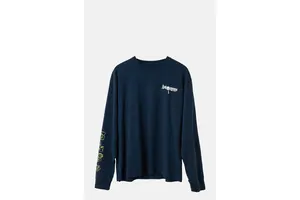
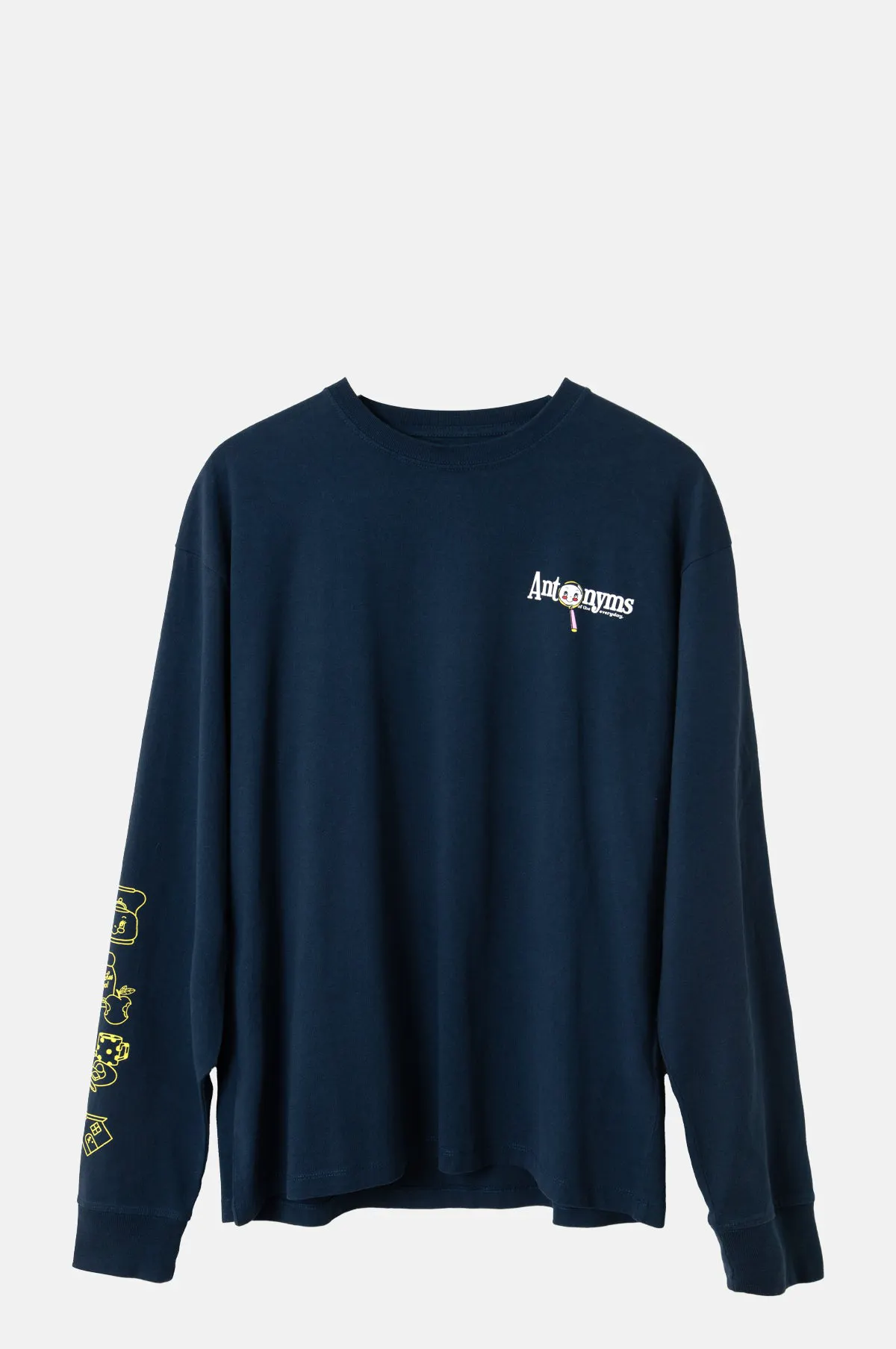

A navy long sleeve tee from Damson Madder with an oversized boxy silhouette, a crew neck, ribbed cuffs, collar and hem, and antonym themed graphics printed at the front, the back and down the sleeves, listed at 45 GBP with five of six sizes in stock and the 16 sold out. It publishes pit to pit, sleeve and length for all six sizes, and two of those columns do something no other table in this run has done. The sleeve reads 64 cm on every one of the six sizes without variation, and the length reads 69 on five of them with a single 68 in the middle. A sleeve that does not grade at all is not a measurement of six garments, it is one number repeated six times. The chest column, by contrast, is the cleverest grading this run has seen, because its uneven steps turn out to hold the ease almost perfectly constant across the whole range. The reference is the Antonyms LS Graphic Tee in Navy. Dongguan Bafinasa Garments Co., Ltd. develops comparable knit tops on OEM and ODM terms, from yarn and print development to retail or FBA ready packing. We publish this as a development reference and build your own version of it, and we do not supply the branded original or reproduce anyone else's label.
Key Features
- Chest grading that alternates three and two centimetres per size and holds the ease almost constant across six sizes. See the note below
- Sleeve published at 64 cm on all six sizes, the only column in this run that does not grade. See the note below
- Graphics at the front, the back and down the sleeves as stated, with no print method given. See the note below
- Oversized boxy silhouette with a crew neck as stated
- Ribbed cuffs, collar and hem as stated. See the note below
- Cotton as stated, made in Turkey, machine wash at 30 degrees
- Five of six sizes in stock, with size 16 sold out
Customisable Options
- Cloth: cotton jersey to the reference, with the weight in grams per square metre set to your market since none is given
- Certification: organic to the reference description, with GOTS or OCS certification and a transaction certificate quoted as an option
- Fit: oversized and boxy to the reference, or brought in by four to six inches for a standard tee
- Print: screen, water based, discharge or digital, each quoted separately with its hand feel and wash test
- Artwork: your own artwork developed from a brief, since we do not reproduce another brand's graphics
- Trims: ribbed collar, cuffs and hem to the reference, or a plain hem, or a contrast rib
- Cloth weight, print method, rib specification, ease, body length, sleeve length, size set, colour development, private label and care labelling
Specifications
| Style | Oversized boxy long sleeve graphic tee with ribbed trims |
| Reference | Damson Madder, Antonyms LS Graphic Tee, style AW26-DM-4238, navy, UK size 6 to 16 |
| Composition | Described as organic cotton in the copy and as 100% cotton in the specification tab. See the note below |
| Cloth | Cotton jersey as stated, with no weight and no construction given. See the note below |
| Fit | Oversized, boxy silhouette as stated |
| Neck | Crew neck as stated |
| Trims | Ribbed cuffs, collar and hem as stated. See the note below |
| Antonym themed graphics at the front, the back and on the sleeves as stated, with no print method given. See the note below | |
| Care | Machine wash at 30 degrees, do not tumble dry, as stated |
| Sizes Offered | UK 6 to 16, six sizes, five in stock with size 16 sold out |
| Measurements Published | Pit to pit, sleeve length and total length for all six sizes. See the note below |
| Published Chest | Pit to pit 52, 55, 57, 60, 62 and 65 cm flat, or 20.5 through 25.6 in. See the note below |
| Published Sleeve | 64 cm on every size, with no grading at all. See the note below |
| Published Length | 69, 68, 69, 69, 69 and 69 cm. See the note below |
| Ease Against Body Bust | About ten inches, held nearly constant across all six sizes. See the note below |
| Model | None stated, no height and no body measurements |
| Photographs | Four |
| Cloth Weight | Not stated |
| Print Fastness | Not stated, no rub or wash fastness figure for the print. See the note below |
| Production | Made in Turkey as stated |
| Reference Retail | 45 GBP as listed, quoted to show the price band this sits in, not as our price |
| Category | Filed by the reference under t-shirts |
| Occasion | Everyday, weekend, layering, travel |
| MOQ | 100 pcs per style per colourway, mixed sizes and colourways accepted |
| Sampling | 7-10 days after tech pack or reference sample confirmation |
| Bulk Lead Time | 20-30 days after sample approval and deposit |
| Service | OEM / ODM / private label, jersey sourcing, print development and wash testing, retail or FBA ready packing |
Size Chart as Published by the Reference
| Size | Pit to Pit (flat) | Sleeve Length | Total Length |
|---|---|---|---|
| UK 6 | 52 cm | 64 cm | 69 cm |
| UK 8 | 55 cm | 64 cm | 68 cm |
| UK 10 | 57 cm | 64 cm | 69 cm |
| UK 12 | 60 cm | 64 cm | 69 cm |
| UK 14 | 62 cm | 64 cm | 69 cm |
| UK 16 | 65 cm | 64 cm | 69 cm |
The chest figures are flat half measures taken with the tee laid down, doubling to 104, 110, 114, 120, 124 and 130 cm around, or 40.9 through 51.2 in. Against the body chart that is about ten inches of ease, and unlike almost every other garment in this run it stays at about ten inches across the whole range, because the grade alternates three and two centimetres of flat width per size, averaging very close to the two inch step in the body chart. The sleeve is published at 64 cm on all six sizes and the length at 69 on five of them with a single 68 at the UK 8, so neither of those columns grades.
Our Proposed Body Chart
| Size | Body Bust | Sleeve | Body Waist | Body Hips | Length | Source |
|---|---|---|---|---|---|---|
| UK 6 | 31 in / 79 cm | 64 cm | 24 in / 61 cm | 34 in / 86 cm | 69 cm / 27.2 in | Our proposal |
| UK 8 | 33 in / 84 cm | 65 cm | 26 in / 66 cm | 36 in / 91 cm | 71 cm / 28 in | Our proposal |
| UK 10 | 35 in / 89 cm | 66 cm | 28 in / 71 cm | 38 in / 97 cm | 73 cm / 28.7 in | Our proposal |
| UK 12 | 37 in / 94 cm | 67 cm | 30 in / 76 cm | 40 in / 102 cm | 75 cm / 29.5 in | Our proposal |
| UK 14 | 39 in / 99 cm | 68 cm | 32 in / 81 cm | 42 in / 107 cm | 77 cm / 30.3 in | Our proposal |
| UK 16 | 41 in / 104 cm | 69 cm | 34 in / 86 cm | 44 in / 112 cm | 79 cm / 31.1 in | Our proposal |
Occasions and Styling
Suits everyday wear, weekends and layering. A boxy long sleeve tee at ten inches of ease is a layering piece rather than a base layer, and it works over a vest or under an open shirt, which is how a graphic sleeve is meant to be seen.
Production and Quality Control
The reference publishes three columns for all six sizes, describes the silhouette, the neck, the trims and the print placement, gives a care instruction and states the country of make. Three things follow: what a column that does not grade tells you, why the uneven chest grade is the best grading in this run, and the claims and omissions around the fibre and the print.
Sixty four centimetres six times, and what a flat column means, and that is the first thing. The sleeve reads 64 cm on a UK 6 and 64 cm on a UK 16, and every size between. A body does not stay the same between a UK 6 and a UK 16, and neither does an arm: across that range the shoulder width and the arm length both change, and a sleeve that fits a UK 6 comfortably will be short on a UK 16 by two or three centimetres at least. So one of two things is true. Either the pattern genuinely holds one sleeve length across the range, which is a decision some houses make on a boxy oversized shape where the shoulder is dropped and the sleeve is cut long, and in that case it should be said rather than left to look like an oversight; or the figure was entered once and copied down, which is far the commoner explanation and is the sort of thing that happens constantly on retail size charts. The practical point is that the column carries no information either way, and a customer reading it learns nothing about the sleeve on their size. The same is true of the length, which reads 69 on five of the six sizes with a single 68 at the UK 8, and that 68 is worth a sentence on its own because it is the kind of figure that tells you the column is unmaintained: a length that does not grade at all is one thing, and a length that does not grade except for one centimetre on one size is another, and the second is almost always a stray keystroke rather than a pattern decision. This run has argued repeatedly that a published table is a claim worth checking, and the check here takes seconds and is the same one recommended throughout: write the differences between consecutive rows in a column, and look at them. On this table the sleeve differences are all zero, the length differences are zero except one, and the chest differences are three, two, three, two, three, which is the interesting part and the subject of the next point.
Three, two, three, two, three, and the grade that holds the fit constant, and that is the second thing. At first sight the chest grade looks like the uneven kind this run has criticised before: the differences between consecutive sizes are three, two, three, two and three centimetres of flat width, where a tidy grade would be a constant. But convert them and something else appears. Three centimetres of flat width is six centimetres of circumference, which is about two and a third inches; two centimetres of flat width is four of circumference, which is about an inch and a half. The body chart moves two inches per size. So a three centimetre step overshoots the body grade by about a third of an inch and a two centimetre step undershoots it by about half an inch, and alternating the two gives an average of just over two inches per size, which is almost exactly the body grade. The consequence is visible in the ease: about ten inches at a UK 6, about ten and a third at the 8, about ten at the 10, about ten and a quarter at the 12, about nine and three quarters at the 14, and about ten and a quarter at the 16. The ease holds constant to within half an inch across six sizes, which is what a grade is supposed to achieve and which almost no garment in this run manages. Most of them let the ease drift by two to four inches from one end of the range to the other, because they were graded in round centimetres against a body chart measured in inches. This one has been graded in whole centimetres too, but whoever set it has alternated the steps so the rounding errors cancel, and the result is a size range that fits the same way on every size. It is the best grading this run has seen and it is worth naming as such, because it is also the clearest illustration of the general principle: a grade is not a formula to be applied, it is a set of decisions whose outcome you check by writing the ease column out against the body chart. We do that as a matter of routine before a grade is fixed, and it is the step that catches both the drift and the typos.
Organic on one line and cotton on the next, and the print that is not specified, and that is the third thing. The description says the tee is crafted from organic cotton, and the specification tab on the same page says made from 100% cotton with no mention of organic, while the hooded top from the same house published in this batch says 100% organic cotton in both places. So the three statements between them leave the fibre position of this garment unclear, and since organic cotton carries a premium and a paper trail, that is not a small ambiguity. No certifying body is named anywhere, so even taking the description at face value there is no way to tell whether it is certified to the Global Organic Textile Standard or to the Organic Content Standard or asserted on a supplier declaration. This run has now met this shape of claim three times, and the recommendation does not change: name the standard, and hold the certificate, because the claim is worth more when it can be checked and it is the first question a large retailer asks. Then there is the print, which is the whole point of the garment and which is specified by nothing at all. Graphics at the front, the back and down both sleeves means at least four print placements, and no method is given: a plastisol screen print sits on top of the cloth with a plastic hand and will crack eventually, a water based or discharge print sits in the cloth with almost no hand and is the premium option, and digital printing suits short runs and photographs and behaves differently again in the wash. They cost differently, they feel different and they age differently, and a graphic tee is a product where the print is the product. Two things follow that belong in any development. The first is testing: a printed garment needs a rub fastness and a wash fastness result on the print itself, and this run has seen fastness figures published on almost nothing. The second is placement across sizes, and it is the one that catches people out: artwork is usually sized for the sample size and then placed at a fixed distance from a seam or a neck point, so on a garment graded across six sizes the print occupies a smaller proportion of the front on the largest size and a larger one on the smallest, and if the placement is not specified the graphics land in different places on every size. We specify placement from named reference points and we approve a printed sample in two sizes rather than one for exactly this reason, and we develop artwork from your brief, since reproducing another brand's graphics is not something we do. Every bulk shipment gets a measurement report against your approved chart.
Optional upgrades include grading the sleeve and the length rather than publishing one figure across six sizes, correcting the single 68 in the length column, naming the certifying body behind the organic claim and holding the transaction certificate, stating the cloth weight in grams per square metre, specifying the print method and quoting plastisol, water based, discharge and digital separately, testing rub and wash fastness on the print itself, specifying print placement from named reference points and approving printed samples in two sizes, developing artwork from your own brief, a closer fit with four to six inches less ease, a plain hem option alongside the ribbed one, size set, colour development, private label, hangtag and care labelling.
Pre-production sample approval, in-line inspection during cutting and sewing, and a final AQL inspection before packing, with measurement reports and photos shared before shipment.
Send us your tech pack, a photo or a reference garment and we will quote within 24 hours. Contact bafinasa@bafinasa.com or WhatsApp +86 13827222469.