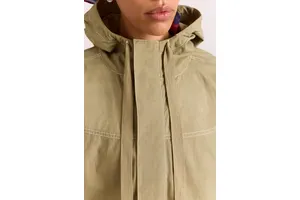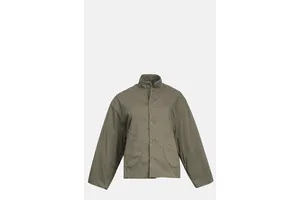
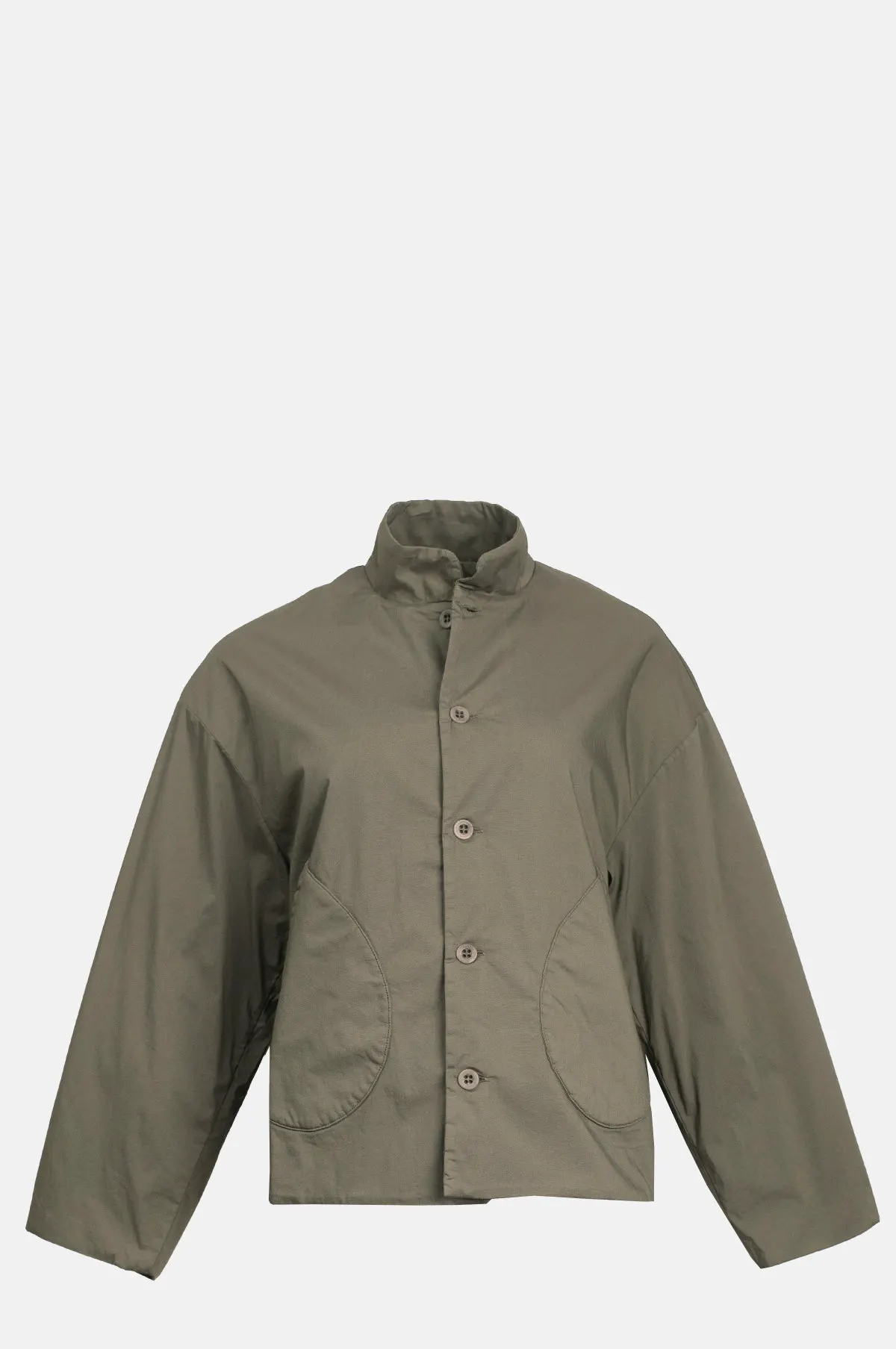

A green padded jacket from LABO.ART with a soft rounded architectural silhouette, thermal insulation, a stand collar, a button-down front, dropped shoulders and curved front patch pockets, listed at 341 GBP with three of four sizes in stock and size 2 sold out. It publishes pit to pit, sleeve and length for all four sizes, and the composition line is the most complete this run has met, since it names the elastane rather than hiding it inside an other fibres figure, which is the gap we flagged on the seersucker overshirt a few pages back. What the page does not name is the insulation, and on a garment described as thermally insulated that is the specification the whole product rests on: no fill type, no fill weight, no warmth figure. The reference is the Ficus Bombay Jacket in Lichene. Dongguan Bafinasa Garments Co., Ltd. develops comparable padded outerwear on OEM and ODM terms, from cloth and fill selection to retail or FBA ready packing. We publish this as a development reference and build your own version of it, and we do not supply the branded original or reproduce anyone else's label.
Key Features
- Composition fully stated at 62% cotton, 35% nylon and 3% elastane, with the elastane named rather than hidden. See the note below
- Padded and thermally insulated as stated, though no fill type, fill weight or warmth figure is given. See the note below
- Chest grading three centimetres flat per size and length grading three, against one on the sleeve. See the note below
- Stand collar, button-down front and dropped shoulders as stated
- Curved front patch pockets as stated, which are more work than a straight patch
- Hip length as stated, running 56 to 65 cm across the four sizes
- Made in Italy as stated, dry clean only
- Three of four sizes in stock, with size 2 sold out
Customisable Options
- Cloth: cotton nylon elastane blend to the reference, with the weight and finish set to your market since neither is given
- Fill: synthetic wadding, down or a wool blend, each quoted with its fill weight and its wash behaviour
- Construction: quilted, or bagged with an inner shell, or unquilted with a hidden stitch, quoted separately
- Collar: stand collar to the reference, or a classic collar, or a hooded version
- Shoulder: dropped to the reference, or set in, which changes the sleeve figure by several centimetres
- Pockets: curved patch to the reference, or straight patch, or welt
- Cloth weight, fill type and weight, ease, body length, sleeve length, pocket style, quilting pattern, size set, colour development, private label and care labelling
Specifications
| Style | Relaxed rounded padded jacket with a stand collar |
| Reference | LABO.ART, Ficus Bombay Jacket, style L972FJ003 009 - 26W LICHENE 011, green, size 0 to 3, given as XS/0, S/1, M/2 and 3/L |
| Composition | 62% cotton, 35% nylon and 3% elastane as stated, totalling one hundred. See the note below |
| Cloth | Cotton and nylon blend as stated, with no weight and no finish given. See the note below |
| Insulation | Padded with thermal insulation as stated, with no fill type, no fill weight and no warmth figure. See the note below |
| Fit | Relaxed, rounded architectural silhouette as stated |
| Collar | Stand collar as stated |
| Front | Button-down front as stated |
| Shoulder | Dropped shoulders as stated. See the note below |
| Pockets | Curved front patch pockets as stated |
| Length | Hip length as stated |
| Care | Dry clean only as stated. See the note below |
| Sizes Offered | 0 to 3, four sizes, three in stock with size 2 sold out |
| Measurements Published | Pit to pit, sleeve length and total length for all four sizes. See the note below |
| Published Chest | Pit to pit 58, 61, 64 and 67 cm flat, or 22.8, 24.0, 25.2 and 26.4 in. See the note below |
| Published Sleeve | 59, 60, 61 and 62 cm, grading one centimetre per size. Origin not stated. See the note below |
| Published Length | 56, 59, 62 and 65 cm, grading three centimetres per size. See the note below |
| Fill Specification | None given. See the note below |
| Model | None stated, no height and no body measurements |
| Photographs | Five |
| Cloth Weight | Not stated |
| Production | Made in Italy as stated |
| Reference Retail | 341 GBP as listed, quoted to show the price band this sits in, not as our price |
| Category | Filed by the reference under coats and jackets |
| Occasion | Autumn and winter, everyday, weekend, travel, cold weather layering |
| MOQ | 100 pcs per style per colourway, mixed sizes and colourways accepted |
| Sampling | 7-10 days after tech pack or reference sample confirmation |
| Bulk Lead Time | 20-30 days after sample approval and deposit |
| Service | OEM / ODM / private label, cloth and fill sourcing, quilting and padding construction, retail or FBA ready packing |
Size Chart as Published by the Reference
| Size | Pit to Pit (flat) | Sleeve Length | Total Length |
|---|---|---|---|
| 0 / XS | 58 cm | 59 cm | 56 cm |
| 1 / S | 61 cm | 60 cm | 59 cm |
| 2 / M | 64 cm | 61 cm | 62 cm |
| 3 / L | 67 cm | 62 cm | 65 cm |
The chest figures are flat half measures taken with the garment laid down, doubling to 116, 122, 128 and 134 cm around, or 45.7 through 52.8 in. Against the body chart that is about fifteen inches of ease at size 0 rising a little to about sixteen at size 3, which is a lot on a jacket and is what the rounded silhouette and the padding are for. The grade is the part to notice: three centimetres of flat chest per size and three centimetres of body length per size, against one centimetre on the sleeve, so the garment grows substantially in width and length while the sleeve barely moves. The sleeve origin is not stated, which on a dropped shoulder garment makes the 59 cm figure impossible to compare with anything else in this run.
Our Proposed Body Chart
| Size | Body Bust | Sleeve | Body Waist | Body Hips | Length | Source |
|---|---|---|---|---|---|---|
| 0 / XS | 31 in / 79 cm | 59 cm | 24 in / 61 cm | 34 in / 86 cm | 56 cm / 22 in | Our proposal |
| 1 / S | 33 in / 84 cm | 60 cm | 26 in / 66 cm | 36 in / 91 cm | 58 cm / 22.8 in | Our proposal |
| 2 / M | 35 in / 89 cm | 61 cm | 28 in / 71 cm | 38 in / 97 cm | 60 cm / 23.6 in | Our proposal |
| 3 / L | 37 in / 94 cm | 62 cm | 30 in / 76 cm | 40 in / 102 cm | 62 cm / 24.4 in | Our proposal |
Occasions and Styling
Suits autumn and winter everyday wear, weekends, travel and cold weather layering. A hip length padded jacket with a stand collar is a between seasons piece rather than a deep winter coat, and the rounded dropped shoulder shape means it goes over a knit without pulling, which is the practical case for the ease it carries.
Production and Quality Control
The reference gives a complete composition, publishes three columns for all four sizes, describes the silhouette, the collar, the front, the shoulder and the pockets, gives a care instruction and states the country of make. Three things follow: what thermally insulated means when no insulation is specified, why a padded cotton nylon jacket is instructed as dry clean only, and what a three centimetre grade on both the chest and the length commits you to.
Padded, insulated, and the one component that is not named, and that is the first thing. The page says padded and thermally insulated, and then says nothing about what is inside. That is the whole product. Insulation in a jacket of this class is specified by three numbers and this page gives none of them: the fill type, which might be a polyester wadding, a down and feather mix, or a wool or wool blend wadding; the fill weight in grams per square metre, which is what decides how warm the jacket is and how much it costs, and which in practice runs from around 60 grams for a light lining weight to 300 or more for a winter one; and the construction, which might be a quilted sandwich, a bagged inner shell, or a free floating pad held only at a few points. Each combination behaves differently. A down fill at a given weight is warmer than a synthetic at the same weight and costs considerably more, and it needs a down proof shell and a baffle or quilt construction to stop it migrating, and it loses loft if it is washed badly. A synthetic wadding is cheaper, washable, and heavier for the same warmth, and it is more tolerant of a simple quilt. A wool wadding sits between them on warmth and cost and it is the one most likely to be behind a dry clean only instruction. Without the fill type and weight there is no way to cost this garment within a wide band, and no way to know whether it is an autumn jacket or a winter one, and those two are different products at different prices. There is a second consequence that belongs in the sampling plan rather than the costing. Insulation migrates. Any padded garment will shift its fill towards the bottom and the edges over a season unless it is quilted densely enough or the fill is bonded or resin treated, and a wash accelerates it, which is the single most common complaint on padded jackets after the first clean. We would specify the quilting pattern and density on the tech pack and run a wash test on a finished sample before bulk, because migration is a fault that appears in the customer's hands and not in the factory's.
Dry clean only, on a jacket whose fibres are mostly cotton and nylon, and that is the second thing. Most padded jackets in a cotton nylon shell are machine washable, and this run has seen cotton corduroy trousers and a cotton seersucker shirt both instructed to machine wash at 30, so the instruction here stands out and is worth accounting for. Three candidates explain it. The fill may be a wool or wool blend wadding, which felts under heat, moisture and agitation and cannot go through a domestic cycle. The shell has 3% elastane, which limits washing temperature and makes tumble drying risky, though it does not usually force a dry clean on its own. Or the garment has enough internal structure, in the collar, the placket and the shoulder, that the maker does not want different components shrinking at different rates, which is a real concern on any jacket with more than one cloth in it. Whichever it is, the instruction has a cost attached, and it is the same cost this run has already counted on the wool garments: a dry clean only jacket is more expensive to own over a winter than the purchase price suggests, and customers increasingly weigh that. There is a development point that follows directly and it is worth quoting as an option rather than accepting as a constraint. If the fill is the reason, then specifying a synthetic wadding instead of a wool one makes the jacket washable at 30, which is a genuine selling point and usually a lower cost as well, at some price in warmth per gram. If the structure is the reason, then it can be engineered out by pre shrinking the components and matching their shrinkage before cutting. Both are worth offering alongside the dry clean version, because the decision belongs to the market the jacket is sold into. And it is worth saying plainly what the composition does tell us, which is more than most pages manage: 62% cotton, 35% nylon and 3% elastane is a complete breakdown totalling a hundred, and the elastane is named rather than buried, which is exactly the disclosure we asked for on the seersucker overshirt earlier in this run, where five per cent was left as other fibres on a cloth whose whole character depended on it.
Three centimetres on the chest and three on the length, against one on the sleeve, and that is the third thing. The chest runs 58, 61, 64 and 67 and the length runs 56, 59, 62 and 65, both grading three centimetres a size, while the sleeve runs 59 through 62, grading one. Over four sizes the body grows nine centimetres in length and the sleeve grows three. That is an unusual combination and it tells you something about the block. A grade this wide on the body length is a decision to make the jacket longer as it gets bigger rather than only wider, which keeps the proportions roughly constant and is a defensible choice, but it means the length is not the same garment at the two ends: at 56 cm it is a short hip length jacket and at 65 cm it is approaching a three quarter length, and those sit differently over a hip and a trouser pocket. The sleeve is the harder one to read, because a one centimetre grade is on the low side even for a set in shoulder and this is stated as dropped, and the only way to reconcile a sleeve that grows one centimetre while the half chest grows three is that the measurement does not start at a point that moves with the shoulder. Which is the complaint this run has now made on nearly every page: without an origin, the sleeve column cannot be compared, and here it is the one column whose grade disagrees with the rest of the table. There is a production consequence worth naming, because it is specific to a padded garment. A wide grade on a padded jacket means the quilting pattern has to be graded as well, and if it is not, the quilting lines will not fall in the same place on the body across the size range, which is visible on a garment with this much ease and this rounded a shape. We grade the quilting with the pattern and check it on the top and bottom size, which is the only way to see whether the lines still read as intended. Every bulk shipment gets a measurement report against your approved chart.
Optional upgrades include specifying the fill type and the fill weight in grams per square metre, which between them decide both the warmth and the price and neither of which appears here, specifying the quilting pattern and density and running a wash test for fill migration on a finished sample, offering a synthetic wadding version that washes at 30 alongside the dry clean only one and quoting them separately, stating the cloth weight and finish, publishing where the sleeve is measured from so the one centimetre grade can be read against the three centimetre body grade, grading the quilting with the pattern and checking it at the top and bottom size, publishing shoulder and across back measurements, adding a model height and body measurements, hooded and classic collar options, straight patch or welt pocket alternatives, a set in shoulder version, length options, size set, colour development, private label, hangtag and care labelling.
Pre-production sample approval, in-line inspection during cutting and sewing, and a final AQL inspection before packing, with measurement reports and photos shared before shipment.
Send us your tech pack, a photo or a reference garment and we will quote within 24 hours. Contact bafinasa@bafinasa.com or WhatsApp +86 13827222469.