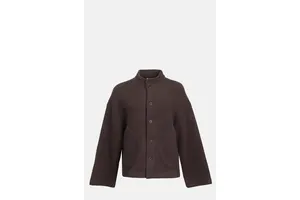
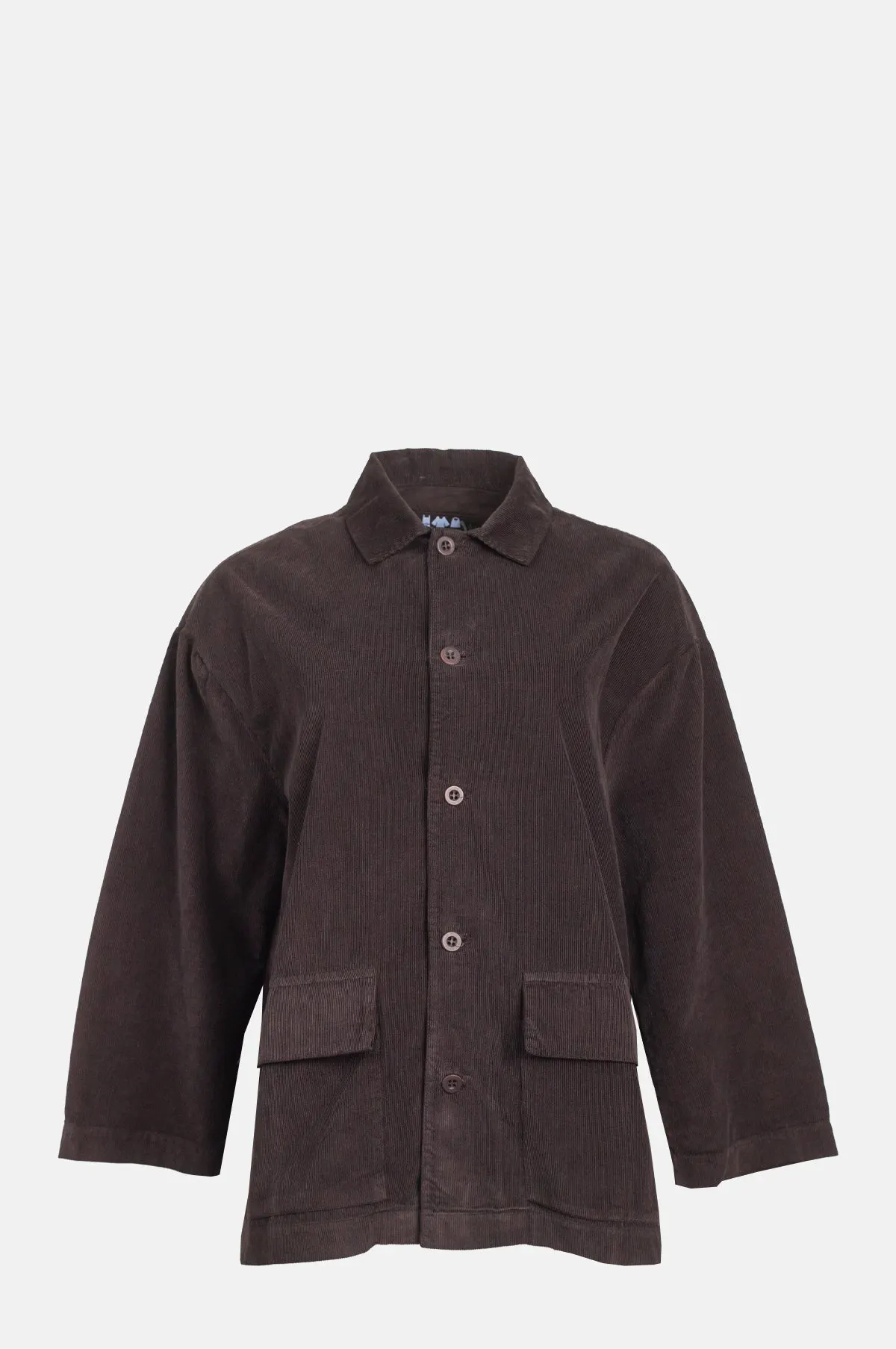

A brown corduroy jacket from LABO.ART with a classic collar, a run of tonal buttons, two front patch pockets and long sleeves, listed at 266 GBP with four of five sizes in stock and the 0 sold out. It publishes pit to pit, sleeve and length for all five sizes, which is the widest size set in this batch, and one figure on it deserves to be read against the jacket published beside it in the same batch: at size 0, this jacket measures 61 cm flat across the chest where the other LABO.ART corduroy measures 53. Same house, same season, same fibre, same size label, and six inches of difference between them. The page also carries one photograph where the rest of the run carries four. The reference is the Giulia Sarca Jacket in Cacao. Dongguan Bafinasa Garments Co., Ltd. develops comparable outerwear on OEM and ODM terms, from cloth and wale selection to retail or FBA ready packing. We publish this as a development reference and build your own version of it, and we do not supply the branded original or reproduce anyone else's label.
Key Features
- Five sizes with a three column table covering all five, the widest size set in this batch
- 61 cm flat chest at size 0, eight centimetres wider than the other corduroy jacket in this batch at the same size label. See the note below
- 100% cotton corduroy in a rich brown, made in Italy as stated
- Two front patch pockets and a classic collar as stated
- Intended as an overshirt or a mid-layer as stated, which is what the ease is there for
- A style number published, which is more than most pages in this run manage. See the note below
- One photograph only. See the note below
Customisable Options
- Cloth: cotton corduroy to the reference, with the wale count and weight open since neither is given
- Fit: easy through the body to the reference, with the ease reducible by six to eight inches for a closer jacket
- Collar: classic to the reference, or a band collar like the jacket beside this one
- Pockets: two patch pockets to the reference, with welt, flap or patch and flap alternatives
- Buttons: tonal brown to the reference, with contrast, horn look or metal options
- Length: 69 to 73 cm to the reference, with a shorter overshirt length as an option
- Cloth weight, wale count, ease, body length, sleeve length, pocket style, size set, colour development, private label and care labelling
Specifications
| Style | Corduroy workwear jacket with patch pockets |
| Reference | LABO.ART, Giulia Sarca Jacket, style L972FJ004 029 - 26W CACAO 006, brown, size 0 to 4, given as 0/XS through 4/XL |
| Composition | 100% cotton as stated |
| Cloth | Soft rich brown corduroy as stated, with no wale count and no weight given. See the note below |
| Collar | Classic collar as stated |
| Front | Button-down front with a run of brown buttons as stated |
| Pockets | Two front patch pockets as stated |
| Sleeves | Long sleeves as stated |
| Fit | Structured fit, intended as an overshirt or as a mid-layer, as stated. See the note below |
| Care | Machine wash at 30 degrees, do not tumble dry, as stated |
| Sizes Offered | 0 to 4, five sizes, four in stock with size 0 sold out |
| Measurements Published | Pit to pit, sleeve length and total length for all five sizes. See the note below |
| Published Chest | Pit to pit 61, 62, 63, 64 and 66 cm flat, or 24.0, 24.4, 24.8, 25.2 and 26.0 in. See the note below |
| Published Sleeve | 59, 60, 61, 62 and 63 cm, grading one centimetre per size. Origin not stated |
| Published Length | 69, 70, 71, 72 and 73 cm, grading one centimetre per size |
| Model | None stated, no height and no body measurements |
| Photographs | One. See the note below |
| Cloth Weight | Not stated, only the words soft and rich |
| Production | Made in Italy as stated |
| Reference Retail | 266 GBP as listed, quoted to show the price band this sits in, not as our price |
| Category | Filed by the reference under coats and jackets |
| Occasion | Everyday, weekend, work in a relaxed setting, autumn and winter layering |
| MOQ | 100 pcs per style per colourway, mixed sizes and colourways accepted |
| Sampling | 7-10 days after tech pack or reference sample confirmation |
| Bulk Lead Time | 20-30 days after sample approval and deposit |
| Service | OEM / ODM / private label, corduroy sourcing and wale selection, nap one way cutting, retail or FBA ready packing |
Size Chart as Published by the Reference
| Size | Pit to Pit (flat) | Sleeve Length | Total Length |
|---|---|---|---|
| 0 / XS | 61 cm | 59 cm | 69 cm |
| 1 / S | 62 cm | 60 cm | 70 cm |
| 2 / M | 63 cm | 61 cm | 71 cm |
| 3 / L | 64 cm | 62 cm | 72 cm |
| 4 / XL | 66 cm | 63 cm | 73 cm |
The chest figures are flat half measures taken with the garment laid down, doubling to 122, 124, 126, 128 and 132 cm around, or 48.0 through 52.0 in. Against the body chart that is about seventeen inches of ease at size 0 falling to about thirteen at size 4, because the chest grades one centimetre flat per size, or two centimetres of circumference, while the body chart moves two inches, or roughly five centimetres. So the jacket is far more oversized at the small end of its range than at the large end, which is the opposite of the behaviour on the other corduroy jacket in this batch, where the ease grows slightly with size. Anyone copying this block should know that the fit character changes across the range and not only the dimensions.
Our Proposed Body Chart
| Size | Body Bust | Sleeve | Body Waist | Body Hips | Length | Source |
|---|---|---|---|---|---|---|
| 0 / XS | 31 in / 79 cm | 59 cm | 24 in / 61 cm | 34 in / 86 cm | 69 cm / 27.2 in | Our proposal |
| 1 / S | 33 in / 84 cm | 60 cm | 26 in / 66 cm | 36 in / 91 cm | 71 cm / 28 in | Our proposal |
| 2 / M | 35 in / 89 cm | 61 cm | 28 in / 71 cm | 38 in / 97 cm | 73 cm / 28.7 in | Our proposal |
| 3 / L | 37 in / 94 cm | 62 cm | 30 in / 76 cm | 40 in / 102 cm | 75 cm / 29.5 in | Our proposal |
Occasions and Styling
Suits everyday wear, weekends, relaxed workplaces and autumn or winter layering. Seventeen inches of ease at the small end and a 69 to 73 cm length make this the longer and easier of the two corduroy jackets in this batch, and the reference is right that it works both as an overshirt over a tee and as a mid-layer under a coat, since there is room in the body for a knit without the shoulder pulling.
Production and Quality Control
The reference publishes three columns for all five sizes, states its fibre, names the cloth, describes the collar, the buttons and the pockets, gives a care instruction, states the country of make and publishes a style number. It is a well specified page in most respects and it carries one photograph. Three things follow: what six inches of difference at the same size label inside one brand tells you, why the ease shrinks as the sizes grow, and what a single image and a missing wale count leave undecided.
The same size label, two jackets, six inches apart, and that is the first thing. The other LABO.ART corduroy jacket published in this batch measures 53 cm flat across the chest at size 0. This one measures 61. Doubled, that is 41.7 in against 48.0 in around, and against a 31 in body it is ten and a half inches of ease against seventeen. The two are made by the same house, in the same season, in the same fibre, in the same country, and they are priced nineteen pounds apart. Their sleeve columns are nearly identical, 59 through 62 against 59 through 63, and their lengths differ by six centimetres. So the chest is where they diverge, and it diverges by more than the difference between a fitted and an oversized garment. This is not a criticism of either jacket, because the two are clearly intended to be different shapes and a house is entitled to run two blocks. It is the clearest demonstration this run has produced of something we have been arguing for a long time, which is that a size letter is not a measurement and cannot be treated as one, not even within a single brand. Two consequences follow, one for the customer and one for the trade. The customer sizing down for a closer fit on one of these will get a completely different result from sizing down on the other, and no page tells them which is which, because both say only that the fit is straight, or structured, or relaxed. And anyone building a size chart by copying a reference page is copying one house's decision about one block, and will reproduce it on garments where it does not belong. The alternative is unglamorous and it works: publish the body measurements the garment is cut for, in the same table as the garment measurements, and let the customer match numbers.
Ease that falls by four inches across the range, and that is the second thing. The chest grades one centimetre flat per size, which is two centimetres of circumference, or about four fifths of an inch. The body chart moves two inches per size, or about five centimetres. So each step up in size adds five centimetres of body and only two of garment, and the ease consequently falls: seventeen inches at size 0, about fifteen and three quarters at 1, about fourteen and a half at 2, about thirteen and a half at 3, and about thirteen at 4. The poplin shirt earlier in this run showed the same effect in a smaller way, and this is what a one centimetre flat grade always produces, because it is a grade built for the cloth rather than for the body. It is worth being clear about what it means. At the small end this jacket is genuinely oversized, and a customer in a size 0 who wants the look in the photograph will get it. At the large end it is merely generous, and a customer in a size 4 who saw the photograph and wanted that volume will not get it, because the proportions have quietly changed. Whether that is right is a design decision and houses make it in both directions, as the jacket beside this one shows, since its three centimetre grade does the opposite and lets the ease grow. But it is a decision that should be made on purpose and written on the spec, and the way to check it is to take your own body chart, apply your own grade, and look at the ease column, which is what we do on every block before it goes to sampling. The sleeve and length columns here grade a tidy one centimetre each, which is consistent and easy to reproduce, and the sleeve origin is not stated, so the 59 cm figure carries the same ambiguity as most of this run.
One photograph, and the specifications that a single front view cannot carry, and that is the third thing. Every other page in this batch carries four images and most of the run carries four or five. This one carries a single front view, which means the two patch pockets are described but not shown, the collar is described but not seen from the side, and there is no back view at all, so the yoke, the shoulder line and the hem shape are unverifiable from the page. On a garment sold as an overshirt and a mid-layer that is a real gap, because how a jacket sits across the back is most of what the customer is buying. Then there is the cloth. Corduroy is specified by its wale count, the number of ribs to the inch, and no count is given, only the words soft and rich, which describe the hand and the colour and not the cloth. A fine wale and a wide wale in the same brown are different jackets at arm's length, they drape differently, they take the dye differently and they cost differently, and there is no way to source this from the page without a guess. No weight is given either. As on the jacket beside it, corduroy has a nap and must be cut one way, which raises cloth consumption by roughly five to ten per cent and makes shade sequencing across panels a real inspection point rather than a formality. No lining statement appears, and a corduroy jacket at this weight may be unlined with bound seams or half lined, which are different garments to wear and to quote. No model information appears, so the 69 cm length cannot be read against a height. And the style number is published, which is genuinely useful and rarer than it should be: it is the one thing on this page that lets anyone order, trace or re-order the garment precisely, and it is worth every house doing. Every bulk shipment gets a measurement report against your approved chart.
Optional upgrades include stating the wale count in ribs per inch and the cloth weight, which together are what specify a corduroy and neither of which appears here, adding back and side views and a close view of the patch pockets, since a single front image cannot show how the jacket sits, saying whether the garment is lined, half lined or unlined, publishing shoulder and across back measurements, adding a model height and body measurements, a closer fit option with six to eight inches less ease for anyone who wants shape rather than volume, holding the ease constant across the size range as an alternative to letting it fall by four inches, a band collar option alongside the classic one, flap or welt pockets as alternatives, a shorter overshirt length, fine and wide wale versions quoted separately, button options, size set, colour development, private label, hangtag and care labelling.
Pre-production sample approval, in-line inspection during cutting and sewing, and a final AQL inspection before packing, with measurement reports and photos shared before shipment.
Send us your tech pack, a photo or a reference garment and we will quote within 24 hours. Contact bafinasa@bafinasa.com or WhatsApp +86 13827222469.