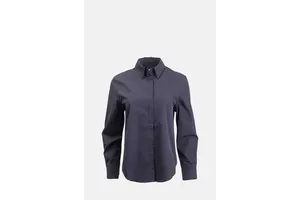
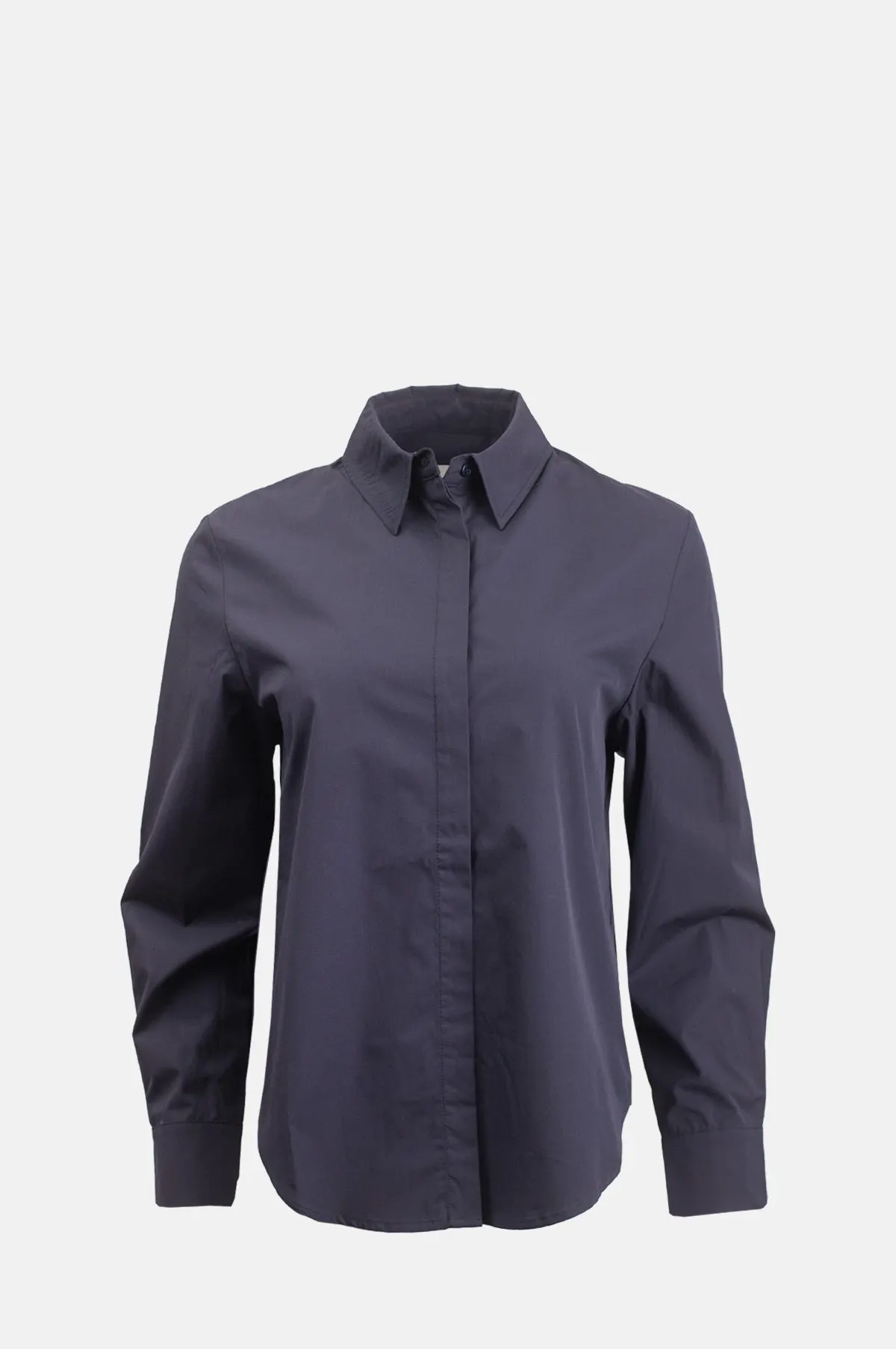

A navy shirt from Sacrecoeur in crisp cotton poplin with a straight cut, classic collar, covered button placket, rounded hem and a back yoke, listed at 139 GBP with three of four sizes in stock and the L sold out. It publishes pit to pit, sleeve and length for all four sizes, and the number that makes this page worth reading is the sleeve: 58 cm, against 79 to 80 cm on the two oversized shirts earlier in this run. That is not a different pattern scale, it is a different shoulder, and it is the clearest proof yet of the point made about dropped shoulders a few pages back, because here the shoulder is set in and twenty centimetres of sleeve simply disappears. The reference is the Sophie Shirt in Bleu. Dongguan Bafinasa Garments Co., Ltd. develops comparable shirting on OEM and ODM terms, from cloth selection and placket construction to retail or FBA ready packing. We publish this as a development reference and build your own version of it, and we do not supply the branded original or reproduce anyone else's label.
Key Features
- A three column table for all four sizes
- A set in shoulder sleeve, publishable at 58 cm, against 79 cm on the dropped shoulder shirts in this run. See the note below
- 100% cotton poplin as stated, machine washable at 30 degrees
- Covered button placket as stated, which is more work and a cleaner front
- Classic collar and straight cut as stated
- Rounded hem and back yoke as stated
- Made in Tunisia as stated
- Around eleven inches of ease, which is less than the oversized shirts but still generous for a straight cut
Customisable Options
- Cloth: cotton poplin to the reference, with weight and finish selectable since neither is stated
- Fit: straight to the reference, or brought in, or eased out to match the oversized blocks elsewhere in this run
- Placket: covered to the reference, or a standard placket, with the cost difference quoted
- Collar: classic to the reference, with point size and interlining weight adjustable
- Hem: rounded to the reference, or straight, or a longer curved back hem
- Shoulder: set in to the reference, or dropped, which changes the sleeve figure by roughly twenty centimetres
- Cloth weight, ease, sleeve length, body length, size set, colour development, private label and care labelling
Specifications
| Style | Straight cut cotton poplin shirt with a covered placket |
| Reference | Sacrecoeur, Sophie Shirt, style SOPHIE/DARKNAVY, navy, size XS to L |
| Composition | 100% cotton as stated |
| Cloth | Crisp cotton poplin as stated, with no weight given. See the note below |
| Fit | Straight cut as stated |
| Collar | Classic collar as stated |
| Front | Covered button placket as stated |
| Hem | Rounded hem as stated |
| Back | Back yoke as stated |
| Care | Machine wash at 30 degrees, do not tumble dry, as stated |
| Sizes Offered | XS, S, M and L, with three in stock and L sold out |
| Measurements Published | Pit to pit, sleeve length and total length for all four sizes. See the note below |
| Published Chest | Pit to pit 54, 55, 56 and 57 cm flat, or 21.3, 21.7, 22.0 and 22.4 in. See the note below |
| Published Sleeve | 58, 59, 60 and 61 cm, grading one centimetre per size. See the note below |
| Published Length | 71, 72, 73 and 74 cm, grading one centimetre per size |
| Model | None stated, no height and no body measurements |
| Photographs | Four |
| Cloth Weight | Not stated, only the word crisp |
| Production | Made in Tunisia as stated |
| Reference Retail | 139 GBP as listed, quoted to show the price band this sits in, not as our price |
| Category | Filed by the reference under blouses and shirts |
| Occasion | Work, everyday, smart casual, travel |
| MOQ | 100 pcs per style per colourway, mixed sizes and colourways accepted |
| Sampling | 7-10 days after tech pack or reference sample confirmation |
| Bulk Lead Time | 20-30 days after sample approval and deposit |
| Service | OEM / ODM / private label, poplin sourcing, placket and yoke construction, retail or FBA ready packing |
Size Chart as Published by the Reference
| Size | Pit to Pit (flat) | Sleeve Length | Total Length |
|---|---|---|---|
| XS | 54 cm | 58 cm | 71 cm |
| S | 55 cm | 59 cm | 72 cm |
| M | 56 cm | 60 cm | 73 cm |
| L | 57 cm | 61 cm | 74 cm |
The chest figures are flat half measures taken with the shirt laid down, doubling to 108 through 114 cm around, or 42.5 through 44.9 in. Against the body chart that is about eleven and a half inches of ease, which is a great deal less than the twenty one and eighteen inches on the two oversized shirts earlier in this run and is what a straight cut should look like, though it is still generous enough that the shirt will not sit close. The sleeve figure is the interesting one. At 58 cm on the smallest size it is around twenty centimetres shorter than the sleeves published on the dropped shoulder shirts in this run, and that is not a difference in arm length, it is a difference in where the measurement starts.
Our Proposed Body Chart
| Size | Body Bust | Sleeve | Body Waist | Body Hips | Length | Source |
|---|---|---|---|---|---|---|
| XS | 31 in / 79 cm | 58 cm | 24 in / 61 cm | 34 in / 86 cm | 71 cm / 28 in | Our proposal |
| S | 33 in / 84 cm | 59 cm | 26 in / 66 cm | 36 in / 91 cm | 73 cm / 28.7 in | Our proposal |
| M | 35 in / 89 cm | 60 cm | 28 in / 71 cm | 38 in / 97 cm | 75 cm / 29.5 in | Our proposal |
| L | 37 in / 94 cm | 61 cm | 30 in / 76 cm | 40 in / 102 cm | 77 cm / 30.3 in | Our proposal |
Occasions and Styling
Suits work, everyday wear, smart casual and travel. A covered placket and a crisp poplin make this the more formal end of the shirts in this run, and the rounded hem means it can be worn out as well as tucked, which the reference suggests with tailored trousers or a skirt, or tucked into jeans for something more casual.
Production and Quality Control
The reference names its cloth as poplin, publishes three columns for all four sizes, describes the placket, the collar, the hem and the yoke, and states a care instruction. The numbers and the words agree. Three things follow: what a twenty centimetre difference in published sleeve length actually means, how much ease a straight cut should carry, and what is missing from a page that is otherwise well specified.
Fifty eight centimetres against seventy nine, and the shoulder explaining all of it, and that is the first thing. Two pages back in this run, on a shirt described as very oversized, the published sleeve was 79.5 cm on the smallest size, and the note there argued that the reason was the dropped shoulder, because when the shoulder point sits out on the arm the measurement from the centre back to the cuff includes several centimetres of body before it reaches any arm. Here is the control case. This shirt has a set in shoulder, it is a straight cut rather than an oversized one, and its sleeve publishes at 58 cm. Twenty one centimetres separate them, and no human arm differs by twenty one centimetres between two size X garments. The whole gap is construction, and it is worth stating plainly what that means for anyone reading tables. A sleeve figure is only comparable between two garments if both were measured from the same point, and on retail pages the point is almost never stated. This page says sleeve length, the other says sleeve length, and they are not the same measurement in any useful sense. So the practical advice is the one this series keeps arriving at: publish the origin. Say centre back neck to cuff, or shoulder seam to cuff, and the number becomes usable, because then a customer can compare it with their own arm and a developer can compare it with their own pattern. Until then the column is decoration, and on these two pages it is misleading decoration, since the casual reader will conclude that one shirt has vastly longer sleeves than the other when the truth is that one has a dropped shoulder.
Eleven and a half inches of ease on a straight cut, and how much is right, and that is the second thing. The chest doubles to 42.5 in against a 31 in body, so there is around eleven inches of room. Set against the twenty one inches on the Cilla shirt and the eighteen on the Edgar, this reads as the fitted option of the three, and set against a true classic shirt it still reads as generous, because a classic shirt usually carries six to eight inches. That puts it in the middle ground that most customers actually want and that almost no page describes honestly, since the word straight tells you nothing about the number. It is worth being precise about what that eleven inches buys. It buys movement across the back without a pleat being strictly necessary, though the page does list a back yoke, and it buys the ability to wear the shirt over a thin layer, and it costs the crisp line that a closer cut would give. Anyone developing this should know that the ease is a variable to be set deliberately rather than inherited, and that moving from eleven inches to eight changes the whole character of the garment while changing the size label not at all. There is a second point in the same numbers. The grade across the four sizes is one centimetre of flat width per size, which is half the grade on the two oversized shirts, so this size set covers a narrower range of bodies and the step between sizes is smaller. That is the correct behaviour for a straighter garment and it is worth noticing, because it means a customer who falls between sizes here has less distance to travel than one on the oversized blocks, where the steps are twice as wide and the advice to size down is correspondingly less useful.
Crisp, with no weight, and the rest of what is missing, and that is the third thing. Poplin is named, which puts this ahead of most pages in the run, and crisp is offered as a description of the hand, which is better than nothing and still not a number. No weight is given, and for a shirt whose commercial argument is that it holds a clean line, weight in grams per square metre is the number that decides whether it does, and it is also the number that decides the cost. The covered placket is worth a sentence on its own, because it is the one construction detail here that costs real money and that customers do not notice by name: it takes more cloth, more pressing and more skill than a standard placket, and it produces the clean front that makes this shirt wearable to work. Anyone costing a copy should be told that removing it is a saving of a few cents and a change in how formal the shirt reads. No model information appears at all, no height and no body measurements, which on a straight cut shirt is less serious than on a shaped garment but still leaves the length uninterpretable, since 71 cm of total length means different things on different heights. The L is sold out, which is a stock point rather than a specification one, and worth noting only because it means the published size set is smaller in practice than it is on paper. Every bulk shipment gets a measurement report against your approved chart.
Optional upgrades include stating the cloth weight in grams per square metre, since crisp is not a number and the clean line this shirt sells depends on it, publishing where the sleeve is measured from, which would make the 58 cm figure usable rather than decorative, offering the same block with a dropped shoulder so the two sleeve conventions can be compared on one page, tightening the ease from eleven inches to eight as a second fit option for anyone who wants a closer shirt, quoting the covered placket and a standard placket separately so the cost of the clean front is visible, adding a model height and body measurements, interlining weight and point size options on the classic collar, a straight hem option alongside the rounded one, length options, size set, colour development, private label, hangtag and care labelling.
Pre-production sample approval, in-line inspection during cutting and sewing, and a final AQL inspection before packing, with measurement reports and photos shared before shipment.
Send us your tech pack, a photo or a reference garment and we will quote within 24 hours. Contact bafinasa@bafinasa.com or WhatsApp +86 13827222469.