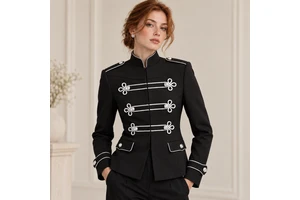
A double breasted jacket in 70% polyester and 30% wool with a 100% polyester lining, dry clean only, made in China, in a small brown check, listed at 120 GBP with two of four sizes in stock and both of those at the extremes of the range. Its collar buttons up into a funnel neck or stays open, and it carries a fabric reference and colourway name where a style number would normally sit. It is cut from the same cloth as a long coat by the same maker, and comparing the two tables produces something neither states: at the same labelled size the jacket is wider across the chest than the coat meant to go over it, while the coat has the longer sleeve. One of those two signals is wrong, and the page gives enough to see the conflict without settling it. The reference is the Sandra Jacket in Chocolate Chip Combi. Dongguan Bafinasa Garments Co., Ltd. develops comparable outerwear on OEM and ODM terms, from cloth selection and check matching to retail or FBA ready packing. We publish this as a development reference and build your own version of it, and we do not supply the branded original or reproduce anyone else's label.
Key Features
- 70% polyester and 30% wool as stated, with a 100% polyester lining as stated
- Dry clean only as stated, set by the minority wool rather than the polyester majority
- High collar that buttons up into a funnel neck or sits open, as stated
- Width grades two centimetres per size and sleeve grades one, while length does not grade. See the note below
- At the same labelled size this is wider across the chest than the long coat in the same cloth. See the note below
- Total length 73 cm in every size, stated constant
- Two of four sizes in stock, and both are at the ends of the range
- Carries a fabric reference and colourway name where a style number would sit
Customisable Options
- Cloth: wool blend check to the reference, offered across wool proportions since that number decides warmth and care
- Lining: polyester to the reference, or a fibre chosen to sit closer to the shell in behaviour
- Collar: funnel neck to the reference, offered with or without the buttoned high closure
- Grading: to the reference, or with length graded, since the hem is currently fixed at every size
- Length, shoulder line, overlap depth, check scale, pocket style, size set, colour development, private label and care labelling
Specifications
| Style | Funnel neck brown check wool blend jacket |
| Reference | Levete Room, Sandra Jacket, Chocolate Chip Combi, sizes XS to L |
| Shell | 70% polyester, 30% wool as stated, totalling one hundred |
| Lining | 100% polyester as stated |
| Cloth | Small brown check, documented by the reference as the same cloth as the Sandra Coat |
| Collar | High collar, buttoned up as a funnel neck or worn undone, as stated |
| Closure | Double breasted button front as stated |
| Pockets | Practical pockets as stated |
| Lining Coverage | Full lining as stated |
| Fit | Relaxed, described as a classic cut |
| Care | Dry clean only as stated |
| Sizes Offered | XS, S, M and L, with XS and M in stock and S and L sold out |
| Measurements Published | Pit to pit, sleeve and total length for all four sizes, which is complete |
| Published Width | Pit to pit 49, 51, 53 and 55 cm, or 38.6 to 43.3 in around. See the note below |
| Published Sleeve | 56, 57, 58 and 59 cm, grading one centimetre per size |
| Published Length | 73 cm in every size, stated constant across the range |
| Width Against Companion | Wider at every size than the coat in the same cloth. See the note below |
| Style Code Field | Carries a fabric reference and colourway name while the companion coat carries nothing |
| Production | Made in China as stated |
| Reference Retail | 120 GBP as listed, quoted to show the price band this sits in, not as our price |
| Category | Filed by the reference under coats and jackets |
| Sold Out Sizes | S and L sold out, leaving the two ends of the range |
| Occasion | Autumn and winter, work, commuting, worn alone or under a coat |
| MOQ | 100 pcs per style per colourway, mixed sizes and colourways accepted |
| Sampling | 7-10 days after tech pack or reference sample confirmation |
| Bulk Lead Time | 20-30 days after sample approval and deposit |
| Service | OEM / ODM / private label, wool blend sourcing, check matching, retail or FBA ready packing |
Size Chart as Published by the Reference
| Size | Bust (pit to pit, flat) | Sleeve | Total Length |
|---|---|---|---|
| XS | 49 cm | 56 cm | 73 cm |
| S | 51 cm | 57 cm | 73 cm |
| M | 53 cm | 58 cm | 73 cm |
| L | 55 cm | 59 cm | 73 cm |
All three figures are flat, so doubling the width gives 98, 102, 106 and 110 cm around, or 38.6, 40.2, 41.7 and 43.3 in. Width grades two centimetres per size and sleeve one, while length is identical at every size. Read against the long coat in the same cloth, this is wider at the chest at every size and shorter in the sleeve at every size, which the note below works through.
Our Proposed Body Chart
| Size | Body Bust | Sleeve | Body Waist | Body Hips | Length | Source |
|---|---|---|---|---|---|---|
| XS | 31 in / 79 cm | 56 cm | 24 in / 61 cm | 34 in / 86 cm | 73 cm / 28.7 in | Our proposal |
| S | 33 in / 84 cm | 57 cm | 26 in / 66 cm | 36 in / 91 cm | 75 cm / 29.5 in | Our proposal |
| M | 35 in / 89 cm | 58 cm | 28 in / 71 cm | 38 in / 97 cm | 77 cm / 30.3 in | Our proposal |
| L | 37 in / 94 cm | 59 cm | 30 in / 76 cm | 40 in / 102 cm | 79 cm / 31.1 in | Our proposal |
Occasions and Styling
Suits autumn and winter, work and commuting, worn on its own or under a coat. A collar that buttons into a funnel neck gives a second way to wear it and a real benefit in wind, and because the front is double breasted the buttons sit where the jacket is widest, so the overlap has to clear the chest before it closes.
Production and Quality Control
This jacket is cut from the same cloth as a long coat by the same maker, and it is the first pair in this project whose tables can be compared directly. Compared, they disagree about what a coat is for. Three further things follow: what the collar does, what selling out at both ends of a range implies, and a field that is filled here and empty next door.
The coat is narrower and longer in the sleeve, and the two signals cannot both be right, and that is the first thing. Put the two tables side by side at the same labelled size. The coat is 37.0, 39.4, 41.7 and 44.1 inches around; this jacket is 38.6, 40.2, 41.7 and 43.3. So the jacket is wider across the chest than the coat at every size except one, where they meet. Meanwhile the coat sleeve is a constant 62 cm and this sleeve runs 56 to 59, so the coat sleeve is three to six centimetres longer at every size. Now, those two facts point in opposite directions. A longer sleeve on the coat is what you would build if the coat were meant to be worn over something, because the outer layer has to clear the inner one at the arm. A narrower chest on the coat is what you would build if it were meant to be worn over nothing at all. Following that through, a customer who took both pieces in the same size would find the jacket, at 102 cm around in a medium, does not fit inside the coat, at 100 cm around in a medium. So they are not a layering pair in matching sizes, and the page never says they are. This series has argued for a long time that fit is decided by stated construction rather than by numbers, and that a measurement with no statement behind it cannot be read. This is the reverse case, which is rarer and more interesting: two complete tables that contradict each other, and a reader who trusts both ends up buying one garment that will not do what the other implies. The practical conclusion is not that anything here is defective. It is that a sleeve figure and a chest figure answer different questions, and that a chest figure only tells you whether a garment will go over something if you also know what the wearer intends to put underneath. That is a thing the reference could settle in a sentence.
A collar that buttons into a funnel neck, and what a second state is worth, and that is the second thing. The high collar closes into a funnel neck or opens into a relaxed collar, so this garment has two distinct ways of being worn and the change is made above the chest rather than anywhere structural. On a coat or jacket that matters more than on a dress, because the collar is where wind and rain enter, and because a collar that closes tight at the throat changes how warm the whole piece feels without any change to the cloth. It is the same class of decision as the detachable necktie on the blouse in this batch, which is that a small reversible detail multiplies what one garment is for at very little cost in material. Two practical notes follow. The first is that a collar buttoning to the throat has to be cut generously enough to clear the neck when closed while still lying flat when open, and those two requirements pull against each other, so the collar stand depth is the measurement to fix early and to check on the fit sample. The second is that the button position on the collar decides how tightly it closes, and this is exactly the kind of thing that is invisible in a photograph and cannot be tested after cutting. It is worth specifying as a measurement rather than as a look.
Sold out at both ends, and a field filled here and empty next door, and that is the third thing. The reference lists four sizes and two of them are in stock: XS and M. So S and L have sold, which is not an obvious pattern to read, and it is the second piece of information in this batch that the earlier source never provided at all. Being able to see which sizes have gone is a commercial signal that no description field carries, and across a longer run of garments it would be worth more than any single review, because it says what people actually bought rather than what they thought afterwards. One instance supports nothing on its own and it is recorded here as observed rather than concluded. The other matter is the code field. Where the companion coat leaves it empty, this jacket carries a string that reads as a fabric reference followed by the colourway name rather than as a garment style number, since the colourway name is already the product name. It is a small thing and it is worth stating carefully, because it is the same observation as before but with the usual explanation removed. Earlier instances of empty fields involved different houses, so a shared process could be blamed and this series said so at the time. Here one maker leaves one field blank on one garment and fills it on the other, in the same cloth, in the same colourway, in the same season. Nothing about that concerns the jackets. What it does establish is the working habit this series has been recommending, which is that when a field is empty on one of two otherwise identical garments, the likeliest explanation is the record rather than the cloth. Every bulk shipment gets a measurement report against your approved chart. Check matching at the centre front and both pocket flaps deserves its own tolerance, since a small brown check hides small errors better than a large one, and centre front is where any mismatch shows first.
Optional upgrades include stating whether this jacket and the matching coat are intended to be worn together and in which size, since at the same labelled size the jacket is wider across the chest than the coat and cannot fit inside it, grading total length rather than holding it at 73 cm in every size, if the target market expects a longer hem to come with a larger body, offering the collar closure with a specified stand depth and button position, since those two decide how tightly it closes and cannot be altered afterwards, stating the wool proportion as a figure with alternatives above and below it, since that one number sets warmth, price and the care instruction together, keeping a polyester lining rather than substituting a fibre that behaves differently from the shell, filling the style number field with a garment reference rather than a fabric and colourway string, restocking S and L and considering why the ends of a range sold first, since only XS and M remain, specifying a matching tolerance at centre front and both pocket flaps, length and shoulder options, size set, colour development, private label, hangtag and care labelling.
Pre-production sample approval, in-line inspection during cutting and sewing, and a final AQL inspection before packing, with measurement reports and photos shared before shipment.
Send us your tech pack, a photo or a reference garment and we will quote within 24 hours. Contact bafinasa@bafinasa.com or WhatsApp +86 13827222469.