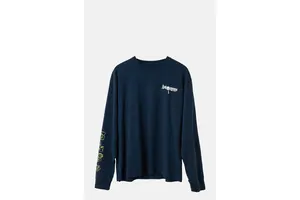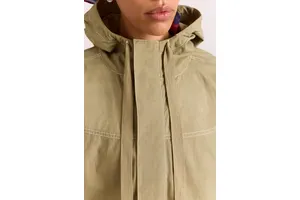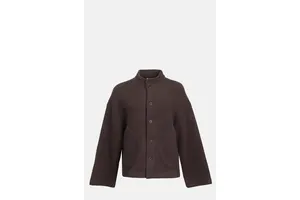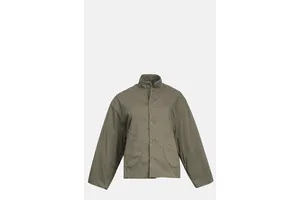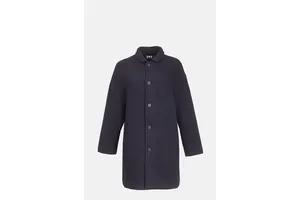
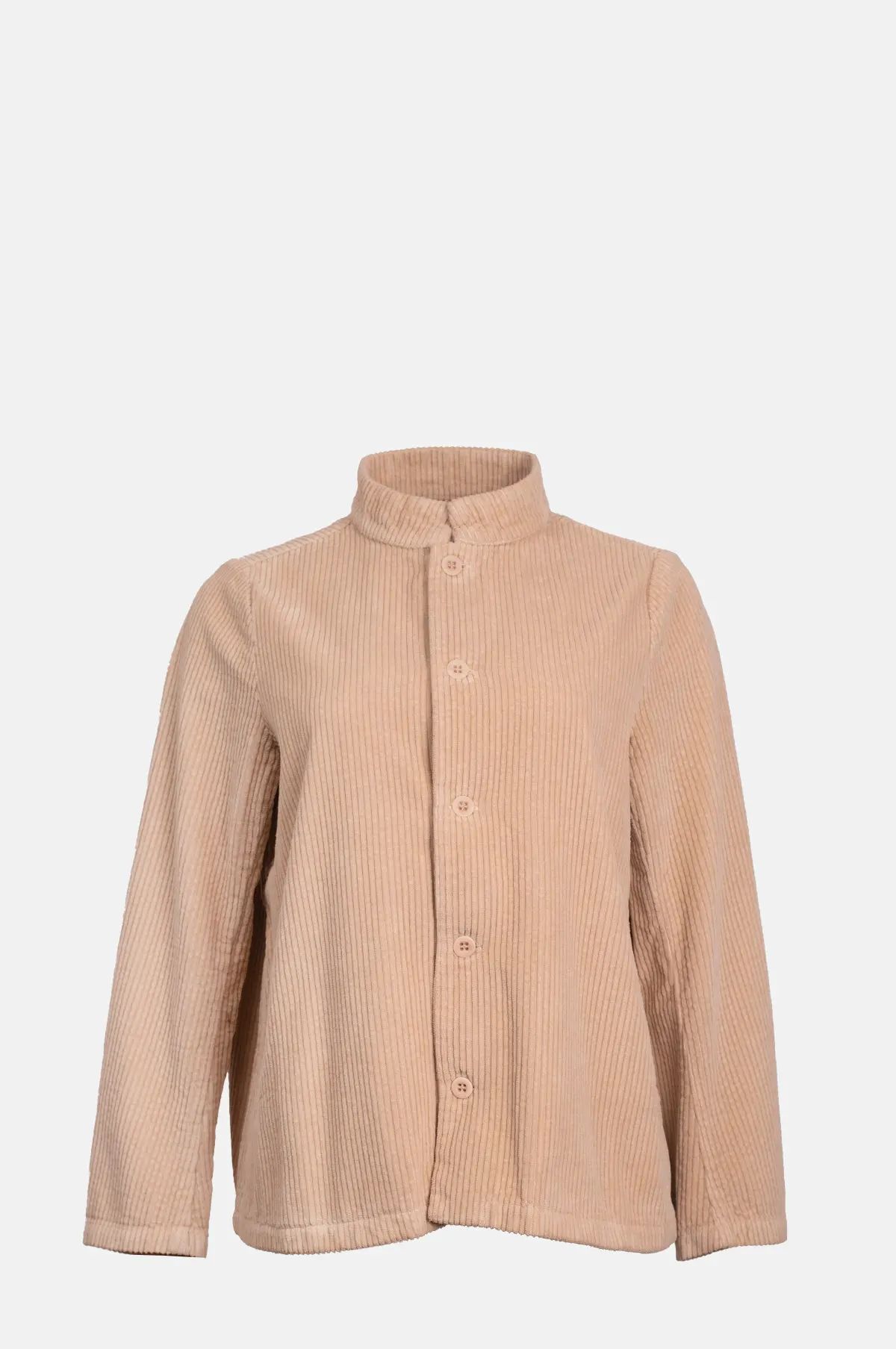

A sand jacket from LABO.ART in a thickly ribbed corduroy, cut straight and neat with a band collar, a button-down front, side pockets and long sleeves, listed at 285 GBP with all four sizes in stock. It publishes pit to pit, sleeve and length for all four sizes, and the number that stands out is not any single measurement but the grade: three centimetres of flat chest width per size, against one centimetre on the poplin shirt earlier in this run and one centimetre on the other corduroy jacket in this batch. The same four size letters are covering three times the range. There is also a naming question, since the style says velluto and the copy says corduroy. The reference is the Pireo Velluto Jacket in Tapioca. Dongguan Bafinasa Garments Co., Ltd. develops comparable outerwear on OEM and ODM terms, from cloth and wale selection to retail or FBA ready packing. We publish this as a development reference and build your own version of it, and we do not supply the branded original or reproduce anyone else's label.
Key Features
- Chest grading three centimetres flat per size across four sizes, the widest grade in this run. See the note below
- 100% cotton corduroy, described as thickly ribbed, made in Italy as stated
- Band collar as stated, which is what gives the jacket its workwear reading
- Straight neat fit with side pockets and a button-down front as stated
- Sleeve and length grading one centimetre per size, against three on the chest. See the note below
- Machine wash at 30 degrees, do not tumble dry, as stated
- All four sizes in stock
Customisable Options
- Cloth: cotton corduroy to the reference, with the wale count and weight open since neither is given
- Wale: thickly ribbed to the reference, with fine, medium and wide wale options quoted separately
- Fit: straight and neat to the reference, with the ease reducible by four to six inches for a closer jacket
- Collar: band collar to the reference, or a classic collar, or a shirt collar
- Pockets: side pockets to the reference, with patch, flap or patch and flap alternatives
- Length: 63 to 66 cm to the reference, with a longer chore coat length as an option
- Cloth weight, wale count, ease, body length, sleeve length, pocket style, size set, colour development, private label and care labelling
Specifications
| Style | Straight fit ribbed corduroy jacket with a band collar |
| Reference | LABO.ART, Pireo Velluto Jacket, sand, size 0 to 3, given as 0/XS, 1/S, 2/M and 3/L |
| Composition | 100% cotton as stated |
| Cloth | Thickly ribbed corduroy in sand as stated, with no wale count and no weight given. See the note below |
| Collar | Band collar as stated |
| Front | Button-down front as stated |
| Pockets | Side pockets as stated |
| Sleeves | Long sleeves as stated |
| Fit | Straight and neat as stated. See the note below |
| Care | Machine wash at 30 degrees, do not tumble dry, as stated |
| Sizes Offered | 0 to 3, four sizes, all in stock |
| Measurements Published | Pit to pit, sleeve length and total length for all four sizes. See the note below |
| Published Chest | Pit to pit 53, 56, 59 and 62 cm flat, or 20.9, 22.0, 23.2 and 24.4 in. See the note below |
| Published Sleeve | 59, 60, 61 and 62 cm, grading one centimetre per size. Origin not stated |
| Published Length | 63, 64, 65 and 66 cm, grading one centimetre per size |
| Model | None stated, no height and no body measurements |
| Photographs | Four |
| Cloth Weight | Not stated, only the words thickly ribbed |
| Production | Made in Italy as stated |
| Reference Retail | 285 GBP as listed, quoted to show the price band this sits in, not as our price |
| Category | Filed by the reference under coats and jackets |
| Occasion | Everyday, weekend, work in a relaxed setting, autumn and winter layering |
| MOQ | 100 pcs per style per colourway, mixed sizes and colourways accepted |
| Sampling | 7-10 days after tech pack or reference sample confirmation |
| Bulk Lead Time | 20-30 days after sample approval and deposit |
| Service | OEM / ODM / private label, corduroy sourcing and wale selection, nap one way cutting, retail or FBA ready packing |
Size Chart as Published by the Reference
| Size | Pit to Pit (flat) | Sleeve Length | Total Length |
|---|---|---|---|
| 0 / XS | 53 cm | 59 cm | 63 cm |
| 1 / S | 56 cm | 60 cm | 64 cm |
| 2 / M | 59 cm | 61 cm | 65 cm |
| 3 / L | 62 cm | 62 cm | 66 cm |
The chest figures are flat half measures taken with the garment laid down, doubling to 106, 112, 118 and 124 cm around, or 41.7 through 48.8 in. Against the body chart that is about ten and a half inches of ease at size 0 rising to about twelve at size 3, so the jacket gets marginally easier as it gets larger. The grade is the striking part: three centimetres of flat width per size is six centimetres of circumference, or about two and a half inches, where the poplin shirt in this run grades one centimetre flat per size and the second corduroy jacket in this batch grades one as well. Over four sizes this jacket grows eighteen centimetres of chest circumference where those grow six. The sleeve origin is not stated, and 59 cm against a 63 cm body length is short enough that the origin matters.
Our Proposed Body Chart
| Size | Body Bust | Sleeve | Body Waist | Body Hips | Length | Source |
|---|---|---|---|---|---|---|
| 0 / XS | 31 in / 79 cm | 59 cm | 24 in / 61 cm | 34 in / 86 cm | 63 cm / 24.8 in | Our proposal |
| 1 / S | 33 in / 84 cm | 60 cm | 26 in / 66 cm | 36 in / 91 cm | 65 cm / 25.6 in | Our proposal |
| 2 / M | 35 in / 89 cm | 61 cm | 28 in / 71 cm | 38 in / 97 cm | 67 cm / 26.4 in | Our proposal |
| 3 / L | 37 in / 94 cm | 62 cm | 30 in / 76 cm | 40 in / 102 cm | 69 cm / 27.2 in | Our proposal |
Occasions and Styling
Suits everyday wear, weekends, relaxed workplaces and autumn or winter layering. A band collar and a straight body make this the most utilitarian jacket in this batch, and it is a mid weight layer rather than an outer coat, so it sits over a shirt or a fine knit and under a coat when the weather turns.
Production and Quality Control
The reference states its fibre as 100% cotton, names the cloth as corduroy, publishes three columns for all four sizes, describes the collar, the front and the pockets, gives a care instruction and states the country of make. It is a short page and a fairly honest one. Three things follow: what a three centimetre grade commits you to, what the word velluto and the absence of a wale count hide, and how much ease a jacket described as neat should carry.
Three centimetres per size, and three answers to the same question, and that is the first thing. Set this table beside the two others in this batch and the same size alphabet means three different things. The poplin shirt grades one centimetre of flat chest per size, so moving from XS to L adds six centimetres of circumference. The second corduroy jacket in this batch also grades one, so over five sizes it adds ten. This one grades three, so over four sizes it adds eighteen. Every one of those is a defensible choice, because a grade is a decision about who the garment is for and how much cloth goes where, and a jacket meant to layer has more reason to open up than a shirt does. The problem is not the grade, it is the label. A customer who wears a size S in all three is getting a 44 in chest from one, a 49 in chest from another and a 46 from the third, and nothing on any page prepares them for that. For a developer the consequence is sharper. If you lift a grade off a reference page and apply it to your own block, you are inheriting a set of decisions made for a different customer, and if you lift two grades from two pages for two styles in one collection, your size letters will not agree with each other across your own range. The discipline that avoids this is the one we work to: grade from your own body chart, in even steps, and publish the body chart beside the garment so the customer is matching their measurements rather than a letter. There is a second point inside the same numbers. The chest grades three centimetres a size while the length and the sleeve grade one, so the jacket becomes wider without becoming longer, and the proportions are not the same garment at size 0 and at size 3. That may be intended, and it is the kind of thing a pattern cutter does deliberately to keep a short length wearable on a larger body, but it should be a decision that is visible rather than one that is discovered.
Velluto, corduroy, and the number that decides which, and that is the second thing. The style is called Pireo Velluto and the copy describes a thickly ribbed corduroy, and velluto is Italian for velvet, which is a different cloth from corduroy: velvet has a cut pile on a plain ground, corduroy has a cut pile in wales with a plain or twill ground between them, and they look and behave differently and they cost differently. The copy is almost certainly the accurate one, since it is specific about ribs, and the name is probably a house style name rather than a description of the cloth. It is still worth flagging, because a buyer working from a style list, a spec writer copying a name into a tech pack, and a search engine will all read velluto as velvet, and one of them will eventually order the wrong cloth. Then there is the number that every corduroy is specified by and that this page does not give: the wale count, the number of ribs to the inch. Thickly ribbed tells you it is a wide wale, which in practice means something in the range of four to eight wales per inch, but wide wale and medium wale are visibly different cloths at arm's length and they take dye differently, and there is no way to buy or to cost this from the page. No weight is given either, and corduroy is normally quoted in both. There is a production consequence specific to this cloth that belongs in any quote and that no retail page will mention. Corduroy has a nap, so it must be cut one way with every panel running the same direction, which raises cloth consumption by roughly five to ten per cent over a cloth that can be cut either way, and it means panels from different parts of the roll can read as different shades under light even when they are the same dye lot. Nap one way cutting and shade sequencing are standard in our cutting room and they belong in the costing from the start rather than as an adjustment later.
Neat, at ten and a half inches of ease, and what else the page omits, and that is the third thing. A 53 cm flat chest doubles to 41.7 in around against a 31 in body, so there is about ten and a half inches of ease on the smallest size of a jacket described as straight and neat. On a shirt that would be generous and on the second corduroy jacket in this batch it would be positively close, since that one carries seventeen. For a jacket that goes over something, ten and a half is about right, and the word neat is doing its work relative to other outerwear rather than relative to a shirt. It is worth saying what that means in practice: a knit with any bulk will fill most of that allowance, so this layers over a shirt or a fine gauge knit comfortably and over a chunky one only just. No shoulder or across back measurement is published, and on a straight structured jacket those matter more than the chest does, because the shoulder is what sets where the garment sits and it is the measurement that cannot be altered afterwards. No lining statement appears at all. A corduroy overshirt of this weight may be unlined with the seams bound or overlocked, or it may be half lined in the body, and the two are different garments to wear and to cost, and the page does not say which this is. No model information appears, so the 63 cm length cannot be read against a height, and the sleeve origin is not stated, which puts this in the same position as most of the run. Every bulk shipment gets a measurement report against your approved chart.
Optional upgrades include stating the wale count in ribs per inch, which is the number this cloth is specified by and the one the page omits, stating the cloth weight in grams per square metre, publishing shoulder and across back measurements, which set where a straight jacket sits better than the chest does, saying whether the garment is lined, half lined or unlined, adding a model height and body measurements, publishing the sleeve origin, offering a closer fit with four to six inches less ease as a second option, a classic collar option alongside the band collar, patch or flap pockets as alternatives to the side pockets, a longer chore coat length, fine and wide wale versions of the same block quoted separately, length, sleeve length, size set, colour development, private label, hangtag and care labelling.
Pre-production sample approval, in-line inspection during cutting and sewing, and a final AQL inspection before packing, with measurement reports and photos shared before shipment.
Send us your tech pack, a photo or a reference garment and we will quote within 24 hours. Contact bafinasa@bafinasa.com or WhatsApp +86 13827222469.