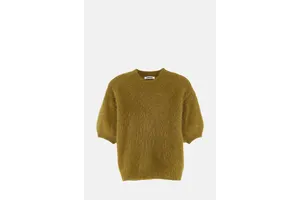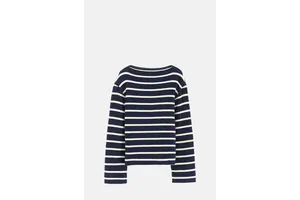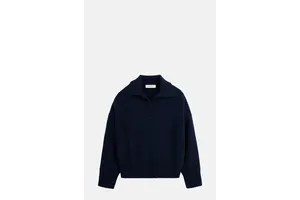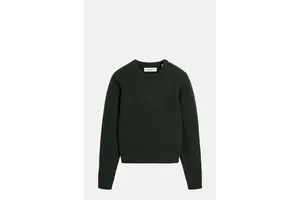
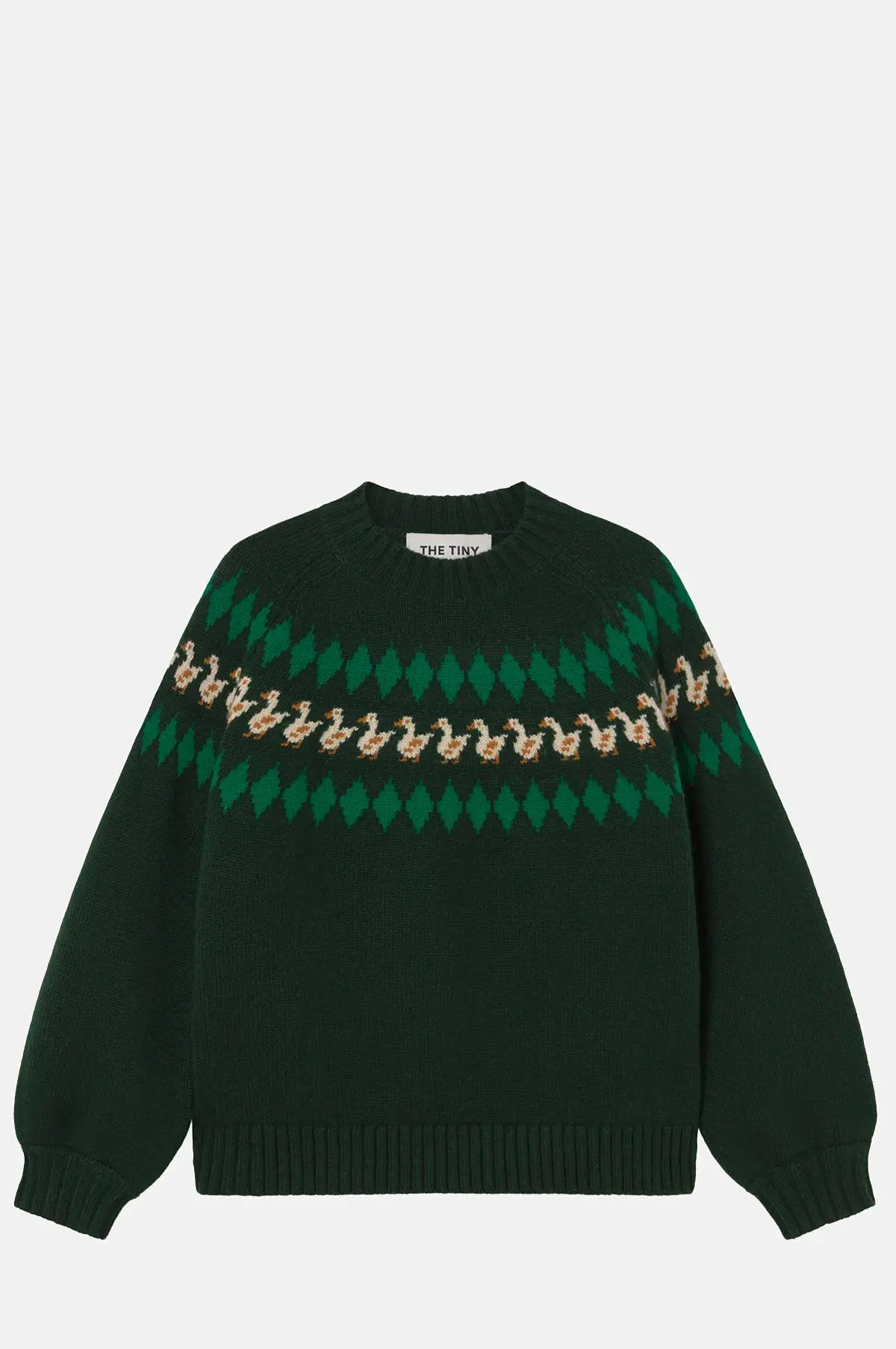

A chunky jumper from The Tiny Big Sister in a super soft merino wool, with a jacquard pattern across the chest, raglan sleeves, a high round neckline and ribbed trims, described as comfortably oversized and listed at 157 GBP with all five sizes in stock. Its sleeve length is published as 52 centimetres on all five sizes, which is one number doing the work of five. That would be a small thing on its own, and this run has met columns that do not grade before. What makes it worth a close look is that two other uncertainties sit on top of it. The sleeves are raglan, and a raglan has no shoulder seam, so there is no shoulder point to measure 52 centimetres from in the first place. And the jumper is oversized with a dropped shoulder line, so even if there were a shoulder point it would not be on the shoulder of the person wearing it. Three ambiguities stacked on one number, and none of them mentioned. The reference is the Geese Sweater in Ink Blue. Dongguan Bafinasa Garments Co., Ltd. develops comparable knitwear on OEM and ODM terms, from yarn and gauge selection to retail or FBA ready packing. We publish this as a development reference and build your own version of it, and we do not supply the branded original or reproduce anyone else's label.
Key Features
- Sleeve length of 52 cm on all five sizes, on a raglan sleeve with no shoulder seam to measure from. See the note below
- Comfortably oversized as stated, with about nine and a fifth inches of ease, which supports the word better than most in this run
- 100% merino wool as stated, with no micron count, no ply, no yarn count and no gauge given. See the note below
- Jacquard pattern across the chest as stated, which is knitted into the cloth rather than printed on it. See the note below
- Raglan sleeves as stated, which have no shoulder seam and which change what a sleeve measurement means. See the note below
- High round neckline and ribbed trims as stated, with no neck opening and no rib specification
- Hand wash only as stated, with no drying instruction on a chunky wool. See the note below
Customisable Options
- Yarn: chunky merino to the reference, with the micron count, the ply, the yarn count and the gauge specified, or a lambswool, a merino blend or a cotton, each quoted separately
- Care: hand wash to the reference, or a machine washable superwash merino quoted as an option
- Pattern: jacquard across the chest to the reference, with the stitch construction and the float length specified, or an intarsia, or an all over jacquard, or a plain body with a knitted band
- Sleeves: raglan to the reference, with the sleeve measurement point stated, or a set-in sleeve, or a dropped shoulder
- Fit: oversized to the reference at about nine inches of ease, or a relaxed six inch version, or a closer one
- Trims: ribbed to the reference, with the rib width and the rib construction specified, or a plain hem and cuff
- Micron count, ply and yarn count, gauge, cloth weight, float length and backing, sleeve measurement point, ease, body length, sleeve length, size set, colour development, private label and care labelling
Specifications
| Style | Oversized chunky merino jumper with a jacquard pattern and raglan sleeves |
| Reference | The Tiny Big Sister, Geese Sweater, style AW26-707, ink blue, sizes 34 to 42. See the note below |
| Composition | 100% merino wool as stated, with no micron count, no ply and no yarn count given. See the note below |
| Yarn | Super soft chunky merino wool as stated, with no micron count and no gauge given. See the note below |
| Pattern | Jacquard pattern across the chest as stated, with no stitch construction and no float length given. See the note below |
| Fit | Relaxed fit as stated, and described as designed to be comfortably oversized. See the note below |
| Neck | High round neckline as stated, with no neck opening given. See the note below |
| Sleeves | Raglan sleeves as stated, measured at 52 cm on all five sizes. See the note below |
| Trims | Ribbed trims as stated, with no rib width and no rib construction given |
| Care | Hand wash only as stated, with no drying instruction. See the note below |
| Sizes Offered | 34 to 42, five sizes, all five in stock |
| Size Conversion | Published: 34 is XS, 36 is S, 38 is M, 40 is L and 42 is XL |
| Measurements Published | Pit to pit, sleeve length and total length for all five sizes. See the note below |
| Published Chest | Pit to pit 51, 53, 55, 57 and 59 cm flat, or 20.1 through 23.2 in. See the note below |
| Chest Around | 102, 106, 110, 114 and 118 cm, or 40.2, 41.7, 43.3, 44.9 and 46.5 in. See the note below |
| Ease Against Body Bust | About 9.2, 8.7, 8.3, 7.9 and 7.5 in from smallest to largest. See the note below |
| Published Sleeve | 52 cm on all five sizes, with no grading and no measurement point given. See the note below |
| Published Length | 59, 60, 61, 62 and 63 cm, grading one centimetre per size |
| Colour | Titled ink blue and described as a deep green shade. See the note below |
| Motif | Named geese in the title and described as ducks in the specification. See the note below |
| Published Hem | None. See the note below |
| Cloth Weight | Not stated |
| Gauge | Not stated. See the note below |
| Model | None stated, no height and no body measurements |
| Photographs | Six |
| Production | Made in China as stated |
| Reference Retail | 157 GBP as listed, the most expensive garment in this house, quoted to show the price band this sits in, not as our price |
| Category | Filed by the reference under knitwear |
| Occasion | Winter, cold days, weekends, outdoors, layered over a shirt or a tee |
| MOQ | 100 pcs per style per colourway, mixed sizes and colourways accepted |
| Sampling | 7-10 days after tech pack or reference sample confirmation |
| Bulk Lead Time | 20-30 days after sample approval and deposit |
| Service | OEM / ODM / private label, merino yarn sourcing with micron specified, gauge and stitch development, jacquard programming, wash testing, retail or FBA ready packing |
Size Chart as Published by the Reference
| Size | Pit to Pit (flat) | Sleeve Length | Total Length |
|---|---|---|---|
| 34 / XS | 51 cm | 52 cm | 59 cm |
| 36 / S | 53 cm | 52 cm | 60 cm |
| 38 / M | 55 cm | 52 cm | 61 cm |
| 40 / L | 57 cm | 52 cm | 62 cm |
| 42 / XL | 59 cm | 52 cm | 63 cm |
The chest figures are flat half measures taken with the jumper laid down, doubling to 102, 106, 110, 114 and 118 cm around, or 40.2, 41.7, 43.3, 44.9 and 46.5 in. Against a body bust of 31, 33, 35, 37 and 39 in across XS to XL, the ease is about nine and one fifth inches at the smallest and about seven and a half at the largest, which is a genuinely oversized garment and which supports what the page claims. The sleeve is published as 52 cm on all five sizes with no grading at all, and no measurement point is given for it on a raglan sleeve, which has no shoulder seam. The length grades a clean one centimetre per size.
Our Proposed Body Chart
| Size | Body Bust | Sleeve | Body Waist | Body Hips | Length | Source |
|---|---|---|---|---|---|---|
| 34 / XS | 31 in / 79 cm | 52 cm | 24 in / 61 cm | 34 in / 86 cm | 59 cm / 23.2 in | Our proposal |
| 36 / S | 33 in / 84 cm | 53 cm | 26 in / 66 cm | 36 in / 91 cm | 61 cm / 24 in | Our proposal |
| 38 / M | 35 in / 89 cm | 54 cm | 28 in / 71 cm | 38 in / 97 cm | 63 cm / 24.8 in | Our proposal |
| 40 / L | 37 in / 94 cm | 55 cm | 30 in / 76 cm | 40 in / 102 cm | 65 cm / 25.6 in | Our proposal |
| 42 / XL | 39 in / 99 cm | 56 cm | 32 in / 81 cm | 42 in / 107 cm | 67 cm / 26.4 in | Our proposal |
Occasions and Styling
Suits winter and cold days, weekends and outdoors. A chunky oversized jumper with a pattern on the chest is a weekend piece rather than a work one, and the raglan sleeve is what lets it go over a shirt without bulk at the shoulder, which is the practical argument for raglan on a heavy knit.
Production and Quality Control
The reference publishes three columns for all five sizes, states its fibre, describes the yarn, the pattern, the fit, the neck, the sleeves and the trims, gives a care instruction, names the country of make, publishes a size conversion, has every size in stock and shows six photographs. Its sleeve is one number for five sizes, its title and its description disagree about both the colour and the bird, and it gives no micron count, no gauge and no drying instruction. Three things follow: the three ambiguities stacked on one sleeve figure, what merino and jacquard each need specified, and the two contradictions inside the page.
One number, five sizes, three ambiguities, and that is the first thing. The sleeve column reads 52, 52, 52, 52 and 52, so the jumper has the same sleeve on an XS and an XL. This run has met columns that do not grade before, on sleeves and on inside legs and on a chest, and it has usually said the same thing: a body grows, so a measurement that does not move describes one size and is copied onto the rest. Here there is more to say, because two further uncertainties sit on the same figure and multiply it. The first is that the sleeves are raglan. A raglan is cut with a diagonal seam running from the underarm to the neck, so there is no shoulder seam and no shoulder point, and a sleeve length is conventionally measured from the shoulder seam. So the 52 has to be taken from somewhere else, and the usual alternatives are the centre back neck, which gives a larger number, and the underarm, which is the one a customer can use, and the difference between them is the distance from the neck to the armpit, which is somewhere between fifteen and twenty five centimetres depending on the size. That is a range wider than the whole column, so the figure cannot be interpreted. The second uncertainty is that the jumper is oversized with, on this evidence, a dropped line at the shoulder, which means that even if there were a shoulder point it would sit down the arm rather than on the shoulder of the person inside it, so the measurement would not correspond to anything on her body either. This run met the raglan version of this problem two batches ago on the American Vintage boat neck, where the sleeve was published without a word about the origin, and it is worth noting how the two cases differ: there the figure was at least graded, so the uncertainty was only about where it started; here it is both ungraded and of unknown origin. The consequence for anyone developing a version of this is that the sleeve cannot be copied from this page at all, and has to be taken off a sample. The remedy is the one this run has recommended every time: state the point the tape went from, and on a raglan publish the underarm to cuff figure beside the neck to cuff one. And it is worth saying what the frozen column costs the customer rather than the factory, because it is the more serious of the two. On a jumper with nine inches of ease, the body is already unspecified, so the sleeve is the one measurement that still means something to somebody choosing a size: a taller woman buying an XL because she wants length gets the same 52 cm sleeve as the XS, and if the figure is from the neck then her sleeve is shorter relative to her arm than the smaller size's is. She cannot discover this from the page, and she will discover it from the garment.
Merino, jacquard, and hand wash with nothing after it, and that is the second thing. Merino is a wool graded by the diameter of its fibre in microns, and the micron count is the specification: it decides the softness, the price and whether the cloth prickles, and below about nineteen and a half microns it stops prickling most people. This page says super soft and says merino and gives no number, which is the same shape as the extra fine merino on the Vitow knitwear last batch, where a word was used in place of the number that defines it. Alongside the micron count a knit needs three more: the ply, which is how many strands are twisted together and which decides the bulk; the yarn count, which the mill quotes from; and the gauge, which is the number of needles per inch on the machine and which decides the fineness of the stitch. A chunky jumper is a low gauge jumper, and a chunky jumper in one yarn at one gauge and the same jumper at another are different garments with different weights and different warmth, and none of the four is on this page. It is worth noting what is missing as a result: no cloth weight, so nobody can tell how warm it is, and no gauge, so nobody can tell how open the knit is, and an open knit in a soft yarn is a knit that snags and pills. Then the jacquard. A jacquard is not a print: the pattern is made by the machine knitting two or more colours of yarn into the same cloth, so the pattern is the structure and not the surface. Three consequences follow and all three belong in a specification. The first is floats: wherever a colour is not being knitted on the face, it runs as a loose strand across the back, and a long float catches on a ring, a watch strap or a bag handle and pulls, so the float length has to be limited, usually by tucking the unused yarn into the back of the cloth at intervals. No float length is given, and on a chunky gauge the floats are longer in absolute terms and therefore more likely to catch. The second is that a jacquard area is thicker and less extensible than plain knitting, because there are two yarns in it where there was one, so the patterned band across the chest behaves differently from the plain sleeves and body, and on a garment knitted to a shape that difference has to be allowed for or the chest band will pull the surrounding cloth. The third is cost: jacquard knitting is slower than plain and consumes more yarn, and both are part of why this is the most expensive garment in the house at 157 pounds. Then the care label, which is one of the shortest in this run and which gets the important part wrong by omission. Hand wash only is right for an untreated wool, and it is worth noting that most merino knitwear sold today is treated so that it can be machine washed, so hand wash only is either a choice or an untreated yarn, and the customer is entitled to know which. What the label does not say is the thing a chunky wool most needs told, which is how to dry it. A wet chunky knit is heavy, and a heavy wet knit hung on a line or over a rail stretches under its own weight and does not come back, which is why every wool label should say dry flat, reshaped, away from direct heat. This page says hand wash only and stops. It is the single most damaging omission on it, it is three words to fix, and this run has now met it on the wool trouser, the wool knitwear and now this: pages that say how to wash a wool and not how to dry one. There is one more thing that belongs with the washing, and it is the reason the ribbed trims matter: a rib that has been washed and dried badly loses its recovery and the cuffs and the hem go slack, and no rib specification is published either.
Two contradictions inside one page, and a house habit, and that is the third thing. The garment is titled Geese Sweater in Ink Blue. The description says it is made in a lovely deep green shade, and the specification list on the same page says the jacquard pattern is with ducks. So the title says blue and the description says green, and the name says geese and the bullets say ducks. Neither is a measurement and neither changes the fit, and it is worth saying why they are still worth a paragraph, because this run has found the same class of contradiction repeatedly and it always points at the same thing. On the Antonyms tee two batches ago the description said organic cotton and the specification said cotton. On the Sunray tee in the last batch the description said recycled cotton and the specification said premium cotton. On the checked dress earlier the description said wool mix and the specification said polyester. In every case the difference runs one way: the prose carries the claim, and the technical panel does not. That is the direction you would expect if two people wrote the two halves, and it is the direction that matters, because the panel is the half a factory works from. Here the contradiction is not between claim and specification but inside the prose and the naming, so it is milder, and yet it is the same underlying thing: nobody read the finished page end to end. And the cost is not abstract. A customer who buys a sweater called Ink Blue and receives a green one has grounds to return it, and a customer searching a shop for a blue jumper will never see this one, because the title is what the search reads. There is a second small thing in the same family: the fit is described as relaxed in the bullet list and as comfortably oversized in the prose, which is a mild duplication of the problem this run has just measured on the bow blouse, where relaxed covered a four inch range across two garments. Here at least the two words agree in direction, and the measurements support them: nine and a fifth inches of ease at the 34 is genuinely oversized, which is more than can be said for most of the garments in this run that claim it. Then the house habit, which is now four garments deep and worth naming because it is the most useful thing these pages have in common. The velvet trousers hold their inside leg at 80 for four of five sizes. The embroidered blouse holds its sleeve at 58 for the top three. This jumper holds its sleeve at 52 for all five. The bow blouse grades its sleeve properly and is the exception. In every case the chest grades, and the body length grades, and the limb does not. That is a template, and a template is better news than a set of unrelated slips, because one person changing one file fixes all of them. Every bulk shipment gets a measurement report against your approved chart.
Optional upgrades include grading the sleeve and stating the point it is measured from, publishing the underarm to cuff figure alongside the neck to cuff one on a raglan, specifying the merino by micron count, ply, yarn count and gauge, stating the cloth weight, specifying the jacquard float length and tucking so the pattern does not catch, adding dry flat, reshaped, away from direct heat to the care label, offering a machine washable superwash merino, specifying the rib by width and construction, reconciling the colour in the title with the colour in the description and the geese with the ducks, publishing the hem width and a model height, intarsia and all over jacquard and plain body options, set-in sleeve and dropped shoulder options, closer and less oversized fit options, size set, colour development, private label, hangtag and care labelling.
Pre-production sample approval, in-line inspection during cutting and sewing, and a final AQL inspection before packing, with measurement reports and photos shared before shipment.
Send us your tech pack, a photo or a reference garment and we will quote within 24 hours. Contact bafinasa@bafinasa.com or WhatsApp +86 13827222469.