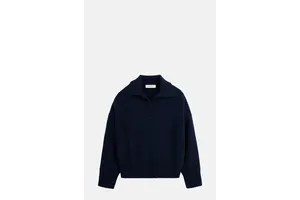
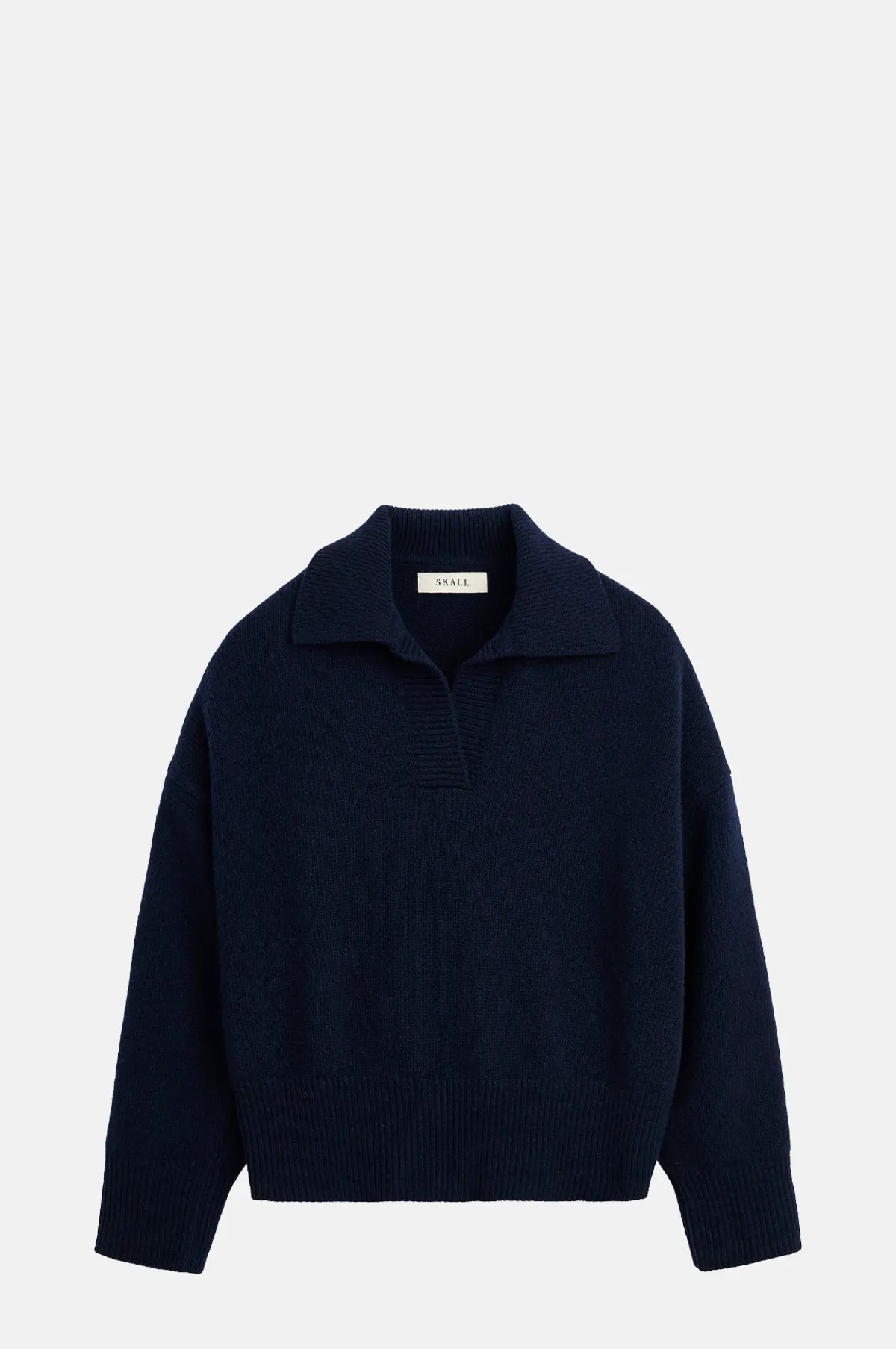

A V-neck jumper from Skall Studio in dark navy, knitted in supple merino wool with a cross-over V that opens into a wide ribbed collar, dropped shoulder sleeves finished with a deep rib and ribbed detailing throughout, listed at 370 GBP with all four sizes in stock. It carries the largest amount of ease this run has measured. The chest is published at 66 to 69 centimetres flat, which is 132 to 138 centimetres around, and against a body bust of 31 to 37 inches that is about twenty-one inches of ease at the smallest size, falling to about seventeen and a third at the largest. This run has been reading size charts for a long stretch now and the biggest it had previously found was a little over twelve inches, so this is roughly double the previous ceiling. It is worth saying at once that this is not a fault, because the garment says it is loose and it is, and the same brand's other two knitwear pieces in this run are genuinely slim and genuinely relaxed, so the three fit words sit in three bands that do not overlap. What is worth examining is what happens to that ease across the four sizes, and what the sleeve figure means when it is set beside the sleeve on the brand's own slim jumper published one batch earlier, because the two are thirty-one centimetres apart on two garments made of the same fibre in the same country. The reference is the Dean V-Neck Jumper in Navy. Dongguan Bafinasa Garments Co., Ltd. develops comparable knitwear on OEM and ODM terms, from yarn selection to retail or FBA ready packing. We publish this as a development reference and build your own version of it, and we do not supply the branded original or reproduce anyone else's label.
Key Features
- About 21 in of ease at the smallest size falling to about 17.3 in at the largest, the largest ease this run has measured. See the note below
- Part of a fit vocabulary that holds up: the same brand's slim jumper measures about 2.4 to 3.6 in of ease, its relaxed cardigan about 12 to 14, and this about 17 to 21. See the note below
- Sleeve 49 to 52 cm grading one centimetre per size, on a dropped shoulder where the measurement origin is already uncertain. See the note below
- The same brand's slim jumper publishes a sleeve of 80 cm in the same fibre and the same country, so the two sleeves cannot be measured from the same point. See the note below
- Model height published at 177 cm against 179 cm on the brand's other three garments, which is what proves the field is real data. See the note below
- 100% merino wool with no micron count, the third merino in this run and the third without one. See the note below
- Heavy weight knit as stated, with no weight in grams. See the note below
Customisable Options
- Yarn: merino wool to the reference, with the micron count and the ply specified, or a lambswool, a merino cashmere or a fine wool blend, each quoted separately
- Fit: loose to the reference at about 18 to 21 in of ease, or a relaxed fit at about 12, or a slim fit at about 3, with the grading step set to hold the ease steady
- Neck: cross-over V opening into a wide ribbed collar to the reference, with the V depth specified, or a shallower V, a round neck or a roll neck
- Shoulder: dropped to the reference, with the drop specified in centimetres below the shoulder point, or a set-in sleeve, or a raglan
- Sleeve: full length to the reference, with the measurement origin stated, or a three quarter sleeve or an elbow length sleeve
- Weight: heavy weight to the reference, with the weight in grams specified, or a mid weight or a fine gauge
- Micron count and ply, gauge and weight, V depth, shoulder drop, sleeve measurement origin and grade, rib depth, drying instruction, size set, colour development, private label and care labelling
Specifications
| Style | Loose fit V-neck jumper with dropped shoulder sleeves and ribbed detailing |
| Reference | Skall Studio, Dean V-Neck Jumper, style 10052-25317, navy, sizes XS to L |
| Composition | 100% merino wool as stated in both the bullets and the panel, with no micron count given. See the note below |
| Yarn | Supple merino wool as stated, with no micron count, no ply and no yarn count given. See the note below |
| Weight | Heavy weight knit as stated, with no weight in grams given. See the note below |
| Structure | Ribbed detailing throughout as stated, with no gauge and no rib depth given |
| Neck | Cross-over V-neck opening into a wide ribbed collar as stated, with no V depth given. See the note below |
| Shoulder | Dropped shoulder sleeves as stated, with the drop not quantified. See the note below |
| Cuffs | Finished with a deep rib as stated, with no rib depth given |
| Fit | A loose silhouette falling freely on the body as stated, with the fit guidance published. See the note below |
| Care | Handwash only as stated, with no drying instruction. See the note below |
| Sizes Offered | XS to L, four sizes, all four in stock |
| Fit Guidance | Published: designed in a loose silhouette falling freely on the body, size down if you prefer it less loose |
| Model | Published: 177 cm tall, wearing a size S. See the note below |
| Measurements Published | Pit to pit, sleeve length and total length for all four sizes. See the note below |
| Published Chest | 66, 67, 68 and 69 cm flat, or 26.0 through 27.2 in. See the note below |
| Chest Around | 132, 134, 136 and 138 cm, or 52.0, 52.8, 53.5 and 54.3 in. See the note below |
| Ease Against Body Bust | About 21.0, 19.8, 18.5 and 17.3 in from smallest to largest, the largest this run has measured. See the note below |
| Published Sleeve | 49, 50, 51 and 52 cm, grading one centimetre per size. See the note below |
| Sleeve Measurement Origin | Not stated, and the shoulder is dropped. See the note below |
| Published Length | 60, 61, 62 and 63 cm, grading one centimetre per size |
| V Depth | None. See the note below |
| Shoulder Drop | Described but not quantified. See the note below |
| Micron Count | None. See the note below |
| Ply and Gauge | None. See the note below |
| Cloth Weight | Not stated, on a garment described as heavy weight. See the note below |
| Photographs | Three |
| Production | Made in Italy as stated, and the style number is shared with the brand's slim jumper. See the note below |
| Reference Retail | 370 GBP as listed, quoted to show the price band this sits in, not as our price |
| Category | Filed by the reference under knitwear |
| Occasion | Autumn and winter, everyday, weekend, layered over a shirt or a tee |
| MOQ | 100 pcs per style per colourway, mixed sizes and colourways accepted |
| Sampling | 7-10 days after tech pack or reference sample confirmation |
| Bulk Lead Time | 20-30 days after sample approval and deposit |
| Service | OEM / ODM / private label, merino sourcing by micron and ply, loose fit and dropped shoulder development, V depth and rib specification, retail or FBA ready packing |
Size Chart as Published by the Reference
| Size | Pit to Pit (flat) | Sleeve Length | Total Length |
|---|---|---|---|
| XS | 66 cm | 49 cm | 60 cm |
| S | 67 cm | 50 cm | 61 cm |
| M | 68 cm | 51 cm | 62 cm |
| L | 69 cm | 52 cm | 63 cm |
The chest figures are flat half measures taken with the jumper laid down, doubling to 132, 134, 136 and 138 cm around, or 52.0, 52.8, 53.5 and 54.3 in. Against a body bust of 31, 33, 35 and 37 in across XS to L, the ease is about twenty-one inches at the smallest and about seventeen and a third at the largest, which is the largest this run has measured and about double the previous ceiling. The ease falls because the chest grades one centimetre flat per size, which is 0.79 in of circumference against a body grade of two inches, so it gives up about 1.2 in at every size. The sleeve grades one centimetre per size and the length does the same.
Our Proposed Body Chart
| Size | Body Bust | Sleeve | Body Waist | Body Hips | Length | Source |
|---|---|---|---|---|---|---|
| XS | 31 in / 79 cm | 49 cm | 24 in / 61 cm | 34 in / 86 cm | 60 cm / 23.6 in | Our proposal |
| S | 33 in / 84 cm | 50 cm | 26 in / 66 cm | 36 in / 91 cm | 62 cm / 24.4 in | Our proposal |
| M | 35 in / 89 cm | 51 cm | 28 in / 71 cm | 38 in / 97 cm | 64 cm / 25.2 in | Our proposal |
| L | 37 in / 94 cm | 52 cm | 30 in / 76 cm | 40 in / 102 cm | 66 cm / 26 in | Our proposal |
Occasions and Styling
Suits autumn and winter, everyday and weekends. A loose heavy knit with a dropped shoulder is an easy layer rather than a shaped one, and the V-neck is what lets it sit over a shirt collar without crowding it.
Production and Quality Control
The reference publishes three columns for all four sizes, states a single fibre in both the bullets and the panel, describes the yarn, the weight, the neck, the shoulder, the cuffs, the fit and the trims, gives a care instruction, names the country of production, publishes fit guidance and gives the height of the model and the size she wears. It gives no micron count, no ply, no gauge, no weight in grams, no V depth, no shoulder drop and no drying instruction, and it does not say where the sleeve is measured from. Three things follow: twenty-one inches of ease, the two sleeves that cannot be measuring the same thing, and the model height that changes.
Twenty-one inches, and three bands that do not overlap, and that is the first thing. The chest is 66 to 69 cm flat, which is 132 to 138 cm around, and against a body bust of 31 to 37 in that is about twenty-one inches of ease at the XS and about seventeen and a third at the L. It is worth putting a scale on that, because ease is the number this run keeps returning to and it is hard to picture: a body bust of 31 in means the body measures 79 cm around the chest, and the garment measures 132 cm, so there is fifty-three centimetres of cloth around a seventy-nine centimetre body, which is two thirds as much again. This run's previous ceiling was a cardigan at a little over twelve inches and another at about fourteen, so this is in a different category, and it is worth saying plainly that the garment is honest about it: it says loose, it says falling freely on the body, and it advises sizing down for less volume, which is the right advice for a garment this full. The more interesting question is what happens across the sizes, and the answer is the familiar one. The chest grades one centimetre flat per size, and one centimetre of flat width is two centimetres of circumference, which is 0.79 inches, against a body bust that grades two inches per size. So the garment grows at less than half the rate the body does and the ease collapses by about one and a fifth inches at every size, from twenty-one to seventeen and a third across three steps. In proportion that is a gentler fall than the run has seen elsewhere, because the starting figure is so large: losing three and a half inches out of twenty-one is a change from very loose to loose, whereas losing four and a half out of seven and a half, which is what one shirt did, is a change from boxy to close. Still, twenty-one and seventeen are meaningfully different garments, and a customer who reads the fit guidance and sizes down from an L to an M gains about half an inch of ease rather than losing it, which is not quite what the words lead her to expect. It is worth setting this beside the other two knitwear pieces this brand put in front of this run, because together they do something no other house in this run has managed. Its slim jumper measures about three and a half inches of ease at the smallest and about two and two fifths at the largest. Its relaxed cardigan measures about eleven and nine tenths to thirteen and nine tenths. This one measures seventeen and a third to twenty-one. So slim, relaxed and loose occupy three bands that do not touch one another, and they are in the right order, and the numbers support the words on all three. This run has spent a great deal of time on the opposite: on a house where the word relaxed spanned eight inches across three garments, and on a boxy shirt whose ease collapsed from seven and a half to under three so that the word stopped describing the large sizes. Against that, three non-overlapping bands is good work and worth crediting. There is one thing to be fair about, which is that two of these garments are both described as loose, and they sit about five inches apart at the same size, so the word is not precise to the inch even here.
Two sleeves, thirty-one centimetres apart, same brand, and that is the second thing. This jumper publishes a sleeve of 49 to 52 cm. The brand's slim jumper, published alongside it and examined one batch earlier, is 100% merino wool, made in Italy, offered in the same four sizes, and publishes a sleeve of 80.25 to 85.5 cm. So two garments of the same fibre, from the same brand, in the same season, made in the same country, in the same size range, have sleeves that differ by thirty-one to thirty-three centimetres. That is not a difference in sleeve length; it is a difference in where the measurement starts. This run established last batch, from that slim jumper, why: a sleeve of 80 cm on a garment whose body is 53 cm long cannot be shoulder-to-cuff, because the arm would be half as long again as the body is tall, so it must be taken from the centre back neck, across the shoulder and down the arm, which adds the neck and the whole shoulder width before the arm begins. And the grade confirmed it, because a sleeve measured from the centre back neck includes the shoulder and therefore grades by more than an arm alone does, and that one graded 1.75 cm per size. Now the same test applied to this garment. A sleeve of 49 cm is far too short to be a centre-back-neck measurement on a body 60 cm long, since that would put the arm at under twenty centimetres. It is also too long to be an underarm measurement, which on an XS would run to the wrist and beyond. What it fits is a measurement from the shoulder seam to the cuff on a shoulder that has been dropped, where the seam sits several centimetres down the upper arm and so the remaining distance to the wrist is correspondingly shorter. And the grade confirms that reading too, for the same reason as before and in the opposite direction: 1 cm per size is what an arm alone grades, where 1.75 is what an arm plus a growing shoulder grades. So two independent figures on each garment, the absolute length and the grade, point to two different origins, and the brand states neither. It is worth saying what that costs a customer, because this is now the clearest case this run has produced. A woman reading the two charts together would conclude that one jumper has sleeves a third longer than the other, and both conclusions would be wrong, and there is no way for her to discover the truth from the pages. And the problem is worse here than on the slim jumper for a specific reason, which is that this sleeve is dropped. This run has now met four sleeve constructions on which the start point is genuinely ambiguous rather than merely unstated: a raglan sleeve has an armhole but no shoulder seam so the origin is undefined, a dropped shoulder puts the seam down the upper arm so the origin is not on the body at all, a cape sleeve has no armhole whatsoever, and now a dropped shoulder on top of an unstated convention. The remedy is four words in a column heading and it costs nothing. It is worth adding that this garment would also be improved by a number for the drop, since dropped shoulder is a design decision measured in centimetres below the shoulder point, and it is described here and not quantified.
One hundred and seventy-seven, not one hundred and seventy-nine, and that is the third thing, and it is a small one that turns out to matter a great deal. The model on this page is 177 cm tall and wears a size S. On the brand's other three garments in this run, the cardigan, the slim jumper and the printed skirt, the model is 179 cm and wears an XS/S, an S and a 36. So the height changes between garments. That is worth remarking on because it is a test this run can now apply to any published field, and it is a useful one: a field that varies from garment to garment is being filled in per garment, and a field that is identical on every garment is either a coincidence or a template. This run has already met the second kind, on another house, where a colour name in the title said one thing and the description said another on two separate garments, which is what a copied field looks like when nobody edits it. Here the opposite: the brand has photographed four different garments, presumably on two different women, and has published the height of whoever was in front of the camera. Which is what makes it worth having at all, and it is worth restating why, because this run has now had to say it several times. A length is not a fact until you know what body it is on. Eighty-six centimetres of skirt on a model of 179 cm puts the hem about twenty-seven centimetres off the floor, which is a midi; the same eighty-six centimetres on a woman of 165 cm puts it about eighteen centimetres off the floor, which is a different garment. This page publishes 60 to 63 cm of body length on a model of 177 cm, which is enough for anyone to place it. It is also worth setting the brand against the other house in this batch, which publishes two garments and gives a model height on neither, so the same calculation cannot be done on either of them. Then the specifications that are missing, which are by now familiar and which matter more at this price than at most. The merino has no micron count, and this is the third merino in this run and the third without one, and merino is sold across a range from about eleven and a half micron at the finest to over twenty-four at the coarsest, so the word alone does not say whether this is a jumper to wear next to the skin. There is no ply and no gauge either. And the page says heavy weight knit, which is a word for a quantity and not the quantity: a heavy knit is heavy when it is wet, which is precisely why the care label needs the clause it does not have. Handwash only, and nothing about drying, and this run has now written dry flat about a wool trouser, two sweaters, a handwash knit and a 430 pound cardigan, and it will say it once more here because this is a heavy loose knit with a dropped shoulder, which is the shape most inclined to lengthen under its own weight when wet. One more thing that is specific to this garment rather than general: the neck is a cross-over V and no depth is given. A V is specified by how far down it goes, and that single number decides whether it is a modest neckline or an open one, and on a garment with seventeen to twenty-one inches of ease the neckline does not stay where it is put, because that much cloth slides on the body as the wearer moves. Every bulk shipment gets a measurement report against your approved chart.
Optional upgrades include stating the micron count, the ply and the gauge of the merino, stating the weight in grams, stating the depth of the V, quantifying the shoulder drop in centimetres, stating where the sleeve is measured from and applying one convention across every style, grading the chest at about two and a half centimetres a size to hold the ease steady, adding dry flat to the care label, stating the rib depth, reducing the ease to a relaxed twelve inches if the fit word is to be precise, a lambswool, merino cashmere and fine wool blend option, set-in and raglan sleeve options, three quarter and elbow length sleeve options, a mid weight and a fine gauge option, more photographs including the back and a neckline detail, size set, colour development, private label, hangtag and care labelling.
Pre-production sample approval, in-line inspection during cutting and sewing, and a final AQL inspection before packing, with measurement reports and photos shared before shipment.
Send us your tech pack, a photo or a reference garment and we will quote within 24 hours. Contact bafinasa@bafinasa.com or WhatsApp +86 13827222469.