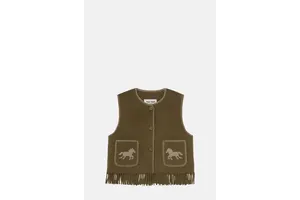
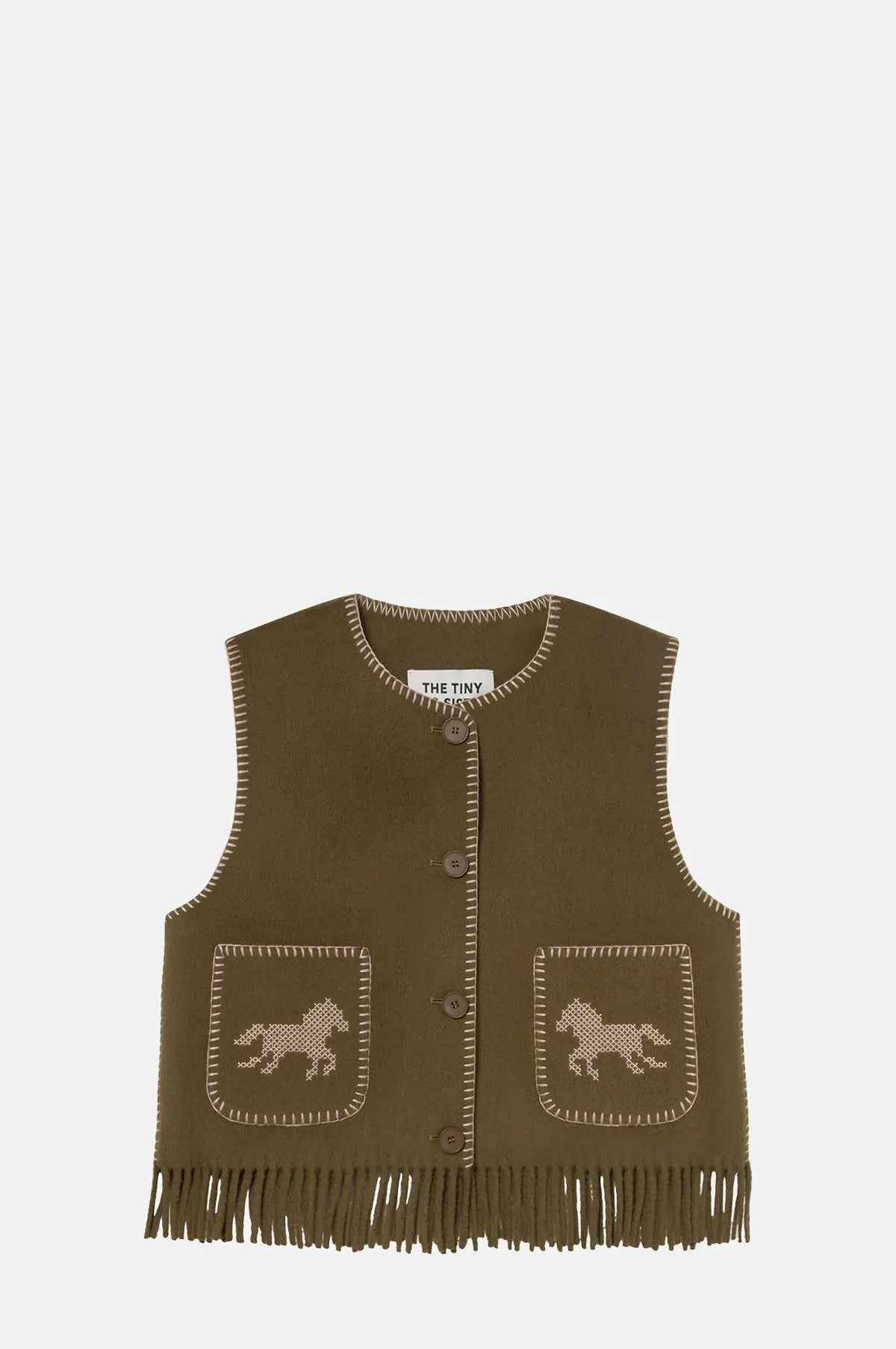

A sleeveless vest from The Tiny Big Sister in a double-faced wool blend, with cross-stitched horse patch pockets, a button through front, decorative blanket stitching and a fringe trim at the hem, listed at 210 GBP with three of four sizes in stock and the smallest sold out. Two things about it are worth a close look and neither is the embroidery, though the embroidery is charming. The first is the hem, which carries a fringe. A fringe hangs below the cloth, and the page publishes a total length, and nothing on it says whether that length is the cloth or the cloth plus the fringe. That is a small ambiguity and it is not unique: this run met the same thing two batches ago on the American Vintage boat neck, whose hem was left with a raw edge beyond the stitching, so its published length was also measuring something whose bottom edge moves. Two garments, two hem treatments, one missing clause each. The second is the care label, which says dry clean only on a cloth that is half polyester, and which is probably right for reasons that have nothing to do with the fibre. The reference is the Horses Embroidered Vest. Dongguan Bafinasa Garments Co., Ltd. develops comparable vests on OEM and ODM terms, from cloth selection and embroidery to retail or FBA ready packing. We publish this as a development reference and build your own version of it, and we do not supply the branded original or reproduce anyone else's label.
Key Features
- Fringe trim at the hem as stated, with no fringe length and nothing to say whether the published length includes it. See the note below
- Double-faced wool blend as stated, which is the reason the garment can be unlined, and the only page in this run to explain why. See the note below
- Dry clean only as stated, on a cloth that is half polyester, which is defensible because of the trims and not because of the fibre. See the note below
- Embroidered patch pockets as stated, on an unlined garment, which changes how a pocket can be attached. See the note below
- Decorative blanket stitching as stated, which is a named stitch with no density given. See the note below
- Button through front as stated, with no button count, no size and no spacing, as on every closure in this house. See the note below
- Cropped and relaxed as stated, with about eight and two fifths inches of ease and a length of 48 cm, so the claim holds
Customisable Options
- Cloth: double-faced wool blend to the reference, with the weight and each face specified, or a single faced cloth with a lining, or a boiled wool, each quoted separately
- Finish: unlined to the reference as the double face allows, or lined, quoted separately
- Hem: fringe to the reference, with the fringe length specified and the total length stated with and without it, or a plain hem, or a bound hem
- Pockets: embroidered patch pockets to the reference, with the embroidery stitch count and the backing specified and the pocket reinforced, or plain patch pockets, or welt pockets
- Closure: button through front to the reference, with the count, size and spacing specified, or a zip, or an open front
- Stitching: decorative blanket stitch to the reference, with the stitch density and the contrast shade specified, or a plain edge, or a bound edge
- Cloth weight and face specification, fringe length and hem statement, embroidery stitch count and backing, pocket reinforcement, button specification, stitch density, ease, body length, size set, colour development, private label and care labelling
Specifications
| Style | Cropped sleeveless vest in double-faced wool blend with embroidered pockets and a fringe hem |
| Reference | The Tiny Big Sister, Horses Embroidered Vest, style AW26-611, dark khaki, sizes 34 to 40 |
| Composition | 50% wool and 50% polyester as stated, with no cloth weight and no blend construction given. See the note below |
| Cloth | Double-faced wool blend as stated, with each face and the weight not given. See the note below |
| Interior | Unlined interior as stated. See the note below |
| Fit | Cropped, relaxed silhouette as stated. See the note below |
| Pockets | Cross-stitched horse patch pockets on the front, as stated, with no stitch count and no pocket size given. See the note below |
| Closure | Button through front as stated, with no button count, size or spacing given. See the note below |
| Stitching | Decorative blanket stitching as stated, contrast, with no stitch density and no shade named. See the note below |
| Hem | Fringe trim at the hem as stated, with no fringe length given. See the note below |
| Care | Dry clean only as stated. See the note below |
| Sizes Offered | 34 to 40, four sizes, three in stock with the 34 sold out. See the note below |
| Size Conversion | Published: 34 is XS, 36 is S, 38 is M and 40 is L |
| Measurements Published | Pit to pit and total length only, for all four sizes. See the note below |
| Published Chest | Pit to pit 50, 52, 54 and 56 cm flat, or 19.7 through 22.0 in. See the note below |
| Chest Around | 100, 104, 108 and 112 cm, or 39.4, 40.9, 42.5 and 44.1 in. See the note below |
| Ease Against Body Bust | About 8.4, 7.9, 7.5 and 7.1 in from smallest to largest. See the note below |
| Published Length | 48, 49, 50 and 51 cm, grading one centimetre per size, with no statement of whether the fringe is included. See the note below |
| Fringe Length | Not stated. See the note below |
| Published Shoulder | None, on a sleeveless garment where the shoulder is most of the fit. See the note below |
| Published Armhole | None. See the note below |
| Published Hem Width | None |
| Button Specification | None. See the note below |
| Model | None stated, no height and no body measurements |
| Photographs | Five |
| Cloth Weight | Not stated |
| Production | Made in China as stated |
| Reference Retail | 210 GBP as listed, the joint most expensive garment in this house alongside the embroidered sweater, quoted to show the price band this sits in, not as our price |
| Category | Filed by the reference under coats and jackets and under tops |
| Occasion | Autumn and spring, weekend, over a shirt or a knit, indoors and out |
| MOQ | 100 pcs per style per colourway, mixed sizes and colourways accepted |
| Sampling | 7-10 days after tech pack or reference sample confirmation |
| Bulk Lead Time | 20-30 days after sample approval and deposit |
| Service | OEM / ODM / private label, double-faced cloth sourcing, embroidery programming, fringe and blanket stitch finishing, retail or FBA ready packing |
Size Chart as Published by the Reference
| Size | Pit to Pit (flat) | Total Length (cm) |
|---|---|---|
| 34 / XS | 50 cm | 48 cm |
| 36 / S | 52 cm | 49 cm |
| 38 / M | 54 cm | 50 cm |
| 40 / L | 56 cm | 51 cm |
The chest figures are flat half measures taken with the vest laid down, doubling to 100, 104, 108 and 112 cm around, or 39.4, 40.9, 42.5 and 44.1 in. Against a body bust of 31, 33, 35 and 37 in across XS to L, the ease is about eight and two fifths inches at the smallest and about seven and one tenth at the largest, which supports the relaxed fit the page claims. The total length grades one centimetre per size from 48 to 51 cm, and the page does not say whether that figure includes the fringe trim at the hem. No shoulder and no armhole are published on a sleeveless garment.
Our Proposed Body Chart
| Size | Body Bust | Body Waist | Body Hips | Length | Source |
|---|---|---|---|---|---|
| 34 / XS | 31 in / 79 cm | 24 in / 61 cm | 34 in / 86 cm | 48 cm / 18.9 in | Our proposal |
| 36 / S | 33 in / 84 cm | 26 in / 66 cm | 36 in / 91 cm | 50 cm / 19.7 in | Our proposal |
| 38 / M | 35 in / 89 cm | 28 in / 71 cm | 38 in / 97 cm | 52 cm / 20.5 in | Our proposal |
| 40 / L | 37 in / 94 cm | 30 in / 76 cm | 40 in / 102 cm | 54 cm / 21.3 in | Our proposal |
Occasions and Styling
Suits autumn and spring and weekends, over a shirt or a knit. A sleeveless layer is the piece that extends a shirt into cold weather without adding sleeves, which is why it works indoors and under a coat, and the cropped length is what keeps it from adding bulk at the hip.
Production and Quality Control
The reference publishes two columns for all four sizes, states its fibre blend, the cloth construction, the interior, the fit, the pockets, the closure, the stitching and the hem, gives a care instruction, names the country of make and publishes a size conversion. It gives no shoulder, no armhole, no hem width, no fringe length, no button specification and no cloth weight, and its total length may or may not include the fringe. Three things follow: what a fringe does to a published length, why dry clean only is probably right here and how that differs from everywhere else in this house, and what double-faced and unlined mean together.
A fringe at the hem, and a length that does not say what it is measuring, and that is the first thing. The vest is trimmed with a fringe at the hem, and the published total length is 48, 49, 50 and 51 cm. A fringe hangs below the cloth, so there are two possible bottom edges on this garment, and the page does not say which one the tape stopped at. If the figure is the cloth, the garment is four or five centimetres longer than the number, depending on the fringe; if it is the cloth plus the fringe, then the cloth itself is shorter than the number and the fringe is part of a measurement that will change as soon as the fringe is trimmed, worn or washed. This run met exactly the same ambiguity two batches ago on the American Vintage boat neck, whose hem was described as having the edge left raw beyond the stitching, and where the same question applied: is the published length the hem stitch or the raw edge? Two garments, two different hem treatments, one missing clause each, and it is worth saying why the clause matters more than it looks. A total length is the figure a customer uses to work out where a garment will fall on her, and it is one of only two or three numbers on most of these pages that she can picture directly. If it is ambiguous by the length of a fringe, she cannot picture it at all, and a fringe is not a small amount: three to five centimetres is the difference between a cropped vest that sits at the waist and one that sits below it. The remedy is the same one this run keeps recommending whenever a measurement has more than one possible reading, and it costs a few words: publish the length of the garment and the length of the trim separately, or write total length including fringe. There is a second point about the fringe that belongs in a specification rather than on a page, and it is about making it. A fringe on a hem is made either by pulling out the weft threads of the cloth itself, which is a woven cloth technique and which requires a cloth that will ravel to a controlled depth, or by knotting or stitching separate strands onto the edge, which is a trim operation and costs more. A double-faced cloth does not ravel in the ordinary way because it has no wrong side and its edges are often stabilised by the construction, so the fringe here is very likely applied rather than pulled, which is one more reason to specify it: an applied fringe is a separate component, with its own length, its own material and its own attachment strength, and all three are numbers. And a fringe is the part of a garment most likely to be damaged in transit and in wear, since it tangles, mats and catches, and it is worth saying that this is one of the reasons a page like this ends up with a restrictive care label, which is where the next point begins.
Dry clean only, on half polyester, and why it is probably right, and that is the second thing. The cloth is 50% wool and 50% polyester, and the label says dry clean only. On the fibre alone that is hard to defend: a wool polyester blend of that ratio is normally stable in water, and most garments in that blend are washable on a wool cycle, and a page that says dry clean only is asking the customer for a recurring cost and a trip to a shop. So it is worth saying what might justify it, because there is something on this garment and it is not the fibre. Look at what is attached to it. There is a fringe at the hem, which mats and tangles in water. There is decorative blanket stitching in a contrast thread, which is a surface stitch that will shrink or bleed differently from the cloth. There are patch pockets embroidered with horses, and an embroidered area on a cloth that gets wet pulls and puckers around the stitches. There is no lining, so every one of those details is visible on the inside of the garment as well as the outside, and there is no lining to hold them flat. And the garment is cropped and structured enough to have a shape, which a wet wash will soften unevenly across the different components. Put together, that is a reasonable case for dry cleaning, and the label is probably right. The problem is not the instruction, it is that the reason is nowhere on the page, and a customer comparing this label with the one on a plain merino jumper from the same house, which says hand wash only, will conclude the house is inconsistent. In fact the two are consistent in an interesting way: the plainer the garment, the wetter the care it can take, and the more trim and embroidery it carries, the drier it has to be. That is a coherent principle and it is worth stating on the page rather than leaving the customer to work it out. It is also worth setting this label beside the other extreme this run has met, which is the pure wool trouser whose label said dry clean only as a reflex rather than for a reason, and where the argument was that wool does not need dry cleaning as often as labels claim. Both cases point at the same reform: state the instruction and one clause of reason, so the customer can judge it. Then the two other garments in this house with wool in them, for the comparison: the geese sweater and the mushrooms sweater are both 100% merino with hand wash only and no drying instruction, and this is a 50% blend with dry clean only. So across three wool garments the house gives three different levels of restriction, and in each case the reason is unstated. There is a fourth observation that belongs here and it is about the buttons, which is the last of the trims: a dry clean only garment with a button through front will have its buttons removed or protected by the cleaner, so the buttons are being specified for a life that includes repeated removal, and a button on a heavy double-faced cloth needs a shank and a backing button and a reinforced spot behind it regardless. No button count, no size, no material and no spacing is published, and this is the third garment in this house whose closure is described and never specified, after the double button placket on the cardigan and the tie bow on the blouse.
Double-faced and unlined, the one page that explains itself, and that is the third thing. The description says the vest is crafted from a double-faced wool blend and the specification list says unlined interior, and those two facts are connected, and it is worth saying how, because this is the only page in this run where one explains the other. A double-faced cloth is woven so that both sides are finished faces, usually by weaving two layers that are interlinked at intervals so there is no wrong side and no raw interlining. Because both sides are presentable, a garment made from it does not need a lining to hide the inside, and because it is effectively two cloths in one, it is warmer and heavier and holds its shape better than a single cloth of the same weight. So unlined is not a cost saving here, it is a consequence of the cloth, and the page is to be credited for giving both halves of the fact. There are two things that follow from it that belong in a specification and are not on the page. The first is about the pockets. On a lined garment, a patch pocket is sewn to the face cloth and the lining sits behind it and hides the stitching. On an unlined garment there is nothing behind it, so the pocket's stitching is visible on the inside of the garment, and if the pocket carries anything with weight in it, the strain goes directly into the face cloth rather than into a lining. So a patch pocket on an unlined garment needs a reinforcement patch behind it, or a facing let into the front, and these pockets are also embroidered, which adds weight and stiffness to a pocket that has no lining to support it. The second is about the seams. In a lined garment the seams are hidden, so they can be overlocked or bound cheaply. In an unlined one every seam is on show, so they have to be finished properly, and the usual methods are to bind them with a tape, to fell them by hand, or to use a flat construction. On a double-faced cloth there is a fourth method that is specific to it and rather elegant, which is to split the two faces apart at the seam, turn one over the other and close it so that no raw edge exists at all, but it is slow and it needs a cloth that splits cleanly. Which method is used is a specification decision, it affects the cost and the look of the inside, and it is not stated. Then the absences, which on a sleeveless garment matter more than usual. No shoulder is published, and on a vest the shoulder is where the fit is decided, since there is no sleeve to absorb any error and the shoulder seam is the edge the eye reads. No armhole is published, and an armhole that is too deep gapes and shows the layer underneath, and one that is too tight binds, and on a sleeveless garment both are immediately visible. No hem width, on a garment described as cropped and relaxed. And no cloth weight, which on a double-faced cloth is roughly double what a single cloth of the same feel would be, and which is the number that decides whether this is a layer for autumn or for deep winter. Every bulk shipment gets a measurement report against your approved chart.
Optional upgrades include publishing the total length and the fringe length separately, or stating whether the figure includes the fringe, specifying the fringe by length, material and attachment strength, stating the cloth weight, which on a double-faced cloth is the number that decides the season, specifying each face of the double-faced cloth, reinforcing the embroidered patch pockets and stating the seam finish chosen for an unlined garment, specifying the buttons by count, size, material and spacing with a backing button, stating the blanket stitch density and naming the contrast shade, publishing the shoulder and the armhole, which on a sleeveless garment are where the fit is decided, publishing the hem width, adding one clause of reason to the dry clean instruction, a lined version, a plain hem and a bound hem option, a zip and an open front option, plain patch and welt pocket options, more photographs and a model height, size set, colour development, private label, hangtag and care labelling.
Pre-production sample approval, in-line inspection during cutting and sewing, and a final AQL inspection before packing, with measurement reports and photos shared before shipment.
Send us your tech pack, a photo or a reference garment and we will quote within 24 hours. Contact bafinasa@bafinasa.com or WhatsApp +86 13827222469.