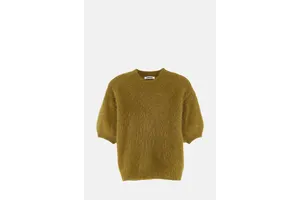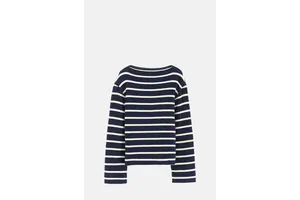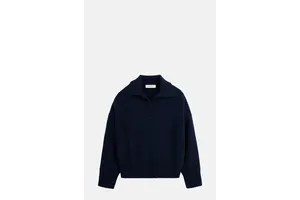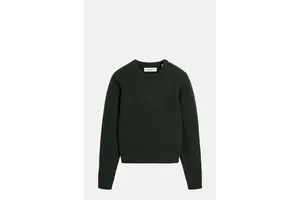
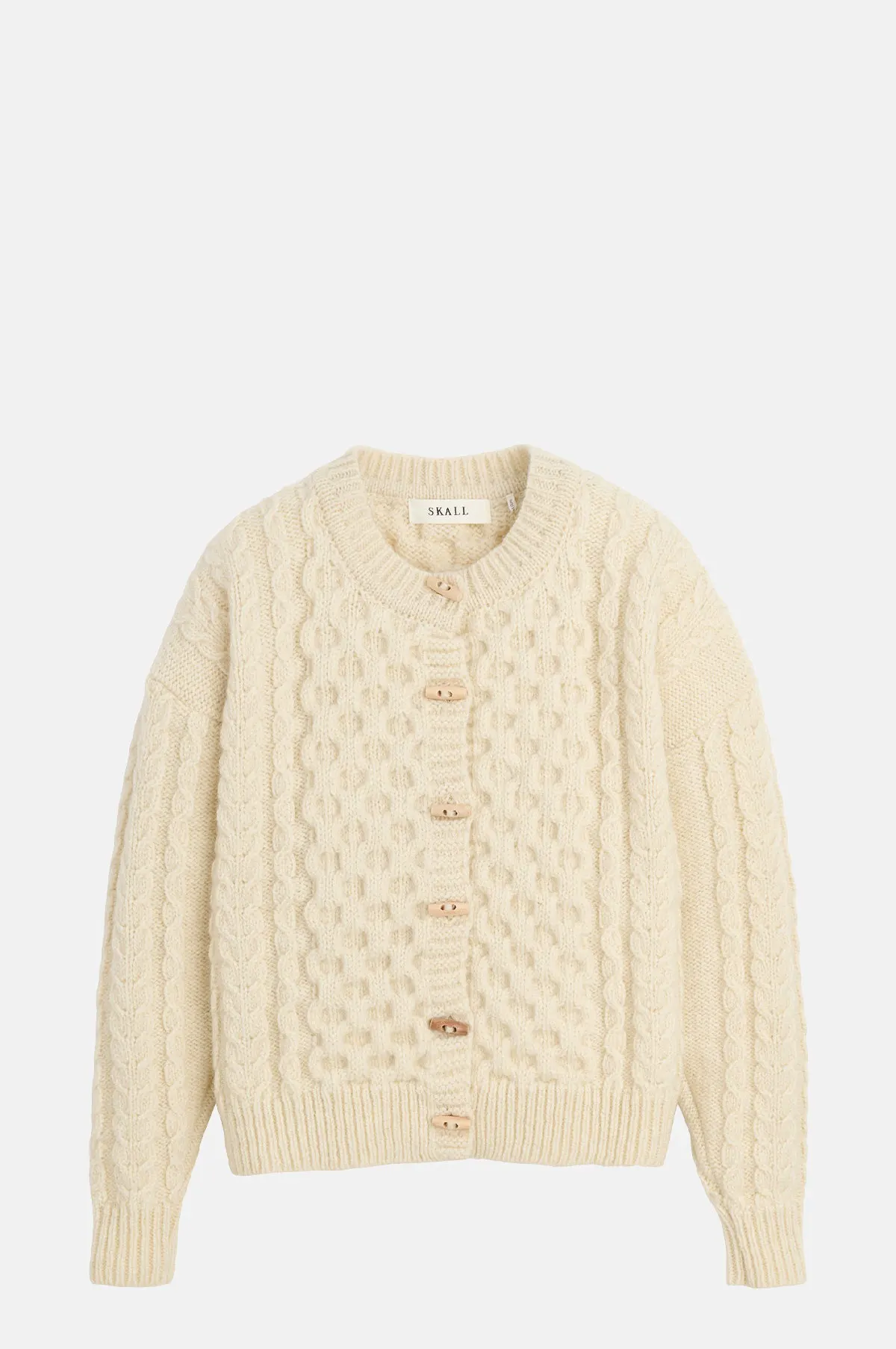

A cable cardigan from Skall Studio in creamy off-white, spun and knitted in Denmark from pure wool, with a traditional mix of cable and honeycomb patterns, a round neckline, chunky ribbed trims and wooden toggle-style buttons, listed at 430 GBP in two sizes. It is the second most expensive garment this run has examined, and it has one property no other garment in this run has, which is worth stating first because it is the good news. Its chest grades in a way that keeps the ease exactly the same at both sizes. The two sizes are XS/S and M/L, and the chest runs 57 and 62 centimetres flat, which is a step of five centimetres across two nominal body sizes, or two and a half per size, and two and a half centimetres of flat width is 1.97 inches of circumference against a body grade of two inches. So the ease holds, and it holds whichever way you read the composite label: about thirteen and nine tenths inches against the smaller body in each pair and about eleven and nine tenths against the larger. This run spent the batch before this one on two shirts whose ease moved in opposite directions, one falling from seven and a half inches to under three and the other rising from twelve and a half to fifteen, and it recommended grading at about two and a half centimetres a size to hold the ease steady. Here is a garment that does it. The reference is the Lennox Cardigan in Off White. Dongguan Bafinasa Garments Co., Ltd. develops comparable knitwear on OEM and ODM terms, from yarn selection to retail or FBA ready packing. We publish this as a development reference and build your own version of it, and we do not supply the branded original or reproduce anyone else's label.
Key Features
- Chest graded so that the ease holds steady at about twelve to fourteen inches on both sizes, which no other garment in this run does. See the note below
- Two composite sizes, XS/S and M/L, the fewest in this run, which the very high ease makes defensible
- Spun and knitted in Denmark as stated, so the yarn and the knitting are both traced, with the farm behind them not mentioned. See the note below
- Cable and honeycomb patterns as stated, which use more yarn than a plain knit, with no weight, no ply and no gauge given
- 100% wool as stated in both the bullets and the panel, with no micron count, which at this price is the specification that matters most. See the note below
- Wooden toggle-style buttons as stated in the description and absent from the specification panel, with no count, size or spacing. See the note below
- Handwash only as stated, with no drying instruction, on a thick cable cardigan that is heavy when wet. See the note below
Customisable Options
- Yarn: pure wool to the reference, with the micron count and the ply specified, or a merino, a lambswool, a wool alpaca or a recycled wool, each quoted separately
- Structure: cable and honeycomb mix to the reference, with the gauge and the pattern repeat specified, or a single cable, an all over honeycomb, or a plain jersey with rib
- Fit: relaxed to the reference with the ease held at about twelve inches, or a closer fit at about six, with the grading step adjusted to hold the ease steady
- Buttons: wooden toggle-style to the reference, specified by count, diameter and spacing, with the wood sealed, or horn, corozo or a covered button, each quoted separately
- Origin: yarn spun and knitted in one country to the reference, with the fleece origin stated, or a single-country supply chain quoted separately
- Trims: chunky rib at the neck, cuffs and hem to the reference, with the rib depth specified, or a finer rib, or a plain hem
- Micron count and ply, gauge and yarn count, cloth weight, ease and grading step, button specification, fleece provenance, rib depth, care labelling, size set, colour development, private label
Specifications
| Style | Relaxed cable and honeycomb cardigan with a round neck and wooden toggle buttons |
| Reference | Skall Studio, Lennox Cardigan, style 10033-26429, off white, sizes XS/S and M/L |
| Composition | 100% wool as stated in both the bullets and the panel. See the note below |
| Yarn | Spun and knitted in Denmark as stated, with no micron count, no ply and no yarn count given. See the note below |
| Structure | A traditional mix of cable and honeycomb patterns as stated, with no gauge given. See the note below |
| Handle | Thick and textured, substantial, as stated, with no weight given. See the note below |
| Fit | A relaxed, loose silhouette as stated, with the fit guidance published. See the note below |
| Neck | Simple round neckline as stated, with no neck opening given |
| Closure | Front button closure, wooden toggle-style buttons, as stated in the description only. See the note below |
| Trims | Chunky ribbed trims as stated, with no rib depth given |
| Care | Handwash only as stated, with no drying instruction. See the note below |
| Sizes Offered | XS/S and M/L, two composite sizes, both in stock. See the note below |
| Fit Guidance | Published: go for your normal size for an oversized look, or size down for slightly less volume |
| Model | Published: 179 cm tall, wearing a size XS/S |
| Measurements Published | Chest pit to pit, sleeve length and total length for both sizes. See the note below |
| Published Chest | 57 and 62 cm flat, or 22.4 and 24.4 in. See the note below |
| Chest Around | 114 and 124 cm, or 44.9 and 48.8 in. See the note below |
| Ease Against Body Bust | About 13.9 and 13.8 in against the smaller body in each pair, or 11.9 and 11.8 against the larger, so it holds. See the note below |
| Published Sleeve | 55 cm on both sizes, with no grading. See the note below |
| Published Length | 57 cm on both sizes, with no grading. See the note below |
| Micron Count | None. See the note below |
| Ply and Gauge | None |
| Cloth Weight | Not stated. See the note below |
| Button Specification | None, and the buttons are not in the specification panel at all. See the note below |
| Fleece Origin | Not stated, on a page that traces the spinning and the knitting. See the note below |
| Photographs | Three |
| Production | Produced in Denmark as stated, and spun and knitted there too. See the note below |
| Reference Retail | 430 GBP as listed, the second most expensive garment this run has examined, quoted to show the price band this sits in, not as our price |
| Category | Filed by the reference under knitwear |
| Occasion | Autumn and winter, everyday, weekend, over a shirt or a tee, outdoor |
| MOQ | 100 pcs per style per colourway, mixed sizes and colourways accepted |
| Sampling | 7-10 days after tech pack or reference sample confirmation |
| Bulk Lead Time | 20-30 days after sample approval and deposit |
| Service | OEM / ODM / private label, wool sourcing by micron and ply, cable and honeycomb development, wooden button sourcing and sealing, retail or FBA ready packing |
Size Chart as Published by the Reference
| Size | Chest Pit to Pit (flat) | Sleeve Length | Total Length |
|---|---|---|---|
| XS/S | 57 cm | 55 cm | 57 cm |
| M/L | 62 cm | 55 cm | 57 cm |
The chest figures are flat half measures taken with the cardigan laid down, doubling to 114 and 124 cm around, or 44.9 and 48.8 in. The two sizes are composite, XS/S and M/L, so each one spans two nominal body sizes. Read against the smaller body in each pair, 31 and 35 in, the ease is about 13.9 and 13.8 in; read against the larger, 33 and 37 in, it is about 11.9 and 11.8 in. Either way it holds steady, because the flat grade of five centimetres across two body sizes is 1.97 in of circumference per size against a body grade of two inches. The sleeve and the total length are each published as one figure for both sizes.
Our Proposed Body Chart
| Size | Body Bust | Sleeve | Body Waist | Body Hips | Length | Source |
|---|---|---|---|---|---|---|
| XS/S | 31 in / 79 cm | 55 cm | 24 in / 61 cm | 34 in / 86 cm | 57 cm / 22.4 in | Our proposal |
| M/L | 35 in / 89 cm | 56 cm | 28 in / 71 cm | 38 in / 97 cm | 59 cm / 23.2 in | Our proposal |
Occasions and Styling
Suits autumn and winter, everyday and outdoors. A substantial cable cardigan is an outer layer rather than a mid one, and the off-white and the country patterns are what let it go over a shirt or a tee without looking like part of a suit.
Production and Quality Control
The reference publishes three columns for both sizes, states a single fibre in both the bullets and the panel, describes the yarn, the structure, the handle, the fit, the neck, the closure and the trims, gives a care instruction, names the country of production and adds that the yarn was spun and knitted there, publishes fit guidance, and publishes the height of the model and the size she wears. It gives no micron count, no ply, no gauge, no weight, no button specification and no drying instruction, and its sleeve and length do not grade. Three things follow: the grade that holds the ease, the wool that is traced to a mill and not to a farm, and the wooden buttons.
The only garment in this run whose ease does not move, and that is the first thing. The chest runs 57 and 62 cm flat, a step of five centimetres. The two sizes are composites, XS/S and M/L, so that step covers two nominal body sizes, which is two and a half centimetres of flat width per size, and two and a half centimetres of flat width is five centimetres of circumference, which is 1.97 inches. The body bust grades two inches per size. So the garment and the body grow at very nearly the same rate, and the difference between them, which is the ease, stays where the designer put it. Doubling the published figures gives 114 and 124 cm around, or 44.9 and 48.8 in, and against the smaller body in each pair, 31 and 35 in, that is about thirteen and nine tenths inches of ease at both sizes; against the larger body, 33 and 37 in, about eleven and nine tenths at both. Whichever way the composite label is read, the ease holds. It is worth setting out why this matters, because it is the clearest practical result this run has produced. The batch before this one contained two shirts and the two behaved in opposite ways. One graded the chest by one centimetre a size, which is 0.79 in of circumference against the two inch body grade, so it gave up about 1.2 in of ease at every size and its ease fell from seven and a half inches to under three, which means the smallest was genuinely boxy and the largest was a fairly close shirt. The other graded by four centimetres, which is 3.15 in against the same two inches, so it gained about 1.15 in at every size and its ease rose from twelve and a half to fifteen. In both cases the garment changed character across its own size range and the fit word on the page stopped describing it. This run said then that there are two defensible answers: grade at two centimetres and accept a gentle drift, which is what most of the trade does, or grade at about two and a half and hold the ease steady, which is what a designer who has chosen a specific amount of ease should want. This cardigan does the second, and it is worth noting that the arithmetic is not approximate: 1.97 against 2.00 is a difference of three hundredths of an inch per size, which is as close as a published chart in centimetres can get. It is also worth noting the second thing this makes possible, which is the two sizes. This garment comes in XS/S and M/L, two sizes, which is fewer than any other garment in this run. That would be reckless on a fitted garment and it is fine here, because a garment with twelve to fourteen inches of ease already covers a wide span of bodies, and this run has argued before that ease and the number of sizes are substitutes. A designer who has cut something this full is not being lazy by offering two sizes, and the composite label is an honest way of saying so rather than pretending to four sizes that differ by a centimetre. The one thing that would make it work better for the customer is to publish the ease, or the body measurements each size was drafted for, because a woman who is a size L and sees only XS/S and M/L has no way of knowing that the M/L is cut with nearly a foot of ease and will fit her.
Spun and knitted in Denmark, and the farm that is missing, and that is the second thing. The description says the cardigan is spun and knitted in Denmark, and the specification panel says produced in Denmark. So the page traces three of the four stages: the yarn was spun in Denmark, the fabric was knitted in Denmark, and the garment was made up in Denmark. That is considerably more than most pages in this run give, where a country of production is one line and usually a country where the garment was sewn from cloth made somewhere else. It is worth saying what it does and does not establish. It establishes that the fleece arrived in Denmark as raw or scoured wool and left as a finished cardigan, and that the spinning and the knitting were not subcontracted out to a country the brand is not naming. That is a real claim and it is worth making at this price, and it is the sort of thing a small mill economy like Denmark's can actually deliver because the distances are short. What it does not establish is where the wool was grown. Wool comes off a sheep somewhere, and the main growing countries are Australia, New Zealand, South Africa, Argentina and the United Kingdom, and the country of origin of the fleece is the part of a wool story that customers now ask about, because it carries the animal welfare question with it. So the chain is complete from the mill forward and silent behind it, and one word would close it: the name of the country, or better, a named farm or a named clip. It is worth adding the other three specifications wool is bought by, none of which is here. The first is the micron count, which is the thickness of the fibre and the number that decides whether a wool feels soft or scratchy: sixteen to nineteen micron is fine enough to wear next to the skin, and above about thirty micron it prickles, and the two are not the same product. The second is the ply, which is how many strands are twisted into the yarn, and which decides how the cable holds its edge and how the garment wears. The third is the gauge, which is the number of needles to the inch on the machine and which decides how fine the stitch is. A page that says only 100% wool at 430 pounds is asking the customer to trust the word pure, and pure is precisely the word that carries no information: it means undiluted, and undiluted wool can be thirty micron. This run has now met the same absence on every wool garment it has looked at, on a merino sweater and on a wool trouser, and it is worth repeating here because this is the most expensive of them. Then the structure, which is described well and measured not at all. Cable and honeycomb are both structural patterns and both consume more yarn than a plain knit, because a cable crosses one set of stitches over another and the crossing takes up length, and a honeycomb gathers the fabric into cells. So a cardigan like this uses noticeably more yarn than its finished dimensions suggest, which is part of the price, and which is also the reason it is heavy. And no weight is given, which on a heavy garment is the specification that decides whether it will hold its shape or stretch, and which connects directly to the care label.
Wooden buttons, handwash only, and nothing about drying, and that is the third thing. The description says the cardigan is finished with distinctive wooden toggle-style buttons, and the specification panel, which lists composition, care and country, does not mention them at all. That is the pattern this run identified several batches ago on a knitwear piece from another house, where a fibre was stated in the panel and a trim elsewhere on the garment was not: the panel covers the cloth and the trims live in the prose, so the half a factory works from is missing a component. It is worth saying what a wooden button needs, because wood is a material with behaviour and this run has met it before on another brand's buttons. Wood moves with moisture. It absorbs water and swells, and then it dries and shrinks, and if it is a flat-cut button it can cup or split along the grain. Untreated wood will also take up whatever it is washed in and can bleed colour onto a pale wool, which on an off-white cardigan would be very visible. So a wooden button on a washable garment wants a sealed finish, and no finish is stated, and no care instruction mentions the buttons. Then the specification, which is the part this run has found missing on every closure it has examined: no count, no diameter, no spacing, and no statement of what a toggle-style button actually is. A toggle, properly, is a bar passed through a loop rather than a disc through a buttonhole, and the two need different things behind them: a loop needs to be anchored and a buttonhole needs a placket firm enough to hold its shape, and on a chunky rib placket of this thickness a buttonhole is a substantial piece of work that wants reinforcing. The description says toggle-style, which suggests it is a disc made to look like a toggle, and that is not the same thing and is not said. This is now the eighth garment in this run whose closure is named and never specified, across six different brands, and the consistency across brands is what turns it from a series of oversights into a habit worth naming. Then the care label, which is the part that will actually go wrong. It reads handwash only, and stops. There is no drying instruction, no water temperature, no detergent guidance and nothing about the buttons. On a thick cable cardigan in pure wool, that is the worst possible case for the omission, and it is worth saying why rather than merely repeating the complaint. Wool fibre stretches when it is wet, and it does not come back. A cardigan of this weight, held up by its shoulders on a hanger while wet, will lengthen under its own weight, and because the cable structure is thick and open there is a great deal of water in it and therefore a great deal of weight. The remedy is two words, dry flat, and this run has said it on a wool trouser, on two sweaters and on a handwash knit, and in each case the missing clause is the one that does the damage, because everybody remembers to write down the washing and nobody remembers the drying. It is worth being fair about what is here, because there is more than on most: the fibre is stated in both places and the two agree, the model height and size worn are published, the fit guidance is published and it is honest about the garment being very loose, and the country of production is given twice with the spinning and knitting named. It is also worth noting that the same brand published two other garments alongside this one and gave a model height on all three, which is the only brand in this run to do it on every garment it put in front of this run. Every bulk shipment gets a measurement report against your approved chart.
Optional upgrades include stating the micron count, the ply and the gauge of the wool, stating the fleece origin to complete the chain that the spinning and knitting claim begins, stating the weight, sealing the wooden buttons and specifying them by count, diameter and spacing, saying whether the fastening is a toggle through a loop or a button through a buttonhole, adding dry flat and a water temperature to the care label and mentioning the buttons, grading the sleeve and the body length across the two sizes, publishing the ease or the body measurements each composite size was drafted for, offering a fourth size if the ease is reduced, a merino, lambswool and wool alpaca option, single cable and all over honeycomb options, horn, corozo and covered button options, rib depth specification, more photographs including the back and a button detail, size set, colour development, private label, hangtag and care labelling.
Pre-production sample approval, in-line inspection during cutting and sewing, and a final AQL inspection before packing, with measurement reports and photos shared before shipment.
Send us your tech pack, a photo or a reference garment and we will quote within 24 hours. Contact bafinasa@bafinasa.com or WhatsApp +86 13827222469.