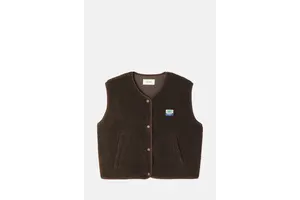
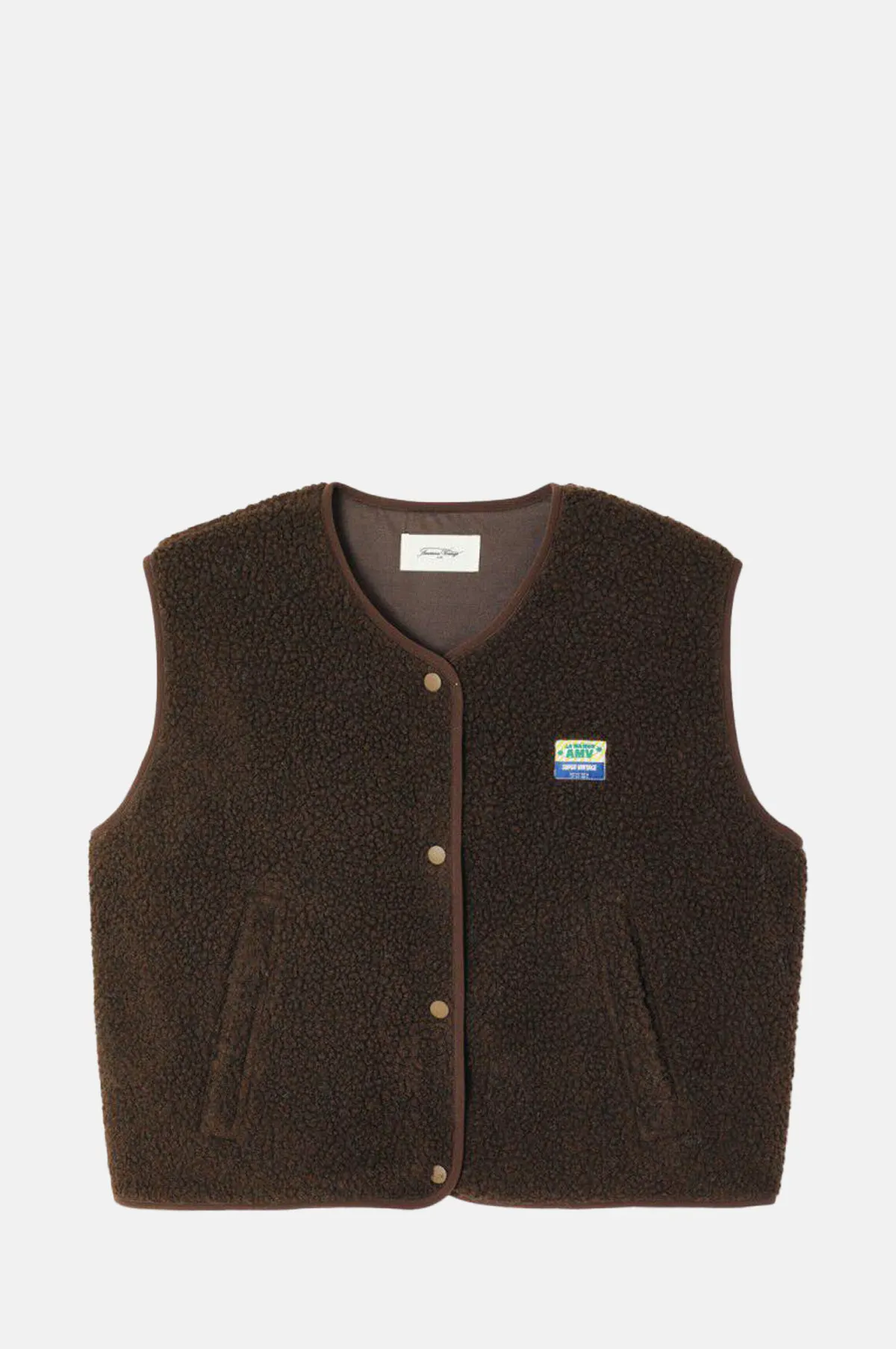

A rich chestnut brown fleece vest from American Vintage, slightly padded, with a small V-neck, popper closures down the front, zippered side pockets and a small logo badge on the chest, listed at 180 GBP in one size. The chestnut is the colourway where the hardware matters most, because a brown fleece with black or brass poppers is a different garment from the same vest with grey ones, and the page specifies none of it. It is also the third of the three to carry the identical two measurement table, and with three colourways now examined side by side this run can say something firmer about what a shared table is worth than it could when the question was abstract. There is a second thing this garment is good for, and it is the reason it is worth a close read: the care label. Wash at 30, and do not tumble dry, do not bleach, do not iron and do not dry clean, which is four prohibitions where most garments in this run give one or none, and every one of them is correct for the material. The reference is the Hoktown Vest in Marronnier Chine. Dongguan Bafinasa Garments Co., Ltd. develops comparable padded and fleece outerwear on OEM and ODM terms, from cloth and wadding selection to hardware specification and retail or FBA ready packing. We publish this as a development reference and build your own version of it, and we do not supply the branded original or reproduce anyone else's label.
Key Features
- Popper closures down the front and zippered side pockets as stated, with no hardware specification at all. See the note below
- A care instruction with four prohibitions, do not tumble dry, bleach, iron or dry clean, every one of them correct for the material. See the note below
- Chestnut brown as stated, with no fastness figure on a mid dark shade. See the note below
- One size, XS/S, with a chest of 126 cm around and a length of 56 cm, identical to the other two colourways. See the note below
- Slightly padded as stated, with no wadding weight and no quilting described. See the note below
- Small logo badge on the chest as stated, with the application method not given. See the note below
- Two photographs, against six on the yellow colourway of the same vest
Customisable Options
- Cloth: polyester fleece to the reference, with the weight in grams per square metre set to your market since none is given
- Hardware: poppers to the reference in a stated finish and a stated number, or a zip front, or a zip with a popper storm flap, or an open front
- Zips: zippered side pockets to the reference, with the tape, pull and stop specified, or patch or welt pockets instead
- Padding: slightly padded to the reference, with the wadding weight specified, or a heavier wadding, or an unpadded version
- Size: one size to the reference, or a graded set from XS to XL, or two sizes covering XS/S and M/L
- Branding: your own badge, embroidered, woven, rubber or heat applied, developed from your brief
- Fleece weight, wadding weight and quilting, hardware finish and testing, fastness testing on the shade, chest badge method, shoulder and armhole measurements, size set, colour development, private label and care labelling
Specifications
| Style | Padded fleece vest in chestnut polyester with popper closures and zippered side pockets |
| Reference | American Vintage, Hoktown Vest, style HOK16BH26MARROC, marronnier chine, a rich chestnut brown, one size XS/S |
| Composition | 100% polyester as stated, with the padding composition not given separately. See the note below |
| Cloth | Polyester fleece as stated, in a chin茅 or flecked yarn, with no weight given. See the note below |
| Padding | Slightly padded as stated, with no wadding weight and no quilting or stabilising described. See the note below |
| Fit | Oversized and very boxy as stated, with the advice to take your usual size on a garment that comes in one size |
| Neck | Small V-neck as stated |
| Front | Popper button closures down the front as stated, with the number, the spacing, the finish and the backing not given. See the note below |
| Pockets | Zippered side pockets as stated, with no zip specification. See the note below |
| Branding | Small AMV logo badge on the chest as stated, with the application method not given. See the note below |
| Care | Wash at 30 degrees, do not tumble dry, bleach, iron or dry clean, as stated. See the note below |
| Sizes Offered | One size, XS/S, in stock. See the note below |
| Measurements Published | Pit to pit and total length, one column only, identical to the other two colourways. See the note below |
| Published Chest | 63 cm flat, or 24.8 in, doubling to 126 cm around, or 49.6 in. See the note below |
| Ease Against Body Bust | About 18.6 in on a 31 in bust, about 16.6 on a 33 in bust, and about 8.6 on a 41 in bust. See the note below |
| Published Length | 56 cm, or 22.0 in |
| Proportion | 126 cm of chest against 56 cm of length, a width to length ratio of about 2.25 to 1 |
| Published Shoulder | None. See the note below |
| Published Armhole | None, on a sleeveless garment whose fit depends on it |
| Published Hem | None. See the note below |
| Colour Fastness | Not stated, no rub, wash or light fastness figure. See the note below |
| Model | None stated, no height and no body measurements |
| Photographs | Two, against six on the yellow colourway of the same vest |
| Fleece Weight | Not stated |
| Padding Weight | Not stated, only the word slightly |
| Production | Made in China as stated |
| Reference Retail | 180 GBP as listed, quoted to show the price band this sits in, not as our price |
| Category | Filed by the reference under coats and jackets, and under tops |
| Occasion | Autumn and winter, weekend, travel, walking, layering over knitwear |
| MOQ | 100 pcs per style per colourway, mixed sizes and colourways accepted |
| Sampling | 7-10 days after tech pack or reference sample confirmation |
| Bulk Lead Time | 20-30 days after sample approval and deposit |
| Service | OEM / ODM / private label, fleece and wadding sourcing, hardware specification and pull testing, fastness testing, retail or FBA ready packing |
Size Chart as Published by the Reference
| Size | Pit to Pit (flat) | Total Length |
|---|---|---|
| XS/S | ||
| 63 cm | ||
| 56 cm |
The chest figure is a flat half measure taken with the vest laid down, doubling to 126 cm around, or 49.6 in, and it is identical on all three colourways of this vest. Against the body chart that is about eighteen and a half inches of ease on a 31 in bust, about sixteen and a half on a 33 in bust, and about eight and a half on a 41 in bust, so the single size will sit on bodies well outside the XS and S it is named for. The length is 56 cm, making the garment about two and a quarter times as wide as it is long. Because the front closes with poppers and can be worn open, the chest is a silhouette rather than a limit, and what decides who can wear it is the shoulder and the armhole, neither of which is published.
Our Proposed Body Chart
| Size | Body Bust | Body Waist | Body Hips | Length | Source |
|---|---|---|---|---|---|
| XS/S | 31 in / 79 cm | 24 in / 61 cm | 34 in / 86 cm | 56 cm / 22 in | Our proposal |
Occasions and Styling
Suits autumn and winter, weekends, travel and walking, over knitwear or a long sleeve tee. A chestnut brown is the easiest of the three colourways to place in a wardrobe, since it sits with denim, cream, olive and navy without much thought, and it hides the soiling that a fleece worn outdoors picks up.
Production and Quality Control
The reference publishes two measurements for its single size, states its fibre, describes the padding, the neck, the closures, the pockets, the badge and the fit, and gives a care instruction with four prohibitions. It gives no hardware specification, no fleece weight, no padding weight, no fastness figure, no shoulder, no armhole and no model. Three things follow: what the poppers and the zips need specified, why this care label is worth holding up as an example, and what three colourways sharing two numbers actually tells you.
Poppers, zips and a badge, and the specification none of them has, and that is the first thing. The description promises popper button closures down the front and zippered side pockets, and those two lines are most of the cost of this garment after the cloth and the wadding, and neither is specified in any way. Poppers, or press studs, are specified by five things: the size, typically a line number; the material, brass or steel or plastic; the finish, which on a chestnut fleece is a visible design decision, since a black popper reads as utility, a brass one as heritage and a matched brown one as quiet; the number and the spacing down the front, which decides both how the garment hangs when it is undone and how much of the front can gape open; and the backing, because a popper set into a fleece with wadding behind it has nothing structural to bite into, and without a stay or a reinforcement patch behind each one it will tear out, and it will do it in the first month rather than the first year. Then there is a pull test, which is a number in kilograms and a machine, and which costs almost nothing. The pocket zips need the same treatment: a tape in a stated material, a coil or a metal chain, a pull, a stop at the bottom, and something at the top to stop the pull sitting against the skin, which on a pocket is either a garage or a folded tape end. And a zip set into a side seam that is also carrying wadding has to be tested for running smoothly, because a seam with wadding behind it is thicker at that point and the zip will catch. It is all ten minutes in a tech pack and it is the difference between hardware that lasts and hardware that is the reason the garment comes back. Then the badge, which is described as a small logo sticker on the chest. Sticker is not a trade term, and it covers three quite different things: a heat applied transfer, which is cheap and which can peel; a rubber or silicone patch, which is dearer and which is sewn or heat set; and an embroidered badge, which is the most expensive and the most durable. They look similar in a photograph and they age completely differently, and on a fleece there is an additional constraint, which is that a heat applied transfer needs a temperature and a pressure that a polyester pile may not tolerate, so the application has to be tested on the actual cloth rather than assumed. We specify all of it, and we develop the badge from your own artwork, since another brand's mark is not something we apply.
Four prohibitions, all of them right, and what a care label is for, and that is the second thing. The instruction reads wash at 30 degrees, do not tumble dry, do not bleach, do not iron and do not dry clean. Four prohibitions where most garments in this run manage one, two or none, and every one of them is correct for a padded polyester fleece, and each for a reason worth setting out because the reasons are what make a label useful rather than decorative. Do not iron, because polyester softens and melts at a low temperature and an iron on a fleece pile flattens it permanently and can glaze it, so the garment cannot be pressed back into shape and there is no remedy once it has happened. Do not tumble dry, because heat and tumbling together are what damage wadding: the sheet migrates, the pile mats and the garment loses the loft that is the whole point of it. Do not bleach, because chlorine attacks the fibre and strips the colour, and on a chin茅 it strips the flecks unevenly, which leaves a garment that is not a lighter version of itself but a mottled one. And do not dry clean, because the solvent used in dry cleaning attacks polyester wadding and can dissolve the adhesive in any bonded construction, which is why a padded synthetic garment is the one case where dry cleaning is actively harmful rather than merely unnecessary. This run has spent eleven batches pointing out that care instructions follow neither the fibre nor the fashion consistently: every wool garment it examined said dry clean only, every corduroy said wash at 30 and do not tumble dry, and one garment dyed cotton said do not dry clean while warning that its colour would move in the wash. This label is the clearest example yet of the principle being applied properly: four prohibitions, each traceable to a specific material in the garment, each preventing a specific and irreversible fault. It is the model of what a care label is for, which is not to tell the customer how to wash the garment but to tell her what will ruin it, and it is worth saying that a label like this is a mark of a brand that knows its own product. Two things are missing from it, and both are cheap. No drying instruction beyond the prohibition, so the customer is told what not to do and not what to do, and dry flat is the instruction that protects wadding. And no wash separately or wash with like colours note, which on a mid dark shade with a flecked yarn matters, since loose dye from a new dark garment will settle on a pale one in the same machine. And this run has now gone thirteen batches without a single published fastness figure, on prints, on garment dyed cotton, on deep navy and now on a brown chin茅, and it will keep saying it: test it, state the grade, put the number on the page.
Two numbers, three colourways, and what can now be said about sharing a table, and that is the third thing. This run has raised the question of whether one size table can honestly serve several colourways on every multi colour garment it has met, and until this batch it has never had the evidence to settle it, because it has never had the tables side by side. Now it has two cases from the same house. The Apoly tee, in a pink, a white and a navy, publishes three identical tables of three columns. This vest, in an orange, a yellow and a chestnut, publishes three identical tables of two numbers. So the brand's position is consistent and can be stated plainly: the colour route does not change the dimensions, and one table is published for all of it. Is that defensible? In principle yes, and this run has said so before: dyeing changes colour, not pattern, and if the cloth, the cut and the finish are the same in every shade then the measurements should be the same, and publishing three tables with three sets of rounding errors would be worse than publishing one. But there are two conditions, and neither is visible on these pages. The first is that the colour route really is only a dye bath. A white is usually bleached rather than dyed, which is a harsher process; a deep or a bright shade may carry a heavier dye load or be dyed after the garment is made; and either of those is a wet process with a dimensional consequence. The twill trouser earlier in this run named a special dye process and then warned that colour would be lost in washing, which is an admission that the route has consequences. Neither of these two garments names a route at all, so the shared table is carrying a claim nobody has stated. The second condition is that the measurement was taken on more than one colourway. The remedy is a minute's work and it is the recommendation: measure one size in every shade before the table goes up, and if the numbers differ by more than a centimetre, either publish a tolerance or publish two tables. There is a second reason a shared table is not enough, and it is the one that applies to this vest in particular. A shared table can only carry dimensions, and every colourway has questions that are not dimensions: opacity on a white, crocking on a navy, light fastness on a bright orange, and on this chestnut a rub fastness and a fading question. None of them is a measurement and none of them appears on any of the three listings, because the description is the same paragraph on all three with the colour phrase swapped. One sentence per colourway carries all of it, and it is the cheapest improvement any multi colour listing can make. Then the absences that apply to all three equally: no fleece weight, no padding weight, no shoulder, no armhole, no hem, no model, no fastness figure, and one size. And one last commercial note, because it is the reason one size is worth taking seriously: a single size means a single SKU, no size returns and no size data, which is a real saving, and it also means a garment with 126 cm of chest being sold only to people who read XS and S as their own. Every bulk shipment gets a measurement report against your approved chart.
Optional upgrades include specifying the poppers by size, material, finish, number and spacing, with a stay behind each one and a pull test, specifying the pocket zips by tape, chain, pull and stop with a garage at the top, testing both hardware types for pull and for corrosion, choosing and testing the badge application on the actual fleece, testing and publishing rub, wash and light fastness for the chestnut, adding dry flat and wash with like colours to what is otherwise an excellent care label, stating the fleece and wadding weights and choosing how the wadding is held, publishing the shoulder and the armhole, restating the single size as the range of bodies it covers, offering a second size, measuring one size in every colourway before publishing a shared table, adding a colour specific line of copy to each listing, a zip front and an open front option, a recycled polyester option with certification, size set, colour development, private label, hangtag and care labelling.
Pre-production sample approval, in-line inspection during cutting and sewing, and a final AQL inspection before packing, with measurement reports and photos shared before shipment.
Send us your tech pack, a photo or a reference garment and we will quote within 24 hours. Contact bafinasa@bafinasa.com or WhatsApp +86 13827222469.