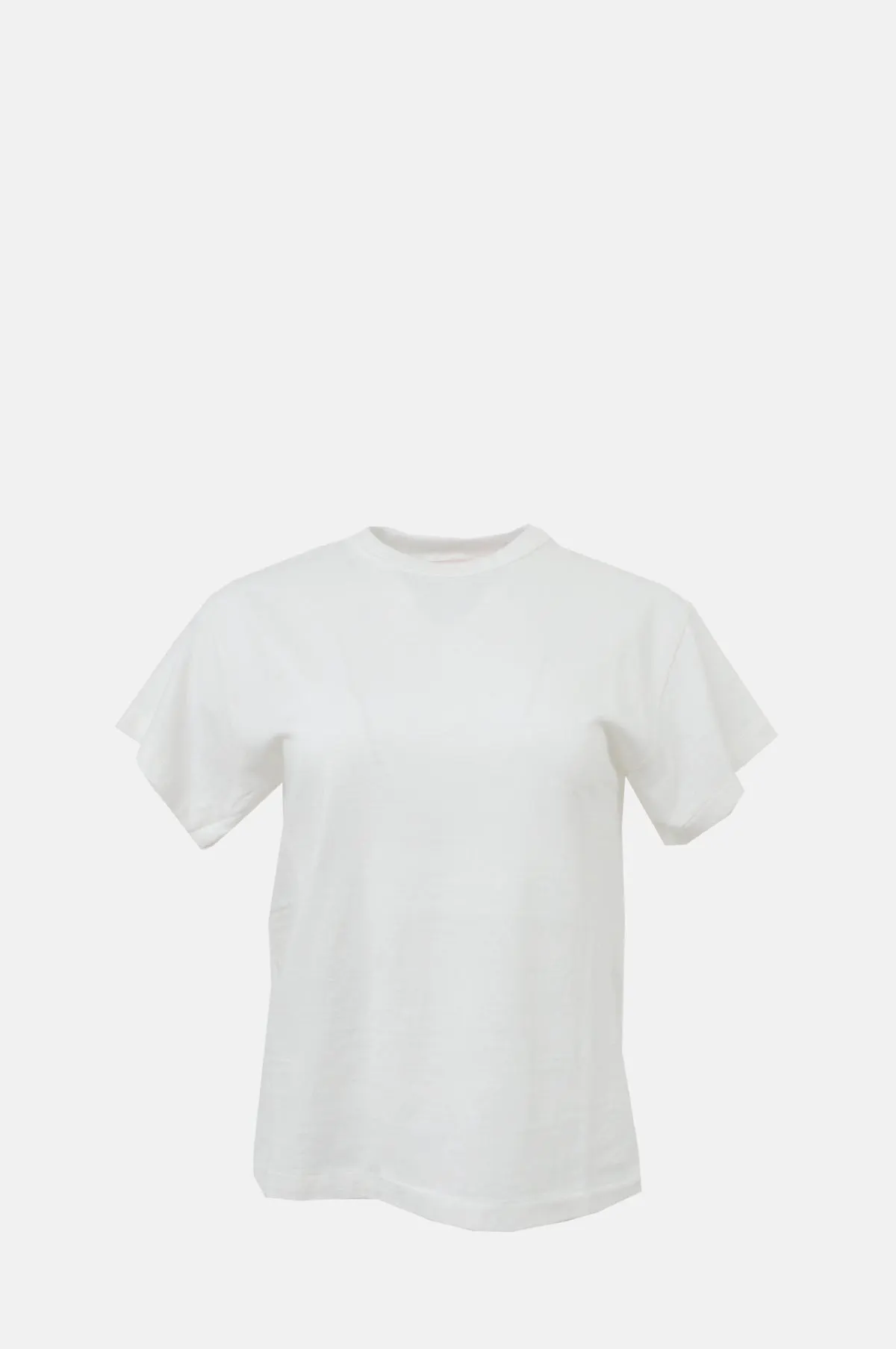

An off white tee from Sunray made on a vintage circular knitting machine, with no side seams, a thick round neckline and a regular fit, in a 260 gram, 19/1 recycled Japanese cotton, listed at 68 GBP with two of five sizes in stock. This is the best specified garment this run has examined in fifteen batches, and it is worth saying why before saying anything else: it publishes the weight of its cloth in grams per square metre, it publishes the count of its yarn, and it publishes a size conversion, 1 is an XS, 2 is an S, 3 is an M, 4 is an L and 5 is an XL. Three facts that every other page in this run has withheld, given in three lines. It is also, and this is the more interesting half, a seamless garment: the body is knitted as a tube with no side seams at all, and that single decision explains both its size table and its stock, in ways worth setting out. The reference is the Na'maka'oh T-Shirt in Off White. Dongguan Bafinasa Garments Co., Ltd. develops comparable knit tops on OEM and ODM terms, from yarn and cloth selection to retail or FBA ready packing. We publish this as a development reference and build your own version of it, and we do not supply the branded original or reproduce anyone else's label.
Key Features
- 260 grams per square metre and a 19/1 yarn count published, the first garment in this run to give either. See the note below
- A size conversion published, 1 is XS through 5 is XL, the first garment in this run to say what its sizes mean. See the note below
- Seamless tubular body knitted on a vintage circular machine with no side seams, as stated, which constrains the width grade and explains the stock. See the note below
- Japanese Ochiwata recycled cotton as stated, a named source, with no third party standard named alongside it. See the note below
- Regular fit as stated, and the ease runs from about three and a half inches down to about two, which supports the word
- Sleeve graded 14, 14, 16, 17 and 17 cm, in blocks rather than size by size. See the note below
- Total length grading four centimetres and then two, twice, twice. See the note below
Customisable Options
- Cloth: 260 gsm recycled cotton to the reference, or a lighter or heavier weight, or a conventional cotton at the same weight, each quoted separately
- Construction: seamless tubular to the reference on a circular machine, or a conventional cut and sewn body with side seams at a lower cost
- Yarn: 19/1 recycled cotton to the reference, or a compact spun, a combed or an organic cotton, each quoted separately
- Certification: recycled content to a named standard with a transaction certificate quoted as an option
- Neck: thick round rib to the reference, or a fine rib, or a bound neck
- Size set: 1 to 5 to the reference with the conversion published, or an XS to XL set, or an extended range
- Cloth weight, yarn count, fibre certification, tubular or cut and sewn, neck rib specification, body length, sleeve length, size set and conversion, colour development, private label and care labelling
Specifications
| Style | Seamless tubular tee in heavyweight recycled cotton with a thick round neckline |
| Reference | Sunray, Na'maka'oh T-Shirt, off white, sizes 1 to 5, with no style code published. See the note below |
| Composition | 100% premium recycled cotton as the specification states, described as Japanese Ochiwata recycled cotton, with no third party standard named. See the note below |
| Cloth | 260 grams per square metre, 19/1 yarn count, as stated, the first garment in this run to publish either figure |
| Construction | Seamless, knitted on a vintage circular machine to create a body with no side seams and minimal twist and tension, as stated. See the note below |
| Fit | Regular fit as stated. See the note below |
| Neck | Thick round neckline as stated |
| Sleeves | Short sleeves, measured at 14, 14, 16, 17 and 17 cm. See the note below |
| Care | Wash lovingly and inside out, gently reshape after the wash, steam when ironing, as stated, with no temperature given. See the note below |
| Sizes Offered | 1 to 5, five sizes, two in stock with 1, 2 and 3 sold out. See the note below |
| Size Conversion | Published: 1 is XS, 2 is S, 3 is M, 4 is L and 5 is XL. See the note below |
| Measurements Published | Pit to pit, sleeve length and total length for all five sizes. See the note below |
| Published Chest | Pit to pit 44, 46, 48, 50 and 52 cm flat, or 17.3 through 20.5 in. See the note below |
| Chest Around | 88, 92, 96, 100 and 104 cm, or 34.6, 36.2, 37.8, 39.4 and 40.9 in. See the note below |
| Ease Against Body Bust | About 3.6, 3.2, 2.8, 2.4 and 1.9 in from smallest to largest. See the note below |
| Published Sleeve | 14, 14, 16, 17 and 17 cm, grading in blocks. See the note below |
| Published Length | 53, 57, 59, 61 and 63 cm, grading four and then two centimetres. See the note below |
| Published Hem | None. See the note below |
| Model | None stated, no height and no body measurements |
| Photographs | One |
| Cloth Weight | 260 grams per square metre, published, the only garment in this run to state one |
| Production | Made in Japan as stated |
| Reference Retail | 68 GBP as listed, the most expensive tee in this run, quoted to show the price band this sits in, not as our price |
| Category | Filed by the reference under t-shirts |
| Occasion | Everyday, weekend, travel, summer, layering |
| MOQ | 100 pcs per style per colourway, mixed sizes and colourways accepted |
| Sampling | 7-10 days after tech pack or reference sample confirmation |
| Bulk Lead Time | 20-30 days after sample approval and deposit |
| Service | OEM / ODM / private label, recycled cotton sourcing, weight and yarn count development, tubular and cut and sewn construction, retail or FBA ready packing |
Size Chart as Published by the Reference
| Size | Pit to Pit (flat) | Sleeve Length | Total Length |
|---|---|---|---|
| 1 / XS | 44 cm | 14 cm | 53 cm |
| 2 / S | 46 cm | 14 cm | 57 cm |
| 3 / M | 48 cm | 16 cm | 59 cm |
| 4 / L | 50 cm | 17 cm | 61 cm |
| 5 / XL | 52 cm | 17 cm | 63 cm |
The chest figures are flat half measures taken with the tee laid down, doubling to 88, 92, 96, 100 and 104 cm around, or 34.6, 36.2, 37.8, 39.4 and 40.9 in. The page publishes a size conversion, so the sizes can be placed against a body chart with more confidence than anywhere else in this run: 1 is an XS, 2 an S, 3 an M, 4 an L and 5 an XL, which against a conventional chart is a bust of 31, 33, 35, 37 and 39 in. The ease is therefore about three and three fifths inches at the smallest and about one and nine tenths at the largest, falling steadily, because the flat grade of two centimetres per size is 1.57 in of circumference against a body grade of two inches. The sleeve grades in blocks, 14, 14, 16, 17 and 17, and the length grades four centimetres and then two.
Our Proposed Body Chart
| Size | Body Bust | Sleeve | Body Waist | Body Hips | Length | Source |
|---|---|---|---|---|---|---|
| 1 / XS | 31 in / 79 cm | 14 cm | 24 in / 61 cm | 34 in / 86 cm | 53 cm / 20.9 in | Our proposal |
| 2 / S | 33 in / 84 cm | 15 cm | 26 in / 66 cm | 36 in / 91 cm | 55 cm / 21.7 in | Our proposal |
| 3 / M | 35 in / 89 cm | 16 cm | 28 in / 71 cm | 38 in / 97 cm | 57 cm / 22.4 in | Our proposal |
| 4 / L | 37 in / 94 cm | 17 cm | 30 in / 76 cm | 40 in / 102 cm | 59 cm / 23.2 in | Our proposal |
| 5 / XL | 39 in / 99 cm | 18 cm | 32 in / 81 cm | 42 in / 107 cm | 61 cm / 24 in | Our proposal |
Occasions and Styling
Suits everyday wear, weekends and travel. A 260 gram tee is a substantial garment rather than a basic, and it is the weight that makes it work as a single layer in summer and as the layer under a shirt in autumn, which is what a heavyweight cotton tee has always been for.
Production and Quality Control
The reference publishes three columns for all five sizes, states the cloth weight, states the yarn count, publishes a size conversion, describes the construction, the fibre and its source, the neck and the fit, gives a care instruction and names the country of make. It has no style code, no hem width, no model, and three of its five sizes are sold out. Three things follow: what a seamless tubular body does to a size table and to a stock list, what it means to publish the two numbers a mill needs, and what is still missing from the best page in this run.
No side seams, and the two consequences, and that is the first thing. The body of this tee is knitted as a tube on a vintage circular machine, which is why it has no side seams, and the description is right about the benefit: a tube has no seam to twist, so the garment hangs straight and does not torque after washing, and there is no seam allowance to sit against the skin. It is a genuinely better garment for it and it is a slow, expensive way to make one, which is part of why a tee costs 68 pounds. Now the consequences, and the first is on the size table. A tubular body is knitted to the diameter of the machine cylinder, so the width of the garment is not a free variable: it is the circumference of the cylinder, and to make a different width you need a different cylinder, or a different machine. That is the explanation for the shape of this table, and it is worth stating because it is the same shape this run has been criticising all along. The chest grades exactly two centimetres of flat width per size, 44, 46, 48, 50 and 52, which is four centimetres of circumference, and those steps are the widths the machines can make rather than widths derived from a body chart. So the grade does not track the body: two centimetres flat is 1.57 in of circumference against a body step of two inches, and the ease therefore falls by about 0.43 in at every size, from about three and three fifths inches at the 1 to about one and nine tenths at the 5. That is the same drift this run measured on the checked blouse and on the hooded top, where it cost two and a fifth inches across a six size range, and it is worth noting what is different here: on those garments there was no apparent reason for the grade, and on this one there is a good one, which is the machinery. A seamless garment cannot have its width graded to the body unless you own a cylinder for every size, and most makers do not. The second consequence is on the stock, and it is the more interesting of the two. Sizes 1, 2 and 3 are sold out and only the 4 and the 5 remain. On a cut and sewn tee that pattern would be a buying decision or a run on small sizes. On a tubular garment made on a slow vintage machine it is a capacity problem: each width needs its own machine, the machines produce a fixed and small number of tubes a day, and a sold out small size cannot be quickly replenished by running the line faster. So the construction that makes the garment better is also the construction that makes it scarce, and a brand selling this has to plan sizes against machine capacity rather than against demand. It is a real constraint and it is worth saying plainly to anyone developing a version: a seamless programme is a capacity commitment, and the alternative, a cut and sewn body with side seams, costs less, makes any width you like and replenishes in weeks.
Two hundred and sixty grams, nineteen slash one, and a size conversion, and that is the second thing. This run has spent fifteen batches asking for three things that almost no page gives, and this page gives all three. The cloth weight: 260 grams per square metre, which is heavy for a tee, and which tells a customer immediately that this is a substantial garment rather than a summer basic, and tells a developer what the cloth will cost. The yarn count: 19/1, which is a coarse single yarn, and which is consistent with the weight, since a heavy jersey needs a thick yarn, and which a mill can quote from. And the size conversion: 1 is an XS, 2 an S, 3 an M, 4 an L and 5 an XL, which is the single fact that has been missing from every three size garment in this run, and which is what makes the ease figures on this page interpretable when they are not interpretable anywhere else. It is worth being precise about what the conversion does and does not settle. It settles the spacing: five sizes in single steps rather than in double ones, so the body moves two inches per size and not four, and that is the fact this run has had to guess at on every S, M and L garment it has looked at, where the two readings differed by up to five inches of ease. What it does not settle is the absolute: an XS is conventionally a UK 6 and an XL a UK 10 to 14 depending on whose chart you use, so there is still a step of inference to get from the letters to a bust measurement. The remedy is one more line: the bust, waist and hip each size is drafted for. But it is worth being clear that this page is ahead of every other page in this run by a wide margin, and it is worth saying what it demonstrates, which is that publishing these three figures takes four lines and removes most of the ambiguity this run has been documenting for fifteen batches. There is a fourth thing the page does well and it is easy to miss: the two numbers agree with each other. A 19/1 yarn and a 260 gram cloth are consistent, which means somebody checked, and that is more than can be said for the contradictory columns this run has found on other pages, where a length and an inside leg implied a rise that shrank between sizes, or where a description and a specification tab gave two different fibres.
What is still missing from the best page in this run, and that is the third thing. Start with the fibre, because it is the one place where this page repeats a mistake this run has met before. The description says the tee is produced using special Japanese Ochiwata recycled cotton, and the specification tab on the same page says made from 100% premium cotton, dropping the word recycled altogether. This run has now watched a claim appear in a description and disappear in a specification tab three times, on the organic cotton of two Damson Madder tees and now on this recycled cotton, and the pattern is always in the same direction: the marketing copy carries the claim and the technical panel drops it. It matters more here than it did there, because recycled is the claim that most needs a certificate behind it. No third party standard is named anywhere on the page, and it is worth being fair about the one thing the page does do: it names the source. Ochiwata is a named mill, and a named source is the right way to make a fibre claim, for the same reason this run credited Lenzing Lyocell on the chiffon dress two batches ago, because a brand that names its supplier has something to lose by naming it wrongly. But a named source is not a certificate, and a recycled content claim wants either the Recycled Claim Standard or the Global Recycled Standard, with a transaction certificate to go with it. There is a production point about recycled cotton that belongs here too, and it is the reason the weight matters so much on this garment: recycled cotton is mechanically recovered from waste, and the fibre comes out shorter than virgin cotton, so it spins into a weaker yarn and is usually blended with something long to carry it. A 100% recycled cotton at 260 grams is therefore doing something difficult, and the weight is what makes it workable, because a heavy cloth hides a lot of yarn irregularity. That is a genuinely interesting piece of engineering and the page says nothing about it beyond the word premium. Then the sleeve column, which reads 14, 14, 16, 17 and 17, and which is graded in blocks: two sizes share 14 and two share 17. On a five size range with a published conversion, an arm grows at every step, and a sleeve that steps 0, 2, 1, 0 is a sleeve that was measured in sizes rather than graded. Then the length, which reads 53, 57, 59, 61 and 63, so the first step is four centimetres and the rest are two. If the first figure were 55 the column would grade a perfect two centimetres throughout, so either the XS is deliberately cut four centimetres shorter than the grade implies, which would be a decision worth stating, or the first figure is a digit out. Both readings are available and the page does not settle them. Then the care instruction, which is the most unusual in this run and worth quoting because it shows what a label can do: wash lovingly and inside out, gently reshape after the wash, and cotton loves water so give it a drink with a good steam when ironing. The material sense in it is excellent, and the reshape instruction in particular is the only place in this run where a page admits that its cloth will move in the wash, which is true of every cotton jersey ever made. What it does not contain is a temperature, or a prohibition, or anything at all about drying, and a heavyweight cotton that has been told to reshape has not been told not to tumble, which is the one instruction that would keep it from needing reshaping in the first place. Then the last two absences, and they are the familiar ones: no hem width, on a garment whose fit is described as regular and whose drape at 260 grams is most of what you are paying for, and no model height, so 53 to 63 centimetres cannot be placed on anybody. And no style code is published at all, which is worse than the codes without colour suffixes this run has criticised in this house, because a garment with no code cannot be reordered in any way. Every bulk shipment gets a measurement report against your approved chart.
Optional upgrades include naming the recycled content standard and holding a transaction certificate, publishing the bust, waist and hip each size is drafted for alongside the letter conversion, making the sleeve grade regular rather than blocked, confirming whether the 53 cm length on the smallest size is a decision or a digit, adding a drying instruction and a temperature to what is otherwise an unusually honest care label, publishing the hem width and a model height, publishing a style code with a colour suffix, quoting a cut and sewn version with side seams as a lower cost and faster to replenish alternative, planning size buys against circular machine capacity, a lighter and a heavier weight option, a combed, compact or organic cotton alternative, a fine rib and a bound neck option, size set, colour development, private label, hangtag and care labelling.
Pre-production sample approval, in-line inspection during cutting and sewing, and a final AQL inspection before packing, with measurement reports and photos shared before shipment.
Send us your tech pack, a photo or a reference garment and we will quote within 24 hours. Contact bafinasa@bafinasa.com or WhatsApp +86 13827222469.