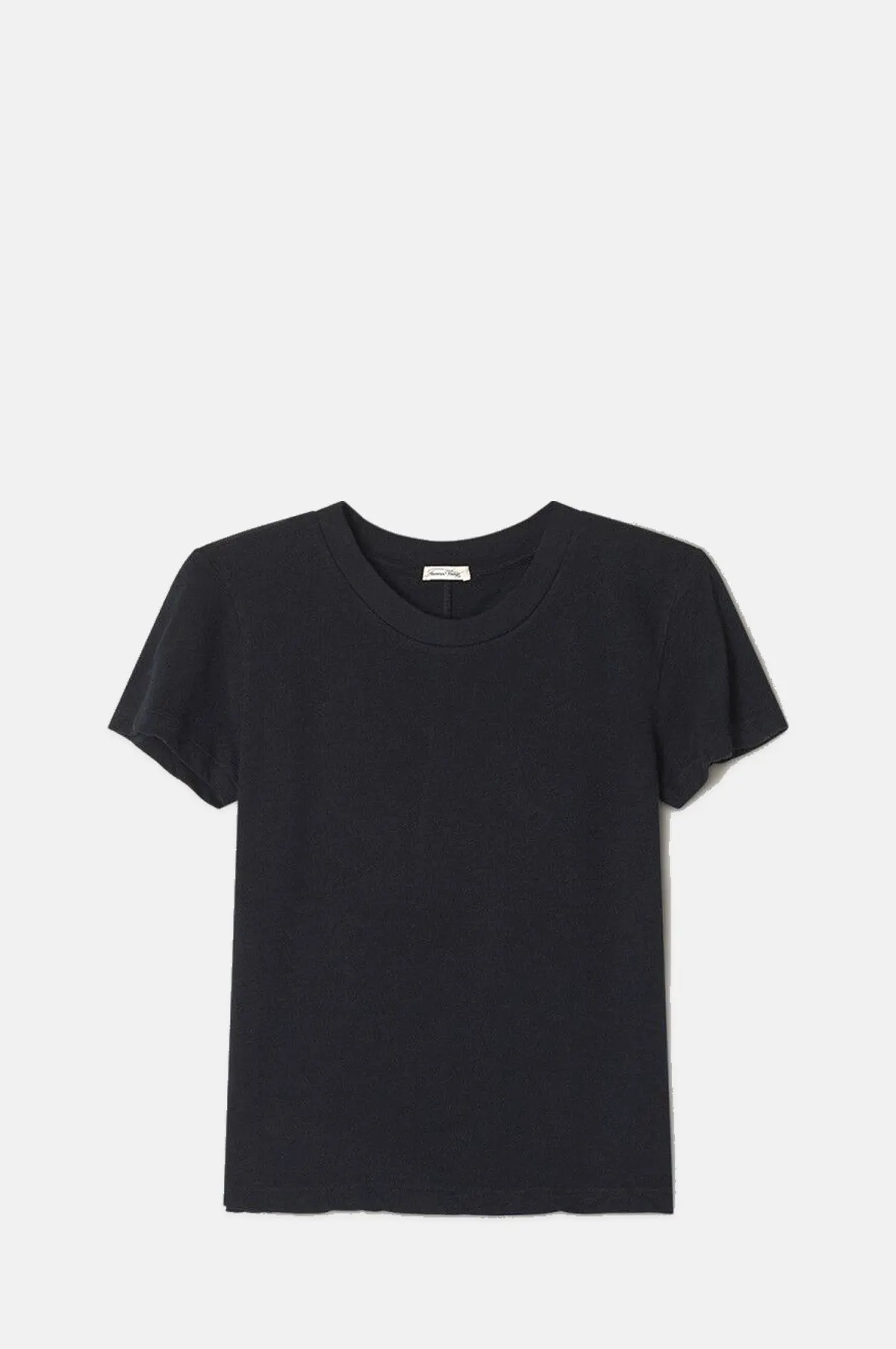

A black short sleeve tee from American Vintage, described as straight fitting and slightly thicker than average, with a thick round collar for a vintage look and a mid-weight cloth that is slightly slubbed, listed at 55 GBP with all three sizes in stock. It publishes pit to pit, sleeve and length for S, M and L, and the chest figures work out at 80, 86 and 90 centimetres around, which against a body chart is less than the body it is labelled for. That sounds alarming and it is worth dealing with properly, because this tee is knitted and every ease figure this run has published has been read as if the cloth were woven. On a knit the question is not whether the garment is bigger than the body, it is whether the cloth stretches and whether it comes back, and neither of those numbers is on this page. There is a second thing here that is more useful than the first, and it is the reason this garment is worth a close read: the chest grades three centimetres and then two, and that average of two and a half is the grade that holds ease constant against a single size step, which tells you what S, M and L mean here, and it is the answer to a question this run has been unable to answer on every other three size garment it has examined. The reference is the Sonoma SS T-Shirt in Noir. Dongguan Bafinasa Garments Co., Ltd. develops comparable knit tops on OEM and ODM terms, from yarn and cloth selection to retail or FBA ready packing. We publish this as a development reference and build your own version of it, and we do not supply the branded original or reproduce anyone else's label.
Key Features
- Chest graded three centimetres and then two, averaging two and a half, which is the grade that holds ease constant against a single size step. See the note below
- Straight fit as stated, and the measurements put the ease below the body at every size, which on a knit needs two more numbers to interpret. See the note below
- Short sleeve published at 17 cm on all three sizes, with no grading at all. See the note below
- Total length graded two centimetres and then one, an irregular grade in a three row table. See the note below
- Thick round collar as stated, which is the detail that most needs a recovery figure and has none. See the note below
- Mid-weight and slightly slubbed as described, with no weight, no yarn count and no slub specification. See the note below
- Machine wash at 30, low heat tumble dry and iron, made in Portugal, with a style code that carries no colour suffix
Customisable Options
- Cloth: mid-weight cotton jersey to the reference, with the weight in grams per square metre and the yarn count set to your market since neither is given
- Stretch: a stated stretch percentage and a recovery figure tested and published, or an elastane blend quoted as an option
- Fit: straight to the reference, or a relaxed version with three to four more inches of ease, or a closer one
- Collar: thick round rib to the reference, with the rib width specified, or a fine rib, or a self fabric binding
- Cloth character: slubbed to the reference with the slub frequency specified, or a plain jersey
- Size set: S, M and L to the reference, or an extended set from XS to XL with the equivalence published
- Cloth weight, yarn count, stretch and recovery, collar rib specification, ease, body length, sleeve length, size set, colour development, private label and care labelling
Specifications
| Style | Straight fit short sleeve tee in mid-weight cotton with a thick round collar |
| Reference | American Vintage, Sonoma SS T-Shirt, style SON28GH21, noir, black, sizes S, M and L |
| Composition | 100% cotton as stated, with no weight and no yarn count given |
| Cloth | Mid-weight jersey as stated, slightly slubbed for a casual look, with no weight in grams per square metre. See the note below |
| Fit | Straight fit as stated. See the note below |
| Collar | Thick round collar as stated, with no rib width and no construction given. See the note below |
| Sleeves | Short sleeves as stated, measured at 17 cm on all three sizes. See the note below |
| Care | Machine wash at 30 degrees, low heat tumble dry and iron, as stated. See the note below |
| Sizes Offered | S, M and L, three sizes, all three in stock |
| Size Equivalence | None published, though the grade implies the sizes are adjacent. See the note below |
| Measurements Published | Pit to pit, sleeve length and total length for all three sizes. See the note below |
| Published Chest | Pit to pit 40, 43 and 45 cm flat, or 15.7, 16.9 and 17.7 in. See the note below |
| Chest Around | 80, 86 and 90 cm, or 31.5, 33.9 and 35.4 in. See the note below |
| Ease Against Body Bust | About minus 1.5, minus 1.1 and minus 1.6 in read as UK 8, 10 and 12, or about minus 1.5, minus 3.1 and minus 5.6 in read as UK 8, 12 and 16. See the note below |
| Published Sleeve | 17 cm on all three sizes, with no grading. See the note below |
| Published Length | 55, 57 and 58 cm, grading two and then one centimetre. See the note below |
| Stretch And Recovery | Not stated, which is the figure that decides whether the ease numbers mean anything. See the note below |
| Published Hem | None. See the note below |
| Model | None stated, no height and no body measurements |
| Photographs | One, on a black garment. See the note below |
| Cloth Weight | Not stated, only the words mid-weight and slightly thicker than average. See the note below |
| Production | Made in Portugal as stated |
| Reference Retail | 55 GBP as listed, quoted to show the price band this sits in, not as our price |
| Category | Filed by the reference under t-shirts |
| Occasion | Everyday, weekend, layering, under knitwear, summer |
| MOQ | 100 pcs per style per colourway, mixed sizes and colourways accepted |
| Sampling | 7-10 days after tech pack or reference sample confirmation |
| Bulk Lead Time | 20-30 days after sample approval and deposit |
| Service | OEM / ODM / private label, jersey sourcing with weight and yarn count specified, collar rib development, stretch and recovery testing, retail or FBA ready packing |
Size Chart as Published by the Reference
| Size | Pit to Pit (flat) | Sleeve Length | Total Length |
|---|---|---|---|
| S | 40 cm | 17 cm | 55 cm |
| M | 43 cm | 17 cm | 57 cm |
| L | 45 cm | 17 cm | 58 cm |
The chest figures are flat half measures taken with the tee laid down, doubling to 80, 86 and 90 cm around, or 31.5, 33.9 and 35.4 in. Read against a body bust of 33, 35 and 37 in, which is UK 8, 10 and 12, the ease is about minus one and a half, minus one and a tenth and minus one and three fifths inches, so the garment is slightly smaller than the body at every size. Read against 33, 37 and 41 in, which is UK 8, 12 and 16, it is about minus one and a half, minus three and a tenth and minus five and six tenths, and the last of those is not a tee at all. So the first reading is the right one, and the grade confirms it: three centimetres and then two averages two and a half, which is one inch of flat width, which is the grade that holds ease constant against a two inch body step. That is the signature of adjacent sizes. The sleeve is 17 cm on all three sizes and the length grades two and then one centimetre.
Our Proposed Body Chart
| Size | Body Bust | Sleeve | Body Waist | Body Hips | Length | Source |
|---|---|---|---|---|---|---|
| S | 33 in / 84 cm | 17 cm | 26 in / 66 cm | 36 in / 91 cm | 55 cm / 21.7 in | Our proposal |
| M | 37 in / 94 cm | 18 cm | 30 in / 76 cm | 40 in / 102 cm | 57 cm / 22.4 in | Our proposal |
| L | 41 in / 104 cm | 19 cm | 34 in / 86 cm | 44 in / 112 cm | 59 cm / 23.2 in | Our proposal |
Occasions and Styling
Suits everyday wear, weekends and layering, and the reference is right that a mid-weight tee works both under knitwear in winter and on its own in summer. A straight fit black tee is the piece most wardrobes are built on, and the thick collar is what makes it read as a considered garment rather than a basic.
Production and Quality Control
The reference publishes three columns for all three sizes, has every size in stock, states its fibre, describes the fit, the collar, the cloth and the sleeve, gives a care instruction and names the country of make. It publishes no cloth weight, no stretch or recovery figure, no equivalence for its sizes and no model, and it shows one photograph. Three things follow: what an ease figure means when the cloth is knitted rather than woven, what the grade tells you about the size letters, and what a thick collar needs specified.
Minus one and a half inches, on a knit rather than a woven, and that is the first thing. Every ease figure this run has published has been read the same way: the garment measure minus the body measure, and positive is comfortable, zero is skin tight and negative does not close. That reading is correct for a woven, because a woven cloth does not stretch, and it is incomplete for a knit, because a knitted cloth stretches and then may or may not come back. This tee measures 80 cm around at the S against a body bust of 84 cm, which on a woven would be a garment that cannot be worn, and on a jersey is a close fitting tee. So the honest statement is not that this garment is too small, it is that the published figures cannot be interpreted without two more numbers, and neither is on the page. The first is stretch, usually given as a percentage of extension under a stated load, and the second is recovery, which is how much of that extension the cloth gives back when the load comes off. A cotton jersey will typically extend comfortably and recover imperfectly, because cotton fibre has poor elastic recovery, which is why a pure cotton rib collar goes slack and why a pure cotton tee grows a little through the day and then more through the wash. That is the reason elastane appears in blends at two or three per cent, as it did in the knitwear this run examined in the last batch: not to make the garment stretchier, but to make it come back. So what this page needs, and what every knit page needs, is a stretch and a recovery figure alongside the measurements, or a statement of the ease the cloth is designed to work at. There is a practical consequence for anyone developing a version of this, and it is worth stating because it is the sort of thing that turns into a returns problem. A tee cut with negative ease in a pure cotton jersey will fit when it is tried on and will grow with wear and washing, and the collar will slacken first because it is the part with the most stretch in it. The options are to add a small percentage of elastane, to specify a compact or a high twist yarn with better recovery, or to cut the garment with a little positive ease and let the cloth do the fitting. All three are a decision in a tech pack and none of them is visible here. And it is worth noticing that the one page in this run that does tell you its cloth moves is the Sunray tee published alongside this one, whose care instruction says to gently reshape the garment after washing, which is an admission written into a care label.
Three centimetres and then two, and the question it answers, and that is the second thing. This run has now examined several garments in S, M and L and has complained on every one of them that no equivalence is published, so the chest figures cannot be turned into an ease figure without guessing whether the letters are adjacent sizes or whether each spans two. The guesses have differed by five inches of ease, which is the difference between a garment that fits and one that does not. This garment does not publish an equivalence either, but its grade gives the answer away. The pit to pit goes 40, 43 and 45, which is a step of three and then a step of two, averaging two and a half centimetres of flat width per size. Two and a half centimetres flat is five centimetres of circumference, which is 1.97 in, and the body chart moves two inches per size for adjacent sizes and four inches per size if each letter spans two. So a two and a half centimetre grade holds ease constant against adjacent sizes and loses two inches per step against spanning ones. And the second reading produces an impossible garment: minus five and six tenths inches of ease at the L is not a tee under any stretch assumption, it is a compression garment, and no jersey does that. So the grade and the plausible ease together establish that S, M and L here are adjacent, and that is the fact this run has been unable to establish on any other three size garment. It is worth saying what this tells you about the house, because it is the second piece of evidence pointing the same way. This run found on the Apoly tee and on the Vitow knitwear that the chest grades were four centimetres and one and a half centimetres per size respectively, and could not tell which was right. On this garment the grade is two and a half, which sits between them and which is the arithmetically correct one for adjacent sizes. So the answer is probably that all of them are adjacent, and the two others are graded loosely while this one is graded properly. And it is worth stating the general rule once more because it is the single most useful thing this run has produced: against a two inch body step, 2.54 cm of flat width per size holds ease constant; against a four inch step it is about 5 cm. One centimetre loses six inches of ease over six sizes, two centimetres loses two and a fifth, three gains one and four fifths, two and a half holds, and the fact that this tee lands on two and a half is not a coincidence but a decision. Then the two columns that do not hold up. The sleeve is 17 cm on all three sizes, which is the fifth ungraded column this run has met, and on a three row table where the other two columns are carefully graded it is a strange omission, since an arm does grow between an S and an L. And the length grades two centimetres and then one, which is an irregular grade in a table of three rows, and the irregularities this run keeps finding are almost always at the top of a range or between the last two sizes, as though the largest size had been set separately.
A thick collar, a slub, and the word mid-weight, and that is the third thing. The collar is the detail the description leads with, a thick round collar for a cool vintage look, and it is specified by nothing: no rib width, no rib construction, no stitch count, no recovery figure. A thick rib collar on a tee is a good design decision and it is also the single most likely thing on the garment to fail, because a rib is the stretchiest part of any jersey and the part that gets the most abuse, pulled over the head twice a day. When a rib loses its recovery it ripples rather than lying flat, which the trade calls bacing, and once it has gone it cannot be pressed back. The remedies are a rib with elastane in it, a higher stitch density, or a collar tape in the seam, and all three are a line on a spec. Then the cloth. Mid-weight is the description, and slightly thicker than your average tee, and both are comparisons whose reference is missing: average of what, and mid-way between what and what. This run has now met more than a dozen unnumbered cloth descriptions and it is worth saying again what the number is for, because this garment is a good example: on a tee the cloth weight decides the price, the drape, the opacity, how it prints, how it washes and how long it lasts, and the difference between 160 and 220 grams per square metre is the difference between a summer basic and a year round one. No yarn count is given either, which is the figure a mill needs alongside the weight. Then the slub, which is a yarn effect and not a finish. A slubbed yarn is spun with deliberate thick and thin places in it, which gives the cloth an uneven surface and a hand made look, and it is specified by the frequency and the length of the slubs, because a slub that is too pronounced makes a cloth that is weak at the thin places and inconsistent in weight, and one that is too subtle is invisible and therefore a waste of money. This run has now met two named yarn effects in consecutive batches, the multichine on the knitwear and this slub, and both are the same case: a specification masquerading as a description. Then the care instruction, which reads machine wash at 30, low heat tumble dry and iron, and which is permissive where most labels in this run are restrictive. Low heat tumble dry is defensible on a plain cotton jersey, and it is worth noting the one thing it works against, which is the collar: tumble drying is what takes the recovery out of a rib faster than anything else, so a label that permits tumbling on a garment whose defining feature is a thick rib collar is at least in tension with itself. And two smaller absences. No hem width is published, so a straight fit cannot be checked for whether the tee hangs straight or flares, and on a garment cut close to the body the hem is where a straight fit either works or does not. And there is one photograph, of a black garment, on which the thick collar, the slub texture and the fit are all things a customer would want to see more than once. Finally the style code, SON28GH21, which carries no colour suffix, the second garment from this house in two batches whose code does not distinguish its colourways, and therefore a code that cannot be used to reorder a specific colour. Every bulk shipment gets a measurement report against your approved chart.
Optional upgrades include publishing the cloth weight in grams per square metre and the yarn count, testing and publishing stretch and recovery for the jersey, which is what makes the ease figures interpretable at all, specifying the collar rib by width, stitch density and elastane content and adding a collar tape, specifying the slub frequency and length, grading the sleeve so it does not sit at 17 cm across three sizes, making the length grade regular or stating deliberately that the L is shorter, publishing the hem width, publishing the UK or EU equivalent for S, M and L, which the grade already implies, adding a colour suffix to the style code, more photographs and a model height, an elastane blend option, a relaxed version with three to four more inches of ease, a fine rib and a bound neck option, size set, colour development, private label, hangtag and care labelling.
Pre-production sample approval, in-line inspection during cutting and sewing, and a final AQL inspection before packing, with measurement reports and photos shared before shipment.
Send us your tech pack, a photo or a reference garment and we will quote within 24 hours. Contact bafinasa@bafinasa.com or WhatsApp +86 13827222469.