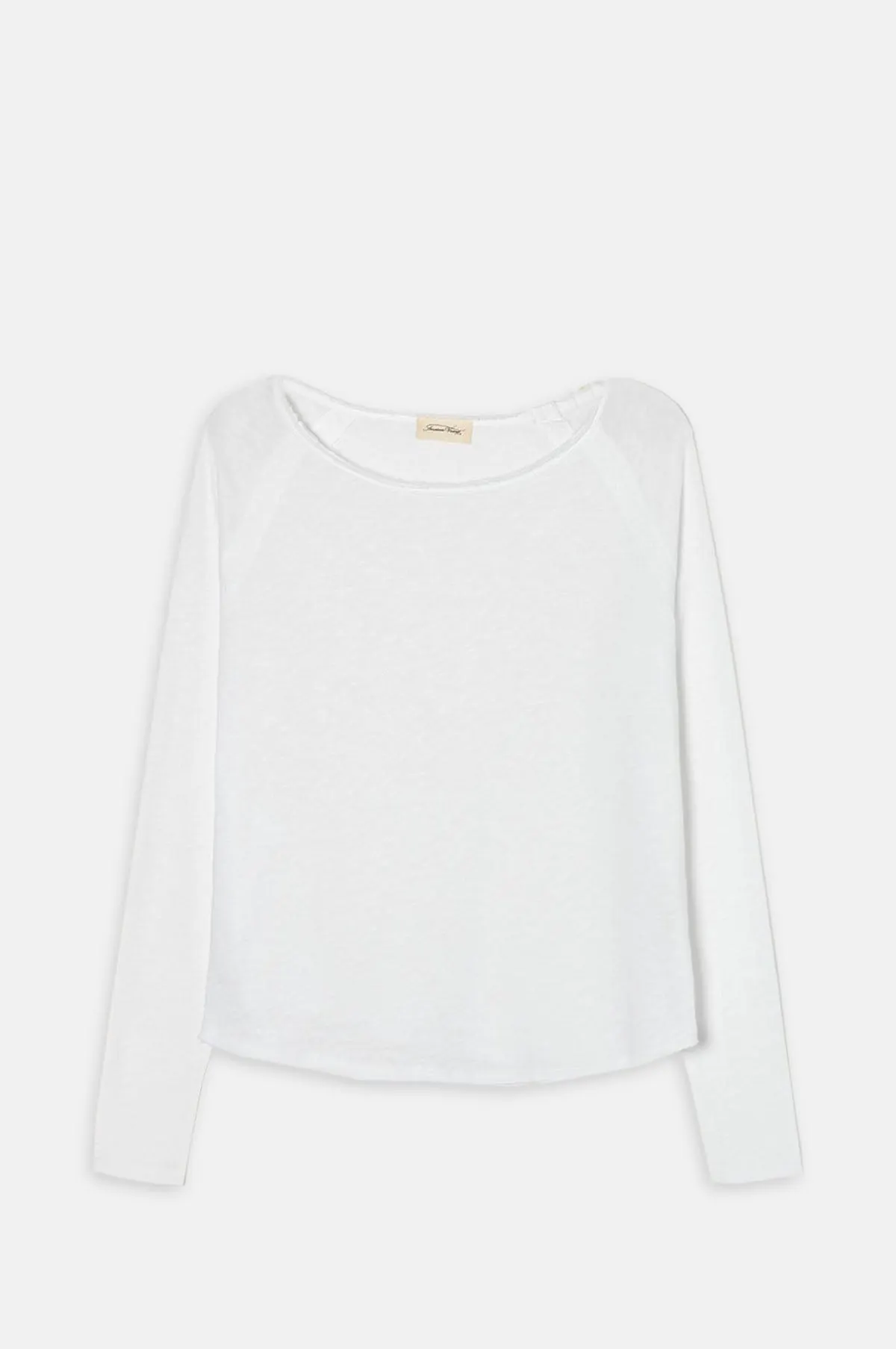

A white boat neck top from American Vintage, described as slightly thicker than a tee and less so than a sweat, with raglan sleeves and a mid-weight cloth whose edge is left raw beyond the hems, listed at 70 GBP with all three sizes in stock. It publishes three columns for three sizes and the table has three faults in it, which is more than any table in this run has had at once. The chest reads 48, 52 and 52, so the largest size is no wider than the one below it. The sleeve reads 74, 76 and 72, so the largest size has a sleeve four centimetres shorter than the one below it. And the length reads 56, 57 and 62, so it grades one centimetre and then five. Any one of those could be argued with; three of them in nine cells is a table that was never read after it was filled in. There is a second thing here worth a close look, and it is the reason this garment is interesting rather than merely wrong: the sleeves are raglan, and a raglan has no shoulder seam, which changes what a sleeve measurement means, and neither this page nor any other in this run says where its sleeve figures are measured from. The reference is the Sonoma Boat Neck Tee in White. Dongguan Bafinasa Garments Co., Ltd. develops comparable jersey tops on OEM and ODM terms, from cloth selection to retail or FBA ready packing. We publish this as a development reference and build your own version of it, and we do not supply the branded original or reproduce anyone else's label.
Key Features
- Chest of 48, 52 and 52 cm, so the largest size is no wider than the middle one. See the note below
- Sleeve of 74, 76 and 72 cm, so the sleeve gets four centimetres shorter at the largest size. See the note below
- Total length of 56, 57 and 62 cm, grading one centimetre and then five. See the note below
- Raglan sleeves as stated, which have no shoulder seam and therefore change what a sleeve measurement means. See the note below
- Raw edge left beyond the hems as stated, which is a design decision that makes the published length unstable. See the note below
- Boat collar as stated, with no neck width published. See the note below
- Mid-weight and very slightly textured as described, with no weight and no yarn count, on a white garment. See the note below
Customisable Options
- Cloth: mid-weight cotton jersey to the reference, with the weight in grams per square metre and the yarn count set to your market since neither is given
- Opacity: a stated weight and a stated opacity level, or a heavier cloth, on a white garment
- Sleeves: raglan to the reference, or a set-in sleeve, with the sleeve measurement point stated either way
- Hem: raw edge beyond the hem to the reference, with the allowance specified and the curl tested, or a clean turned hem
- Neck: boat collar to the reference, with the width specified, or a crew, a V or a cowl
- Fit: to the reference once the chest grade is corrected, or a relaxed version, or a closer one
- Cloth weight, yarn count, opacity, hem finish and allowance, sleeve construction and measurement point, neck width, body length, size set, colour development, private label and care labelling
Specifications
| Style | Boat neck top in mid-weight cotton with raglan sleeves and a raw edge hem |
| Reference | American Vintage, Sonoma Boat Neck Tee, style SON31, white, sizes S, M and L |
| Composition | 100% cotton as stated, with no weight and no yarn count given. See the note below |
| Cloth | Mid-weight jersey as stated, very slightly textured, with no weight in grams per square metre. See the note below |
| Weight Position | Described as slightly thicker than a tee and less so than a sweat, a comparison with no number on either side. See the note below |
| Neck | Flattering boat collar as stated, with no neck width given. See the note below |
| Sleeves | Raglan sleeves as stated, measured at 74, 76 and 72 cm. See the note below |
| Hem | Edge left raw beyond the hems for a casual look, as stated, with the allowance not given. See the note below |
| Care | Wash on a delicate cycle at 30 degrees and iron at low heat, as stated, with no drying instruction. See the note below |
| Sizes Offered | S, M and L, three sizes, all three in stock |
| Size Equivalence | None published, no UK, EU or US equivalent and no body measurements given |
| Measurements Published | Chest, sleeve length and total length for all three sizes. See the note below |
| Published Chest | 48, 52 and 52 cm flat, or 18.9, 20.5 and 20.5 in. See the note below |
| Chest Around | 96, 104 and 104 cm, or 37.8, 40.9 and 40.9 in. See the note below |
| Ease Against Body Bust | About 4.8, 5.9 and 3.9 in read as UK 8, 10 and 12, or about 4.8, 3.9 and minus 0.1 in read as UK 8, 12 and 16. See the note below |
| Published Sleeve | 74, 76 and 72 cm, decreasing by four at the largest size. See the note below |
| Published Length | 56, 57 and 62 cm, grading one and then five centimetres. See the note below |
| Sleeve Measurement Point | Not stated, on a raglan sleeve where there is no shoulder seam to measure from. See the note below |
| Raw Edge Allowance | Not stated. See the note below |
| Opacity | Not stated, on a white garment. See the note below |
| Model | None stated, no height and no body measurements |
| Photographs | One, on a white garment |
| Cloth Weight | Not stated, only the words mid-weight and very slightly textured. See the note below |
| Production | Made in Portugal as stated |
| Reference Retail | 70 GBP as listed, quoted to show the price band this sits in, not as our price |
| Category | Filed by the reference under t-shirts |
| Occasion | Between seasons as the reference claims, spring and autumn, everyday, weekend, layering |
| MOQ | 100 pcs per style per colourway, mixed sizes and colourways accepted |
| Sampling | 7-10 days after tech pack or reference sample confirmation |
| Bulk Lead Time | 20-30 days after sample approval and deposit |
| Service | OEM / ODM / private label, jersey sourcing with weight specified, raglan and set-in construction, raw edge finishing, retail or FBA ready packing |
Size Chart as Published by the Reference
| Size | Chest (flat) | Sleeve Length | Total Length |
|---|---|---|---|
| S | 48 cm | 74 cm | 56 cm |
| M | 52 cm | 76 cm | 57 cm |
| L | 52 cm | 72 cm | 62 cm |
The chest figures are flat half measures taken with the garment laid down, doubling to 96, 104 and 104 cm around, or 37.8, 40.9 and 40.9 in, and the largest size is no wider than the middle one. Against a body bust of 33, 35 and 37 in, read as UK 8, 10 and 12, the ease is about four and four fifths, five and nine tenths and three and nine tenths inches; against 33, 37 and 41 in it runs about four and four fifths, three and nine tenths and minus one tenth. The sleeve is published at 74, 76 and 72 cm, so it falls by four centimetres at the largest size, and the length grades one and then five centimetres. No measurement point is given for the sleeve on a raglan construction, which has no shoulder seam.
Our Proposed Body Chart
| Size | Body Bust | Sleeve | Body Waist | Body Hips | Length | Source |
|---|---|---|---|---|---|---|
| S | 33 in / 84 cm | 74 cm | 26 in / 66 cm | 36 in / 91 cm | 56 cm / 22 in | Our proposal |
| M | 37 in / 94 cm | 75 cm | 30 in / 76 cm | 40 in / 102 cm | 58 cm / 22.8 in | Our proposal |
| L | 41 in / 104 cm | 76 cm | 34 in / 86 cm | 44 in / 112 cm | 60 cm / 23.6 in | Our proposal |
Occasions and Styling
Suits the between season role the reference claims for it, spring and autumn, everyday and weekends. A boat neck top in a mid-weight jersey is the layer that replaces a sweatshirt when a sweatshirt is too much and a tee is not enough, and the raglan sleeve is what lets it go over a shirt without bulk at the shoulder.
Production and Quality Control
The reference publishes three columns for all three sizes, has every size in stock, states its fibre, describes the neck, the sleeves, the hem and the weight of the cloth, gives a care instruction and names the country of make. Three of the nine cells in its table cannot be right. Three things follow: the three faults and what each of them most likely is, what a raglan sleeve does to a measurement, and what a raw edge does to a length.
Nine cells, three faults, and that is the first thing. Take them in order. The chest reads 48, 52 and 52 cm, so the step from S to M is four centimetres and the step from M to L is nothing at all. A size with no width grade is not a size, it is a length variation: a customer moving from the M to the L gets five more centimetres of length and no more room anywhere. This run has met columns that do not grade, but always across every size in the set, which is at least consistent; a column that grades and then stops is harder to explain, and the likeliest explanation is a figure repeated from the row above when the table was filled in. The sleeve reads 74, 76 and 72, which is worse, because it goes backwards: the L sleeve is four centimetres shorter than the M sleeve, and a larger garment with a shorter sleeve is not a design decision anyone makes. The obvious reading is a transposition, since 72 and 78 are one digit apart and 74, 76, 78 would grade a perfect two centimetres per size, which is what every other tidy column in this run has done. The length reads 56, 57 and 62, so the first step is one centimetre and the second is five, and a grade that changes by a factor of five between two steps of the same size set is not a grade. If the M were 58 and the L 60 the column would grade a perfect two, and if the S were 54 and the M 57 and the L 62 it would be a deliberate three and five. Both readings are available and the page does not settle them, which is the point: three cells, three plausible corrections, and no way from the page to tell which is intended. It is worth saying what this costs, because it is not abstract. A customer reading this table who is between sizes has nothing to go on, and a buyer or a developer who copies these figures into a specification copies three errors into a pattern. The remedy is the same one this run has recommended on every table with a fault in it, and it takes five minutes: read the differences between consecutive rows out loud before publishing. Had anyone done that here, a step of zero in the chest, a step of minus four in the sleeve and a step of one next to a step of five in the length would each have stopped them. It is also worth setting this table beside the one on the short sleeved Sonoma from the same family, published alongside it in this batch, which grades three and then two in the chest, holds its sleeve at seventeen and grades two and one in the length. Two garments with the same name, from the same house, in the same three letters, and their chest measurements differ by eight centimetres at the S, which is either two different fits or one of them wrong, and with no equivalence published for either there is no way to say.
Raglan, and the sleeve that cannot be measured from a shoulder that is not there, and that is the second thing. A raglan sleeve is cut in one piece with a diagonal seam running from the underarm up to the neck, so there is no shoulder seam and no shoulder point at all. That is the reason it is used: it removes the seam from the top of the shoulder, which is where a strap sits and where a set-in sleeve can feel tight, and it gives a softer, more casual line, which suits a garment described as being between a tee and a sweat. But a sleeve length is conventionally measured from the shoulder seam, and a raglan has none. So the figure has to be taken from somewhere else, and there are three conventions in use: from the centre back neck, which is the standard for raglan and which gives a larger number; from the natural shoulder point estimated on the body, which is guesswork; and from the underarm to the cuff, which is the most useful to a customer and the least often published. The difference between the first and the third is large, since the distance from the neck to the armpit is somewhere between fifteen and twenty five centimetres depending on the size and the slope of the shoulder. So a sleeve of 74 cm could be a long sleeve of about 55 cm measured from the underarm, or a much shorter one measured from the neck, and the two are different garments. This is the second time in two batches this run has met a shoulder construction that invalidates its own sleeve figure: the knitwear published in the last batch had dropped shoulders, where the shoulder seam has moved down the arm, and this has raglan, where it does not exist. In both cases the sleeve figure was published without a word about where it was taken. The fix is one clause, and it is the same clause this run has asked for on every length figure it has examined: state the point the tape went from. For a raglan the recommendation is to publish the underarm to cuff figure alongside the neck to cuff one, or simply to publish the one customers can use. And there is a second raglan point that belongs in a specification and is not here, which is the angle and the shape of the raglan seam itself, since a raglan that is too shallow pulls across the back and one that is too deep leaves the armhole hanging, and the two are set by the seam line rather than by any measurement on this page. No armhole depth is published, and on a raglan the armhole is the whole fitting.
A raw edge, a white garment, and a label that forgets the dryer, and that is the third thing. The description says the edge is left raw beyond the hems for a more casual aesthetic, which is a real design decision and one that has consequences worth setting out, because it is the rare case where a design detail makes a published measurement unstable. A raw cut edge on a jersey, left beyond a hem stitch, will do two things. It will curl, because a single jersey curls towards the technical face at any cut edge, and it will fray a little with washing, and both of those change the length of the garment over its life. So a total length of 56 cm is a measurement taken on a new garment, and the garment will not stay at 56, and no allowance for the raw edge is published, so nobody knows how much of that length is hem and how much is edge. It is a small thing and it is the sort of thing that shows up as inconsistency between pieces, since a raw edge that has curled differently on two garments gives two different lengths from the same pattern. The specification that would settle it is one number: the allowance beyond the hem stitch, in millimetres, and a wash test to see what it does. Then the washing. The care instruction reads wash on a delicate cycle at 30 degrees and iron at low heat, and it says nothing about drying. On this garment that is the one omission that matters, because tumble drying is precisely what will destroy a raw edge: the tumbling action frays the cut edge and sets the curl, and any garment with a raw detail should say dry flat or do not tumble dry. It is worth noting the contrast with the short sleeved Sonoma in the same family, whose label permits a low heat tumble dry, so two garments from one house give two different drying instructions and neither mentions the detail that makes drying consequential. Then the cloth and the colour. Mid-weight is the description and very slightly textured, and the weight is positioned with a comparison rather than a number: slightly thicker than a tee, but less so than a sweat. That is a definition by two garments the cloth is not, and it is the thirteenth or fourteenth unnumbered cloth description in this run, and on a white garment it is worse than usual, because the weight of a white jersey decides whether you can see through it. A white single jersey at 160 grams is semi sheer and one at 220 is not, and the customer cannot tell from a photograph, and no opacity figure is published either. Then the neck, which is the feature the garment is named and sold on: a flattering boat collar, with no neck width. A boat neck is defined by being wide, and the width is what decides whether it sits on the shoulder or slips off it, and no number is given, and no model is shown to judge it from. Finally the code, SON31, which carries no colour suffix for a garment that certainly comes in more than one colour, and which is the third from this house in two batches with the same problem: a code that identifies a style and not a colour is a code that cannot be used to place a reorder. Every bulk shipment gets a measurement report against your approved chart.
Optional upgrades include correcting the three cells in the table and reading the row differences aloud before publishing, grading the chest through the largest size instead of repeating 52, stating the sleeve measurement point and publishing the underarm to cuff figure on a raglan, specifying the raglan seam shape and the armhole depth, specifying the raw edge allowance in millimetres and wash testing it, stating the cloth weight in grams per square metre and the opacity on a white, adding a drying instruction suited to a raw edge, publishing the boat neck width, publishing the UK or EU equivalent for S, M and L, adding a colour suffix to the style code, more photographs and a model height, a set-in sleeve version, a clean turned hem version, a crew and a V neck option, size set, colour development, private label, hangtag and care labelling.
Pre-production sample approval, in-line inspection during cutting and sewing, and a final AQL inspection before packing, with measurement reports and photos shared before shipment.
Send us your tech pack, a photo or a reference garment and we will quote within 24 hours. Contact bafinasa@bafinasa.com or WhatsApp +86 13827222469.