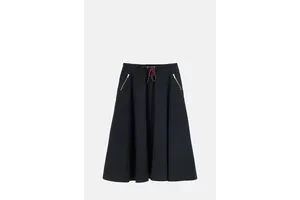
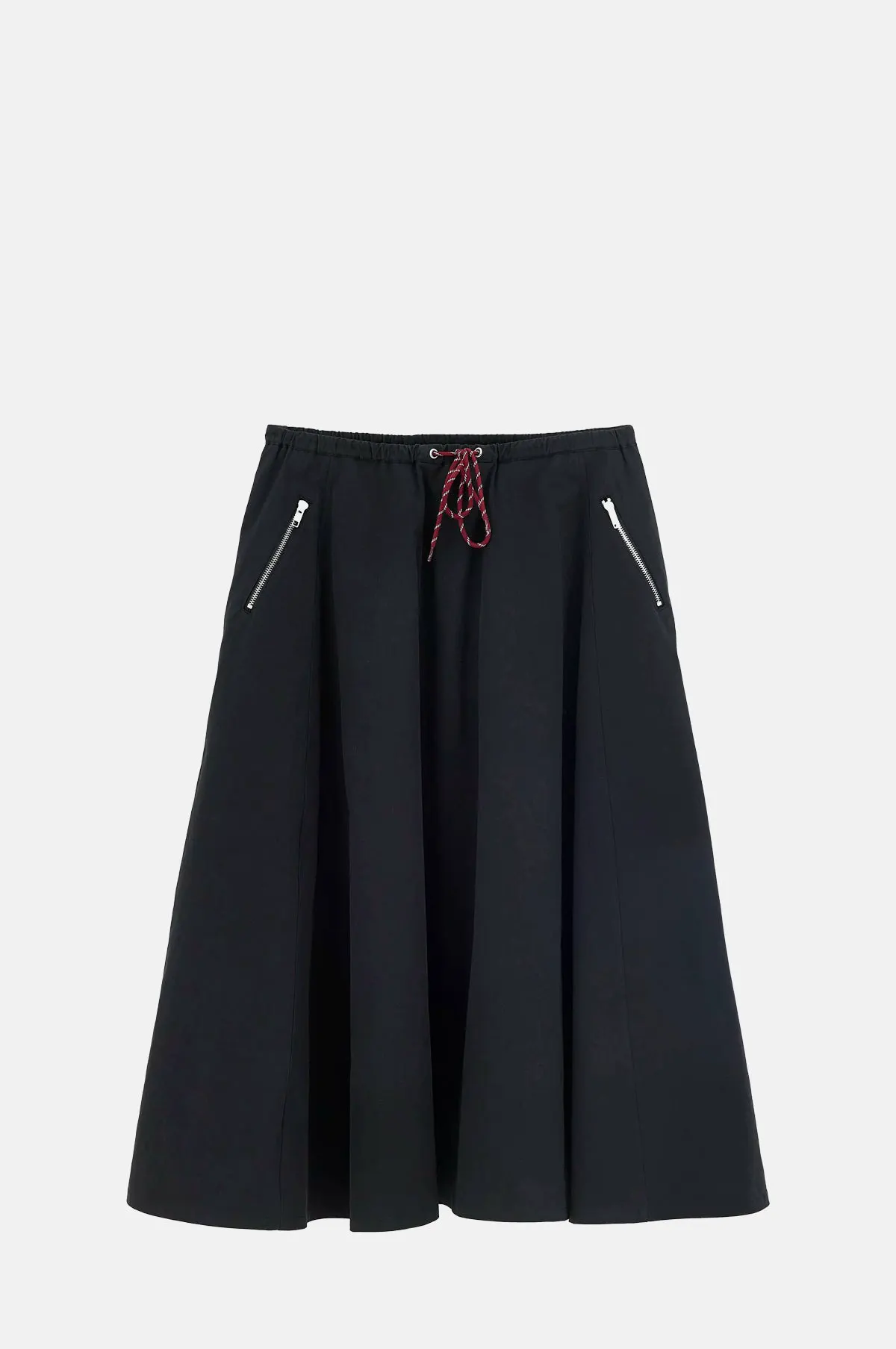

An A-line midi skirt from Bellerose in jet black, cut from a crisp and lightweight cotton with a drawstring waist and zipped side pockets, listed at 165 GBP with all five sizes in stock. Its waist column is worth stopping over, because on the face of it the skirt is too small. The waist is published at 28 to 36 centimetres flat, which is 56 to 72 centimetres around, against a body waist of 61 to 81 centimetres at these sizes, so the chart says the skirt is two to nearly four inches narrower than the body it is meant to fit. This run has met that before and found an explanation, but the explanation does not apply here, and that is what makes it interesting. The garment it met it on had an elasticated waist, and an elasticated waist at rest is narrower than the body by design, because that is what makes it grip. This skirt has no elastic. It has a drawstring, and a drawstring is the most adjustable waist there is, so a figure two inches under the body cannot be the width the waistband is cut to. This run now has three waists on three garments and three different constructions behind them, and the published number does not tell you which one you are looking at. The reference is the Harlin Skirt in Black. Dongguan Bafinasa Garments Co., Ltd. develops comparable skirts on OEM and ODM terms, from cloth sourcing to retail or FBA ready packing. We publish this as a development reference and build your own version of it, and we do not supply the branded original or reproduce anyone else's label.
Key Features
- Drawstring waist as stated, with the waist published about 2.0 to 3.7 in under the body waist, which a drawstring cannot be cut to. See the note below
- The third waist construction this run has met, after an elastic-only waist and an elastic plus cord waist, and the published number does not distinguish them. See the note below
- Waist and total length both grade two centimetres per size, uniformly, which is one of the most consistent charts in this run. See the note below
- Zipped side pockets as stated, which adds a component the page does not specify, with no zip type, length or pocket dimensions. See the note below
- A-line as stated, with no hem width given, so the shape of the skirt is not quantified
- Crisp and lightweight cotton as stated, with no weight and no cloth type given. See the note below
- Hand wash only, on 100% cotton, which the fibre does not explain and the page does not. See the note below
Customisable Options
- Cloth: crisp lightweight cotton to the reference, with the weight and the construction named, or a cotton poplin, a cotton lawn or a cotton twill, each quoted separately
- Waist: drawstring to the reference, with both the fully drawn and the fully open waist published, or an elasticated waist, or a flat waistband, or a half elastic back, each quoted separately
- Pockets: zipped side pockets to the reference, with the zip specified by type and length and the pocket by opening and depth, or plain side seam pockets, or patch pockets, or no pockets
- Length: midi to the reference at 80 to 88 cm, or a shorter length, with the hem width published either way
- Finish: crisp to the reference, with the finish named and its durability stated, or a softened finish, or an unwashed finish
- Sizes: 34 to 42 to the reference, or extended, with the waist state labelled in the chart
- Cloth weight and construction, fully drawn and fully open waist measurement, zip type and length, pocket opening and depth, hem width, waistband depth, finish specification, drying and ironing instructions, size set, colour development, private label and care labelling
Specifications
| Style | A-line midi skirt with a drawstring waist and zipped side pockets |
| Reference | Bellerose, Harlin Skirt, style BW262210 P1959-001, black, sizes 34 to 42 |
| Composition | 100% cotton as stated in the panel. See the note below |
| Cloth | Crisp and lightweight cotton as stated, with no weight and no construction named. See the note below |
| Waist | Drawstring waist as stated, with no elastic mentioned and the measurement state not given. See the note below |
| Pockets | Zipped side pockets as stated, with no zip specification and no pocket dimensions given. See the note below |
| Shape | Classic A-line as stated, with no hem width given. See the note below |
| Length | Midi-length as stated, with the figures published. See the note below |
| Care | Hand wash only as stated, with no drying and no ironing instruction. See the note below |
| Sizes Offered | 34 to 42, five sizes, all five in stock |
| Size Conversion | Published: 34 is XS, 36 is S, 38 is M, 40 is L and 42 is XL |
| Fit Guidance | None published |
| Model | None published. See the note below |
| Measurements Published | Waist and total length for all five sizes. See the note below |
| Published Waist | 28, 30, 32, 34 and 36 cm flat, or 11.0 through 14.2 in. See the note below |
| Waist Around | 56, 60, 64, 68 and 72 cm, or 22.0, 23.6, 25.2, 26.8 and 28.3 in. See the note below |
| Gap Against Body Waist | About 2.0, 2.4, 2.8, 3.2 and 3.7 in below the body waist, which a drawstring cannot be cut to. See the note below |
| Waist Fully Drawn or Open | Not stated. See the note below |
| Published Length | 80, 82, 84, 86 and 88 cm, grading two centimetres per size. See the note below |
| Hem Width | None, on a garment described as A-line. See the note below |
| Hip | None |
| Waistband Depth | None |
| Cloth Weight | Not stated. See the note below |
| Zip Specification | None. See the note below |
| Pocket Specification | None. See the note below |
| Photographs | Six |
| Production | Made in China as stated |
| Reference Retail | 165 GBP as listed, quoted to show the price band this sits in, not as our price |
| Category | Filed by the reference under skirts |
| Occasion | Spring, summer and autumn, everyday, relaxed dressing, with a tee, under a jumper or with boots |
| MOQ | 100 pcs per style per colourway, mixed sizes and colourways accepted |
| Sampling | 7-10 days after tech pack or reference sample confirmation |
| Bulk Lead Time | 20-30 days after sample approval and deposit |
| Service | OEM / ODM / private label, cotton sourcing by weight and finish, drawstring waist and zip pocket development, retail or FBA ready packing |
Size Chart as Published by the Reference
| Size | Waist (flat) | Total Length |
|---|---|---|
| 34 / XS | 28 cm | 80 cm |
| 36 / S | 30 cm | 82 cm |
| 38 / M | 32 cm | 84 cm |
| 40 / L | 34 cm | 86 cm |
| 42 / XL | 36 cm | 88 cm |
The waist figures are flat half measures taken with the skirt laid down, doubling to 56, 60, 64, 68 and 72 cm around, or 22.0, 23.6, 25.2, 26.8 and 28.3 in. Against a body waist of 24, 26, 28, 30 and 32 in across XS to XL, those are about 2.0, 2.4, 2.8, 3.2 and 3.7 inches smaller. Since the waistband has a drawstring and no elastic is mentioned, a waistband of 56 cm around could not pass over the hips, so the published figure must be the waist drawn in rather than the width it is cut to, and the width it is cut to is not published. Both columns grade two centimetres per size, uniformly.
Our Proposed Body Chart
| Size | Body Bust | Body Waist | Body Hips | Length | Source |
|---|---|---|---|---|---|
| 34 / XS | 31 in / 79 cm | 24 in / 61 cm | 34 in / 86 cm | 80 cm / 31.5 in | Our proposal |
| 36 / S | 33 in / 84 cm | 26 in / 66 cm | 36 in / 91 cm | 82 cm / 32.3 in | Our proposal |
| 38 / M | 35 in / 89 cm | 28 in / 71 cm | 38 in / 97 cm | 84 cm / 33.1 in | Our proposal |
| 40 / L | 37 in / 94 cm | 30 in / 76 cm | 40 in / 102 cm | 86 cm / 33.9 in | Our proposal |
| 42 / XL | 39 in / 99 cm | 32 in / 81 cm | 42 in / 107 cm | 88 cm / 34.6 in | Our proposal |
Occasions and Styling
Suits spring, summer and autumn and relaxed everyday dressing. The reference describes it as extremely wearable and says the styling options are endless, which is fair for a plain black A-line: it takes a tee in summer, a jumper over it in autumn and boots either side of winter.
Production and Quality Control
The reference publishes two columns for all five sizes, states a single fibre, describes the cloth, the waist, the pockets, the shape and the length, gives a care instruction, names the country of production and publishes a size conversion. It publishes no fit guidance and no model information, gives no hem width, no hip, no waistband depth, no cloth weight, no zip specification and no pocket dimensions, and it does not say what state the waist is measured in. Three things follow: the waist that reads too small, the two columns that grade together, and the zipped pockets on a crisp cotton with a care label the fibre does not explain.
Fifty-six centimetres around, on a waist with a cord, and that is the first thing. The waist is published at 28 to 36 cm flat, which is 56 to 72 cm around, and the body waist at these sizes is 61 to 81 cm, so the skirt measures about two inches narrower than the body at the smallest size and nearly four at the largest. This run has met a waist smaller than the body once before, on a printed skirt two batches ago, and found the explanation in the construction: that waistband was elasticated, and an elasticated waistband at rest is narrower than the body by design, because that is what makes it grip, so the published figure was the elastic at rest and was not an error. That explanation is not available here. The Harlin has a drawstring waist, and no elastic is mentioned anywhere on the page. And a drawstring waist works in the opposite way: the waistband is cut wider than the body, the cord runs through it, and the wearer pulls the cord to gather the surplus. Which means the waistband cannot be cut to 56 cm around on the smallest size, because a waistband of 56 cm would not pass over hips of about 86 cm to get the skirt on in the first place. So the published figure must be the waist drawn in, and the figure that a maker actually needs, which is the width the waistband is cut to, is not published at all. It is worth setting out why this matters more than a rounding quibble, and the clearest way is to put the three waists this run has now examined side by side. One is elastic only, published at 56 cm around, about two to three inches under the body, and correct, because the elastic grips. One is elastic plus a self-tie cord, published at 80 cm around, about five to six inches over the body, and also correct, because the cord does the gripping and the elastic can be loose. And this one is a drawstring with no elastic, published at 56 cm around, about two to four inches under the body, and it is the waist fully drawn. So two of them sit at 56 cm and two of them have cords, and the three numbers do not tell you which construction you have. A customer has to read the prose to find out, and even then she is given one end of a range: a drawstring waist is adjustable from the width it is cut to down to the width it can be drawn to, and only the second of those is here. What should be published is both, and it is a single extra column: fully drawn and fully open. It is worth adding that a drawstring waist is the most forgiving waist of the three, so the garment is more wearable than its chart suggests, which is a shame, because the chart is what she looks at first.
Two centimetres on both columns, and that is the second thing, and it is the good news. The waist grades 28, 30, 32, 34 and 36, and the length grades 80, 82, 84, 86 and 88, so both columns step by exactly two centimetres at every size. That is a more consistent chart than most of this run has seen, which has otherwise met columns frozen across five sizes, columns that step two and three and two and three, and columns whose step changes halfway up the range. It is worth saying what a two centimetre step does to the ease, because it is the same arithmetic this run has been doing throughout. Two centimetres of flat width is four centimetres of circumference, which is 1.57 inches, against a body waist that grades two inches per size. So the garment grows at a little under the rate the body does and the gap closes by about two fifths of an inch at every size, which is exactly the drift visible in the figures: the skirt is about two inches under the body waist at the smallest size and about three and seven tenths under at the largest. That is a small, steady, predictable drift and there is nothing wrong with it. Then the length, which is worth a word because two centimetres per size is a generous grade for a skirt. It means the largest size is eight centimetres longer than the smallest. This run has argued before that a frozen length is more defensible on a skirt than on a dress, since a skirt hangs from the waist and the waist sits at the same height on the body whatever the size, so an ungraded skirt is not obviously wrong. Grading it is better still, but eight centimetres across five sizes is a strong answer, and it assumes the brand's larger customer is also taller. That assumption is the one thing worth checking, and it cannot be checked here, because this brand publishes no model height on any of the garments this run has examined, so there is no body to place any of these lengths on. The description says midi-length and the figures of 80 to 88 cm are consistent with that on an average height, so the word is supported, which is worth crediting. What is not given is the hem width, and on an A-line skirt the hem width is the number that defines the shape: it is the difference between a gentle A and a full one, and it is also what decides how much cloth is in the skirt and therefore what it costs.
Zipped pockets, and a care label the cotton does not explain, and that is the third thing. The pockets are zipped side pockets, and this run has now counted pockets on a good many garments and has not once been given a pocket dimension, so that part is familiar. What is new is the zip. A zip is a component with its own specification, and none of it is here: no type, since a coil zip, a metal zip and a concealed zip behave differently and cost differently; no length, which is what decides how much the pocket mouth can open; no pull; and no statement about whether the zip is finished at the top with a garage or left exposed. It is worth saying what a zip does to a skirt like this, because it is not a neutral addition. A zip is heavier and stiffer than a crisp lightweight cotton, so it will pull at the pocket mouth and it will show through the cloth as a ridge, which matters on a fabric the page itself calls crisp and lightweight. And a zipped pocket sits at the hip, which on an A-line skirt is exactly where the silhouette begins to widen, so any bulk there is placed at the least forgiving point on the garment. Then the cloth and the care label, which is where this garment is least satisfactory. The page says crisp and lightweight cotton, and gives no weight and no construction, so it does not say whether this is a poplin, a lawn or a twill, and crisp is a description of a finish rather than a specification of one. And the care label reads hand wash only, with no drying instruction and no ironing instruction. It is worth saying why that is worth objecting to here in a way it is not elsewhere, and the reason is that it does not follow from the fibre. Cotton is the most washable fibre in common use; nothing about 100% cotton requires hand washing. So the instruction must be there for something else, and there are three candidates on this garment, none of which is mentioned: the crisp finish, which washing softens and which will not come back; the jet black dye, which on cotton is the most prone to fading and to rubbing off of any colour, particularly in the first wash; and the zips, which are damaged by agitation and which abrade the cloth they are sewn into. This run has met this shape of problem once before, on a waistcoat that was half polyester and could only be dry cleaned, where the reason turned out to be the decoration rather than the cloth. It is the same structure: the instruction is right and the explanation is missing, and a customer who does not know why is a customer who will ignore it. Two clauses would fix most of it, and they are the two this run keeps recommending: how to dry it, and whether it can be ironed, which on a crisp cotton that creases is not a small question. Every bulk shipment gets a measurement report against your approved chart.
Optional upgrades include publishing the waist both fully drawn and fully open, naming the cloth by weight and construction and the finish by name, specifying the zip by type and length and the pocket by opening and depth, publishing the hem width and the hip, adding a drying instruction and an ironing instruction, explaining why a cotton garment is hand wash only, adding a wash with like colours clause, which matters most on jet black, publishing a model height so the midi length can be placed on a body, a cotton poplin, cotton lawn and cotton twill option, flat waistband, elasticated waist and half elastic back options, plain side seam, patch and no pocket options, a shorter length option, size set, colour development, private label, hangtag and care labelling.
Pre-production sample approval, in-line inspection during cutting and sewing, and a final AQL inspection before packing, with measurement reports and photos shared before shipment.
Send us your tech pack, a photo or a reference garment and we will quote within 24 hours. Contact bafinasa@bafinasa.com or WhatsApp +86 13827222469.