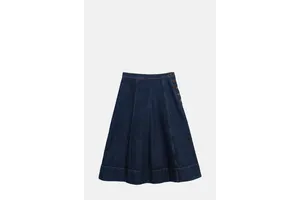
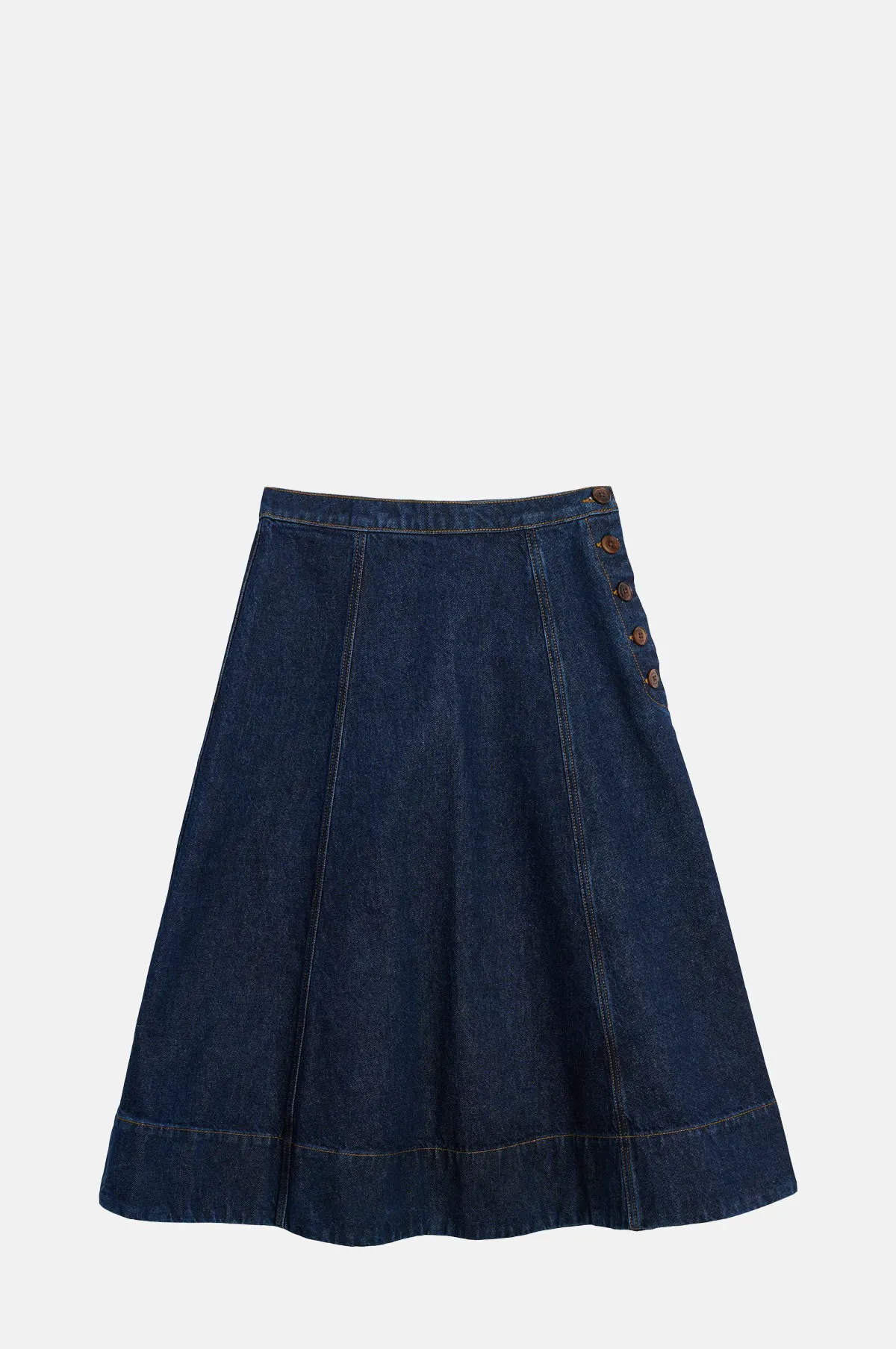

A denim skirt from Skall Studio in deep indigo, built from panels of washed organic cotton denim with a structured A-line shape, a high rise waist and a run of brown buttons fastening the side, listed at 280 GBP with two of the four sizes left in stock. It is the first garment this run has examined that names a certification for its fibre claim, and that is worth saying at the top because this run has been asking for it for a long stretch. Four garments so far have claimed organic and none of them said who certified it. This one carries the letters GOTS. The certification is real and the word is there, but it is in an unexpected place, and that turns out to matter. The other thing worth looking at is the waist, because on this garment there is nothing to help it. Every elasticated waist this run has measured had some mechanism to explain its number; this skirt has woven cotton denim with no stretch, no elastic, no drawstring and no give anywhere, which makes the one measurement the page leaves out the one that decides whether the skirt can be worn at all. The reference is the Katinka Skirt in Indigo Blue. Dongguan Bafinasa Garments Co., Ltd. develops comparable denim skirts on OEM and ODM terms, from cloth and wash development to retail or FBA ready packing. We publish this as a development reference and build your own version of it, and we do not supply the branded original or reproduce anyone else's label.
Key Features
- GOTS named, the first certification this run has met on a fibre claim, though it appears in the style code line rather than beside the claim itself. See the note below
- High rise waist as stated, which means the published waist really is at the waist, unlike the low-rise trouser this run examined last batch. See the note below
- 100% organic cotton denim as stated, with no stretch, no elastic and no drawstring, and no hip measurement published. See the note below
- A run of buttons to the side as stated, with no button count and no statement of whether the opening is full or partial. See the note below
- Constructed from panels as stated, which is what makes the A-line, with no panel count and no hem width given. See the note below
- Deep indigo washed denim as stated, with no weight in ounces and no note about indigo rubbing off. See the note below
- Machine wash at 30 and do not tumble dry as stated, with no wash with like colours clause on the most crocking dye there is
Customisable Options
- Cloth: organic cotton denim to the reference, with the weight in ounces stated, or a conventional denim, a stretch denim or a lighter cotton twill, each quoted separately
- Certification: GOTS to the reference, with the certifier and licence number stated, or conventional cotton, or a different standard, quoted separately
- Waist: high rise to the reference, with the hip published, or a mid rise, with the hip published either way
- Fastening: a run of buttons to the side to the reference, specified by count, size and spacing and stated as a full or partial opening, or a side zip, or a fly front, each quoted separately
- Panels: panelled A-line to the reference, with the panel count and the hem width published, or a gored skirt, or a wrap skirt
- Wash: washed indigo to the reference, with the wash named, or a raw indigo, or a lighter wash, or a black denim, each quoted separately
- Cloth weight in ounces, certification and licence number, hip measurement, hem width, panel count, button count, size and spacing, full or partial opening, wash specification and shrinkage, colour fastness, size set, colour development, private label and care labelling
Specifications
| Style | High-rise A-line midi skirt in panelled denim with a side button fastening |
| Reference | Skall Studio, Katinka Skirt, style 10571-26703, GOTS, indigo blue, sizes 34 to 40 Danish |
| Composition | 100% organic cotton as stated in the panel. See the note below |
| Certification | GOTS as stated in the style code line, with no certifier and no licence number. See the note below |
| Cloth | Deep indigo washed denim as stated, with no weight given. See the note below |
| Construction | Constructed from panels as stated, with no panel count given. See the note below |
| Shape | A structured A-line shape as stated, with no hem width given. See the note below |
| Length | Midi-length as stated, with the figures published and consistent with the word |
| Rise | High rise waist as stated, with the rise not quantified. See the note below |
| Fastening | A run of brown buttons to the side as stated, with no count, size or spacing given. See the note below |
| Care | Machine wash at 30 degrees, do not tumble dry, as stated, with no wash with like colours clause. See the note below |
| Sizes Offered | 34 to 40 Danish, four sizes, with 34 and 38 in stock at the time of writing |
| Size Conversion | Published: 34 is XS, 36 is S, 38 is M and 40 is L |
| Fit Guidance | None published |
| Model | None published. See the note below |
| Measurements Published | Waist and total length for all four sizes. See the note below |
| Published Waist | 34, 36, 38 and 40 cm flat, or 13.4 through 15.7 in. See the note below |
| Waist Around | 68, 72, 76 and 80 cm, or 26.8, 28.3, 29.9 and 31.5 in. See the note below |
| Ease Against Body Waist | About 2.8, 2.3, 1.9 and 1.5 in, and at the waist itself, since the rise is high. See the note below |
| Published Length | 75, 76, 77 and 78 cm, grading one centimetre per size |
| Hip | None, on a woven denim skirt with no stretch. See the note below |
| Hem Width | None, on a garment whose shape is its selling point. See the note below |
| Rise Figure | None, on a garment described as high rise. See the note below |
| Cloth Weight | Not stated, on the one cloth with a universal weight unit. See the note below |
| Button Specification | None. See the note below |
| Opening Full or Partial | Not stated. See the note below |
| Panel Count | None. See the note below |
| Photographs | Six |
| Production | Made in Turkey as stated. See the note below |
| Reference Retail | 280 GBP as listed, quoted to show the price band this sits in, not as our price |
| Category | Filed by the reference under skirts |
| Occasion | Autumn, winter and spring, everyday, with a jumper and boots, or with the matching jacket |
| MOQ | 100 pcs per style per colourway, mixed sizes and colourways accepted |
| Sampling | 7-10 days after tech pack or reference sample confirmation |
| Bulk Lead Time | 20-30 days after sample approval and deposit |
| Service | OEM / ODM / private label, GOTS certified organic denim sourcing, wash development, panelled skirt construction, retail or FBA ready packing |
Size Chart as Published by the Reference
| Size | Waist (flat) | Total Length |
|---|---|---|
| 34 / XS | 34 cm | 75 cm |
| 36 / S (sold out) | 36 cm | 76 cm |
| 38 / M | 38 cm | 77 cm |
| 40 / L (sold out) | 40 cm | 78 cm |
The waist figures are flat half measures taken with the skirt laid down, doubling to 68, 72, 76 and 80 cm around, or 26.8, 28.3, 29.9 and 31.5 in. Against a body waist of 24, 26, 28 and 30 in across XS to L, the ease is about 2.8, 2.3, 1.9 and 1.5 in, and because the skirt is high rise that comparison is the right one. The total length grades one centimetre per size from 75 to 78 cm, which is consistent with the word midi. No hip measurement is published, and on a woven denim with no stretch that is the measurement which decides whether the skirt can be worn.
Our Proposed Body Chart
| Size | Body Bust | Body Waist | Body Hips | Length | Source |
|---|---|---|---|---|---|
| 34 / XS | 31 in / 79 cm | 24 in / 61 cm | 34 in / 86 cm | 75 cm / 29.5 in | Our proposal |
| 36 / S | 33 in / 84 cm | 26 in / 66 cm | 36 in / 91 cm | 77 cm / 30.3 in | Our proposal |
| 38 / M | 35 in / 89 cm | 28 in / 71 cm | 38 in / 97 cm | 79 cm / 31.1 in | Our proposal |
| 40 / L | 37 in / 94 cm | 30 in / 76 cm | 40 in / 102 cm | 81 cm / 31.9 in | Our proposal |
Occasions and Styling
Suits autumn, winter and spring and everyday dressing. A structured denim midi is a year round piece, and the reference suggests a jumper and boots or the matching jacket as a set, which is right: denim on denim only works when the two pieces are from the same cloth.
Production and Quality Control
The reference publishes two columns for all four sizes, states a single fibre, names a certification, describes the cloth, the construction, the shape, the length, the rise and the fastening, gives a two-clause care instruction, names the country of production and publishes a size conversion. It publishes no fit guidance and no model information, and gives no hip, no hem width, no rise figure, no cloth weight, no panel count and no button specification. Three things follow: the certification and where it is written, the waist with nothing to help it, and the buttons down the side.
GOTS, at last, and it is in the wrong place, and that is the first thing. The style code line on this page reads 10571-26703 GOTS Indigo blue. Those three letters are the first certification this run has met on any fibre claim, and that is worth saying clearly because this run has been asking for one for a long time. Four garments so far have claimed organic cotton. One claimed it in the description and confirmed it in the panel. One claimed it twice over, for the shell and for the lining, and self-consistently. And none of them said who certified it. That matters because an organic claim is a claim about farming and processing, and farming claims run on standards with audits and certificates and licence numbers, and a mill cannot buy against a word. GOTS is a real answer to that, and a stronger one than most, because it covers the processing and the social criteria along the chain and not only the fibre in the field, and because it has two grades depending on the proportion of organic fibre, the higher of which requires ninety-five per cent. A hundred per cent organic cotton claim, which is what this page makes, would meet the higher one. So the word is worth having and this run credits it. Two things are still wrong with it. The first is where it sits. The composition panel, which is where the claim is made, reads made from 100% organic cotton and says nothing about certification. The word GOTS appears further down, appended to a style code and a colour name. A customer reading the claim does not see the evidence, and evidence that is not next to the claim is evidence that most readers will not find. The second is that it is a name without a reference. Certified products carry the certifier's name and a licence number, and those are what let anyone check the claim rather than take it on trust, and neither is here. It is also worth applying a test this run developed two batches ago, which is that a field appearing on some garments and not on others is per-garment data rather than a blanket statement. This brand's other organic cotton skirt, examined two batches ago, carried no such word in its code. So the certification is probably attached to this garment rather than to the brand's cotton generally, which is the honest way to do it, and which also means the other skirt's claim is unverified and a customer cannot tell the two apart.
A waist with nothing to help it, and that is the second thing. The waist is published at 34 to 40 cm flat, which is 68 to 80 cm around, and against a body waist of 24 to 30 in that is about 2.8 inches of ease at the smallest falling to about 1.5 at the largest. That is a close, ordinary fit for a skirt and there is nothing wrong with it. It is worth saying at once why this particular comparison is valid when so many in this run have not been. Last batch this run examined a low-rise trouser whose column was headed waist, and pointed out that a low-rise band does not sit at the natural waist, so the body measurement it should be compared against is not the waist and is not published. This skirt is high rise, so its band does sit at the natural waist, and the comparison is the right one. That is worth crediting, because it is the same column heading used honestly in one place and misleadingly in another. Now the problem. The composition is 100% organic cotton denim: a woven cloth with no elastane in it. There is no elastic in the waist, no drawstring to adjust it, and no stretch anywhere in the garment. Every waist this run has measured up to now has had some mechanism of this kind, and the mechanism was what explained the number: an elasticated waist published two inches under the body because elastic at rest is narrower than the body by design, a corded waist published five inches over it because the cord does the gripping. This skirt has no mechanism at all. Which means the skirt has to pass over the hips exactly as it is cut, with two to three inches of ease at the waist and nothing else to give. And the hip measurement, which is the number that decides whether it will, is not published. It is worth being precise about how much is missing here, because it is more than one absent figure. The chart gives two columns, waist and total length. A woven skirt needs the waist, the hip, and either the hem width or a description of the flare, and it needs them because a skirt is a tube that has to pass over the widest part of the body and then sit on the narrowest. This page gives one of the three. It is also worth noting what is not quantified in the rise: high rise is stated, and it is the right word for where this skirt sits, but it is not given as a figure, and the rise is what decides how much of the hip the waistband itself covers. Then the panels, which are described and not counted. The description says the skirt is constructed from panels, and that is the right way to make an A-line, because the flare comes from the seams rather than from gathering. But the number of panels decides how the flare is distributed around the body, how the skirt hangs, and how much cloth it takes, and there is none. Nor is there a hem width, so the shape that the page calls its selling point is not quantified at either end.
A run of buttons to the side, and it is not said how far they run, and that is the third thing. The description says the skirt is fastened with a run of brown buttons to the side. A run of buttons is a count, and no count is given, and no size, and no spacing. That is now the tenth or so garment in this run whose closure is named and never specified, and this run has stopped treating that as a series of separate oversights. But there is something specific here that is more important than the count, and it is the thing the page does not say at all: does the run of buttons open the skirt completely, or does it stop partway? That single fact decides how the garment is put on. If the buttons run the full length of the side seam, the skirt opens out and can be stepped into and closed on the body, and the waist measurement alone governs the fit. If they stop partway, then the skirt has to be pulled on over the hips like a pull-on skirt, and the hip governs everything. And because the cloth is woven cotton with no stretch and no hip is published, a customer cannot work out which it is or whether she can get the skirt on. It is worth saying what the buttons are doing mechanically in either case, because a side buttoning on a fitted skirt is not a decorative detail. Each button carries load: it is holding the seam closed against the body, and the placket behind it has to be stiffened and reinforced or the buttons will pull the cloth into points between them. That is why the spacing matters as much as the count, since the gap between buttons is where a placket gapes. And buttonholes in a dense denim want reinforcing as well, because denim frays at a cut edge. Then the cloth, which carries two specifications the page omits and one it warns about only indirectly. Denim is the one cloth in common use with a universal weight unit, the ounce per square yard, and no weight is given, so nobody knows whether this is a light skirt-weight denim or a heavy one, which decides how the A-line stands and how the garment wears. And the colour is deep indigo, and indigo is the dye most prone to rubbing off onto anything it touches, which is the property that gives denim its character and also the one that ruins a light coloured bag or a light coloured seat. The care label reads machine wash at thirty degrees and do not tumble dry, which is right for denim on the second point and says nothing on the first: no wash with like colours, no wash inside out, and no ironing instruction on a cloth that is usually pressed. Made in Turkey is stated, which is a coherent choice, since Turkey has both the denim mills and the wash houses for this kind of work. Every bulk shipment gets a measurement report against your approved chart.
Optional upgrades include stating the certifier and the licence number beside the claim rather than in a code, publishing the hip, which is the missing measurement that matters most on a woven skirt with no stretch, stating whether the button run is a full opening or a partial one, specifying the buttons by count, size and spacing, publishing the hem width and the panel count, stating the rise as a figure, stating the cloth weight in ounces, naming the wash and the shrinkage, adding wash with like colours, wash inside out and an ironing instruction, publishing a model height so the midi length can be placed on a body, a conventional and a stretch denim option, lighter cotton twill option, side zip and fly front options, gored and wrap options, raw indigo, lighter wash and black denim options, size set, colour development, private label, hangtag and care labelling.
Pre-production sample approval, in-line inspection during cutting and sewing, and a final AQL inspection before packing, with measurement reports and photos shared before shipment.
Send us your tech pack, a photo or a reference garment and we will quote within 24 hours. Contact bafinasa@bafinasa.com or WhatsApp +86 13827222469.