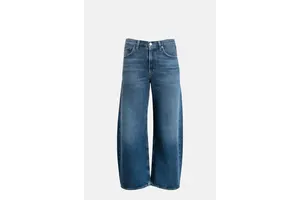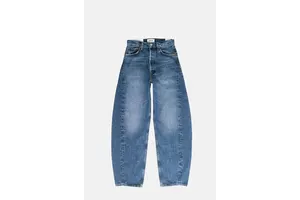
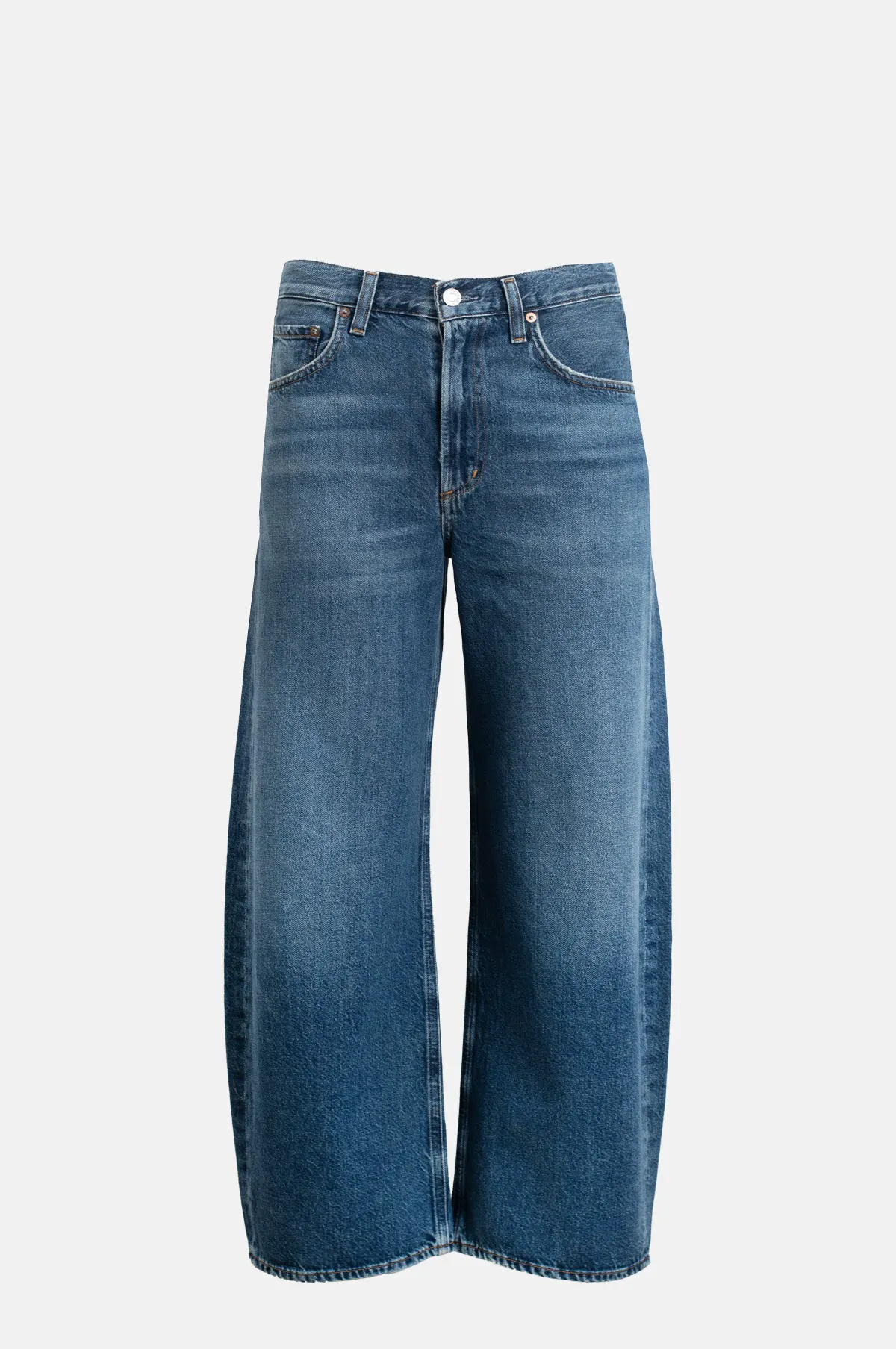

A cropped jean from Agolde in non-stretch denim with a curved seam down a wide leg, sitting low on the hips, in a medium worn indigo, listed at 320 GBP with seven of eight sizes in stock. This page publishes more useful numbers than most in this run: a rise, an inseam, a leg opening, a fit verdict and the height of the model and the size she wears. And unusually, the numbers agree with each other. The inseam is 69 cm, the rise is eleven and a half inches, which is 29 cm, and the two add to 98 cm, which is exactly the total length the table publishes. Three figures from two different places on the page that reconcile to within a couple of millimetres, which this run has almost never been able to say. But one of those numbers contradicts the words around it. The product is named Low Curve, the description says it sits low on the hips, and the published rise is eleven and a half inches, which by any conventional measure is a high rise. Either the brand measures its rise from somewhere else, or the copy is wrong, and the page does not say which. The reference is the Low Curve Jean Crop in Curb. Dongguan Bafinasa Garments Co., Ltd. develops comparable denim on OEM and ODM terms, from denim selection and wash development to retail or FBA ready packing. We publish this as a development reference and build your own version of it, and we do not supply the branded original or reproduce anyone else's label.
Key Features
- Rise of 11 1/2 in published, on a jean named Low Curve and described as sitting low on the hips. See the note below
- A published inseam of 69 cm, a rise of 29 cm and a total length of 98 cm that reconcile with each other. See the note below
- Waist grading 2, 2, 1, 1, 1, 2 and 2 cm across eight sizes, which is uneven. See the note below
- Actual waist running about two to three and a half inches above the number on the label, and not by a constant amount. See the note below
- Non-stretch weightless denim as stated, with no weight in ounces and no shrinkage or sanforized statement. See the note below
- Curved seam along a wide leg as stated, which is a patterned seam and not a straight one. See the note below
- Rise, inseam, leg opening and model height all published, and a care instruction with four clauses
Customisable Options
- Denim: non-stretch rigid cotton to the reference, with the weight in ounces per square yard and the shrinkage stated, or a comfort stretch or a power stretch, each quoted separately
- Wash: medium worn indigo to the reference, developed and approved on a swatch, or a rigid unwashed, a black, a light stone or a bleach, each quoted separately
- Rise: low, mid or high, each specified in inches as a front rise measured from the crotch seam to the top of the waistband at the front, so the measurement point is unambiguous
- Leg: cropped barrel to the reference, with the curved seam drawn on the pattern, or a straight barrel, a wide leg, a straight leg or a tapered leg
- Length: cropped inseam to the reference, held constant across sizes or offered in two inseams, with the shrinkage allowed for
- Closure: zipper fly to the reference, or a button fly, each quoted separately
- Denim weight and shrinkage, wash development, rise measurement point, leg opening as flat or around, inseam options, hardware finish, size set, colour development, private label and care labelling
Specifications
| Style | Cropped barrel leg jean in rigid denim with a curved seam, sitting low on the hips |
| Reference | Agolde, Low Curve Jean Crop, style A283B-1604, curb, sizes 24 to 31 |
| Composition | 100% regenerative cotton as stated, with no programme and no certification named. See the note below |
| Denim | Non-stretch, weightless denim washed down for a soft hand, as stated, with no weight in ounces and no shrinkage given. See the note below |
| Wash | Medium worn indigo as stated, with no wash process named |
| Fit | Slouchy, cropped and tapered with a barrel leg, stated as true to size. See the note below |
| Rise | 11 1/2 in as stated, or 29 cm. See the note below |
| Inseam | 27 1/2 in as stated on the product, and 69 cm in the table. See the note below |
| Leg Opening | 21 in as stated, with nothing to say whether it is flat or around. See the note below |
| Seam | A curved seam along the wide leg creating a barrel effect, as stated, with no curve specification |
| Closure | Zipper fly closure as stated |
| Care | Machine wash cold inside out with like colours, tumble dry on a low setting, as stated. See the note below |
| Sizes Offered | 24 to 31, eight sizes, seven in stock with the 25 sold out |
| Fit Verdict | This fit is true to size, as stated. See the note below |
| Model | Published: 5'11'', wearing a size 27 |
| Measurements Published | Waist, inseam and total length for all eight sizes, plus rise and leg opening. See the note below |
| Published Waist | 33, 35, 37, 38, 39, 40, 42 and 44 cm flat, or 13.0 through 17.3 in. See the note below |
| Waist Around | 66, 70, 74, 76, 78, 80, 84 and 88 cm, or 26.0, 27.6, 29.1, 29.9, 30.7, 31.5, 33.1 and 34.6 in. See the note below |
| Gap Against the Label | About 2.0, 2.6, 3.1, 2.9, 2.7, 2.5, 3.1 and 3.6 in above the size number. See the note below |
| Published Inseam | 69 cm on all eight sizes, and 27 1/2 in on the product, which is 69.9 cm. See the note below |
| Published Length | 98 cm on all eight sizes, which reconciles with the inseam and the rise. See the note below |
| Published Hip | None, on a jean described as slouchy and sitting low. See the note below |
| Published Thigh | None, on a garment whose whole shape is a barrel leg |
| Denim Weight | Not stated, only the word weightless. See the note below |
| Shrinkage | Not stated, on a rigid jean that is to be tumble dried. See the note below |
| Units | Mixed, with the rise, inseam and leg opening in inches and the table in centimetres. See the note below |
| Photographs | Five |
| Production | Made in Turkey as stated. See the note below |
| Reference Retail | 320 GBP as listed, quoted to show the price band this sits in, not as our price |
| Category | Filed by the reference under jeans |
| Occasion | Everyday, weekend, work, year round, dressed up or down |
| MOQ | 100 pcs per style per colourway, mixed sizes and colourways accepted |
| Sampling | 7-10 days after tech pack or reference sample confirmation |
| Bulk Lead Time | 20-30 days after sample approval and deposit |
| Service | OEM / ODM / private label, denim sourcing by weight and shrinkage, wash development and approval, curved seam pattern work, hardware and zip specification, retail or FBA ready packing |
Size Chart as Published by the Reference
| Size | Waist (flat) | Inseam | Total Length |
|---|---|---|---|
| 24 | 33 cm | 69 cm | 98 cm |
| 25 | 35 cm | 69 cm | 98 cm |
| 26 | 37 cm | 69 cm | 98 cm |
| 27 | 38 cm | 69 cm | 98 cm |
| 28 | 39 cm | 69 cm | 98 cm |
| 29 | 40 cm | 69 cm | 98 cm |
| 30 | 42 cm | 69 cm | 98 cm |
| 31 | 44 cm | 69 cm | 98 cm |
The waist figures are flat half measures taken with the jean laid down, doubling to 66, 70, 74, 76, 78, 80, 84 and 88 cm around, or 26.0, 27.6, 29.1, 29.9, 30.7, 31.5, 33.1 and 34.6 in. Those run about two to three and a half inches above the number on the label, and the gap is not constant, because the waist grade is uneven at two, two, one, one, one, two and two centimetres. The inseam is published as 69 cm and the total length as 98 cm on all eight sizes. The rise is published as 11 1/2 in, or about 29 cm, and 69 plus 29 is 98, so the three figures reconcile. The length column in our proposed chart below follows our generic two centimetre template; for denim we would in fact hold the inseam constant and publish the rise and the shrinkage instead, which is the argument made in the notes.
Our Proposed Body Chart
| Size | Body Bust | Body Waist | Body Hips | Length | Source |
|---|---|---|---|---|---|
| 24 | 31 in / 79 cm | 24 in / 61 cm | 34 in / 86 cm | 69 cm / 27.2 in | Our proposal |
| 25 | 31 in / 79 cm | 24 in / 61 cm | 34 in / 86 cm | 71 cm / 28 in | Our proposal |
| 26 | 33 in / 84 cm | 26 in / 66 cm | 36 in / 91 cm | 73 cm / 28.7 in | Our proposal |
| 27 | 33 in / 84 cm | 26 in / 66 cm | 36 in / 91 cm | 75 cm / 29.5 in | Our proposal |
| 28 | 35 in / 89 cm | 28 in / 71 cm | 38 in / 97 cm | 77 cm / 30.3 in | Our proposal |
| 29 | 35 in / 89 cm | 28 in / 71 cm | 38 in / 97 cm | 79 cm / 31.1 in | Our proposal |
| 30 | 37 in / 94 cm | 30 in / 76 cm | 40 in / 102 cm | 81 cm / 31.9 in | Our proposal |
| 31 | 39 in / 99 cm | 32 in / 81 cm | 42 in / 107 cm | 83 cm / 32.7 in | Our proposal |
Occasions and Styling
Suits everyday, weekends and work, year round. A cropped barrel leg is a shape rather than a basic, so it carries an otherwise plain outfit, and the crop is what makes it work with a boot or a flat rather than needing a heel.
Production and Quality Control
The reference publishes a waist, an inseam and a total length for eight sizes, plus a rise, a leg opening, a fit verdict, a care instruction with four clauses, the country of make, the height of the model and the size she wears. Its three length figures reconcile with each other, which is rare. Its waist grade is uneven, it mixes inches and centimetres on one page, and it gives no denim weight, no shrinkage, no hip and no thigh. Three things follow: the rise that contradicts the name, the numbers that do agree, and the two specifications denim cannot do without.
Eleven and a half inches, called low, and that is the first thing. The jean is named Low Curve, the bullets say it sits low on the hips, and the published front rise is eleven and a half inches. In ordinary denim terms that is not a low rise. A front rise, taken from the crotch seam up to the top of the waistband at the front, runs about seven to nine inches on a low rise jean, about nine to eleven on a mid, and above eleven on a high. Eleven and a half sits at the top of the mid range and into the high range, and it is the sort of number you find on a jean that comes up to or above the navel. So the number and the word are pulling against each other, and it is worth being careful about which is wrong, because there are two possibilities and the page gives no way to choose between them. The first is that the brand measures its rise from somewhere other than the convention, and brands genuinely do differ: some measure to the top of the waistband and some to the bottom, some measure along the front seam and some along the side, and the difference between the front and the side measurement on a curved waistband can be an inch or more. The second is that the copy is describing the previous version of the style, or using low to mean slouchy rather than to mean a low rise, since the bullets also call it slouchy and low slung. Both are plausible and the customer cannot tell. This run has argued on garment after garment that a measurement needs its origin stated, and here is the cleanest case yet, because the ambiguity is not a rounding detail: depending on which convention is meant, this is either a low-slung jean or a high-rise one, and those are garments a customer buys for opposite reasons. The fix is one clause, front rise measured from the crotch seam to the top of the waistband, and it settles it. It is worth adding why the rise matters more than usual on this particular jean, and it is the crop. A cropped jean is defined by where its hem falls, and where the hem falls is the sum of two things: how high the waistband sits on the body, which is the rise, and how long the leg is below the crotch, which is the inseam. The inseam here is fixed at 69 cm on every size. So the only variable that places the hem is the rise, and the one figure on the page that places the rise is the one figure that contradicts the copy. A customer therefore has a fixed inseam and an ambiguous rise, and cannot work out whether she is buying a crop that sits above the ankle or a jean that comes to the floor. The model is five feet eleven and wears a size 27, which helps, but only for her height.
The numbers that do agree, and the ones that wobble, and that is the second thing. Start with the good news, because this run rarely gets to give it. The table publishes an inseam of 69 cm and a total length of 98 cm. Separately the page publishes a rise of eleven and a half inches, which is 29.2 cm. Add 69 to 29.2 and you get 98.2, against a published total length of 98. That is a reconciliation to within two millimetres across three figures published in two different places and in two different units, and it is the first time in this run that a page's numbers have been self consistent in this way. It means the figures were measured rather than invented, and it means a customer can trust them. There is one small wrinkle worth recording because it shows the two figures came from different sources: the product name and the fit line say the inseam is twenty seven and a half inches, which is 69.9 cm, while the table says 69 cm, so the table rounds down by about a centimetre. That is a rounding difference rather than an error, and it is the sort of thing that happens when one figure is converted from inches and the other is measured in centimetres, but on a page that otherwise reconciles so well it is worth a line. Now the wobble. The waist reads 33, 35, 37, 38, 39, 40, 42 and 44 cm, so the steps between sizes are two, two, one, one, one, two and two centimetres. That is not smooth: the four sizes from 26 to 29 go up by a single centimetre each, and the sizes at both ends go up by two. It is worth saying what that does, because it is visible to the customer in a way most grading irregularities are not. Doubling each figure gives a waist around of 26.0, 27.6, 29.1, 29.9, 30.7, 31.5, 33.1 and 34.6 in, and the label numbers are 24 to 31, so the gap between what the label says and what the garment measures is about 2.0, 2.6, 3.1, 2.9, 2.7, 2.5, 3.1 and 3.6 inches. That gap is the well known gap between a jean's label size and its actual measurement, and on most brands it is at least steady. Here it is not: it rises to 3.1 at the 26, falls back to 2.5 at the 29 and then climbs to 3.6 at the 31. So a customer who has learned her size in this brand by trial will find that the relationship between the number on the label and the garment she gets changes twice across the range, and she will have to relearn it. That is the practical cost of an uneven grade, and it is worth being fair that there may be a good reason: some brands deliberately compress the grade in the middle of the range because that is where most of their sales are, and a finer grade there fits more people well. If that is what is happening, it is a smart decision and it should be said, because otherwise it reads as an error. This run has now found uneven grading on a dress and a jacket in the same batch as this, and on several garments before them, and in every case the same two things are true: it is invisible to the customer until she compares sizes, and one line in the chart would make it either deliberate or fixed.
Weight, shrinkage, and what rigid denim does without them, and that is the third thing. Denim is specified by weight, and its unit is ounces per square yard: ten ounce is a light jean, twelve is a mid, fourteen is a heavy one, and the weight decides the drape, the warmth, how the jean fades and how long it lasts. This page says weightless, which is a word and not a number, and it is a word pulling in an unusual direction, because the same description also asks for authentic rigid character and an ultra-soft hand. Those three do not sit comfortably together: a very light rigid denim tends toward the papery, and softness in a rigid jean usually comes from heavy washing rather than from the cloth, and the heavier the wash the less authentic the character looks. Getting all three is a real development job and it is exactly what a mill would want a weight and a wash standard for. So the missing number is not a nicety here, it is the specification that decides whether the cloth can do what the copy claims. Then shrinkage, which is the other denim number and which is missing too. Rigid cotton denim shrinks. It shrinks because the yarn was put under tension in the loom and water releases it, and an untreated rigid jean can lose three to five per cent of its length on the first wash, which on a 69 cm inseam is two to three and a half centimetres. Mills control this by sanforizing, which is a controlled pre-shrinking process, and a jean is either sanforized or it is not, and if it is, the residual shrinkage is quoted as a figure, usually under one or two per cent. This page says neither, and it matters here more than on most jeans for a specific reason: the care instruction says tumble dry on a low setting, and tumble drying is the single most effective way to shrink a rigid jean, since it applies heat and agitation together. So a customer is being told to do the thing most likely to change the length of a garment whose length is its defining feature, on a garment with no shrinkage figure published. The crop she buys is not necessarily the crop she will have after two washes. Two clauses would fix it: state the residual shrinkage, and either say sanforized or, if it is not, say so and give the expected shrinkage. It is worth crediting what the care label does get right, because it is the most complete in this run: machine wash cold, inside out, with like colours, and tumble dry low. Cold and inside out and with like colours are all specifically about indigo, which bleeds, and a medium indigo wash on a jean washed hot with pale clothes will ruin them, so those clauses are doing real work. The one thing left out is how often to wash it, which on an indigo jean is the advice that preserves the colour longest, and which is worth a clause. Then two smaller absences of the usual kind. The leg opening is given as twenty one inches and the page does not say whether that is measured flat across the hem or all the way round, and the difference is a factor of two: flat it is a wide barrel hem of about 106 cm around, which matches the description, and around it would be a narrow hem of about 53 cm, which would contradict it. This run has met flat versus around ambiguity on nearly every garment in fifteen batches and it is never stated. And no hip and no thigh are published on a jean described as slouchy and sitting low, where the hip is the measurement that decides whether it stays up. Finally, one positive worth recording: the jean is made in Turkey. Turkey is one of the few countries with denim mills, wash houses and garment factories all in reach of each other, so a jean made there has had its cloth and its wash developed close to where it was sewn, which is a meaningful statement about a denim product in a way that a country of origin often is not. Every bulk shipment gets a measurement report against your approved chart.
Optional upgrades include stating the front rise and the point it is measured from so the low claim can be checked, stating the denim weight in ounces per square yard and reconciling it with the weightless and rigid claims, stating the residual shrinkage or stating that the denim is sanforized, holding the inseam constant but publishing the rise and the shrinkage so the crop can be worked out, offering a second inseam or an uncropped length, smoothing the waist grade or stating the compressed middle grade as deliberate, stating the leg opening as flat or around and in centimetres to match the table, publishing the hip and the thigh, adding a washing frequency note to protect the indigo, specifying the curved seam on the pattern, developing and approving the wash on a swatch, a comfort stretch option, straight leg and tapered leg options, a button fly option, hardware finish, size set, colour development, private label, hangtag and care labelling.
Pre-production sample approval, in-line inspection during cutting and sewing, and a final AQL inspection before packing, with measurement reports and photos shared before shipment.
Send us your tech pack, a photo or a reference garment and we will quote within 24 hours. Contact bafinasa@bafinasa.com or WhatsApp +86 13827222469.