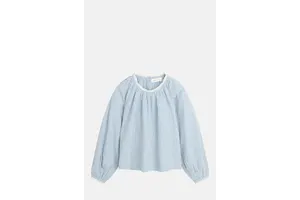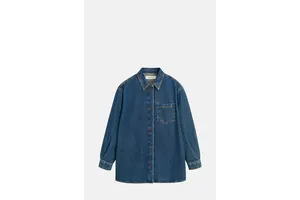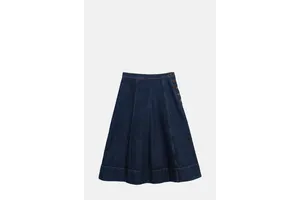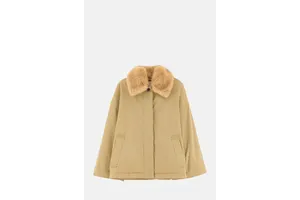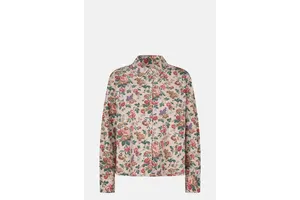
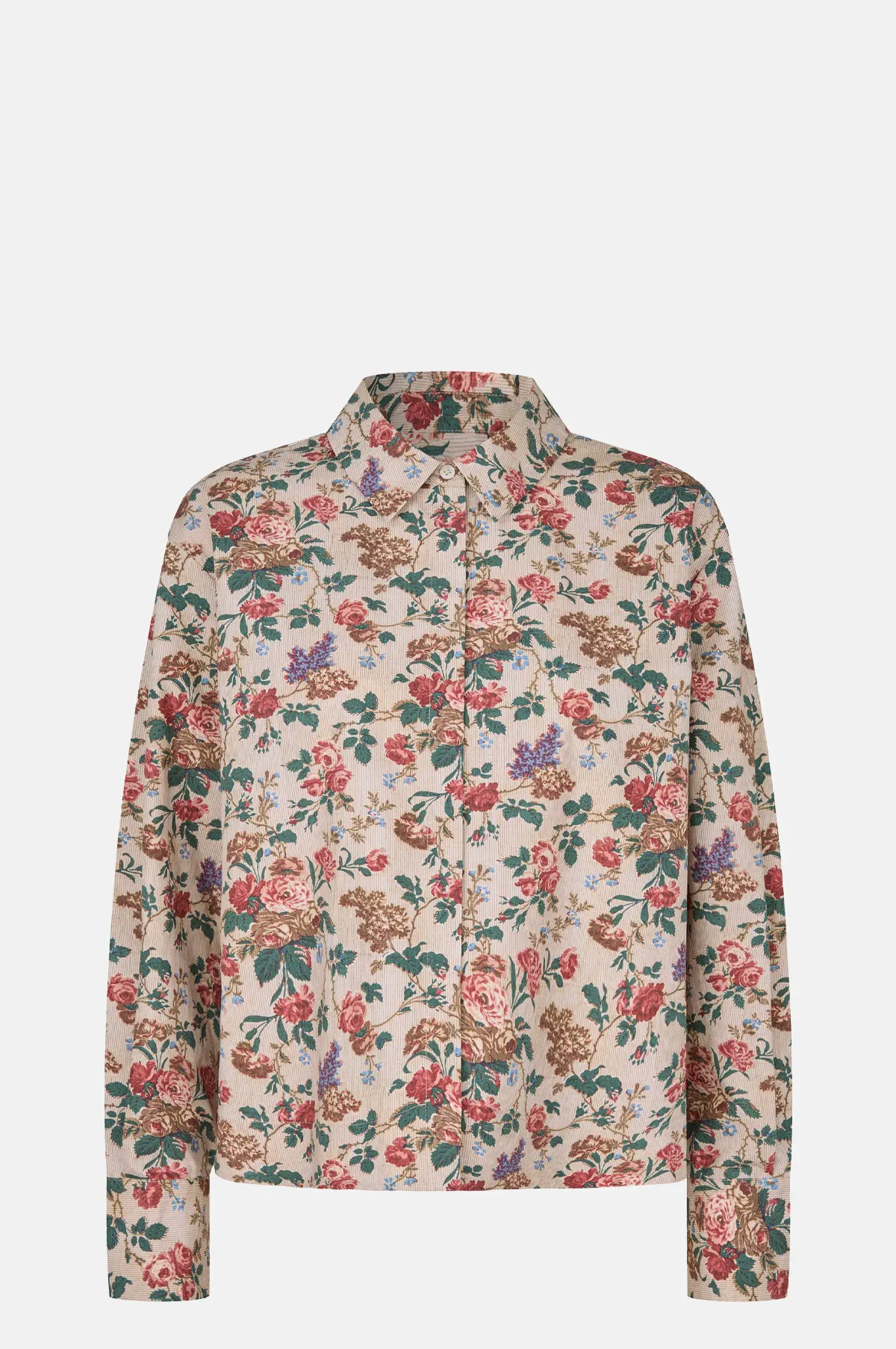

A printed cotton shirt from Tapis Noir in a nineteenth century French floral taken from the brand's archive of antique textiles, boxy and slightly cropped with a neat collar, wide sleeves and mother-of-pearl buttons, listed at 229 GBP with two of three sizes in stock. Its chest column grades by four centimetres per size, which is twice the step most garments in this run use, and that gives it a property no other garment in this run has. The chest works out at 116 centimetres around at the smallest size and 132 at the largest, against a body bust that grows by four inches over the same range, so the ease rises from about twelve and a half inches to fifteen. Every other garment this run has measured loses ease as the size goes up, because a flat grade of two centimetres is less circumference than a body grade of two inches, and this one gains it because four centimetres is more. The blouse published alongside this one, from another brand, is the exact opposite: it grades by one centimetre and its ease collapses from seven and a half to under three. Two shirts, one batch, one too generous and one too tight, and in both cases the fit changes character across the range. The reference is the Frances Cotton Shirt in Rose Beige. Dongguan Bafinasa Garments Co., Ltd. develops comparable printed shirts on OEM and ODM terms, from cloth and print development to retail or FBA ready packing. We publish this as a development reference and build your own version of it, and we do not supply the branded original or reproduce anyone else's label.
Key Features
- Boxy, slightly cropped fit as stated, with about twelve and a half inches of ease at the smallest size rising to fifteen at the largest. See the note below
- Chest grading four centimetres per size, which is why the ease grows rather than falls. See the note below
- 100% organic cotton as stated in both the bullets and the panel, the first organic claim in this run where the two agree, with no certification named. See the note below
- Mother-of-pearl buttons as stated, the most specific button material in this run, with no count, no size and nothing to say whether they are genuine shell. See the note below
- An archive print kept at a larger scale as stated, with no repeat given, on a page that sells the scale of the print as its feature. See the note below
- The old repairs and patches of the original piece kept in the design as stated, which is a print that depicts damage. See the note below
- Model height and size worn both published, 179 cm in a size 1/Medium
Customisable Options
- Cloth: printed organic cotton to the reference, with the weight and the certification named, or a conventional cotton, a cotton lawn or a viscose, each quoted separately
- Print: archive floral to the reference, with the repeat published in centimetres and the placement specified, or a smaller scale version, or a different archive print, or a placement print
- Fit: boxy and slightly cropped to the reference with the ease held constant at about twelve inches, or graded two centimetres so the ease stays even, or a closer fit
- Buttons: mother-of-pearl to the reference, genuine or imitation stated, with the count and the size in ligne specified, or corozo, or a covered button, or a concealed placket
- Sleeves: wide to the reference, with the cuff width and the fullness specified and the sleeve graded across the sizes, or a gathered cuff, or a narrow sleeve
- Collar: neat collar to the reference, with the collar height and the collar spread specified, or a band collar, or a mandarin collar
- Cloth weight and certification, print repeat and placement, ease and grading step, button specification and care, sleeve specification and grading, collar specification, size set, colour development, private label and care labelling
Specifications
| Style | Boxy slightly cropped shirt in printed organic cotton with mother-of-pearl buttons |
| Reference | Tapis Noir, Frances Cotton Shirt, style TN26024003, rose beige, sizes 0 to 2 |
| Composition | 100% organic cotton as stated in both the bullets and the panel, with no certification named. See the note below |
| A nineteenth century French flower print in pink, purple and brown on an off-white ground, from an archive of antique fabrics, kept at a larger scale, as stated, with no repeat given. See the note below | |
| Print Detail | The old repairs and patches from the original archive piece are kept in the design, as stated. See the note below |
| Fit | Boxy shape with a slightly cropped fit as stated. See the note below |
| Collar | Neat collar as stated, with no height and no spread given. See the note below |
| Sleeves | Wide sleeves as stated, measured at 57 cm on all three sizes. See the note below |
| Buttons | Delicate mother-of-pearl buttons as stated, with no count, no size and nothing to say whether they are genuine shell. See the note below |
| Care | Wash at 30 degrees Celsius as stated, with no drying, no ironing and nothing about the buttons. See the note below |
| Sizes Offered | 0/Small, 1/Medium and 2/Large, three sizes, two in stock with the Small sold out. See the note below |
| Size Conversion | Published in the size labels: 0 is Small, 1 is Medium and 2 is Large |
| Model | Published: 179 cm tall, wearing a size 1/Medium |
| Colour Accuracy | A note on the page directs the customer to the photograph on a white background as the one showing the colour most accurately. See the note below |
| Measurements Published | Pit to pit, sleeve length and total length for all three sizes, with the sleeve column headed Sleve. See the note below |
| Published Chest | Pit to pit 58, 62 and 66 cm flat, or 22.8 through 26.0 in. See the note below |
| Chest Around | 116, 124 and 132 cm, or 45.7, 48.8 and 52.0 in. See the note below |
| Ease Against Body Bust | About 12.7, 13.8 and 15.0 in from smallest to largest, so the ease grows. See the note below |
| Published Sleeve | 57 cm on all three sizes, with no grading. See the note below |
| Published Length | 58, 60 and 62 cm, grading two centimetres per size |
| Print Repeat | None, on a page that sells the scale of the print. See the note below |
| Button Specification | None. See the note below |
| Collar Specification | None. See the note below |
| Published Hem | None, on a garment described as boxy |
| Cloth Weight | Not stated |
| Certification | None named, on a page that claims organic twice. See the note below |
| Photographs | Six |
| Production | Made in China as stated |
| Reference Retail | 229 GBP as listed, quoted to show the price band this sits in, not as our price |
| Category | Filed by the reference under blouses and shirts |
| Occasion | Spring, summer and autumn, everyday, weekend, work, as a set with the matching skirt as the reference suggests |
| MOQ | 100 pcs per style per colourway, mixed sizes and colourways accepted |
| Sampling | 7-10 days after tech pack or reference sample confirmation |
| Bulk Lead Time | 20-30 days after sample approval and deposit |
| Service | OEM / ODM / private label, organic cotton sourcing with certification, print development and repeat setting, mother-of-pearl button sourcing, retail or FBA ready packing |
Size Chart as Published by the Reference
| Size | Pit to Pit (flat) | Sleeve Length | Total Length |
|---|---|---|---|
| 0 / Small | 58 cm | 57 cm | 58 cm |
| 1 / Medium | 62 cm | 57 cm | 60 cm |
| 2 / Large | 66 cm | 57 cm | 62 cm |
The chest figures are flat half measures taken with the shirt laid down, doubling to 116, 124 and 132 cm around, or 45.7, 48.8 and 52.0 in. Against a body bust of 33, 35 and 37 in across S to L, the ease is about twelve and seven tenths inches at the smallest and about fifteen at the largest, so the shirt gets looser as it gets bigger, which is the opposite of what happens on almost every garment in this run. The cause is the grading step: four centimetres of flat width per size is 3.15 in of circumference against a body grade of two inches, so about 1.15 in of ease is gained at every step. The sleeve is published as 57 cm on all three sizes, and the length grades two centimetres per size.
Our Proposed Body Chart
| Size | Body Bust | Sleeve | Body Waist | Body Hips | Length | Source |
|---|---|---|---|---|---|---|
| 0 / Small | 33 in / 84 cm | 57 cm | 26 in / 66 cm | 36 in / 91 cm | 58 cm / 22.8 in | Our proposal |
| 1 / Medium | 35 in / 89 cm | 58 cm | 28 in / 71 cm | 38 in / 97 cm | 60 cm / 23.6 in | Our proposal |
| 2 / Large | 37 in / 94 cm | 59 cm | 30 in / 76 cm | 40 in / 102 cm | 62 cm / 24.4 in | Our proposal |
Occasions and Styling
Suits spring, summer and autumn, everyday and weekends. A printed shirt with a boxy cut is a piece that carries an outfit on its own, so it works with a plain trouser or, as the reference suggests, with the matching skirt as a set, and the print is what makes it read as dressed rather than casual.
Production and Quality Control
The reference publishes three columns for all three sizes, states its fibre as organic in both the bullets and the panel, describes the print and its provenance, the fit, the collar, the sleeves and the buttons, gives a care instruction, names the country of make, publishes the height of the model and the size she wears, and adds a note telling the customer which photograph shows the colour accurately. It gives no print repeat, no cloth weight, no button specification, no collar specification and no certification, and its sleeve does not grade. Three things follow: the ease that grows, the organic claim that finally agrees with itself, and the buttons and the print.
Fifteen inches, twelve and a half, and the only garment in this run that gets looser, and that is the first thing. The chest measures 116 cm around at the size 0 against a body bust of 84 cm at a Small, so there is about twelve and seven tenths inches of ease, and at the size 2 it is 132 cm against 94 cm, so about fifteen inches. So the shirt is very boxy at the small end and even boxier at the large end, and the ease grows by about 1.15 in at every size. The arithmetic is worth setting out because it is the mirror of everything else in this run. Four centimetres of flat width per size is eight centimetres of circumference per size, which is 3.15 inches. The body bust grades two inches per size. So the garment gains 3.15 in where the body gains 2 in, and the difference, 1.15 in, is added to the ease at every step. Every other garment this run has measured works the other way, because the usual flat grade is two centimetres, which is 1.57 in of circumference against the same 2 in body grade, so about 0.43 in of ease is lost at every step and garments get closer fitting as they get bigger. The blouse published alongside this one, from another brand, grades by one centimetre and loses 1.2 in at every step, which is nearly three times the usual loss. So in one batch this run has found both extremes: a grade too small, where the garment stops being boxy by the time it reaches the largest size, and a grade too large, where it becomes more boxy. Both are the same fault seen from two sides, and the fault is that the grading step and the body step are not being related to each other at all. It is worth saying what the right answer is, because there are two and the difference between them is a decision rather than a correction. If the designer wants every size to be equally boxy, then the chest must grade by exactly the body grade plus whatever ease is wanted, which on a two inch body grade is about two and a half centimetres of flat width per size, and the ease will hold at whatever figure was chosen. If the designer wants the ease to drift in the ordinary way, then the chest grades two centimetres and the ease falls gently by about 0.43 in per size, which is what most of the trade does and what most customers are used to. What should not happen is either of the two things in this batch, because in both the garment changes character across its own size range and the word boxy stops meaning anything. It is worth adding one defence for this shirt, which the run should make because it is fair. A garment with twelve to fifteen inches of ease is a garment that does not need many sizes, and this one comes in three, which is fewer than any other shirt in this run. That is the right decision and this run has said so before about an oversized sweater: ease and size range are substitutes, and a designer who has cut something this full is not being lazy by offering three sizes. The problem is that the customer cannot see that, because the ease is not published, so a woman who would comfortably wear the Medium has no way to know it and will assume the shirt does not come in her size.
Organic, twice, and still no certificate, and that is the second thing. The bullets say 100% organic printed cotton and the specification panel says 100% organic cotton. This run has now met four fibre claims of this kind and it is worth lining them up, because they form a sequence and the sequence has a direction. On the Antonyms tee the description said organic cotton and the panel said simply cotton. On a tee from another brand the description said recycled cotton and the panel said premium cotton. On a checked dress the description said wool mix and the panel said polyester. And on the jean two batches ago the description said regenerative cotton and the panel agreed, but no programme was named. In every one of those the prose made a claim and the technical panel did not repeat it, and this run has argued that the direction matters, because the panel is the half a factory works from. Here the two halves agree. The prose says organic and the panel says organic, and that is the first time in this run, and it is worth saying plainly that this is better and that the brand has done something most of its peers have not. But it is still not enough, and the reason is worth setting out because it is the same reason every time. Organic is not a self-declaring word. It means the fibre was grown to a standard, under a scheme, with records, and the scheme is what gives the word its meaning. For cotton the usual one is the Global Organic Textile Standard, which covers the farming and also the processing, and there are national schemes and certification bodies besides. A claim of organic cotton without a scheme named is a claim that cannot be checked by anyone, including the factory that has to buy the cloth, because a mill cannot quote against a word. So the fix is one line: the name of the standard and, ideally, the certificate number. It is worth adding what else is missing from the same panel, which is short: no cloth weight, on a shirt whose drape depends on it and whose boxy shape needs enough weight to fall properly, since a very light cloth with twelve inches of ease will cling and a heavier one will hang. Then the buttons, which are the other detail this page is specific about and which is worth more than a sentence. Mother-of-pearl is the most precise button material in this run, and it is worth saying what it actually is: it is nacre, the iridescent inner layer of a shell, cut into discs and polished, and it is a natural material with real properties. It is brittle, so it cracks where a plastic button would flex. It is attacked by heat and by some solvents. It loses its lustre if it is abraded. And it is expensive and slow to set, which is part of what the customer is paying for at this price. Three specifications follow and none is given. The first is whether they are genuine shell or an imitation, because there is a great deal of plastic finished to look like nacre and the two are not the same product at this price, and the page does not say. The second is the count and the size, which the trade gives in ligne and which decides the spacing down the placket, and this run has now found that gap on every closure it has examined. The third is the care, which is where this page does real damage: the label reads wash at 30 degrees Celsius and nothing else, and a mother-of-pearl button put through a machine wash will be knocked against the drum and will dull and can crack, and the ordinary protections are to wash inside out, to use a delicates bag, or to accept that the shirt will need its buttons replaced eventually. None of that is said. It is worth noting the shape of the omission, because this run has met it now on a leather patch, on a wool jumper, on a faux fur jacket and here: the care instruction covers the cloth and not the components, and the components are what fail first.
A print sold on its scale, with no scale given, and that is the third thing. The description says the print comes from an archive of antique fabrics and is a nineteenth century French flower print, and it says the brand could not resist putting it on an even larger scale. So the page is explicitly selling the scale of the print as the point of the garment, and it never says what that scale is. A printed pattern is specified by its repeat, which is the distance before the pattern starts again, given in centimetres, and that single figure determines almost everything about how the print will look on a finished garment. It determines how many flowers appear on a shirt front, because a fifteen centimetre repeat gives you several and a sixty centimetre repeat may give you one. It determines whether the motif can be placed symmetrically on a placket. It determines how much cloth is wasted, because a large repeat cannot be shifted along the marker to save room, exactly as a nap cannot be flipped, so a large-scale print costs more cloth than a small one, and this run made that argument about velvet and corduroy. And it determines whether the print matches across the seams, which on a shirt means across the placket, the pockets and the yoke, and which is a decision that costs money and has to be made before cutting. None of that can even be discussed without the repeat, and it is not published. It is worth adding what else a large-scale print raises, which is placement. With a repeat that large, where the motif falls on the body varies from shirt to shirt, because two shirts cut from different parts of the same roll will have the flowers in different places. On a small print nobody notices; on a large one it is the first thing she sees, and the trade either accepts it or controls it by cutting every panel from the same point in the repeat, which uses more cloth. Not stated. There is a second thing about this print that is unusual and worth flagging, because it is a customer service issue rather than a specification one. The description says that the brand has delightfully kept the old repairs and patches from the original archive piece in the design. So the print reproduces, as part of the pattern, the patches and repairs on an antique textile. That is a charming idea and it is honestly disclosed here, and this run should credit the disclosure. But it means the finished shirt is printed with images of mended damage, and a customer who does not read the description carefully, or who sees the shirt on a hanger in a shop, may well take those printed patches for faults in a new garment. It is worth saying so on the page in plainer language, and it is worth saying in the packing, because a printed patch is exactly the sort of thing that generates a return and a puzzled email. Then the last two things, briefly. The sleeve is published as 57 cm on all three sizes, so it does not grade, which is the run's most common single fault and which on a size range of only three is a larger share of the range than usual. And the collar is described as neat, which is a word rather than a specification, and a collar is specified by its height and its spread, and neither is given. It is worth finishing on what this page does better than most, because it does two things well. It publishes the model's height, 179 cm, and the size she wears, which is one of the two facts this run has asked for on every garment and which only a handful of brands supply. And it adds a note telling the customer that the photograph on a white background shows the colour most accurately, which is an admission that the other photographs are not colour accurate, and which is the honest version of something this run met last batch, where a jacket's copy admitted in person that the texture did not come across in the picture. Both are admissions that a photograph cannot be trusted, and this one goes further and tells the customer which picture to trust. That is worth crediting, and it is worth noting the obvious corollary: if one image is the accurate one, the other five are not. Every bulk shipment gets a measurement report against your approved chart.
Optional upgrades include publishing the print repeat in centimetres, deciding and stating whether the print is matched across the placket and the yoke and whether the placement is controlled, naming the organic standard and the certificate, stating the cloth weight, holding the ease constant by grading the chest at about two and a half centimetres per size or grading it at two so the ease drifts gently, publishing the ease so the three sizes can be sold to the customers who need them, specifying the mother-of-pearl buttons by count, size in ligne and whether they are genuine shell, adding wash inside out and in a delicates bag to protect the buttons, specifying the collar by height and spread, grading the sleeve across the three sizes, publishing the hem width, stating plainly on the page and in the packing that the printed patches are part of the print, offering a smaller scale version and a placement print option, corozo and covered button options, a band collar and a mandarin collar option, a fourth size, size set, colour development, private label, hangtag and care labelling.
Pre-production sample approval, in-line inspection during cutting and sewing, and a final AQL inspection before packing, with measurement reports and photos shared before shipment.
Send us your tech pack, a photo or a reference garment and we will quote within 24 hours. Contact bafinasa@bafinasa.com or WhatsApp +86 13827222469.