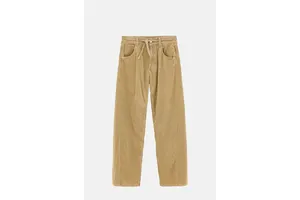
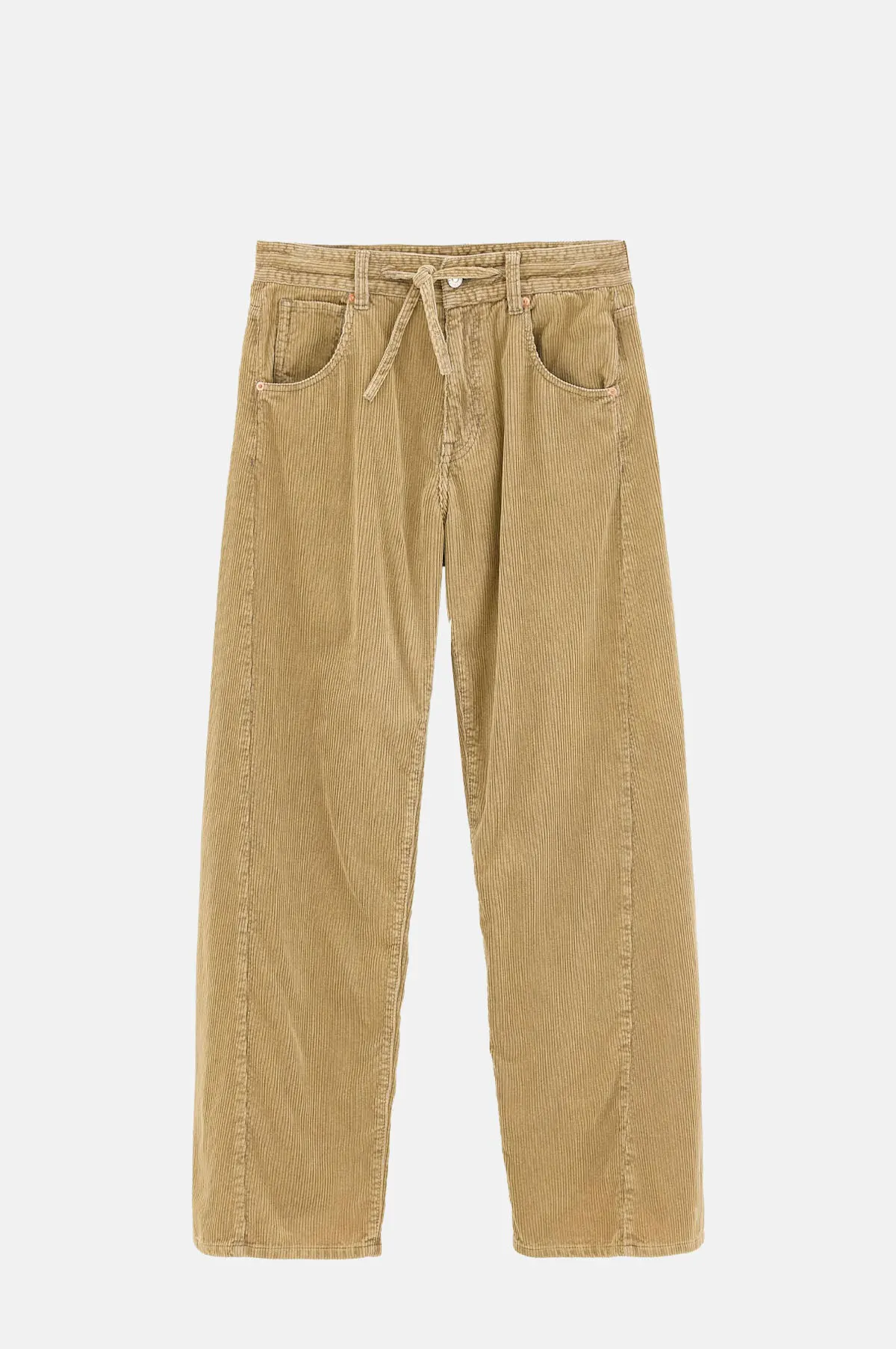

A wide leg trouser from Bellerose in a soft cotton and lyocell corduroy, with an elasticated paperbag waist finished with a self-tie cord, scoop pockets at the front and patch pockets at the back, listed at 165 GBP with four of six sizes in stock. This page does something no other page in this run has done, and it is one word long. Its size table heads the waist column waist 1/2, which is to say it states outright that the figure is a flat half measure and has to be doubled. This run has spent fifteen batches complaining that a published waist could be either flat or all the way round and that no page ever says which, and here is a page that says. It is worth adding immediately that the other trouser from this same brand, published alongside this one, heads the same column simply waist, without the half, so the brand knows how to do it and does it on one page and not the other. Which matters here more than anywhere, because this waist is elasticated, and an elasticated waist has a second ambiguity layered on top of the first: a flat measurement of elastic can be taken with the elastic relaxed or with it stretched, and the two are not close to each other. The reference is the Pearcy Jean in Clay. Dongguan Bafinasa Garments Co., Ltd. develops comparable trousers on OEM and ODM terms, from cloth selection to retail or FBA ready packing. We publish this as a development reference and build your own version of it, and we do not supply the branded original or reproduce anyone else's label.
Key Features
- Waist column headed waist 1/2, which states that the figure is a flat half measure, the only page in this run to do so, while the same brand's other trouser does not. See the note below
- Elasticated paperbag waist as stated, so the flat waist could be the elastic relaxed or stretched, and the page does not say. See the note below
- Self-tie cord as stated, which on a paperbag waist is the thing holding the trouser up, with no cord length and no anchoring described. See the note below
- Wide leg silhouette as stated, with no leg opening, no thigh and no hip published
- Two front scoop pockets and two back patch pockets as stated, with counts and types, and a cotton pocket lining. See the note below
- Corduroy as stated, as on the other trouser from this brand, with no wale count given. See the note below
- Both length columns holding one step then repeating, so the inseam is 77 then 78 and the total length 107 then 108
Customisable Options
- Cloth: cotton lyocell corduroy to the reference, with the wale count and the weight specified, or a cotton corduroy, a wide wale, a needlecord or a plain twill, each quoted separately
- Waist: elasticated paperbag to the reference, with the relaxed and the stretched width both published, or a flat front waistband, or a half elastic back, or a drawstring channel alone
- Tie: self-tie cord to the reference, with the cord length specified and the cord anchored into the structure, or a fixed bow, or a belt loop and a separate belt
- Leg: wide to the reference, with the leg opening and the thigh specified, or a straight leg, a tapered leg or a barrel leg
- Pockets: two scoop and two patch to the reference, with the pocket openings and depths specified, or slash pockets, or welt pockets at the back
- Rise: to the reference, published in centimetres from a named point
- Wale count and cloth weight, relaxed and stretched waist, cord specification and anchoring, leg opening and thigh, pocket specification, rise, size set, colour development, private label and care labelling
Specifications
| Style | Wide leg trouser in corduroy with an elasticated paperbag waist and a self-tie cord |
| Reference | Bellerose, Pearcy Jean, style BW262170 P1908-024, clay, sizes 25 to 30 |
| Composition | 67% cotton and 33% lyocell as stated, with no cloth weight given |
| Cloth | Soft cotton and lyocell blend corduroy as stated, with no wale count and no weight given. See the note below |
| Waist | Elasticated paperbag waist with a self-tie cord as stated. See the note below |
| Fit | Wide-leg silhouette as stated, with no rise published |
| Pockets | Two front scoop pockets and two back patch pockets as stated, with no dimensions given. See the note below |
| Pocket Lining | 100% cotton as stated |
| Trim | Leather brand patch at the rear waist as stated, with no leather specification. See the note below |
| Care | Machine wash at 30 degrees as stated, with no drying instruction and nothing about the leather patch. See the note below |
| Sizes Offered | 25 to 30, six sizes, four in stock with both the 25 and the 30 sold out. See the note below |
| Size Conversion | None published, on a numeric size range. See the note below |
| Model | None stated, no height and no body measurements |
| Measurements Published | Waist 1/2, inseam and total length for all six sizes. See the note below |
| Published Waist | 40, 41, 42, 43, 44 and 45 cm flat, or 15.7 through 17.7 in, headed waist 1/2. See the note below |
| Waist Around | 80, 82, 84, 86, 88 and 90 cm, or 31.5, 32.3, 33.1, 33.9, 34.6 and 35.4 in. See the note below |
| Gap Against the Label | About 6.5, 6.3, 6.1, 5.9, 5.6 and 5.4 in above the size number, which on an elasticated waist is expected rather than misleading. See the note below |
| Published Inseam | 77, 77, 77, 78, 78 and 78 cm, stepping once in the middle. See the note below |
| Published Length | 107, 107, 107, 108, 108 and 108 cm, stepping once in the middle. See the note below |
| Implied Rise | 30 cm on all six sizes, from the two length columns, which agree. See the note below |
| Waist Relaxed or Stretched | Not stated. See the note below |
| Wale Count | None. See the note below |
| Leg Opening | None, on a garment whose whole shape is a wide leg. See the note below |
| Published Hip | None. See the note below |
| Published Thigh | None |
| Cloth Weight | Not stated |
| Photographs | Six |
| Production | Made in Tunisia as stated |
| Reference Retail | 165 GBP as listed, ten pounds below the other corduroy trouser from this brand, quoted to show the price band this sits in, not as our price |
| Category | Filed by the reference under trousers |
| Occasion | Autumn and winter, everyday, weekend, work, with a knit tucked in |
| MOQ | 100 pcs per style per colourway, mixed sizes and colourways accepted |
| Sampling | 7-10 days after tech pack or reference sample confirmation |
| Bulk Lead Time | 20-30 days after sample approval and deposit |
| Service | OEM / ODM / private label, corduroy sourcing by wale count and weight, elasticated waist and tie development, pocket construction, retail or FBA ready packing |
Size Chart as Published by the Reference
| Size | Waist 1/2 (flat) | Inseam | Total Length |
|---|---|---|---|
| 25 | 40 cm | 77 cm | 107 cm |
| 26 | 41 cm | 77 cm | 107 cm |
| 27 | 42 cm | 77 cm | 107 cm |
| 28 | 43 cm | 78 cm | 108 cm |
| 29 | 44 cm | 78 cm | 108 cm |
| 30 | 45 cm | 78 cm | 108 cm |
The waist column is headed waist 1/2, so the figures are flat half measures taken with the trouser laid down, doubling to 80, 82, 84, 86, 88 and 90 cm around, or 31.5, 32.3, 33.1, 33.9, 34.6 and 35.4 in. Those run about five and a half to six and a half inches above the number on the label, which is what an elasticated, gathered waist looks like and is not the vanity gap it would be on a fixed waistband. The grade is a clean one centimetre per size. Subtracting the inseam from the total length gives an implied rise of 30 cm on all six sizes without exception, so the two length columns agree.
Our Proposed Body Chart
| Size | Body Bust | Body Waist | Body Hips | Length | Source |
|---|---|---|---|---|---|
| 25 | 31 in / 79 cm | 24 in / 61 cm | 34 in / 86 cm | 77 cm / 30.3 in | Our proposal |
| 26 | 33 in / 84 cm | 26 in / 66 cm | 36 in / 91 cm | 79 cm / 31.1 in | Our proposal |
| 27 | 33 in / 84 cm | 26 in / 66 cm | 36 in / 91 cm | 81 cm / 31.9 in | Our proposal |
| 28 | 35 in / 89 cm | 28 in / 71 cm | 38 in / 97 cm | 83 cm / 32.7 in | Our proposal |
| 29 | 35 in / 89 cm | 28 in / 71 cm | 38 in / 97 cm | 85 cm / 33.5 in | Our proposal |
| 30 | 37 in / 94 cm | 30 in / 76 cm | 40 in / 102 cm | 87 cm / 34.3 in | Our proposal |
Occasions and Styling
Suits autumn and winter, everyday and weekends. A paperbag waist is the version of a trouser that works with something tucked in, because the gathered waist and the tie are the detail, and the wide leg keeps it from reading as formal.
Production and Quality Control
The reference publishes three columns for all six sizes, heads its waist column waist 1/2 so the customer knows it is a half measure, states a two-fibre composition with percentages, describes the waist, the tie, the leg and the pockets in useful detail, gives a care instruction and names the country of make. It does not say whether the elasticated waist is measured relaxed or stretched, gives no wale count, no weight, no rise, no leg opening and no size conversion, and it is missing both ends of its size range from stock. Three things follow: the two words that settle a fifteen batch argument, elastic relaxed or stretched, and the tie that holds the trouser up.
Waist 1/2, one word, fifteen batches, and that is the first thing. The column is headed waist 1/2. That is a statement that the published figure is a flat half measure and that it doubles to give the waist all the way round, and it is the first time in this run that a page has said so. It is worth setting out how much this matters, because the ambiguity it removes has been one of the two or three most persistent problems in these pages. On the checked skirt earlier in this run, on the velvet trousers, on the linen jumpsuit, on the wool trouser, on the jean in the batch before this one, and on the other trouser from this very brand published alongside this one, a waist was published as a number with nothing to say whether it was the width of the garment laid flat or the distance all the way round it. Those two readings differ by a factor of two, which is not a rounding error, it is the difference between a garment that fits and one that does not, and it has been unresolvable on every page because none of them said. Here it is resolved in one word. And the proof that it is a choice rather than an accident is in the same batch: the Parthe jean from this same brand heads the identical column waist, with no half, so the brand has the habit on one page and not on the other. That is the clearest evidence this run has had that this particular omission is not a technical limitation but an inconsistency, and inconsistencies are fixable in a way that limitations are not, because one person can change a template. It is worth saying what the half measure means for the numbers, because they are large. Doubled, the waist runs 80 to 90 cm around against label sizes of 25 to 30, so the garment measures about five and a half to six and a half inches more than the number on the label. On a fixed waistband that would be alarming, and it would be a trouser that falls down, and this run has treated a gap of that size as vanity sizing when it found it on fixed waists. Here it is not, and the page gives enough information to see why: the waist is elasticated and gathered into a paperbag with a self-tie cord, so it is meant to be wider than the body and then drawn in. That is credit where it is due, because the description explains the construction well enough for the measurement to make sense. But there is a second ambiguity sitting on top of the first, and it is the one this page does not resolve, and on an elasticated waist it is the more consequential of the two.
Relaxed or stretched, and the tie that does the work, and that is the second thing. An elasticated waistband can be measured flat in two states: with the elastic at rest, which is the narrowest the band will ever be on the body, and with the elastic pulled out straight, which is the widest it will go. The two are not close. A band with a relaxed flat width of 40 cm might stretch to 60 or 70, and the difference between them is not a detail, it is the entire answer to the question of who can get into the trouser and how tight it will feel. The published column runs 40 to 45 cm flat, and if those are relaxed figures then the trouser will comfortably take a body several inches larger at every size, and if they are stretched figures then the relaxed waist is much smaller and the range of bodies it fits is narrower. The page does not say, and this run has not met this ambiguity before, which is worth noting: in fifteen batches the flat-versus-around question has come up on nearly every garment, and this is a second and independent question layered on top of it, and it exists only on garments with elastic in them. The remedy is two columns rather than one, relaxed and stretched, and it is what the trade does internally, and it is the single most useful thing a brand can publish on an elasticated garment, because those two numbers together tell a customer both whether it will go on and whether it will stay up. Now the tie. The waist is finished with a matching self-tie cord for a gathered paperbag effect, and it is worth being clear about what the tie is doing, because on this garment it is not decorative. An elasticated waist of 80 cm around on a size 25, whose body waist is about 63 cm, is not being held up by the elastic; the elastic is loose enough to go over the hips and the cord is what draws it in and keeps it there. So the cord is the fastening, and this run made this argument two batches ago about a different garment and it applies here word for word. A tie that carries load has three requirements that a decorative bow does not. It has to be long enough to tie, and no cord length is published, so nobody knows whether the bow in the photograph is the bow you get. It has to be anchored into the structure of the garment rather than stitched to the waistband at one point, because a cord under tension will tear out of a soft waistband or distort it, and no anchoring is described. And it has to be specified, because a cord is a component with a material, a diameter and a construction, and a flat cord and a round cord tie differently and wear differently. There is a fourth point that belongs to the factory rather than the customer, and it is the ordinary one: cords are the part of a garment that catches in the machine and in transit, so they want tacking down for packing and a note on the label. It is worth adding what this means for the fit claim, because the page does not make one and the numbers make it for it: with an elastic waist and a tie, the size range this trouser covers is very wide, and the customer's real question is not which size but how much gathering she wants. Two published waist figures would answer that, and one does not. Then the length columns, which are the good news and worth stating because they are the best-behaved part of this table. The inseam runs 77, 77, 77, 78, 78 and 78, and the total length runs 107, 107, 107, 108, 108 and 108, so subtracting gives an implied rise of 30 cm on all six sizes without a single exception. Two columns that agree perfectly across the whole range. It is worth setting that beside the same brand's other trouser published alongside this one, whose columns disagree on two of its six rows, because together they settle the question: the same brand, one season, one table that reconciles and one that does not, so the reconciliation is a matter of checking rather than of luck.
Both ends gone, and the pockets that were described properly, and that is the third thing. The trouser is offered in six sizes and four are in stock; the 25 has gone and the 30 has gone, leaving the middle four. That is an unusual pattern and worth a note, because this run has found the top size missing on garment after garment and has argued that brands under-buy the larger sizes, and the evidence has been consistent. Here both ends have gone, which is the opposite shape: the extremes sell out and the middle stays. There are two readings and both are plausible. The first is that the brand bought a ratio that over-weighted the middle, which is the common error in the other direction and which leaves the sizes that are hardest to fit sitting on the shelf. The second is that an elasticated, tied waist genuinely fits a wider range of bodies, so customers at both ends of the range are buying the same middle sizes and the extremes are being bought by fewer people who happen to have cleared them out. This run has argued before that ease and size range are substitutes, and if that is what is happening here then it is working: a garment that fits across six inches of waist does not need as many sizes. Either way the customer sees a page with four of six sizes available and no explanation, and the two ends of the range are precisely the customers who most need to know whether the middle will fit them. Now the pockets, which is where this page is genuinely good and where the credit is earned. It says two front scoop pockets and two back patch pockets, which gives a count and a type for each, and it gives the pocket lining its own line at one hundred per cent cotton. That is more pocket specification than most pages in this run by a distance, and it is worth noting what a scoop pocket is, because the word is doing real work: a scoop pocket is cut into the front of the trouser with a curved opening rather than a straight one, and the curve is what lets a hand go in without the opening gaping, and it needs a facing behind it to hold the curve. So the description tells a factory something useful. What is missing is the dimension: no opening width and no depth, on pockets described as deep, and a customer cannot tell whether a phone goes in. And there is one consequence of the pockets that belongs with the waist: scoop pockets cut into the front sit right where a paperbag waist gathers, so the pocket opening and the gathering are competing for the same space on the front panel, and how they are resolved is a pattern decision worth drawing rather than leaving. Then the rest of the absences, short and familiar. No wale count on a corduroy, which is the specification the cloth is bought by and which this run set out in the note on the other trouser from this brand. No cloth weight, on a wide leg whose drape depends on it. No leg opening, on a garment whose whole description is a wide leg. No hip and no thigh, which on a trouser with an elastic waist matter less than on a fixed one, since the elastic does the work, but which decide how the leg hangs. No rise published, although the columns imply 30 cm. No size conversion on a numeric range from 25 to 30, and no model height. And the same leather brand patch at the rear waist as the other trouser, on the same machine wash at thirty degrees, with the same two problems: leather in water stiffens and cracks, and dyed leather bleeds, and neither is mentioned. Every bulk shipment gets a measurement report against your approved chart.
Optional upgrades include publishing the waist both relaxed and stretched, which is the single most useful addition on an elasticated garment, specifying the self-tie cord by length and material and anchoring it into the structure rather than to the waistband, stating the wale count and the cloth weight, publishing the leg opening, the thigh and the hip, publishing the rise in centimetres from a named point, specifying the scoop pocket by opening and depth, replacing the leather patch with a washable alternative or testing it for bleeding and adding a drying instruction, keeping the waist 1/2 labelling on every page in the range and applying it to the other trouser, a flat front waistband, a half elastic back and a drawstring channel option, straight, tapered and barrel leg options, slash and welt pocket options, size set, colour development, private label, hangtag and care labelling.
Pre-production sample approval, in-line inspection during cutting and sewing, and a final AQL inspection before packing, with measurement reports and photos shared before shipment.
Send us your tech pack, a photo or a reference garment and we will quote within 24 hours. Contact bafinasa@bafinasa.com or WhatsApp +86 13827222469.