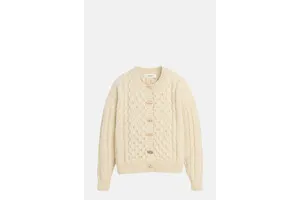
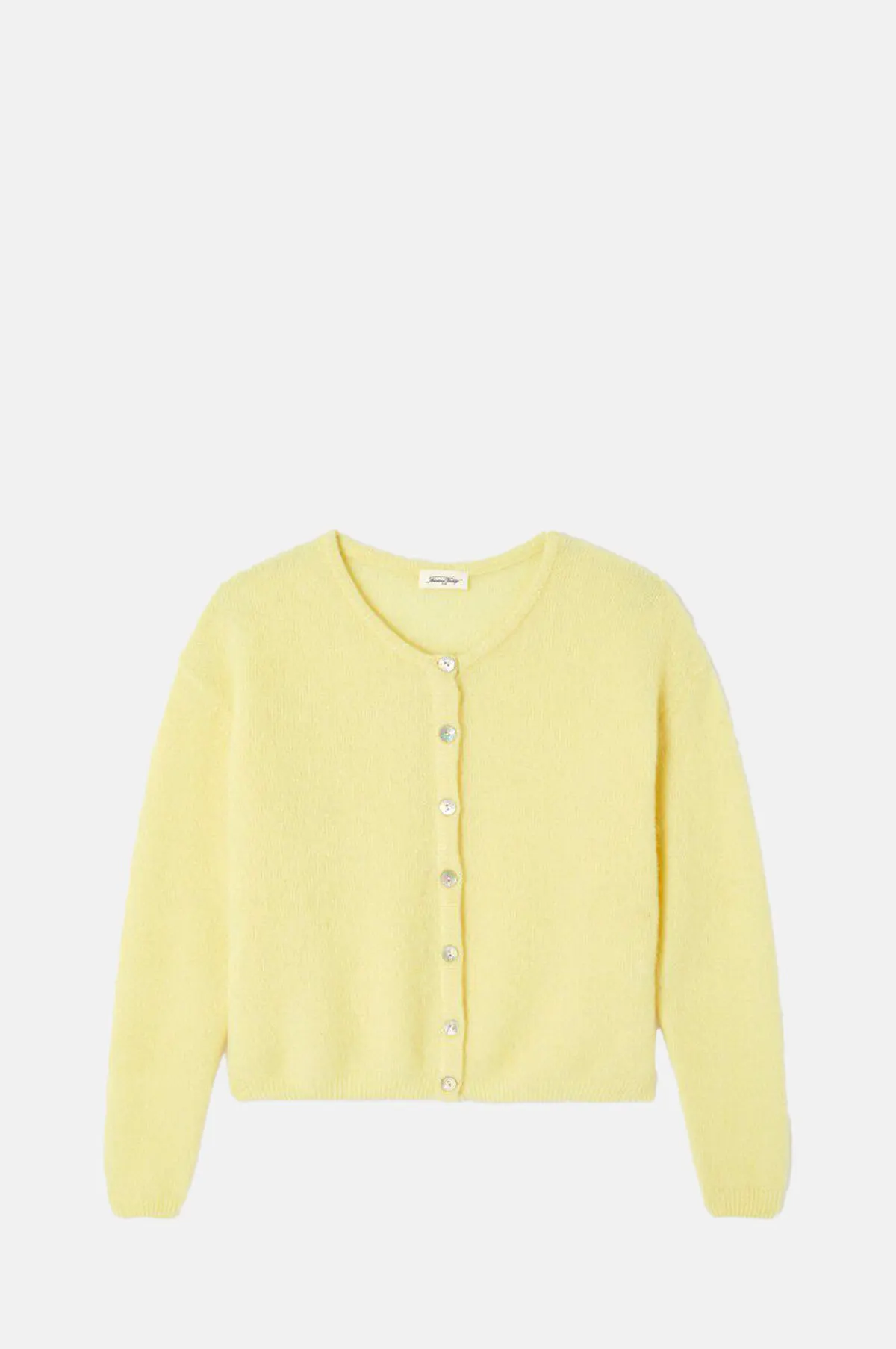

A lemon yellow cardigan from American Vintage in a soft, spongy alpaca and wool blend, with a neat round neck, long sleeves, mother of pearl buttons running down the front and ribbed edges, listed at 165 GBP with all three sizes in stock. Above its size table there is a line this run has never met on any garment: please note this cardigan increases quite a lot in length between sizes. A brand warning its own customers about its own grading is worth stopping for, and the numbers explain why. The total length reads 48, 55 and 60 cm, so it grades seven centimetres and then five, twelve centimetres across two sizes, which is six centimetres per size on a garment that starts at forty eight. The largest size is twenty five per cent longer than the smallest. Meanwhile the chest grades one centimetre and then two. So the cardigan gets a great deal longer and barely any wider as it goes up, and the small size and the large one are not the same garment in two sizes, they are two different garments. The reference is the Vitow Cardigan in Citronnier Chine. Dongguan Bafinasa Garments Co., Ltd. develops comparable knitwear on OEM and ODM terms, from yarn and gauge selection to button specification and retail or FBA ready packing. We publish this as a development reference and build your own version of it, and we do not supply the branded original or reproduce anyone else's label.
Key Features
- A note above the table warning that the length increases a great deal between sizes, the first time in this run a page has flagged its own grading. See the note below
- Total length of 48, 55 and 60 cm, grading seven and then five centimetres, so the L is a quarter longer than the S. See the note below
- Chest grading only one and then two centimetres, against that length grade, so the proportion changes completely across three sizes. See the note below
- Mother of pearl buttons down the front as stated, with no size, count or backing given. See the note below
- 34% alpaca, 34% wool, 29% polyamide and 3% elastane as stated, with no yarn count and no gauge given. See the note below
- Ribbed edges as stated, which is what carries the buttonholes, and soft, spongy and lightweight with a medium thickness as described, none of it numbered
- Hand wash at 40 degrees maximum as stated, with no drying or ironing instruction, on a wool and alpaca blend. See the note below
Customisable Options
- Yarn: an alpaca, wool, polyamide and elastane blend to the reference, or a lambswool, a merino, a cotton or a recycled blend, each quoted separately
- Gauge: to your market, with the machine gauge and the yarn count specified rather than described
- Length: graded to the reference, or held to a consistent proportion with a shorter grade, and cropped, hip and long options
- Buttons: mother of pearl to the reference, or corozo, or horn, or a matched resin button, with the size, the count and the holes specified
- Edges: ribbed to the reference, or a plain band, or a self facing with a stabilised buttonhole
- Neck: round neck to the reference, or a V neck, or a collar
- Yarn count and gauge, fibre blend, button specification, length grade, body length, sleeve length, size set, colour development, private label and care labelling
Specifications
| Style | Long sleeve cardigan in an alpaca and wool blend with mother of pearl buttons |
| Reference | American Vintage, Vitow Cardigan, style VITO19EH26CCI, citronnier chine, a fresh lemon yellow, sizes S, M and L |
| Composition | 34% alpaca, 34% wool, 29% polyamide and 3% elastane as stated. See the note below |
| Yarn | A soft and spongy knit described as lightweight with a medium thickness, with no yarn count and no machine gauge given. See the note below |
| Neck | Neat round neck as stated |
| Sleeves | Long sleeves as stated, measured at 52, 54 and 56 cm |
| Front | Mother of pearl buttons down the front as stated, with the size, the count and the buttonhole construction not given. See the note below |
| Edges | Neat ribbed finish as stated. See the note below |
| Care | Hand wash, maximum 40 degrees, as stated, with no drying and no ironing instruction. See the note below |
| Sizes Offered | S, M and L, three sizes, all three in stock |
| Size Equivalence | None published, no UK, EU or US equivalent and no body measurements given |
| Measurements Published | Chest pit to pit, sleeve length and total length for all three sizes, with a note above the table. See the note below |
| Published Chest | Pit to pit 54, 55 and 57 cm flat, or 21.3, 21.7 and 22.4 in. See the note below |
| Chest Around | 108, 110 and 114 cm, or 42.5, 43.3 and 44.9 in. See the note below |
| Ease Against Body Bust | About 9.5, 6.3 and 3.9 in read as UK 8, 12 and 16, or about 9.5, 8.3 and 7.9 in read as UK 8, 10 and 12. See the note below |
| Published Sleeve | 52, 54 and 56 cm, grading two centimetres per size |
| Published Length | 48, 55 and 60 cm, grading seven and then five centimetres. See the note below |
| Length Grade | Six centimetres per size on average, or twelve centimetres across two sizes, so the L is about twenty five per cent longer than the S |
| Published Shoulder | None. See the note below |
| Published Hem | None. See the note below |
| Model | None stated, no height and no body measurements |
| Photographs | Two |
| Yarn Count Or Gauge | Not stated, only the words soft, spongy, lightweight and medium thickness. See the note below |
| Production | Made in Bulgaria as stated |
| Reference Retail | 165 GBP as listed, quoted to show the price band this sits in, not as our price |
| Category | Filed by the reference under knitwear |
| Occasion | All year round as the reference claims, work, weekend, travel, over a shirt or a dress |
| MOQ | 100 pcs per style per colourway, mixed sizes and colourways accepted |
| Sampling | 7-10 days after tech pack or reference sample confirmation |
| Bulk Lead Time | 20-30 days after sample approval and deposit |
| Service | OEM / ODM / private label, yarn and gauge development, alpaca and wool sourcing, button specification, knitwear washing and pressing, retail or FBA ready packing |
Size Chart as Published by the Reference
| Size | Pit to Pit (flat) | Sleeve Length | Total Length |
|---|---|---|---|
| S | 54 cm | 52 cm | 48 cm |
| M | 55 cm | 54 cm | 55 cm |
| L | 57 cm | 56 cm | 60 cm |
The chest figures are flat half measures taken with the cardigan laid down, doubling to 108, 110 and 114 cm around, or 42.5, 43.3 and 44.9 in, and they grade only one centimetre and then two. The sleeve grades a steady two centimetres per size. The length does not: it reads 48, 55 and 60 cm, which is a step of seven and then one of five, or twelve centimetres across two sizes, and the page carries a note above the table warning that the length increases quite a lot between sizes. Against a body bust of 33, 37 and 41 in, read as UK 8, 12 and 16, the ease is about nine and a half inches at the S and about three and nine tenths at the L; read as UK 8, 10 and 12, it is about nine and a half, eight and three tenths and seven and nine tenths.
Our Proposed Body Chart
| Size | Body Bust | Sleeve | Body Waist | Body Hips | Length | Source |
|---|---|---|---|---|---|---|
| S | 33 in / 84 cm | 52 cm | 26 in / 66 cm | 36 in / 91 cm | 48 cm / 18.9 in | Our proposal |
| M | 37 in / 94 cm | 53 cm | 30 in / 76 cm | 40 in / 102 cm | 50 cm / 19.7 in | Our proposal |
| L | 41 in / 104 cm | 54 cm | 34 in / 86 cm | 44 in / 112 cm | 52 cm / 20.5 in | Our proposal |
Occasions and Styling
Suits all year round, as the reference claims, and a lightweight alpaca blend is a good argument for it. A lemon cardigan is a layer over a shirt or a dress for work and over a tee at the weekend, and at these lengths the S is a cropped piece that sits at the waist while the L falls to the hip.
Production and Quality Control
The reference publishes three columns for all three sizes, carries a note warning about its own length grade, states a four part fibre blend with percentages, describes the neck, the buttons, the edges and the hand of the cloth, gives a care instruction and names the country of make. Three things follow: what a note about your own grading is worth, why the length and the chest grade in opposite directions, and what a knit needs specified that a woven does not.
A page that warns you about itself, and that is the first thing. Above the table sits the line: please note this cardigan increases quite a lot in length between sizes. This run has examined more than forty size tables and has complained about most of them, and the complaint has almost always been the same: the numbers were set, published and never looked at again. Here is a page that was looked at. Somebody compared the rows, saw that the length column behaved strangely, and decided the customer should be told. That is worth saying plainly, because it is exactly the discipline this run has been asking for, and it is rarer than it should be. Now, what the note tells you about the page. It is either a design decision or a fault, and the note is the right response to the first and a bandage on the second. If it is a decision, then the brand has chosen to make the small size cropped and the large size hip length, which is a legitimate choice on a cardigan, and warning the customer is not merely honest but helpful, because she would otherwise order an L expecting a longer version of the S and receive a different proportion. If it is a fault, then the note is a way of disclosing an error without correcting it, which is better than silence and worse than a fix. And it is worth asking which it is, using the numbers. Twelve centimetres of length across two sizes is six per size. Set that beside the other two columns: the sleeve grades two centimetres per size and the chest grades one and a half. So the length is grading at four times the rate of the sleeve and four times the rate of the chest, and on a garment, everything is normally graded in the same proportion. A knitwear length grade of one to two centimetres per size is the norm; six is three to six times that. So the likely reading is that the length column is not a grade at all but a set of three separate decisions, or a set of three separate measurements, or a set of three separate garments. The note neither confirms nor denies any of them, and it does not tell the customer what she most needs, which is how long the thing will be on her. A length of 48 cm and a length of 60 cm are not interchangeable, and no model height is published to place either of them, so the one figure the note draws attention to is the one figure on the page that cannot be interpreted. The recommendation writes itself: keep the note, and add the model height, or better, say what the length is meant to be relative to, since a cropped cardigan at the waist and one at the high hip are both 48 cm on different women.
Longer and barely wider, and the grade running the wrong way, and that is the second thing. Put the two columns beside each other and the shape of the problem appears. The chest goes 54, 55 and 57 cm flat, so the garment gains three centimetres of flat width across two sizes, or six centimetres of circumference, which is about two and a third inches. The length goes 48, 55 and 60, so the garment gains twelve centimetres, which is about four and three quarter inches. So across the same two sizes the cardigan gets four and three quarter inches longer and two and a third inches wider, and those are not the same kind of change. The consequence is visible in the proportion: at the S the garment is 108 cm around the chest and 48 cm long, which is a width to length ratio of about 2.25 to 1, and at the L it is 114 around and 60 long, which is about 1.9 to 1. Those are two different silhouettes. The S is a short, wide, boxy cardigan and the L is a longer, straighter one, and a customer who sees the S on a friend and orders the L gets something her friend would not recognise. Now the ease, which moves in the same direction and for the same reason. The chest grade of one and a half centimetres average is 1.18 in of circumference per size, and the body chart moves two inches per size if S, M and L are adjacent and four if they each span two sizes. So on the wider reading the ease runs about nine and a half, six and a third and three and nine tenths inches, losing over five and a half inches across the range, and on the narrower reading about nine and a half, eight and three tenths and seven and nine tenths, losing about one and three quarters. This run has now measured that drift on a dozen garments and the rule has not changed: 2.54 cm of flat width per size holds ease constant against a two inch body step, and about 5 cm holds it against a four inch one. This cardigan grades at one and a half, which is well under either, so the ease falls on both readings. And it is worth setting it against the jumper published alongside it in this batch, because the comparison is the most striking thing this run has found in a single house. That garment grades its chest at four centimetres per size and its length at two. This one grades its chest at one and a half and its length at six. Same brand, same season, same three letters for sizes, and the two are almost exactly inverted: where one puts its grade into the width, the other puts it into the length. One of those two decisions is at least questionable, and with no equivalence published for S, M and L there is no way from the pages alone to say which. That is the argument for publishing the body measurements each size is drafted for, and it has never had a better exhibit than these two garments sitting side by side.
What a knit needs, and what this one does not give, and that is the third thing. A woven cloth is specified by its weight in grams per square metre, and this run has spent a dozen batches asking for that number. A knit is specified by two different numbers: the count of the yarn, usually given as a metric count, and the gauge of the machine it was knitted on, which is the number of needles per inch. Together they decide the weight, the drape, the warmth, the opacity and the price, and they are the figures a mill needs in order to quote at all. This page gives neither. What it gives instead is soft, spongy, lightweight and medium thickness, which is four adjectives where two numbers would do, and it is worth noting that two of them pull against each other: lightweight is a statement about weight and medium thickness is a statement about bulk, and a knit can be both, but a customer cannot tell from them whether this cardigan is a summer layer or a winter one. This run has now met more than ten unnumbered cloth descriptions and this is the first from a knit, where the missing numbers are not grams per square metre but yarn count and gauge. Then there is the blend, which the page does give properly, with percentages that add to a hundred, and which deserves a comment of its own. Thirty four per cent alpaca and thirty four per cent wool, with twenty nine per cent polyamide and three per cent elastane. The polyamide is there for strength, since alpaca and wool on their own in a fine gauge are fragile, and the elastane is there for recovery, so the rib and the cuffs spring back rather than bagging. Both are sensible and both are the mark of a blend that was designed rather than costed. But alpaca brings two behaviours that belong in a specification and do not appear here: it sheds, because the fibre is smooth and slippery and works out of the yarn, and it pills, and both are tested rather than described. No pilling grade is published and no shedding note is given, and a customer who buys an alpaca blend and finds it shedding on her jacket will think it is faulty. Then the buttons, which are the detail that makes this cardigan and which are specified by nothing. Mother of pearl is a natural material, and it is worth saying what that means in production: every button differs slightly in shade and in the pattern of the nacre, so a cardigan with eight of them down the front has eight buttons that were matched by eye, and a shade and a lustre standard has to be agreed; the material is brittle, so it cracks under a poorly set buttonhole and it does not tolerate a hard press; and it is a natural product, so a large retailer may ask where it came from. None of that is on the page, and neither is the count, the size in lignes, the number of holes, or the spare button that any good cardigan comes with. Then there is the buttonhole itself, and it is the knitwear version of a problem this run has met on wovens: a buttonhole cut into a knit will stretch and gape unless there is something behind it, and the usual answers are a ribbed band, which this garment has and which is the reason the description mentions ribbed edges, or a facing, or a stabilised strip behind the placket. The page describes the rib and says nothing about the buttonhole, which is the part that fails. And there is the care instruction, and it is worth closing on it because it is the second example this run has found of a label that does not match its own fibre. The cardigan says hand wash, maximum 40 degrees, and nothing else: no drying instruction and no ironing instruction. The jumper published alongside it, in the identical fibre blend to the last percentage, says hand wash, iron on a low setting, do not tumble dry. Two garments of the same cloth, two different labels, and the shorter one is missing the two instructions that matter most on wool and alpaca: do not tumble dry, because heat and agitation felt and shrink the fibre, and iron on low, because a hot iron glazes it. This run has said on every wool garment it has examined that the instruction follows the fibre, and here is the cleanest proof yet that it often follows nothing at all. Every bulk shipment gets a measurement report against your approved chart.
Optional upgrades include stating the yarn count and the machine gauge, which are what a mill needs to quote and what decide the weight and the warmth, grading the length in proportion with the chest rather than at six centimetres per size, or stating deliberately that the garment is cropped at the S and hip length at the L, publishing the body measurements each size is drafted for, adding a model height so 48 and 60 cm can be placed on a body, testing and publishing a pilling grade and a shedding note for the alpaca, specifying the mother of pearl buttons by size, count, holes and lustre, agreeing a shade standard for a natural material and supplying a spare, specifying the buttonhole construction behind the ribbed band, completing the care label with do not tumble dry and iron on a low setting, a V neck and a collar option, corozo, horn or resin buttons as alternatives, cropped, hip and long lengths, lambswool, merino, cotton and recycled blend options, size set, colour development, private label, hangtag and care labelling.
Pre-production sample approval, in-line inspection during cutting and sewing, and a final AQL inspection before packing, with measurement reports and photos shared before shipment.
Send us your tech pack, a photo or a reference garment and we will quote within 24 hours. Contact bafinasa@bafinasa.com or WhatsApp +86 13827222469.