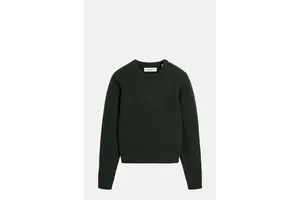
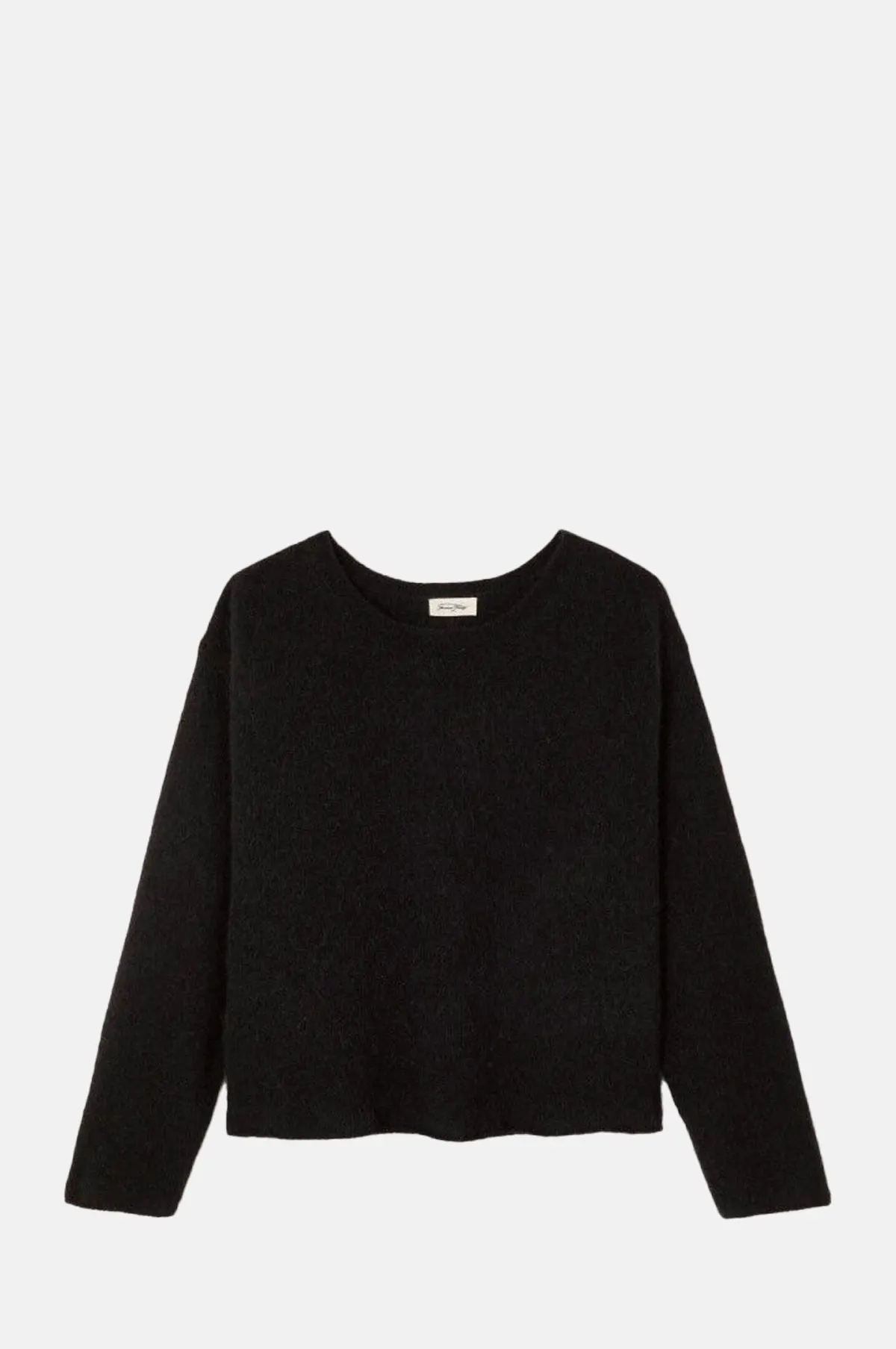

A black oversized jumper from American Vintage in a super soft alpaca and wool blend, with a boat neck, dropped shoulders, long sleeves with turn-up cuffs and ribbed edging, listed at 150 GBP with all three sizes in stock. It carries the same fibre blend as the cardigan published alongside it, to the last percentage, and it grades its measurements almost exactly the other way round: that garment puts four centimetres per size into its length and one and a half into its chest, and this one puts four into its chest and two into its length. Two garments, one brand, one size set, opposite decisions, and no published equivalence for S, M and L to tell you which of them is right. The dropped shoulders are the other thing worth stopping on, because they break a measurement. A sleeve length is normally taken from a shoulder seam, and on a garment whose shoulder seam sits halfway down the upper arm that figure no longer describes anything a customer can use. The reference is the Vitow Knit in Noir. Dongguan Bafinasa Garments Co., Ltd. develops comparable knitwear on OEM and ODM terms, from yarn and gauge selection to retail or FBA ready packing. We publish this as a development reference and build your own version of it, and we do not supply the branded original or reproduce anyone else's label.
Key Features
- Oversized with dropped shoulders as stated, and the chest measurement supports the word. See the note below
- Dropped shoulders, which make the published sleeve figure hard to interpret. See the note below
- Chest grading four centimetres per size against the cardigan's one and a half, in the same blend and the same size set. See the note below
- Boat neck, turn-up cuffs and ribbed edging as stated, with no neck width and no cuff measurement
- 34% alpaca, 34% wool, 29% polyamide and 3% elastane as stated, with no yarn count and no gauge. See the note below
- Black as stated, with no fastness figure on a shade that both rubs and fades. See the note below
- Hand wash, iron on a low setting, do not tumble dry, as stated, on the same blend the cardigan labels differently
Customisable Options
- Yarn: an alpaca, wool, polyamide and elastane blend to the reference, or a lambswool, a merino, a cotton or a recycled blend, each quoted separately
- Gauge: to your market, with the machine gauge and the yarn count specified rather than described
- Shoulder: dropped to the reference, with the drop specified in centimetres, or a set-in shoulder
- Fit: oversized to the reference at about twelve to thirteen inches of ease, or brought in for a closer jumper
- Neck: boat neck to the reference, with the width specified, or a crew, a V or a roll neck
- Cuffs: turn-up to the reference, or a plain rib cuff, or a deep rib
- Yarn count and gauge, fibre blend, shoulder drop and sleeve measurement point, ease, body length, sleeve length, size set, colour development, private label and care labelling
Specifications
| Style | Oversized boat neck jumper in an alpaca and wool blend with dropped shoulders |
| Reference | American Vintage, Vitow Knit, style VITO18PH26, noir, black, sizes S, M and L |
| Composition | 34% alpaca, 34% wool, 29% polyamide and 3% elastane as stated. See the note below |
| Yarn | Described as super soft, with no yarn count and no machine gauge given. See the note below |
| Fit | Oversized, loose cut, as stated, with the advice to buy your usual size. See the note below |
| Neck | Boat neck as stated, with no neck width given |
| Shoulder | Dropped shoulders as stated, with the drop not specified. See the note below |
| Sleeves | Long sleeves as stated, measured at 50, 52 and 54 cm, with turn-up cuffs. See the note below |
| Edging | Ribbed edging as stated |
| Care | Hand wash, iron on a low setting, do not tumble dry, as stated. See the note below |
| Sizes Offered | S, M and L, three sizes, all three in stock |
| Size Equivalence | None published, no UK, EU or US equivalent and no body measurements given |
| Measurements Published | Pit to pit, sleeve length and total length for all three sizes. See the note below |
| Published Chest | Pit to pit 58, 62 and 66 cm flat, or 22.8, 24.4 and 26.0 in. See the note below |
| Chest Around | 116, 124 and 132 cm, or 45.7, 48.8 and 52.0 in. See the note below |
| Ease Against Body Bust | About 12.7, 11.8 and 11.0 in read as UK 8, 12 and 16, or about 12.7, 13.8 and 15.0 in read as UK 8, 10 and 12. See the note below |
| Published Sleeve | 50, 52 and 54 cm, grading two centimetres per size, with no origin stated. See the note below |
| Published Length | 54, 56 and 58 cm, grading two centimetres per size |
| Published Shoulder Drop | None. See the note below |
| Published Neck Width | None. See the note below |
| Published Hem | None. See the note below |
| Model | None stated, no height and no body measurements |
| Photographs | Two |
| Yarn Count Or Gauge | Not stated, only the phrase super soft. See the note below |
| Colour Fastness | Not stated, no rub, wash or light fastness figure on a black. See the note below |
| Production | Made in China as stated |
| Reference Retail | 150 GBP as listed, quoted to show the price band this sits in, not as our price |
| Category | Filed by the reference under knitwear |
| Occasion | Autumn and winter, everyday, weekend, work, travel, layering |
| MOQ | 100 pcs per style per colourway, mixed sizes and colourways accepted |
| Sampling | 7-10 days after tech pack or reference sample confirmation |
| Bulk Lead Time | 20-30 days after sample approval and deposit |
| Service | OEM / ODM / private label, yarn and gauge development, alpaca and wool sourcing, knitwear washing, pressing and pilling control, retail or FBA ready packing |
Size Chart as Published by the Reference
| Size | Pit to Pit (flat) | Sleeve Length | Total Length |
|---|---|---|---|
| S | 58 cm | 50 cm | 54 cm |
| M | 62 cm | 52 cm | 56 cm |
| L | 66 cm | 54 cm | 58 cm |
The chest figures are flat half measures taken with the jumper laid down, doubling to 116, 124 and 132 cm around, or 45.7, 48.8 and 52.0 in, and they grade a full four centimetres of flat width per size. Against a body bust of 33, 37 and 41 in, read as UK 8, 12 and 16, the ease is about twelve and seven tenths, eleven and eight tenths and eleven inches; read as UK 8, 10 and 12, it runs about twelve and seven tenths, thirteen and eight tenths and fifteen. So on either reading the garment is genuinely oversized. The sleeve grades two centimetres per size with no origin stated, and the length grades two centimetres from 54 to 58 cm.
Our Proposed Body Chart
| Size | Body Bust | Sleeve | Body Waist | Body Hips | Length | Source |
|---|---|---|---|---|---|---|
| S | 33 in / 84 cm | 50 cm | 26 in / 66 cm | 36 in / 91 cm | 54 cm / 21.3 in | Our proposal |
| M | 37 in / 94 cm | 51 cm | 30 in / 76 cm | 40 in / 102 cm | 56 cm / 22 in | Our proposal |
| L | 41 in / 104 cm | 52 cm | 34 in / 86 cm | 44 in / 112 cm | 58 cm / 22.8 in | Our proposal |
Occasions and Styling
Suits autumn and winter, everyday wear, weekends, work and travel. A black oversized jumper with a boat neck is one of the few garments that goes from a desk to a weekend without changing, and the dropped shoulder is what lets it be worn over a shirt without bulk at the armhole.
Production and Quality Control
The reference publishes three columns for all three sizes, states a four part fibre blend with percentages, describes the fit, the neck, the shoulder, the sleeves, the cuffs and the edging, gives a care instruction with two useful additions and names the country of make. It publishes no equivalence for its sizes, no yarn count, no gauge, no shoulder drop and no fastness figure. Three things follow: what a dropped shoulder does to a sleeve measurement, why the two Vitow garments grade in opposite directions, and what a black alpaca blend needs that the page does not give.
Fifty centimetres of sleeve, measured from where, and that is the first thing. The sleeve is published at 50, 52 and 54 cm, which grades tidily and which is more than most garments in this run manage, since the majority publish no origin for any length and several publish no sleeve at all. But this garment has dropped shoulders, and a dropped shoulder breaks the measurement. A sleeve length is conventionally taken from the shoulder seam, because that is the point where the arm meets the body, and on a standard set-in shoulder the seam sits at the top of the arm and the figure means something. On a dropped shoulder the seam has been moved down the upper arm, sometimes by five centimetres and sometimes by fifteen, and the figure measured from it is no longer the length of anything a customer can picture. Take the two extremes: a sleeve of 50 cm measured from a shoulder seam that sits 2 cm down the arm is a different sleeve from one of 50 cm measured from a seam 12 cm down, and the second is a shorter sleeve in wear by ten centimetres. This run has complained on garment after garment that no origin is stated for a length, and it has said each time that the fix is one word. Here the fix is two, because the shoulder has moved: state the drop, which is a distance in centimetres from the natural shoulder point, and state where the sleeve was measured from, which on a dropped shoulder garment is best given from the neck or, better still, from the underarm to the cuff, since that is the part of the sleeve that actually covers the arm. It is worth saying why this matters more on an oversized knit than on anything else. The whole point of a dropped shoulder is that the fit at the shoulder is not doing any work, so the garment hangs from the neck and the armhole instead, and the two measurements that decide where it hangs are the neck width and the armhole depth, and neither is published. A boat neck is already a wide neck by definition and no width is given, so there is nothing on this page that tells a customer whether the neck will slip off one shoulder or sit where it should, which on a boat neck is the question that decides whether she keeps it.
Four centimetres here and one and a half there, and that is the second thing. The cardigan published alongside this jumper is made of the identical blend, comes from the same house, in the same season, in the same three letter sizes, and its chest grades one centimetre and then two, while this one grades four and four. Their lengths go the other way: the cardigan grades seven and then five, and this one grades two and two. So where the cardigan puts almost all of its grade into the length, this jumper puts most of its into the width, and the two are close to mirror images of one another. It is worth being fair about whether that is possible, because it is: different patterns do grade differently, a cardigan and a jumper are different shapes, and a designer might reasonably want one to stay short and get wider and the other to stay the same width and get longer. But it is also worth saying what it looks like, which is two garments graded by two different people to two different conventions, and there is a piece of evidence that points that way. The cardigan carries a note warning that its length increases a great deal between sizes, which means somebody looked at that column and noticed it was unusual. Nobody appears to have looked at these two side by side, because if they had, the contrast between a chest grade of one and a half and one of four, on the same brand and the same size letters, would have prompted a question. And here is the reason the question cannot be settled from the pages, and it is the point this run has been making about three letter sizes since it met them two batches ago. The correct chest grade depends on how much body a size step covers. If S, M and L are adjacent sizes, the body moves two inches per step and the grade that holds ease constant is 2.54 cm of flat width. If each letter spans two sizes, the body moves four inches and the grade needs to be about 5 cm. This jumper grades at 4 cm, which is between the two, and the cardigan at 1.5, which is well under both. So on the narrow reading this jumper gains ease across the range, about twelve and seven tenths rising to fifteen inches, and the cardigan loses about one and three quarters. On the wide reading this jumper holds its ease close to constant, about twelve and seven tenths falling to eleven, which is a well graded garment, and the cardigan loses more than five and a half, which is not. Two garments, two grades, and the judgement between them rests on a fact neither page publishes. That is the whole argument for putting the body measurements on a size chart, and it is worth stating in one line because it is the single cheapest thing any brand in this run could do: say what body each size is drafted for, and every figure on the page becomes checkable.
A black alpaca blend, and the figures that are not there, and that is the third thing. Start with the composition, which the page gives properly and which is worth reading carefully, because it is a designed blend rather than a costed one. Thirty four per cent alpaca and thirty four per cent wool give the hand and the warmth; twenty nine per cent polyamide gives the strength, since alpaca in particular is a slippery fibre with little crimp and a fine yarn in it is fragile without a synthetic core or blend; and three per cent elastane gives recovery, so the rib at the hem and the cuffs springs back rather than bagging out by lunchtime. Three per cent is a small number doing a specific job, and it is worth noting what it is not doing: with twelve to fifteen inches of ease in the body, the elastane is not there to make the garment fit, it is there to make it keep its shape, and that is a distinction worth having in a specification because it changes the wash test you ask for, which for elastane is a recovery test rather than a stretch test. What the page does not give is the two numbers a mill needs to quote: the yarn count and the machine gauge. Super soft is the description, and it is the eleventh or twelfth unnumbered cloth description in this run, and on a knit the missing figures are not grams per square metre but count and gauge, which together decide the weight, the drape, the warmth and the price. Then there is the colour, and black is the shade with the most questions attached and the fewest answers here. Black on a wool and alpaca blend has two faults, and they are the two most complained about in knitwear: it rubs, because a deep shade carries loosely held dye on the surface, and it fades, because black absorbs more light and more heat than any other colour and the fibre degrades faster. Both are tested and graded, and this run has now gone fourteen batches without a single published fastness figure on any garment, on prints, on navy, on garment dyed cotton and now on black. Test it, state the grade, put it on the page. Then the care instruction, which is the best of the two in this batch and worth setting out because it shows what the other one is missing: hand wash, iron on a low setting, do not tumble dry. Hand wash because agitation felts wool, iron low because heat glazes it, and do not tumble dry because heat and tumbling together will shrink a wool and alpaca blend into something unwearable. Those three lines are correct and specific and they follow the fibre. The cardigan in the same blend, from the same house, says hand wash at forty and nothing else, and that is the clearest demonstration this run has found that a care label often follows habit rather than material. And two smaller notes. The turn-up cuffs are a nice detail and they are the reason the sleeve figure is ambiguous in a second way, since a turned-up cuff can be measured folded or unfolded, which is another reason to state where the measurement was taken. And no model height or body measurements appear, so 54 cm of length cannot be placed on anybody, and on an oversized garment the length is a good half of what the style looks like. Every bulk shipment gets a measurement report against your approved chart.
Optional upgrades include stating the shoulder drop in centimetres and giving the sleeve from the underarm or the neck rather than from a seam that has moved, publishing the neck width on a boat neck and the armhole depth, stating the yarn count and the machine gauge, publishing the body measurements each size is drafted for so the four centimetre grade can be checked, testing and publishing rub, wash and light fastness on the black, testing elastane recovery rather than stretch, testing and publishing a pilling grade for the alpaca, adding a model height so 54 cm can be placed on a body, stating whether the sleeve includes the turn-up, a set-in shoulder option, a crew, V and roll neck option, lambswool, merino, cotton and recycled blend options, size set, colour development, private label, hangtag and care labelling.
Pre-production sample approval, in-line inspection during cutting and sewing, and a final AQL inspection before packing, with measurement reports and photos shared before shipment.
Send us your tech pack, a photo or a reference garment and we will quote within 24 hours. Contact bafinasa@bafinasa.com or WhatsApp +86 13827222469.