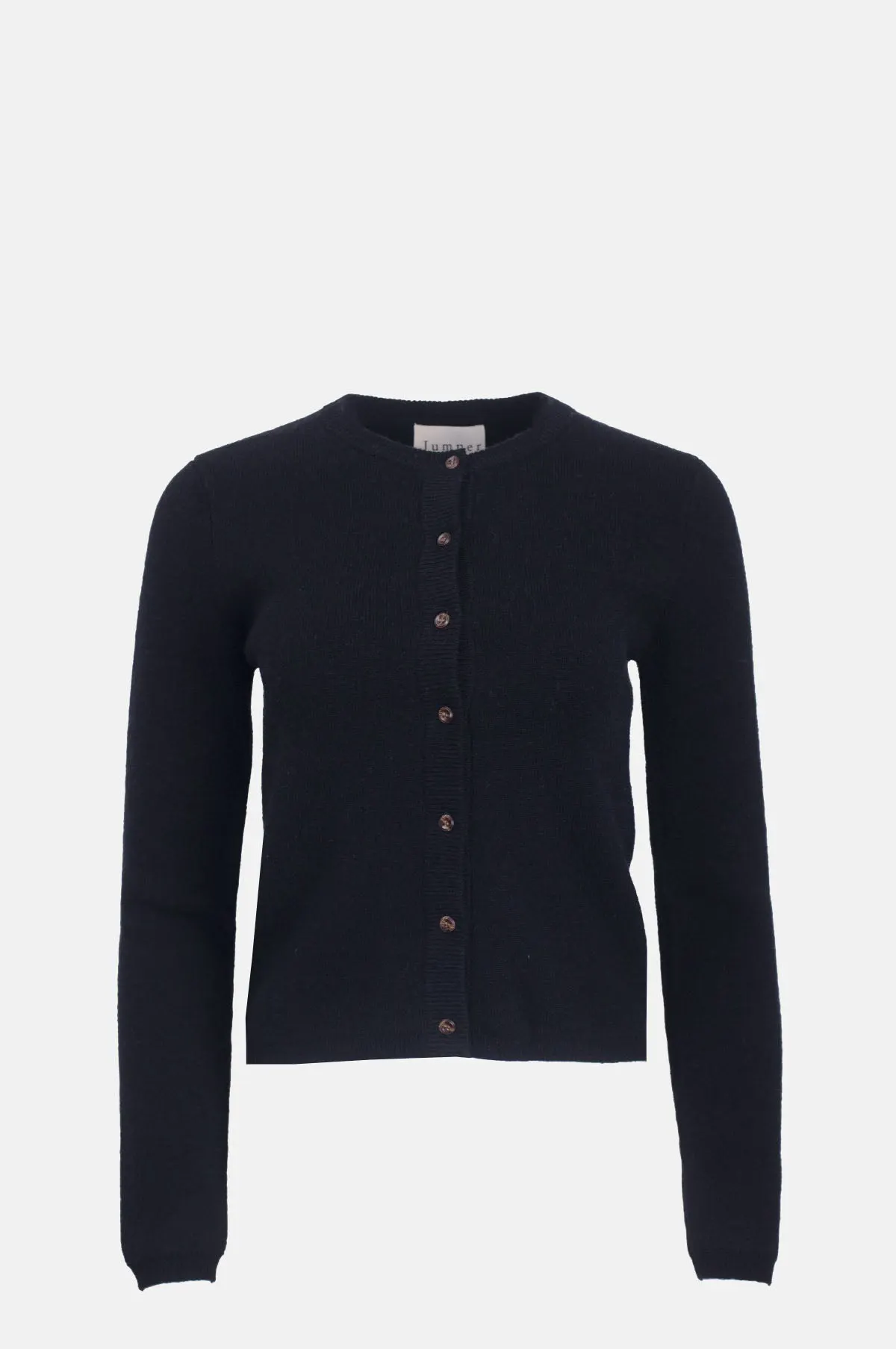

A classic black cardigan from Jumper 1234 in an 88% cashmere and 12% spandex blend, with a round crew neck, long sleeves, tortoiseshell buttons down the front and ribbed edges, listed at 219 GBP with three of the four sizes left. It is worth leading with the chart, because this garment carries its own control case and that makes it the most informative thing in this batch. Three columns are published for four sizes. Two of them cannot be produced by any uniform grade: the chest runs 42, 44, 49 and 53, stepping two, five and four, and the sleeve runs 61, 61, 62 and 63, stepping zero, one and one. The third is a clean, exact two centimetre grade: the length runs 53, 55, 57 and 59. So one garment has two columns that are genuinely irregular and one that is perfectly regular, and the test this run applies decides which is which rather than guessing. That is a different result from nearly every other garment this run has examined, where an odd-looking column turned out to be an even grade in disguise, and the reason it matters is set out below. The other thing worth a hard look is the yarn, because 12% spandex is a great deal of spandex and the page gives no specification for any of it. The reference is the Stretch Cardigan in Black. Dongguan Bafinasa Garments Co., Ltd. develops comparable knitwear on OEM and ODM terms, from yarn sourcing by ply, gauge, micron and elastane brand to retail or FBA ready packing. We publish this as a development reference and build your own version of it, and we do not supply the branded original or reproduce anyone else's label.
Key Features
- Chest 42, 44, 49 and 53 cm, which no uniform grade produces, and sleeve 61, 61, 62 and 63 cm, which no uniform grade produces either. See the note below
- Length 53, 55, 57 and 59 cm, an exact two centimetre grade, so the garment carries its own control. See the note below
- About 2.1 in of ease at the smallest, dipping to about 1.6 in and then rising to about 4.7 in, so the neat fit is not the same fit at every size. See the note below
- 88% cashmere and 12% spandex as stated, with no ply, no gauge, no micron, no fibre length, no grade, no weight and no elastane brand. See the note below
- No measurement tension stated, on a cloth with 12% spandex, which is the most likely reason two of the three columns are irregular. See the note below
- Tortoiseshell buttons down the front as stated, with no button count, no size, no spacing and no material. See the note below
- Described as a medium thickness in one sentence and a lightweight layer in the next. See the note below
Customisable Options
- Yarn: 88% cashmere and 12% spandex to the reference, with the ply, the gauge and the elastane brand stated, or a cashmere wool blend with elastane, or a merino with elastane, or a cotton with elastane, each quoted separately
- Stretch: 12% elastane to the reference, with the stretch percentage and the recovery stated, or a lower elastane content at 2 to 5%, or a higher one, each quoted separately
- Fit: neat to the reference, with the ease at every size published, or a relaxed fit, or a regular fit, each quoted separately
- Front: button down to the reference, with the button count, size and spacing specified, or a zip front, or an open front with no closure, each quoted separately
- Collar: round crew neck to the reference, with the neck width and depth specified, or a V neck, or a shawl collar, each quoted separately
- Trims: ribbed edges to the reference, with the rib structure and depth specified, or a plain edge, or a wider rib
- Ply, gauge, micron and fibre length, garment weight in grams, elastane brand, stretch percentage and recovery, measurement tension, button count and size, neck width and depth, rib depth, size set, colour development, private label and care labelling
Specifications
| Style | Neat fit cardigan with a crew neck, a button down front and ribbed trims |
| Reference | Jumper 1234, Stretch Cardigan, style #LAN26-4006, black, sizes 1 to 4 |
| Composition | 88% cashmere and 12% spandex as stated in the panel. See the note below |
| Yarn Specification | None: no ply, no gauge, no micron, no fibre length, no grade and no weight. See the note below |
| Elastane | 12% as stated, with no brand, no stretch percentage and no recovery given. See the note below |
| Thickness | Medium thickness as stated, and described as a lightweight layer in the next sentence. See the note below |
| Fit Word | Neat fit as stated. See the note below |
| Collar | Round crew neck as stated, with no neck width and no neck depth given. See the note below |
| Sleeves | Long sleeves as stated, with no sleeve measurement origin given |
| Front | Button down front as stated, with no button count, size, spacing or material given. See the note below |
| Trims | Ribbed finish to the edges as stated, with no rib structure and no rib depth given. See the note below |
| Measurement Tension | Not stated, on a cloth with 12% spandex. See the note below |
| Care | Hand wash only as stated, with no temperature, no detergent, no drying instruction and no warning against wringing. See the note below |
| Pilling | Not mentioned |
| Certification | None named. See the note below |
| Sizes Offered | 1 to 4, four sizes, with 1, 2 and 3 in stock at the time of writing |
| Size Conversion | Published: 1 is XS, 2 is S, 3 is M and 4 is L |
| Fit Guidance | None published beyond the fit word |
| Model | None published |
| Measurements Published | Pit to pit, sleeve length and total length for all four sizes. See the note below |
| Published Chest | 42, 44, 49 and 53 cm flat, or 16.5 through 20.9 in. See the note below |
| Chest Around | 84, 88, 98 and 106 cm, or 33.1, 34.6, 38.6 and 41.7 in. See the note below |
| True Chest Grade | None: no uniform grade rounds to this column. See the note below |
| Ease Against Body Bust | About 2.1, 1.6, 3.6 and 4.7 in, which is not monotonic. See the note below |
| Published Sleeve | 61, 61, 62 and 63 cm, and no uniform grade rounds to this column either. See the note below |
| Sleeve Measurement Origin | Not stated |
| Published Length | 53, 55, 57 and 59 cm, an exact two centimetre grade. See the note below |
| Rib Specification | None. See the note below |
| Neck Dimensions | None. See the note below |
| Button Specification | None. See the note below |
| Cloth Weight | Not stated |
| Photographs | One. See the note below |
| Production | Made in China as stated, with the fibre origin not stated. See the note below |
| Reference Retail | 219 GBP as listed, quoted to show the price band this sits in, not as our price |
| Category | Filed by the reference under knitwear |
| Occasion | Autumn and winter, layering, everyday |
| MOQ | 100 pcs per style per colourway, mixed sizes and colourways accepted |
| Sampling | 7-10 days after tech pack or reference sample confirmation |
| Bulk Lead Time | 20-30 days after sample approval and deposit |
| Service | OEM / ODM / private label, cashmere and elastane yarn sourcing with ply, gauge, micron and elastane brand stated, stretch and recovery testing, measurement under stated tension, button sourcing by size and count, rib development, retail or FBA ready packing |
Size Chart as Published by the Reference
| Size | Pit To Pit (flat) | Sleeve Length | Total Length |
|---|---|---|---|
| 1 / XS | 42 cm | 61 cm | 53 cm |
| 2 / S | 44 cm | 61 cm | 55 cm |
| 3 / M | 49 cm | 62 cm | 57 cm |
| 4 / L (sold out) | 53 cm | 63 cm | 59 cm |
The chest figures are flat half measures taken with the cardigan laid down, doubling to 84, 88, 98 and 106 cm around, or 33.1, 34.6, 38.6 and 41.7 in. Against a body bust of 31, 33, 35 and 37 in across XS to L, the ease is about 2.1, 1.6, 3.6 and 4.7 in, so it dips at the second size and then nearly triples. The sleeve steps zero, one and one, and the length is an exact two centimetre grade. No uniform grade produces the chest or the sleeve column.
Our Proposed Body Chart
| Size | Body Bust | Sleeve | Body Waist | Body Hips | Length | Source |
|---|---|---|---|---|---|---|
| 1 / XS | 31 in / 79 cm | 61 cm | 24 in / 61 cm | 34 in / 86 cm | 53 cm / 20.9 in | Our proposal |
| 2 / S | 33 in / 84 cm | 62 cm | 26 in / 66 cm | 36 in / 91 cm | 55 cm / 21.7 in | Our proposal |
| 3 / M | 35 in / 89 cm | 63 cm | 28 in / 71 cm | 38 in / 97 cm | 57 cm / 22.4 in | Our proposal |
| 4 / L | 37 in / 94 cm | 64 cm | 30 in / 76 cm | 40 in / 102 cm | 59 cm / 23.2 in | Our proposal |
Occasions and Styling
Suits autumn and winter and everyday layering. A neat black cardigan in a cashmere blend is the piece that goes over a shirt or under a coat, and the black makes it the easiest version to wear with anything.
Production and Quality Control
The reference publishes three columns for all four sizes, states the fibre blend to the percentage, describes the neck, the sleeves, the front, the buttons and the trims, gives a fit word and a thickness word, gives a care instruction, names the country of production and publishes a size conversion. It gives no yarn specification of any kind beyond the blend, no elastane brand, no stretch or recovery figure, no measurement tension, no neck dimensions, no rib specification, no button specification and no weight, and publishes no fit guidance beyond one word and no model information. Three things follow: the garment that carries its own control, the ease that is not monotonic, and the yarn that is not specified.
Two columns that fail and one that passes, on the same garment, and that is the first thing, because a control inside the garment is worth more than a control from another brand. This run has spent many batches applying one test: it asks whether some single uniform grade, rounded to whole centimetres, would produce the published column. If the answer is yes, then a column that looks uneven is usually even, which has been good news for most of the brands this run has looked at. On this cardigan the test splits. The length reads 53, 55, 57 and 59, and a grade of exactly two centimetres produces it, so that column is a clean, even grade. The chest reads 42, 44, 49 and 53, stepping two, five and four, and the test rules it out outright: to keep the first step at two the grade would have to be under about 2.5, and to reach 53 after three steps it would have to be over about 3.5, and no number is both. The sleeve reads 61, 61, 62 and 63, and that one fails too, for the same kind of reason: the first step being zero confines the grade to under half a centimetre and the last step being three confines it to over half a centimetre. So this garment has two columns that no uniform grade explains and one that an exact grade explains, and because they are on the same garment the comparison is clean. Now the explanation, which this run will offer as an inference and label as one. The difference between this garment and the pure cashmere jumper this run published last batch is the spandex. Last batch's roll collar, 100% cashmere with no elastane, had all three of its columns pass the test: chest a uniform 3.8, sleeve a uniform one, length a uniform 0.6. This garment, with 12% spandex, has two of three fail. The two stretch garments published alongside this one fail five columns out of six between them. So the irregularity lines up with the elastane rather than with the house, and there is an obvious mechanism. On a cloth with 12% spandex, the number you read off a tape depends on how hard the garment is pulled and on whether it is laid relaxed or smoothed flat, and nobody says which. A five centimetre swing between two sizes on a stretch knit is far more likely to be the tape than the pattern, because no pattern is graded two, five and four. That is why the length is the column that survives: it is the dimension least affected by how the lay is tensioned. It is worth saying what the fix costs, which is one line: state that the measurements are taken with the garment laid relaxed and unstretched, or measure on a form. This run does exactly that and publishes the tension on every chart it writes.
Two and a half inches that becomes four and a half, and that is the second thing. Set the chest against a body bust of 31, 33, 35 and 37 in and the ease runs about 2.1, 1.6, 3.6 and 4.7 in. Two things about that sequence are worth saying. The first is that it dips. The extra small has about 2.1 in of ease and the small has about 1.6, so the small is the snuggest garment in this range relative to the body inside it, and someone who takes a small is getting a closer fit than someone who takes an extra small. The same dip appears on both of the stretch garments published alongside this one, so it is systematic rather than a one-off. The second is that the range is wide. The largest size carries about 4.7 in of ease against 2.1 at the smallest, which is more than double, so a garment sold as a neat fit is neat at one end of the range and not at the other. It is worth being careful here, and this run has to correct its own method in public. Every ease figure it has published so far has been on wovens and on knits without elastane, where ease is a meaningful quantity because the garment has to be bigger than the body to go on. With 12% spandex it is not the same quantity at all, because the cloth stretches and the garment does not have to be bigger. So the vocabulary this run has built up, where slim sits around two and a half to three and a half inches and relaxed around twelve or thirteen, does not apply to this garment and the run will not pretend it does. A neat fit on a high-stretch knit is made by the elastane, not by the ease, and a small ease figure here is not the warning it would be on a woven shirt. What the run can still say is the thing that matters most on a stretch garment, which is whether the fit is the same fit at every size, and on this chart it is not. It is also worth noting what is missing that a stretch garment especially needs: no stretch percentage, no recovery figure, and no statement about what the garment does after it has been worn for a day, which is where elastane shows its quality. And no sizing guidance at all, which is the one thing that would help most on a garment whose fit changes shape across the range.
Twelve per cent of the garment, and no name for it, and that is the third thing. The panel says 88% cashmere and 12% spandex and nothing else about the yarn. Twelve per cent is a great deal of elastane: most stretch knits run at two to five per cent, and twelve is shaping rather than comfort stretch, which is consistent with the neat fit the description promises and is presumably the point of it. But elastane is one of the few fibres where the branded version genuinely outperforms the generic one, because recovery life is the whole value of the fibre and it varies by manufacturer. Nothing says which is used, and it is twelve per cent of the garment. Then the cashmere, which gets the same treatment it got last batch on this brand's pure jumper: no ply, no gauge, no fibre length, no fineness in microns, no grade and no weight in grams. And the weight matters more on cashmere than on anything else this run has examined, because cashmere is traded by weight, so the gram weight of the finished garment is the number that explains the price and the only number that lets a buyer compare this against another cardigan at twice the money. The page offers a thickness word instead, and it is worth looking at how it uses it, because it uses it twice and the two uses disagree. The description says the blend provides a neat fit with a medium thickness, and then in the very next sentence calls it a great lightweight layer. Medium thickness and lightweight are not the same claim, and a reader cannot reconcile them. That is a small thing in itself and it is the clearest possible illustration of why weight words need numbers behind them: given a choice between two adjectives on the same garment, the reader has no way to pick. The hand wash instruction that follows is the right one and it is worth crediting it, because heat is what destroys elastane and a high-spandex knit should not be machine washed. But it is the only clause, and on this blend the clauses that are missing are the ones that matter: no temperature, no detergent, and above all no drying instruction. A cashmere and elastane knit must not be wrung and must not be tumble dried, and it should be dried flat and reshaped while damp. Without those, the correct first clause is followed by nothing, and the garment is more likely to be damaged in the drying than in the washing. It is worth adding one line on origin while the yarn is on the table. This is made in China, where the cashmere certainly was not grown, so the fibre origin is entirely unstated, and for a fibre where two named standards exist covering animal welfare and grazing land, neither is mentioned. Every bulk shipment gets a measurement report against your approved chart.
Optional upgrades include stating the ply, the gauge, the fibre length and the fineness in microns, stating the garment weight in grams and replacing the two conflicting weight words with one number, naming the elastane brand and publishing the stretch percentage and the recovery, publishing the measurements with the tension stated, publishing the ease at every size and grading for constant ease, giving the button count, size, spacing and material, giving the neck width and depth, giving the rib structure and depth, extending the care label to give the temperature, the detergent, the drying method and a warning against wringing, adding a pilling note, adding fit guidance and a model height, a cashmere wool, merino and cotton elastane option, lower and higher elastane content, relaxed and regular fit options, V neck and shawl collar options, zip front and open front options, size set, colour development, private label, hangtag and care labelling.
Pre-production sample approval, in-line inspection during cutting and sewing, and a final AQL inspection before packing, with measurement reports and photos shared before shipment.
Send us your tech pack, a photo or a reference garment and we will quote within 24 hours. Contact bafinasa@bafinasa.com or WhatsApp +86 13827222469.