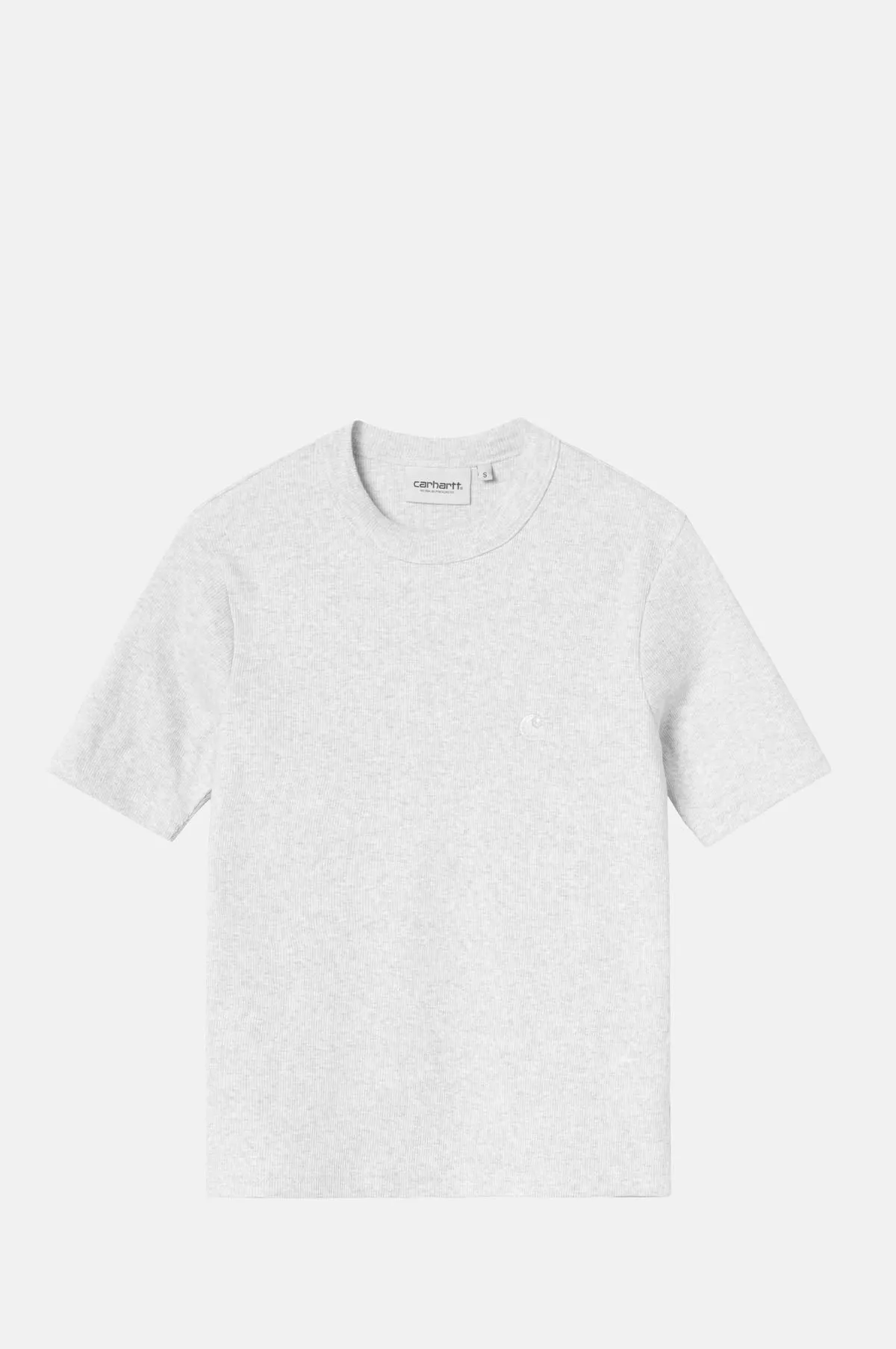

The Philipa T-shirt from Carhartt WIP in ash heather, the grey sister of the white version this run is publishing at the same time, and the comparison between them is the useful thing here, because the two carry the same style number and an identical measurement table and they do not say the same things. The grey page describes the cloth as a midweight stretch cotton jersey with a subtle marled texture and a soft handle. The white page describes the cloth not at all. Same garment, same fibre, same mill, same price, and one of the two tells a reader what it is made of. This run has been testing whether a second colourway adds information ever since it found a pair of trousers in two colours that shared a table and added nothing, and the answer is now settled in both directions: sometimes a second colourway adds nothing at all, and sometimes it carries a specification the first one lacks. There is no rule, and a reader cannot know which she is getting. The other thing worth setting out is a comparison across the brand's own T-shirt range, which is the largest divergence this run has measured between two garments sharing a size label. At size L, this tee measures about 33 inches around the chest and the brand's loose jersey tee measures about 44. Same brand, same season, same price, same letter, eleven inches apart. The reference is the S/S Philipa T-Shirt in Ash Heather. Dongguan Bafinasa Garments Co., Ltd. develops comparable jersey, rib and marl on OEM and ODM terms, from cloth sourcing by weight, rib structure and stretch performance to retail or FBA ready packing. We publish this as a development reference and build your own version of it, and we do not supply the branded original or reproduce anyone else's label.
Key Features
- Same style number and an identical measurement table as the white colourway, and this page describes the cloth while that one does not. See the note below
- Midweight stretch cotton jersey as stated here, with no weight in grams per square metre, the unit the trade quotes jersey in. See the note below
- Subtle marled texture and a soft handle as stated here, and neither appears on the white page. See the note below
- Machine washable up to 30 here and machine wash at 30 there, two wordings of one instruction on one garment, and one is a maximum and one is a setting. See the note below
- About 9.5 to 11 in smaller around the chest than the same brand's loose jersey tee at the same size label. See the note below
- Negative ease of about 2.7 to 3.9 in, so it is designed to be worn stretched, with no stretch and no recovery published. See the note below
- 98% cotton and 2% elastane as stated, comfort level rather than shaping level, with nothing to say what the elastane does
Customisable Options
- Cloth: midweight stretch cotton jersey to the reference, with the weight in grams per square metre stated, or a lighter jersey, or a heavier one, or a plain marl, each quoted separately
- Colour: ash heather marl to the reference, with the marl fibre blend stated, or a piece dyed solid, or a different heather shade, each quoted separately
- Rib: fine rib to the reference, with the structure and gauge specified, or a 2x2 rib, or a wider rib, each quoted separately
- Fit: slim with negative ease to the reference, with the stretch and recovery published, or a neat fit, or a regular fit, each quoted separately
- Stretch: about 2% elastane to the reference, with the stretch percentage and recovery published, or a higher elastane content, or no elastane, each quoted separately
- Handle: soft handle to the reference, with any finishing stated, or an enzyme washed handle, or an untreated handle, each quoted separately
- Cloth weight in grams per square metre, marl fibre blend, rib structure and gauge, stretch percentage and recovery, neck width and depth, logo size and position, size set, colour development, private label and care labelling
Specifications
| Style | Slim fit ribbed baby tee in a marled stretch cotton jersey with a chest logo |
| Reference | Carhartt WIP, S/S Philipa T-Shirt, style 035471, ash heather, sizes XS to L |
| Composition | 98% cotton and 2% elastane as stated in the panel |
| Cloth | Midweight stretch cotton jersey as stated, with no weight in grams per square metre. See the note below |
| Cloth Weight | Not stated. See the note below |
| Texture | Subtle marled texture as stated, with no specification of the marl. See the note below |
| Handle | Soft handle as stated, with nothing to say how it is achieved. See the note below |
| Rib | Ribbed as stated, with no rib structure, no gauge and no rib depth given |
| Fit Word | Slim fit as stated, and a slim silhouette in the description, and both are accurate. See the note below |
| Neck | Crew neck as stated, with no neck width and no neck depth given |
| Sleeves | Short sleeves as stated, measured at 18 to 21 cm |
| Logo | Signature C logo embroidered tonally on the chest as stated, with no size and no position given |
| Stretch | Not quantified: no stretch percentage, no recovery and nothing about performance after wear. See the note below |
| Care | Machine washable up to 30 degrees on a delicate cycle, do not tumble dry, as stated, and worded differently from the white colourway. See the note below |
| Certification | None named |
| Sizes Offered | XS, S, M and L, four sizes, with S in stock at the time of writing |
| Size Conversion | Not applicable, since the sizes are letter sizes |
| Fit Guidance | None published beyond the fit word |
| Model | None published |
| Measurements Published | Pit to pit, sleeve length and total length for all four sizes, identical to the white colourway. See the note below |
| Published Chest | 36, 37, 41 and 42 cm flat, or 14.2 through 16.5 in. See the note below |
| Chest Around | 72, 74, 82 and 84 cm, or 28.35, 29.13, 32.28 and 33.07 in. See the note below |
| True Chest Grade | None: no uniform grade rounds to this column. See the note below |
| Ease Against Body Bust | About minus 2.7, minus 3.9, minus 2.7 and minus 3.9 in, so negative at every size. See the note below |
| Published Sleeve | 18, 19, 20 and 21 cm, a clean one centimetre grade |
| Published Length | 52, 53, 56 and 57 cm, stepping 1, 3 and 1. See the note below |
| Divergence From The Brand's Other Tee | About 9.5 to 11 in smaller around the chest at the same size label. See the note below |
| Cloth Weight | Not stated. See the note below |
| Rib Specification | None. See the note below |
| Photographs | Two |
| Production | Made in Bulgaria as stated, with no certification named |
| Reference Retail | 35 GBP as listed, quoted to show the price band this sits in, not as our price |
| Category | Filed by the reference under T-shirts |
| Occasion | Spring and summer, layering, everyday |
| MOQ | 100 pcs per style per colourway, mixed sizes and colourways accepted |
| Sampling | 7-10 days after tech pack or reference sample confirmation |
| Bulk Lead Time | 20-30 days after sample approval and deposit |
| Service | OEM / ODM / private label, marl and heather jersey sourcing by weight and blend, rib development, stretch and recovery testing, tonal embroidery, retail or FBA ready packing |
Size Chart as Published by the Reference
| Size | Pit To Pit (flat) | Sleeve Length | Total Length |
|---|---|---|---|
| XS | 36 cm | 18 cm | 52 cm |
| S | 37 cm | 19 cm | 53 cm |
| M | 41 cm | 20 cm | 56 cm |
| L | 42 cm | 21 cm | 57 cm |
The chest figures are flat half measures taken with the shirt laid down, doubling to 72, 74, 82 and 84 cm around, or 28.35, 29.13, 32.28 and 33.07 in, and they are identical to the white colourway of the same style. Against a body bust of 31, 33, 35 and 37 in across XS to L, that is about minus 2.7, minus 3.9, minus 2.7 and minus 3.9 in, so the garment is smaller than the body it is sized for at every size, which is what a ribbed stretch baby tee is designed to be. The chest steps 1, 4 and 1 cm and the length steps 1, 3 and 1, and neither is a uniform grade. The sleeve grades a clean one centimetre per size.
Our Proposed Body Chart
| Size | Body Bust | Sleeve | Body Waist | Body Hips | Length | Source |
|---|---|---|---|---|---|---|
| XS | 31 in / 79 cm | 18 cm | 24 in / 61 cm | 34 in / 86 cm | 52 cm / 20.5 in | Our proposal |
| S | 33 in / 84 cm | 19 cm | 26 in / 66 cm | 36 in / 91 cm | 54 cm / 21.3 in | Our proposal |
| M | 35 in / 89 cm | 20 cm | 28 in / 71 cm | 38 in / 97 cm | 56 cm / 22 in | Our proposal |
| L | 37 in / 94 cm | 21 cm | 30 in / 76 cm | 40 in / 102 cm | 58 cm / 22.8 in | Our proposal |
Occasions and Styling
Suits spring and summer and layering. A fitted ribbed tee in a soft grey marl is the piece that goes under everything, and the marl gives it more depth than a flat solid.
Production and Quality Control
The reference publishes three columns for all four sizes, states the fibre to the percentage, describes the cloth, the texture and the handle, names the rib, the neck, the sleeves and the logo and its embroidery method, gives a fit word, gives a two clause care instruction with a named cycle, names the country of production and carries two photographs. It gives no cloth weight, no marl specification, no rib specification, no stretch or recovery figure, no neck dimensions and no logo size or position, and publishes no fit guidance beyond one word and no model information. Three things follow: what this colourway says that the other does not, the eleven inches between two tees with the same label, and what the difference between the two pages reveals about how product copy gets written.
Midweight, marled, soft, and none of it on the white one, and that is the first thing. These two pages are the same garment. They share a style number, 035471, differing only in the colour code at the end. They share a fibre panel to the percentage. They share a measurement table cell for cell: 36, 37, 41 and 42 across the chest, 18, 19, 20 and 21 on the sleeve, 52, 53, 56 and 57 in length. And they do not say the same things. This page says the garment is cut from a midweight stretch cotton jersey, that it has a subtle marled texture, and that it has a soft handle. It also describes the logo as embroidered, where the white page leaves the method unstated in the body of the text. The white page says none of that: no cloth, no texture, no handle. So the cloth of the white tee is undescribed on its own page, and can only be discovered by finding the grey one. This run has been running a test on colourways for some time, ever since it examined two colours of a corduroy trouser that shared a table exactly and where the second colour added nothing at all but a photograph. It said then that it could not tell whether a second colourway carries new information or inherits the first one's numbers, and it promised to keep testing rather than guess. The answer is now settled, and it is not one answer but both. Sometimes a second colourway adds nothing. Sometimes, as here, it carries a specification the first does not. There is no rule governing which, and a customer has no way to know whether she is looking at the fuller page or the thinner one, because nothing marks the difference. It is worth adding what this particular case shows about the mechanism, because it explains a great deal. The specification that appears on the grey page and not the white one is precisely the specification visible in a photograph of a grey marl: the marl itself. The word marled describes what the writer could see. Midweight, which is not visible in any photograph, is present on one page and missing on the other without pattern. So the copy describes the picture, and this run would suggest that is not a coincidence but the shape of the whole problem. Every specification this run has spent batches asking for is invisible in a photograph: the weight in grams per square metre, the ply, the gauge, the fineness in microns, the denier, the rib structure, the stretch and the recovery. And every one of them is missing, on page after page, across brand after brand. Meanwhile the things that do appear, the fit words, the textures, the handles, the colours, are exactly the things a writer can see. That is the most economical explanation this run has for the pattern it has been cataloguing, and it is worth stating once: the page is not a specification, it is a description of a photograph.
Eleven inches, same letter, same price, same brand, and that is the second thing, and it is the largest divergence this run has measured between two garments carrying the same size label. This tee at a size L measures about 33 inches around the chest. The brand's loose jersey tee, published by this run at the same time, at the same 35 GBP, in the same season, at a size L measures about 44 inches around. The difference is about 11 inches of circumference, and across the four sizes it runs between about 9.5 and 11 inches. The length tells the same story in centimetres: 57 here against 71 there, so the same brand's L is 14 centimetres shorter on one tee than the other. Now, some of that is legitimate and should be said plainly. One is a slim ribbed baby tee designed to be worn stretched, and the other is a loose jersey tee designed to have room, and they are not the same garment and are not trying to be. But the consequence is not legitimate, and it is this: the letter L on this brand's T-shirts carries no information at all. It does not tell a customer her chest measurement, or whether the garment will be tight or roomy, or how long it will be. It tells her nothing she can carry from one style to the next. And this is no longer a single observation. This run measured the same phenomenon on the brand's jeans, where two pairs carrying the label 27 differed by 3.15 inches at the waist. Eleven inches on the tees, three on the jeans, and in both cases nothing on either page warns the customer that the number on the label is not transferable. It is worth putting the two tees side by side on ease, because that is the cleanest way to see it. The loose jersey tee has about 6.8 inches of ease, so it is nearly seven inches bigger than the body. This one has about 2.7 to 3.9 inches of negative ease, so it is about three inches smaller than the body. The same brand, the same price, the same letter, and the swing between them is about ten and a half inches, from three inches of compression to seven inches of room. A customer who knows she takes a large in one will be wrong in the other by a margin no brand has any business leaving unstated. And the brand publishes the numbers that would let her work it out, on both pages, so the information exists and is simply never presented in a form that compares the two.
Up to thirty, and at thirty, and that is the third thing, and it is small enough to be easy to miss and precise enough to be worth reporting. This page says machine washable up to 30 degrees. The white page, for the same garment, says machine wash at 30 degrees. Those are two different instructions. One is a maximum, which permits washing cooler, and the other is a setting, which does not. They are not far apart in practice, and no garment will be ruined by the difference, but they are not the same sentence, and the more informative of the two is the one on this page, since a maximum leaves the customer free to wash cooler and a setting does not. Two colourways of one garment, one style number, two wordings of the same clause, and nobody compared them. That is the same finding as the cloth description and the same finding as the two jeans with different care labels, and it is worth saying what it means in aggregate: there is no house standard for what a page says, not even within one style number. It is worth closing on the two things that are genuinely good here, because this run should not only report gaps. The fibre panel includes the elastane and states it to the percentage, at 2%, which is the ordinary comfort level rather than the twelve percent this run found on another brand's knits where the elastane was doing shaping work. And the care label names a cycle, on a delicate setting, which is the second garment in this run to do so and one of only two. What remains missing is the list this run has been giving for batches and can now give in one line. The cloth weight in grams per square metre, so that midweight means something. The marl blend, since a heather is a blend of fibre colours and there is no reason not to say what it is. The rib structure and gauge, on a garment that is entirely rib. The stretch percentage and the recovery after wear, which on a negative ease garment are the whole specification. And the neck dimensions and the logo size and position, which are the two things that decide how it looks on. Every bulk shipment gets a measurement report against your approved chart.
Optional upgrades include quoting the cloth weight in grams per square metre, specifying the marl fibre blend, specifying the rib structure, gauge and depth, publishing the stretch percentage and the recovery tested after twenty-four hours of wear, publishing the ease at every size and saying plainly that it is negative by design, giving the neck width and depth, giving the logo size and position, stating how the soft handle is achieved, using one wording of the care instruction across every colourway, putting the cloth description on every colourway rather than one, adding detergent, wash inside out, ironing and dry flat to the care label, adding fit guidance and a model height, a lighter and a heavier jersey, a plain marl and other heather shades, a 2x2 rib and a wider rib, neat and regular fit options, a higher elastane content and a no elastane option, scoop and V neck options, printed logo and no logo options, size set, colour development, private label, hangtag and care labelling.
Pre-production sample approval, in-line inspection during cutting and sewing, and a final AQL inspection before packing, with measurement reports and photos shared before shipment.
Send us your tech pack, a photo or a reference garment and we will quote within 24 hours. Contact bafinasa@bafinasa.com or WhatsApp +86 13827222469.